• anna j. clutterbuck-cook
  • contact
  • curriculum vitae
  • find me elsewhere
  • marilyn ross memorial book prize

the feminist librarian

the feminist librarian

Author Archives: Anna Clutterbuck-Cook

comment post: unfinished thoughts on non-consensual sexualization

07 Thursday Feb 2013

Posted by Anna Clutterbuck-Cook in think pieces

≈ 4 Comments

Tags

being the change, bigotry, comment post, feminism, gender and sexuality, moral panic

Regular readers of this blog may remember that over the past year or so I’ve been haunting the conservative Family Scholars Blog hosted by the Institute for American Values (IAV) think tank founded by David Blankenhorn, sometime high-profile opponent of same-sex marriage. In part, I follow the blog because my smart and funny friend Fannie is one of their guest bloggers. I am also deeply interested in the worldview of people whose understanding of how the world works, and what values will increase the well-being of humanity, are so different from my own.

Last week, I found myself sucked into a comment thread at the FSB wrestling with the subject of what I’ll call “non-consensual sexualization.” My working definition of non-consensual sexualization is public expressions which frame another person’s appearance, presence, or actions in a sexual light without their participation or consent. You might also call this plain old “sexual objectification.” I’m using my phrase here because I think it’s important to highlight the non-consensual part of what’s going on here. Continue reading →

booknotes: histories and cultures of sexuality

05 Tuesday Feb 2013

Posted by Anna Clutterbuck-Cook in book reviews

≈ Leave a comment

Tags

children, feminism, gender and sexuality, history, smut

As promised, here is my round-up of recently-read titles having to do with various aspects of human sexuality, politics and culture.

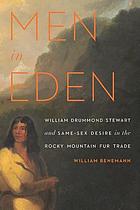
Men in Eden: William Drummond Stewart and Same-Sex Desire in the Rocky Mountain Fur Trade by William Benemann (University of Nebraska Press, 2012). Let’s begin with the book Hanna referred to as the book about “mountain men humping!” Benemann takes as his subject a 19th century Scottish aristocrat, William Drummond Stuart, and through Stuart’s colorful life explores the contours of same-sex desire on the borderlands of “civilized” society. Stewart, a younger son who later in life inherited the family title from his older brother, came of age during the Napoleonic wars and served in the 15th King’s Hussars where he rose to the rank of Captain. After retiring from the army, Stewart traveled widely in the Middle East and North America — and in North America found the homosociality of the American West particularly amenable. Throughout his life, Stewart’s most enduring relationships were with men, including one French-Cree trader who he traveled extensively with and even took with him back to Scotland after assuming responsibility for the family’s estate; the couple lived for a time in one of the secluded lodges on the land, where Stewart kept all the material evidence of his travels abroad. According to Benemann, previous treatments of Stewart have gone out of their way to ignore the evidence of same-sex relationships in the Scotsman’s life. Benemann’s work is a thoughtful and nuanced challenge to this previous “closeting” of Stewart’s sexual self, taking those same-sex relationships for granted as a meaningful part of Stewart’s experience. Anyone with an interest in nineteenth-century Anglo-American sexuality and gender should definitely add this one to their reading list.

Documenting Intimate Matters: Primary Sources for a History of Sexuality in America edited by Thomas A. Foster (University of Chicago Press, 2013). Published as a companion volume to John D’Emilio and Estelle Freedman’s seminal Intimate Matters (1988), this new primary source reader offers a thoughtful compilation of lightly annotated documents related to various aspects of sexuality in American culture from the colonial era to the present. A brief 225 pages, featuring selections from about seventy sources, this reader is best seen as a jumping-off point for further discussion and exploration rather than a source for full-text transcriptions. Each of the five chronologically-arranged sections are introduced with a brief preface on the sexual issues of the period in question, and each document likewise features a thoughtful introduction. While necessarily incomplete, given its length, Documenting Intimate Matters is admirably diverse in its socio-cultural and geographic scope as well as the genres of (textual) documents found therein. Some of my favorite include newspaper announcements from the 1780s-90s placed by men whose wives had deserted them to inform creditors the husbands would no longer take responsibility for their (ex?) wives debts; the angry diary entries of Frederick Ryman (1884)*, whose sentiments about women would not be out of place on anti-feminist blogs of today; and Susan Fitzmaurice’s 2002 reflections on the struggles of raising a child with Downs Syndrome in away that prepares them for a sexually active, sexually pleasurable, and sexually responsible adulthood. An excellent anthology for use in introductory classes.

*Full disclosure: Ryman’s diaries reside at the Massachusetts Historical Society.

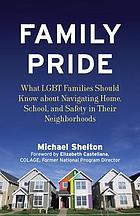
Family Pride: What LGBT Families Should Know about Navigating Home, School, and Safety in Their Neighborhood by Michael Shelton (Beacon Press, 2013). The latest addition to Beacon Press’s “queer ideas/queer actions” series, Shelton’s Family Pride is an accessible and nuanced snapshot of life in America for queer parents with children as we enter the 2010s. Centering the lived experiences of both LGBT parents and their children — through in-depth interviews Shelton conducted, as well as the growing body of relevant research literature — Shelton’s book should be on the bookshelf of every “family values” advocate (members of the Institute for American Values I’m looking at you!) as well as in the library of every queer activist and/or LGBT organization. While the title makes it sound like Family Pride is a handbook for queer families, in reality the volume is more of a status-quo assessment with some recommendations (from Shelton’s perspective as a therapist who has worked with queer families) for what queer families need in order to thrive. He does an excellent job of incorporating (I’d even argue prioritizing) the experiences of families who don’t often make “gay family” headlines: queer parents in straight marriages, parents who are in the closet, non-white families, families living with financial insecurity, families with uncertain immigration status, parents in prison or with a history of interaction with the law that makes calling the police for help an unthinkable solution to anti-gay speech or acts. My only quibble with Shelton’s framing is that he never explicitly defines an “LGBT family” as a unit made up of parents-plus-children in which at least one parent is queer — yet that is clearly his operational definition. I would have appreciated either a more explicit acknowledgement that this book focuses on parenting-while-gay OR an effort to include the voices of queer families that do not include children. We are, most assuredly, families too.

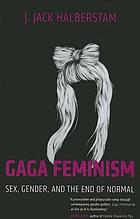
Gaga Feminism: Sex, Gender, and the End of Normal by J. Jack Halberstam (Beacon Press, 2012). While in Austin, I snagged a copy of yet another volume in the “queer actions/queer ideas” series — Halberstam’s meditation on the playful, anarchic queer feminism burbling up through the actions and expressions within youth culture. Taking pop culture references from Sponge Bob to Lady Gaga, Halberstam argues for the liberatory playfulness of more fluid sex and gender identities that — rather than requiring taxonomical fixity — provide a sandbox full of tools and opportunities for self-expression. I’m an easy sell on this score: while I am at times skeptical about the power of pop culture expression to effect political change, neither am I threatened by sex and gender anarchy. I am comfortable in my own gender (fairly conventional, by 21st century standards — though I’d likely have been a shockingly difficult daughter in many an earlier time and/or place) and sexuality (fluidly bisexual, married, monogamous). And I see no reason not to afford others the opportunity

Hard to Swallow: Hard Core Pornography on Screen edited by Claire Hines and Darren Kerr (Columbia University/Wallflower Press, 2012). This excellent anthology explores the pornographic genre of “hard core” films from a variety of perspectives: through the lens of history, film studies, sexual politics, and more. The majority of contributions focus on the United States and Britain (the editors are lecturers at Southampton Solent University, UK), and despite the negative connotations of “hard to swallow” virtually all of the authors take for granted that pornographic film as a genre deserves serious consideration. Pornography, it is assumed throughout, is simply explicit representation of human sexual activities; the messages of that representation can be positive or negative, depending upon execution and interpretation. My favorite pieces include: Linda Williams’  ‘”White Slavery,’ Or the Ethnography of ‘Sexworkers’: Women in Stag Films in the Kinsey Archive”; “The Progressive Potential of Behind the Green Door” by Darren Kerr; “Reel Intercourse: Doing Sex on Camera” by Clarissa Smith,” and “Interrogating Lesbian Pornography: Gender, Sexual Iconography, and Spectatoring,” by Rebecca Beirne. At their best, these essays go beyond commonplace assumptions about pornography as inherently degrading, as without cultural merit, as a male-only pursuit. Williams’ piece examines the subjectivity of women in early twentieth century stag films, wondering what light surviving films might shed on performers’ agency. Kerr, in “The Progressive Potential…” revisits a film that has been understood as misogynist and asks us to think, again, about the centrality of female sexual pleasure in the narrative. Clarissa Smith pushes back against the notion that performers in porn “just have sex on camera,” suggesting that engaging an audience in erotic fantasy is, in fact, a difficult role for which real skills are required (can we all say “duh?”). And finally, Beirne’s contribution explores the nuances of voyeurism, performance, and sexual subjectivity in the work of lesbian pornographers.

The entire anthology was absolutely worth reading, though I had quibbles with various assumptions along the way: one author, for example, claimed in passing that “the consumption of pornography … is an essentially private past time, indulged in as an accompaniment or prelude to masturbation.” Yes … but also, no. Reading/viewing erotica can happen in many contexts, only some of which are solitary, and doesn’t necessarily lead to masturbation for all consumers, every time. Likewise, the uncomplicated statement that pornography “began as a male-only pursuit,” even if the author acknowledges that “that male-ness has been diluted in recent years,” is to ignore the long history of female pornographers and women who have enjoyed erotic material. Women + sexual agency is not, contrary to popular opinion, a twenty-first century phenomenon.

I continue to be fascinated, too, by the assumption (apparently played out in the majority of pornographic film) that straight men don’t like to see male bodies centered in porn: from the descriptions of works and from the analysis of the authors it certainly sounds like in mainstream “hard core” (explicit) pornography, it’s women’s bodies on display for a presumed male audience. Granted I’m queer, so. But in general, what I find visually arousing is the depiction of people having sex. People having sex in ways I can then fantasize about enjoying like they’re enjoying it. Watching a woman orgasm on screen is hot (to me) because ohgodohgod I know what that feels like, and if I were in her situation I’d be coming too. So I’m curious what’s happening for men who watch porn in which the role of the male actor is basically a two-step process. Step one: Get it up. Step two: Ejaculate on screen. Like, isn’t that kinda disappointingly … thin on material that encourages imaginative projection of yourself into the scene? It’s just this thing I keep thinking about, as I’m reading these pieces that assume because women’s bodies are the bodies depicted, therefore the audience is supposed to imagine having sex with them (therefore be someone who likes having sex with women) rather than imagine being them (a person, male or female, experiencing sexual pleasure). How would we analyze pornography differently if we assumed the viewer’s involvement with those on-screen was a process of empathetic identification rather than (positive or negative) objectification?

Lots to think about … and I’m footnote mining Hard to Swallow for oft-cited authors and works so I’ve already got several other books on pornography on order at the library and look forward to reviewing them here!

you know you’re a giant nerd when …

04 Monday Feb 2013

Posted by Anna Clutterbuck-Cook in linkspam

≈ 2 Comments

Tags

being the change, family, married life, npr

… your NPR membership card arrives in the mail and you’re super excited to a) feel like a grown up again ’cause you can afford to be a member of NPR for the first time since starting graduate school, and b) because WBUR is awesome enough that they actually had a way for us to join as a family and the membership card features both our names.

Um, yeah. That’s it for now. 

recipes: root vegetable, pear and ginger bake

03 Sunday Feb 2013

Posted by Anna Clutterbuck-Cook in our family

≈ 1 Comment

Tags

domesticity, food, recipes

(via)
This weekend, I finally got around to cooking with some of the root vegetables that came with our January CSA share from Still Life Farm. The little newsletter that comes with every share included a recipe for smashed rutabagas with ginger-roasted pears (yum!). Taking that recipe as a starting point, I created the following vegetable and fruit roast, which has been lovely hot (topped with a little grated toscano cheese) and cold as well. The measurements are approximate, so this is definitely one of those recipes where you start with what you have and go from there. I used:

2 medium turnips, peeled and chopped
1 large rutabaga, peeled and chopped
3 medium onions, chopped
1 package extra firm tofu, chopped
4 firm pears, chopped
1/2 cup crystallized, sweetened ginger, chopped as desired
2 Tbl olive oil
1-2 tsp thyme (fresh or dried)
1-2 tsp coarsely ground salt (we used Trader Joe’s lemon, thyme & bay sea salt)

DIRECTIONS:
1. Pre-heat oven to 400 degrees Fahrenheit 
2. Oil a 9 x 12 glass or ceramic baking dish with the 2 Tbl olive oil.
3. Chop turnips, rutabaga, onions, and tofu directly into the baking pan and toss lightly with a wooden spoon to coat with oil. Add thyme and salt to taste and put in oven to bake uncovered for about 30 minutes, stirring occasionally.
4. Meanwhile, chop pears and ginger and set aside.
5. When the turnips and rutabaga have started to soften, add pears and ginger to the bake. Stir until well-mixed and return to oven. Bake another 20-35 minutes until pears are heated through and as soft as you desire.
6. Serve hot with toscano or gruyere cheese grated over the top.

comment post: pressure to self-disclose in the classroom

31 Thursday Jan 2013

Posted by Anna Clutterbuck-Cook in think pieces

≈ 7 Comments

Tags

being the change, comment post, education, gender and sexuality

unidentified classroom, possibly in Georgia (Library of Congress)

I subscribe to a number of listservs through H-Net, an online hub for humanities scholars. This past week, on  H-HistSex, the list for History of Sexuality, there’s been a discussion about class exercises for the first day of class in a gender/sexuality course. I can’t link to the conversation “thread” as a stable link, but you can find all of the relevant emails in the January 2013 log with the subject heading Re: Exercise for first day of class in gender/sex course. The resulting conversation was one that I thought some people who read this blog might be interested in. So I’m sharing a few excerpts here (all publicly accessible through the message log above) and wrapping up the post with my own comment which I sent out this afternoon to the group.

Several faculty contributed ideas about “getting to know you” activities that included some sort of topical self-disclosure and/or exercise designed to prompt personal reflection about sexuality and gender. For example:

I teach an introductory class … and it’s often fun to make them stand up and ask them to sit if the statement you make applies to them . . . to see who is the last one standing. You can use all kinds of “gender” statements like “I’ve dressed as the ‘opposite’ sex” or “I’ve seen a drag show.” They seem to like this exercise.

And:

I have found that simple writing a three paragraph first person narrative as an opposite gender as useful exercises. Students have responded initially as very difficult to do. But in the end they find it increased awareness of gender issues.

Or:

Think of a pivotal experience that made you aware of the construction of gender in your own life.  Use details to describe a specific incident or two.  It could be either a positive (empowering) incident, or negative (discriminatory, hurtful) incident…Not only does it get them thinking of the issues we’ll be covering, but it has turned out to be a wonderful “getting to know you” kind of exercise.

To which some people pushed back, suggesting that such activities can be experienced as threatening or alienating to some students:

You don’t want to instantly lose shy, introverted students who have not faced explicit or alternate understandings of sex and gender. Some students do NOT want to talk in front of large groups.  Further, there might be students from very conservative backgrounds who will be lost if they are pushed too quickly.

Or, as another contributor pointed out:

We might want to reconsider activities that require students to self-expose by standing or moving or agreeing/admitting to statements. This can be very problematic for any students who are/identify/gravitate toward the non-normative (i.e., trans- and genderqueer students, students who may be questioning their gender and/or sexual orientations, as well as for students who are disabled). There requires a lot of imposed confession of students. Ditto the activity that requires students to write as the “opposite” gender — what do I write about if I am identifying as trans or gender queer?

What I think is most interesting is the resistance that these cautions provoked among some other contributors. One person wrote:

If students aren’t exposed to this theorization of the personal and personal theorization in our classrooms with forthcoming discussion leaders that role model critical thinking then where exactly will they be exposed to it? A puritanical fear of sharing about gender and sex and sexuality seems to me counter-productive to the very purpose of feminism and women’s/gender/sexuality studies.

That was the contribution that finally prompted me to enter into the discussion myself, from the perspective of someone who has been in the study, not instructor position, as well as someone who has thought deeply and observed closely the power dynamics in the classroom. Here is my full comment [with a few clarifications added in brackets]:

In response to the observation “A puritanical fear of sharing about gender and sex and sexuality seems to me counter-productive to the very purpose of feminism and women’s/gender/sexuality studies,” I would just like to offer a couple of thoughts.

I am a former women’s studies student (B.A., self-designed major) and have experience in graduate school in gender studies classrooms as well, although my advanced degrees are in History and Archives Management. I believe in the power of self-disclosure in the classroom, but I also think that it is important that student[s] feel INVITED rather than REQUIRED to share aspects of their life story, particularly in a classroom setting where there is a power dynamic (all classroom settings) and before trust between students and between each student and the faculty member has been established (e.g. on the first day of class). I have been in situations where there was pressure to share aspects of my life story that I didn’t feel comfortable sharing, and later felt a (low-grade, admittedly) kind of violation [as a result]. I have also been in class with students who do NOT experience schools as safe spaces, OR who experience schools as safe spaces precisely because they don’t require that level of self-disclosure (which the students associate with bullying, etc.).

So while sharing personal experience can be very powerful in the right setting, it can also feel violating and can cause students to turn away from the very type of gender theorizing we hope to encourage them to pursue. Perhaps if such exercises are done early on in class (or, indeed, at any point during the semester), the sharing of reflections by the student could be optional? (And I mean truly optional, with no pressure from the professor to disclose what they don’t feel comfortable disclosing.) Obviously, the professor can do everything possible to model an open and non-judgmental space, but it is impossible to know what baggage every student may carry into the classroom — particularly around experiences of sex and gender which are so deeply personal (and often private, even if not shameful) experiences.

I think the success of such sharing turns on consent. Think, for example, of the psychological difference between choosing to self-disclose one’s sexual orientation or gender identity and being “outed” by someone when you weren’t ready or didn’t feel safe doing so.

I am all for open discussion about gender and sexuality, but I think every student is in a different place in terms of their willingness and ability to speak in deeply personal terms about what those things mean to them. The option for speaking about those ideas with a little more distance and self-protection, particularly at first, seems respectful of that variation among learners.

I had at least one participant email me off-list to thank me for speaking up. I think the entire exchange is a really important example of how mindful we all need to be about the situation nature of self-disclosure and the way that power dynamics can make something that sounds liberating (and might even be liberating for some people in the space) coercive, an abuse of professorial power.

Yes, as the faculty member responsible for teaching the class, you can ask your students to do difficult intellectual and even emotionally-stretching tasks. In a class on sexuality and gender a responsible professor will likely push most of their students to the edge (or beyond) of their comfort zone at some point during the semester. However, there is a difference between requiring students to think critically about gender and sexuality and demand that they share aspects of their identity or experiences in a room full of quasi-strangers, at least some of whom are likely to hold negative beliefs — or at least misconceptions about — those qualities. I would not have felt safe, for example, speaking about my emerging bisexual desires in the women’e studies classes I took as an undergraduate because of remarks other students had made about bisexual promiscuity. I would have not felt safe talking about my interest in pornography or BDSM role-play around some of my women’s studies faculty. In graduate school, I had a trans friend who came out (voice shaking) in order to combat some of the stereotypes being tossed around in class, and felt conflicted about that self-disclosure after the fact. I had friends from working-class backgrounds who struggled with feelings of difference; simply saying as an introductory exercise that they came from a household below the poverty line wouldn’t have made them feel any more like they belonged in the classroom space.

There are ways to allow for self-disclosure without demanding it — mostly by modeling acceptance as a mentor and encouraging students to examine their pre-conceptions about others. When you speak up as a faculty member and challenge a student’s sloppy thinking you’re sending a message to that quiet student in the back room that they can also raise challenges to similar statements, without prefacing those arguments with a litany of self-identity qualifications. And I’d argue that this ultimately makes the classroom a safer space for everyone within it to listen, to speak, and stand a chance of being heard.

booknotes: urban histories

29 Tuesday Jan 2013

Posted by Anna Clutterbuck-Cook in book reviews

≈ Leave a comment

Tags

boston, history

Looking at my reading selections for the past couple of months, I can sort them into two basic piles: books having to do with gender/sexuality/feminism (what else is new?) and books on urban history. The urban history kick is a relatively new thing for me, prompted by a) an ongoing side research project that requires background knowledge about Boston circa the 1910s, b) the aggressive gentrification of our neighborhood — fingers crossed we’re not priced out! — and c) happening upon a cultural history of “main street” on the new books wall at our local public library (see below). I’m going to do a collective review of the gender/sexuality/feminism books next week — once I finish my advance review copy of this promising anthology on hard core porn — but first, here are my thoughts on a few urban history titles.

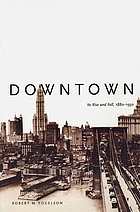
Fogelson, Robert. Downtown: Its Rise and Fall, 1880-1950 (Yale U. P., 2001) and Bourgeois Nightmares: Suburbia, 1870-1930 (Yale U.P., 2005). More or less by accident — Downtown was what our local library had on the shelf! — I stumbled upon preeminent historian of urban America Robert Fogelson’s work when I went in search of Boston and Brookline histories back in December. In Downtown Fogelson explores the development of the central business district in American cities — thanks to the layout of New York City colloquially known as “downtown” regardless of geographic orientation — and traces its fate through the first half of the twentieth century as it moved from the business district to the central business district to simply one of many business districts. He touches on a number of key cities, although New York, Boston, Chicago, and Los Angeles are recurring examples. I particularly enjoyed the attention to the perennial question of public transit and the changes wrought by the rise of the automobile. Fogelson pays particular attention to the interplay between city planners and businessmen (the urban elite) and the populace at large — the way in which those with power seek to create and control a certain type of urban environment on the one hand, while unanticipated and often anarchic-feeling forces bring changes economic and cultural to the urban landscape.

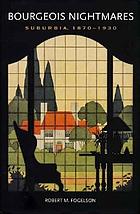
It’s the desire for stasis that is, in fact, at the heart of the second Fogelson book I read: Bourgeois Nightmares. The title, a play on Robert Fishman’s Bourgeois Utopias (1987), explores the dark side of America’s suburban sprawl between 1870-1930. Fogelson begins his narrative by suggesting that the central desire which drove the American upper-, upper-middle- and middle-classes to suburban subdivisions around the turn of the twentieth century was the desire for stability. In order to sell land in these new neighborhoods, subdividers had to sell the promise of that stability — the promise that one’s land would never fall in value, that one’s neighborhood would remain pleasant, that one’s neighbors would always be desirable. The mechanism by which they enforced stability was through the creation of restrictive covenants: contractual limitations on how landowners could use and dispose of the land which they purchased. Most notoriously, restrictions were used to exclude non-white (and sometimes non-Christian and even non-Protestant) residents from the suburban development. They were also used to police the aesthetics of place: fences, landscaping, architectural design, the domestic animals one could own, the signs one could put up, and the business one could do from one’s property. Fogelson convincingly argues that restrictive covenants were a successful marketing tool despite the limitations they placed on property rights because they reassured the “bourgeois” classes that they were protected not only from outsider undesirables but also from the potentially-appalling behavior of their peer neighbors.

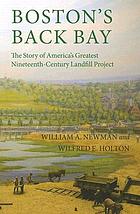
Holton, Wilfred and William A. Newman. Boston’s Back Bay: The Story of America’s Greatest Nineteenth-Century Landfill Project (Northeastern U.P., 2006). The Massachusetts Historical Society moved into the back bay in the 1890s, as the back bay landfill project was nearing its close. The land on which the MHS stands, at the corner of Boylston Street and The Fenway, teeters on the edge of landfill and what used to be known as Gravelly Point. Originally, the Back Bay served as both a source of hydro power and also Boston’s sewer — where the citizens of Boston sent their waste in hopes that the tide would wash it out to sea (a hit-or-miss proposition, particularly after the bay was sectioned by dams and railway bridges in the early 1800s. Between the 1820s and the 1890s the Commonwealth of Massachsuetts undertook the massive land-creation project of filling in the bay and what seems like the daunting task of selling the recently-noxious area as a posh neighborhood of expensive townhouses and cultural institutions. Holton and Newman are primarily interested in the engineering innovations that made filling in the Back Bay tidal flat possible and the construction of buildings feasible. Honestly, there’s only so much detail about railway lines, gravel pits, and building foundations I can sustain interest for, although descriptions of the changing landscape and the generous inclusion of maps to chart the progress of land-creation were both welcome. I would have appreciated more cultural and social history. Given the Back Bay’s numerous drawbacks as land for residential construction — including a high water table that caused sewers to back up twice daily and fill basements with toxic and foul-smelling substances! — the successful selling of the neighborhood as a desirable location for the Boston elites is a story that begs to be told in more depth. Still, I do feel I now have a better grasp on the whys and hows of the Back Bay landfill project. Now on to Nancy Seashole’s Gaining Ground: A History of Landmaking in Boston (MIT Press, 2003).

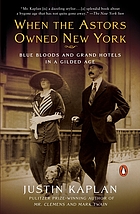
Kaplan, Justin. When the Astors Owned New York: Blue Bloods and Grand Hotels in the Gilded Age (Viking, 2006). One feature of American downtown life in the Gilded Age was the luxury hotel. Using the real estate giants William Waldorf Astor and his cousin John Jacob Astor as his biographical through-line, Justin Kaplan offers a lively tour of the rise of the modern-day hotel during the late nineteenth-century. What I found most fascinating about the book — apart from the salacious details of intra-familial rivalry — was the cultural history of a type of institution (the luxury hotel) that today we take more or less for granted as an essential feature in any city. Yet the first establishment that approximated what we think of as a hotel, The Tremont here in Boston, opened in 1829. It was the first lodging-house to become a destination per se rather than just a place for businessmen and travelers to find a bed and a meal in transit from one location to the next. Its indoor bathrooms, particularly, became so popular that upperclass families in the nearby Beacon Hill neighborhood sometimes made there way to the hotel for their weekly bath. The Astor family built on these innovations with alacrity and by the end of the 1800s their hotels in New York City were the subject of songs, the hub of high society, where people went to see and be seen. While Kaplan’s narrative is short on footnotes, it is grounded in the historical record and is not overly ambitious in its claims. An entertaining and informative read.

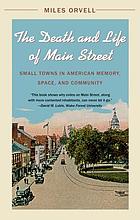
Orvell, Miles. The Death and Life of Main Street: Small Towns in American Memory, Space and Community (University of North Carolina Press, 2012). Orvell’s work is a cultural history of “main street” in America — both how it actually functioned in the social and economic landscape and also what it signified in the American mind. Examining literary and cinematic portrayals as well as the politics of creating, destroying, and rehabilitating “main street” as a social space throughout the 19th and 20th centuries, Orvell points to the ongoing tension in the American cultural landscape between “main street” as a site for wholesome enjoyment and small-town safety and main street as a site for small-mindedness and community policing. The idyllic nature of small-town / “main street” America, in other words, very often depends on the erasure of people whose presence is disruptive to “niceness”: educated women with uppity notions about gender equality, labor organizers, and — over and over again — those whose skin color, ethnicity, and religion fail to conform with a WASP-y vision of true American-ness. From 19th-century paeons to the “vanishing” New England village square to late-20th century Disney-sponsored planned communities, The Death and Life of Main Street offers a highly readable, well-researched window into one particular facet of the (real and mythical) American landscape.

Next on the urban history reading list is Stephen Puleo’s A City So Grand: The Rise of an American Metropolis, Boston 1850-1900 (Beacon Press, 2010). I’ll be sure to let you know how it goes! But next week we’ll be taking a turn to a mix of books both historical and cultural that touch on human sexuality and the politics thereof.

why do I write (and read) fan fiction? [part three]

26 Saturday Jan 2013

Posted by Anna Clutterbuck-Cook in fandom

≈ 4 Comments

Tags

fanfic, feminism, gender and sexuality, genre fiction, smut, the body, the personal is political, why be judgy?, writing

See part one and part two for the context of this post.

So having explored fan fiction generally (and why I’m drawn to it) and erotic fan fiction as a sub-genre of fic, and why I think it’s important, I thought I’d round this little series out with some thoughts on what draws me to the particular fandoms and pairings (relationships) I write … and what I’m trying to do when I write them. Besides, you know, enjoy the smut. I’m also going to address, below, a couple of questions I’ve fielded lately about the ethics of fic-writing practice.

Donna Noble (Doctor Who)*

Why write the pairings I write?

Well, so, it’s tempting to say that I write the things I write because I find them compelling and I just do, okay? On a certain level, trying to explain why you find the the fiction you like compelling is like trying to explain why you love your partner. It’s not really reducible to a bullet point list.

But on the other hand, I’m me. So of course I have some Thoughts on the subject. And it starts with the fact that I consumed a lot of erotic fan fiction at a point where I was beginning to actively think about relational sexuality and how sexual identity and desire worked in peoples’ lives (see post two). And I really enjoyed a lot of fan fic I was reading, mostly gay male pairings ’cause those were the fandoms Hanna and I were reading, but I struggled to find sexually-explicit lesbian pairings. And the femslash I did come across was frustratingly in-explicit about sex, or written by people who didn’t seem to fully grasp the possibilities of what two female-bodied people might do together, sexual-intimacy wise. Hetero and gay male sex scenes in fic (and, to be fair, in a lot of regular porn) work on a fairly standard narrative arc that culminates in penetrative sex — penis-in-vagina or anal sex — as The Most Bestest Form of Sexual Intimacy. It’s pretty much always orgasm-producing for both partners and sometimes it’s clear the authors (and the characters they’re writing) don’t consider sex to have happened until there’s been a penis inside a vagina or an anus.

Without a penis, what do you do?! Okay, yes, there are dildos and vibrators, but honestly not a lot of fics wade into the territory of sex toys very skillfully, and dildos in a lesbian sex scene too often just cue the author to assume sex with a dildo is about role playing het sex. Which it can be, but certainly doesn’t have to be. In my opinion, it’s much more fun to start without that penetrative-sex-as-goal model in mind and think about all the ways two bodies might come together (double entendre very much intended).

So I developed a (Queer, Feminist) Agenda. Which was to inject the world with realistic smut about ladybits. Smut that was tactile, visceral, about real bodies coming together and people making meaning out of the sex they were engaged in. And I’m an historian, so I started out pilfering from Downton Abbey, writing an eight-story arc about Sybil Crawley and Gwen. And I went on from there to other female pairings and eventually stuck my toe into the waters of m/m slash. It was kind of terrifying at first, pushing out into writing about men having sex — something I don’t have hands-on experience with. But I discovered that, at least the way I go about it, the characters take hold of the narrative regardless of gender and help me feel my way through giving them positive (and I hope realistic) sexual experiences! And in part, I was motivated by the same (Queer, Feminist) Agenda as I had been with writing female-bodied sex scenes: the be-all and end-all of sex for guys doesn’t have to be penetration.

I’m hardly the first person to observe this, but for people who are queer in some way, writing slash fiction can be a way to revise the heteronormative narratives of mainstream media. And, I’d add as a feminist, it can be a way to revise sexism and other isms as well. Watching a television show with primarily straight relationships and re-writing or filling in those stories to imagine queer relationships injects our experience into the cultural discourse. Characters on television, in film, in books, are assumed straight until explicitly identified as queer; fan fiction more often assumes that everyone is a little bit queer unless they’re proven to be straight. It’s a re-visioning of the world in which sexual variety is the norm — one part reflection of our actual experiences in queer subcultures, and one part wishful “what if…” thinking. Looking at my small repertoire of fic pairings, I’d argue I tend to choose characters who have the potential to — when queered in some way — disrupt the normative expectations about sex and relationships that we see in a lot of porn, erotica, and mainstream media — television shows, movies, etc., the original material from which fan fiction is born. Perhaps starting out as a critique of the original material, I often find my acts of fanfic subversion increases my pleasure as a consumer of the original material.

I enjoy writing stories about women unabashedly enjoying sex and knowing their bodies. I enjoy writing stories about elder folk, late-in-life lesbianism, about people having sex when their bodies don’t always work the way they want them to. I like writing fic in which it’s taken for granted (by me, the author, at least) that men can, and do, enjoy a full range of emotional intimacy, body insecurities, carry baggage from damaging relationships, enjoy sex that isn’t always fucking. (In fact, I have yet to write a fic that includes men having anal sex.) I like writing the vulnerability of desire, about what it means to expose to another person just how much you want, and (often even more frightening) what you want. I like writing sex that includes awkward conversations and misunderstandings and bodies that frustrate and fears that overwhelm — but that all ultimately circle around that moment of knowing and being known that can come when people get naked together, in every sense of the word.

The ethics of slash: a few final thoughts.

Aside from the ethics of porn, which is a topic about which much ink (and internet bile) has been spilled, the ethics of fan fiction (or, more generally, “transformative works”) is itself a topic for discussion on the internet and beyond. Hanna and I belong to the Organization of Transformative Works, a non-profit organization that advocates for the practice of fan works and also runs the Archive of Our Own project, which seeks to collect and preserve fan works online. They publish a peer-reviewed journal, Transformative Works and Cultures, that explores fandom in its infinite varieties. So if you’re interest is piqued and you’d like to delve into the politics and culture of fan creation — or poke around and read some fic or whatever variety! — I really can’t recommend them highly enough.

What I wanted to do here is touch on a couple of ethical issues that have come up recently in conversation with friends — namely the ethics of “m/m erotica” written by women, and the practice of writing RPF or “real person” fic.

Can, or should, women write erotica about gay men?

Periodically, there are internet-based wrangles over whether or not “m/m erotica” — which in the world of published romance/erotica generally means “gay porn for girls,” or (usually) women-authored fiction about gay male relationships marketed to a (presumed straight) female readership — is ethical (see for example here and here). The question is whether the m/m genre is exploitative, a hetero appropriation of gay male culture. The practice of writing erotic fan fiction is overwhelmingly a female one, and male/male pairings — as I write above — generate an incredible amount of enthusiasm, from both writers and readers (who appear to be, again, overwhelmingly female).

As an aside: fan-fiction writing as a feminized activity is something that deserves attention, and I have no doubt someone somewhere is doing incredible work on it. I think there’s a lot to explore in that dynamic — and I’m looking forward to being a part of the conversation, along with people who’ve done way more research than I into the phenomenon.

But back to the ethics of being a woman writing/reading porn involving men having sex with other men. Which is something I, a cis woman, do on a near-daily basis (see above). I admit that, when the articles about m/m erotica appeared, I did some soul-searching about it. When people suggest an activity might be exploitative it’s pretty much always a good idea to take their position seriously and listen to what they have to say. But. Here’s my thing about the case against m/m erotica: it basically comes down to an argument that if people of sexual identity A create or consume erotica about (fictional) people of sexual identity B, particularly if there’s a dynamic of social privilege in the mix, that’s per se a problem.

But sexual identity isn’t some sort of siloed, static thing — or at least I don’t experience it that way. Our sexual identities, desires, practices — they’re messy and complicated and shift over time. Preferred sex and/or gender of one’s actual partners aside, we can have fantasies and enjoy porn about practices we would never want to actually engage in. And, I would argue, we can find porn about bodies and practices we don’t per se find arousing, arousing because so much of sex isn’t the geometry of bodies coming together but (see post two) the narrative surrounding that context. Recent research is beginning to support this notion, particularly for female-bodied persons. As J. Jack Halberstam points out in the recent book Gaga Feminism (Beacon Press, 2012):

People are not asking why it is that gay men do not, generally speaking, produce any [sexual] fantasies around femininity, while lesbians produce lots of fantasy environments that include men or masculinity. When, in The Kids Are All Right, the lesbian couple watches gay male pornography to spice up their sex life, the scene was met with incredulity, especially from gay men. Indeed, a gay magazine journalist called me and asked me to comment on this bizarre (to him) scene. I responded that lots of lesbians watch and like gay male porn, straight male porn, and everything in between … [According to sexual response studies] while men, gay and straight, tend to respond in inflexible ways to erotic images of men and women (straight men want to see female bodies, gay men want to see male bodies), women, gay and straight, tend to respond in flexible ways to images of men, women, and animals. (p. 87-88).

So my point is that what sounds like a fairly reasonable call for non-appropriation (“what do these straight women think they’re doing, fantasizing about gay men!”) becomes tangled really quickly.

To use my own example: I’m a bisexual woman in a same-sex relationship with another woman. Does that mean I’m only “allowed” to be involved in reading/writing porn featuring two women? Are threesomes okay — or not, because I’m not in an open or poly relationship? If I write about sex involving male bodies, is it okay because as a bi woman I’m sexually attracted to men? But then it would be okay for straight women to write gay porn also, so maybe I’m only allowed to write porn about hetero pairings? But I’ve never been in a straight relationship, and identify as part of the queer community — so maybe that’s off-limits as well. But if I’m part of the queer community then we’re back where we started: maybe I get to create and consume porn about same-sex couples because I’m part of a same-sex couple?

So you end up on this merry-go-round of factors that could be used to determine who is or isn’t “qualified” or ethically able to create certain types of sexual fictions. And I think that that sort of policing ultimately impoverishes us all. If we started saying that straight people could only write or enjoy porn about straight folks, and gay men and lesbians could only write or enjoy porn about gay men and lesbians … not only would we miss out exploring the sexual diversity of humanity through the imaginative act of writing and reading, but we’d also be ignoring that there are people who don’t fit into these neat and tidy categories of the self.

I’m not saying there isn’t a place for critique. Hell, in my book, there’s nothing in the world so sacrosanct as to be beyond critique. And I absolutely believe that there is porn out there that fetishizes queerness for the straight gaze. I mean, I wouldn’t be writing porn in the first place if I hadn’t gotten frustrated with the conventions and stereotypes I saw being recapitulated over and over in the porn I was reading. So I think anyone involved in writing erotica should be open to conversation about their work, open to hearing people say, “Hey, that thing you did there in that story rubbed me the wrong way, and here’s why.” It’s not a requirement to engage, but I would hope the resulting conversation could be an opportunity for growth for all involved.

What are my feelings on “real person” erotic fan fiction?

Yup, it’s a thing in the world, people writing (often erotic) fan fiction featuring real-life celebrities. Often, though not always, these celebrities are the actors portraying the characters that these same authors write other fan fiction pieces about. But there are also people who write erotic fan fiction about politicians, musicians, and other people in the public eye.

I had a follower on Twitter ask me last week what I think about the practice:

@feministlib Must ask: do you have thoughts on RPF/RPS in contrast to general fanfic or slash fiction? Ethical/Moral/Creative boundaries?
— Jen Jurgens (@capricurgens) January 19, 2013

I responded:

@capricurgens thanks for asking! short answer is that I’m squicked out by RPF because it feels non-consensual and intrusive to me (1/2)
— feministlibrarian (@feministlib) January 19, 2013


@capricurgens if person wants to write/film erotica starring themselves & partners & others enjoy it, ok. but RPF = non-con in my book (2/2)
— feministlibrarian (@feministlib) January 19, 2013

And I’m not sure I have a whole lot more to add to this “short answer” response. Characters (whether portrayed by actors or written about in a text) are characters not human beings. We joke about how they take over our brains and insist their own version of events, but at the end of the day they are human creations — not humans themselves. They have no independent bodily autonomy or agency. They have no legal or social standing as persons. Real people do.

Real people can create erotica or pornography that involves themselves and offer it to others (friends or strangers) to enjoy consuming — as long as everyone’s staying safe and is able to consent without coercion I’m down with that. I even think teenagers technically under the age of consent should have the protected right to create erotica materials involving themselves and share those materials with their peers as part of their own sexual exploration. Obviously this raises questions about how to give them a safe space to explore their sexuality without being exploited, and I agree that’s a conversation to be had. But the general principle is: we should all have the creative license to explore our sexuality in textual and visual ways and share it as we desire.

However: consent is key here. I imagine human beings have always developed fantasies around other actual people prior to full and enthusiastic consent being given — in the case of those we later become sexually intimate with — or in situations where those relationships will never flower, but we’re crushing hard anyway. This isn’t about policing personal imagination — have all the damn fantasies you want about whomever and whatever you find turns you on.

I’d argue, though, that in the case of fantasies about real live actual people who aren’t involved in the spinning out of those fantasies? Those stories or images are best left in private spaces: your computer hard-drive, your journal, whatever. I’m not thinking so much of regulation here — I’m not arguing we pull RPF from the Archive and ban people from publishing more — but I’m arguing that as a matter of common courtesy it’s kinda, well, rude, to put your fantasies about actual people who you have no relationship with and who aren’t consenting to have these sexualized stories or images created around them out into the world of the ‘net where those same people could presumably come across said stories by Googling their names.

If someone wrote an erotica story — even a really sweet hot one! — about me as me and posted it online and I stumbled across it, it would feel really stalkery and invasive to me. Like, my wife is the only one at this point in time who has my permission to spin out stories about my bits that way.

So yes, I do think there are boundaries and ethical considerations where fan-creation is concerned. And I appreciate that there are people within fandom who are willing and interested in engaging in ongoing conversations about those difficult aspects of the genre. What I do hope is that those outside of the genre will think twice before dismissing the practice wholesale as facile or perverted (in the not-cool way). Because I think fan engagement with (mainstream) creative works has a lot of potential to change and complicate the (mainstream) conversation about human sexuality.


*One of the pieces of fan fiction I’m most proud of is a Donna Noble/Idris fic completed for last year’s International Day of Femslash.

movienotes: les miserables

22 Tuesday Jan 2013

Posted by Anna Clutterbuck-Cook in media

≈ 2 Comments

Tags

fanfic, feminism, history, movies, politics

I have some book reviews I need to write for books I’ve read this month, and a third “why I write fic” post in the queue, but I just got back from a weekend with my sister in the beautiful Austin, Texas, and my brain can’t seem to form coherent-yet-complex thoughts. So instead, I’m going to offer up a few observations about the film version of Les Miserables that I saw in the theater the weekend before last.

Javert (Crowe) and Valjean (Jackman)

I saw the musical once before, live, when I was in London in January of 2004. My principle memories at the time involve enjoying the music (I’m a life-long musical theatre fan, so a good musical will always win me over in the end), being distracted by the book I’d picked up that day and brought with me to read during intermission (The Time-Traveler’s Wife), and my surprise at the fact that the emotional-relational through-line for the story is not the second act marriage-plot between Marius and Cosette but the connection forged between Jean Valjean and Inspector Javert. It is their dance of power, desperation, obsession, compassion, forgiveness, and despair that drive the plot from start to finish. Hugo’s novel is that 19th century classic the Social Problems Novel and, and is — I’m sure I am far from the first to remark upon this! — a queer choice for musical theatre.

Fantine (Hathaway) selling her hair.

A few thoughts in no particular order:

  • Women, work and society. The film version of Les Mis had some really interesting (largely visual) observations to make about women and work. There’s Fantine, Anne Hathaway’s character, who is working in a factory to pay for her daughter’s care. Rumored to be a slut, and punished by the foreman for being a single mother, she’s cast onto the streets and sells her hair, teeth, and sex before succumbing to consumption. Her daughter, Cosette, has been boarded out as a laborer herself, working for a couple running an inn (the buffoonish and cruel Thenardiers). While Cosette is rescued by Valjean and ascends to the middle class through marriage (one could argue a certain kind of “wage work” in its own right, certainly an economic decision), her age-mate Eponine Thenardier — abused by her parents and pining after Cosette’s lover — cross-dresses as a boy to join the revolution and ultimately dies on the barricade. On the periphery of the story drift prostitutes, beggars, and female religious who serve as nurses and also offer refuge for Jean Valjean at various points throughout the story. When the student revolutionaries are shot by French soldiers, the uprising put down, it is women who are left to scrub down the blood-filled streets. Overall, Les Mis hammers home in multiple ways the limited options for the vast majority of women in 19th century France. True, there were limited options for most people living in France at that time — but this film adaptation does a good job of highlighting the way women’s sex/gender limited them in particular ways.
  • Futility of revolutionary action? Throughout, the film/musical has a deeply ambivalent relationship to the politics of its student revolutionaries. Marius’s boyfriend Enjolras is a charismatic and idealistic young Parisian student who, with a group of peers, orchestrates a violent rebellion (based on a real historical incident) that ultimately fails and leaves everyone — save Marius, rescued by Jean Valjean for his adopted daughter’s sake — dead. In Hugo’s world, the violence of the state (personified by Javert; more below) is responsible for the wretchedness of virtually every character in the story, but political action is depicted as ultimately futile and deadly. Yet the film ends with a triumphant reprise of the rebels call to arms, with Fantine, Valjean, and all of the dead students waving tricolor flags high above the Parisian skyline. Have they … won? And if so, how? Is the film meant to suggest revolutionary action is ever-needed? If the next generation (Marius and Cosette) have retreated into bourgeois respectability — Marius’ father welcomes them in with open arms and throws a lavish party for their wedding — should this be considered a win? For whom? I have read some reviews that suggest Hugo’s narrative points toward interpersonal love triumphing over political action (again, more below) but if that is the thrust of the plot it is an unsatisfying one: many people, even many “deserving” poor, die or are left in desperate poverty despite benevolence (and occasionally actual care) extended to them by others. If I had to guess, I’d hazard that Hugo might imagine that all attempts to improve the human condition on a large scale are doomed to failure, and that one-to-one interactions are our only — and ultimately futile — recourse.
  • Letting go of the next generation. As I wrote above, my first impressions of Les Mis is that it is a story about parents and letting go. Fantine, first, must let go of Cosette in order to provide for her (by going to work and leaving her with the innkeepers), and then ultimately must let her go when she dies and entrusts her to Valjean, a man she barely knows. She cannot know what her daughter’s future holds — for good or ill — and yet must depart. And then in the second act Valjean must let go of Cosette when she falls in love with Marius. While at first this loss is painful to him, and he tries to leave  the country with Cosette in tow, when he intercepts a letter from Marius to Cosette he regrets his actions and rescues Marius from the barricades. After the two children are engaged to be married, Valjean — his duty to his daughter complete, now she is in another man’s care — he departs to a monastery to die. We also have, of course, all of the children who die: Eponine and the students, including a young street urchin named Gavroche who is the first casualty of the day. The adults may believe these young peoples’ actions are foolish and futile, dangerous even, but the young people ultimately must forge their own paths.
  • The central romance in the story is between Valjean and Javert. So, okay, you don’t have to read their relationship as one long exercise in Unresolved Sexual Tension – but I certainly found it much more satisfying than the Marius/Cosette situation, let me tell you. Inspector Javert spends decades in pursuit of Valjean, obsessed with the man and fascinated/repulsed by the notion that the “criminal” Valjean (imprisoned for stealing a loaf of bread) could ever be anything other than a criminal. Valjean, whose religious conversion shortly after he is paroled helps him rebuild his life, tries to model a more nuanced morality for Javert (while, you know, evading re-arrest!) — and in the penultimate scene he succeeds. Given the opportunity to kill or capture Valjean, whom he has tracked into the Parisian sewers, Javert lets Valjean go. And is so shattered by his decision to let the rule of law go in the interest of human compassion that he commits suicide.
  • Oh, and the acting. I was really impressed with everyone in this cast, all of whom seemed to really be throwing themselves into their work both musically and acting-wise. At times, Hugh Jackman and Russell Crowe really seemed to be struggling with the score which surprised me — since I know Jackman, at least, is a strong singer. But I think that might have been a function of recording the songs live on-set rather than in a recording studio before or after the shoot. And Helena Bonham Carter and Sacha Baron Cohen as the odious Thenardiers were delightfully campy, offering some of the only comic relief around — and even then, theirs is a story that has a pretty tragic side if you linger more than a moment or two). 
And that’s all I got, folks. If you’re musical theater fans or fans of the Victorian “social problem” novel, I’d highly recommend seeing the film — preferably in the theatre since it truly is a spectacle of a movie musical. I know some people were really frustrated by the filming — the tendency to frame actors in the corner of the screen, or incompletely, but I actually like that technique for the way it makes you notice the composition of the shot, makes you realize a visual image is being constructed for you, rather than allowing you to feel you’re simply immersed in the action. Artifice, in this instance I would argue, works well with the musical genre.

why do I write (and read) fan fiction? [part two]

17 Thursday Jan 2013

Posted by Anna Clutterbuck-Cook in fandom

≈ 4 Comments

Tags

fanfic, gender and sexuality, smut, writing

(via)

See part one for the background to this post.

I’ve been letting this sit in my drafts folder for a couple of days and I’m starting to feel the weight of perfection closing in … so quickly, quickly! I’m going to try and get these ideas out there before I’m crushed by the tyranny of Unfinished Thoughts.

Why write erotic fan fiction?

Why erotic fan fiction indeed.

So a couple of things.

Building on what I wrote in response to the question “why fan fiction,” thinking about the lives of characters “off screen” (or after the novel or series is done) can often translate into imagining the playing-out of relationships that were established in canon. Not only do many mainstream novels (not just the ones for children and young adults) fade to black around sexual encounters, they often skirt the whole question entirely by ending the story arc with the get-together moment, or at least the early days of the relationship. Inquiring minds want to know what happens after — and once you get to beyond a certain age, it seems pretty clear that sexual intimacy is often (though obviously not always) a part of the “after.” It’s long been a habit of the heart, for me, to extend the existence of fictional characters to give them the relationships and experiences the main narrative only gestures toward.

Too, when I was re-introduced to the concept of fan-created fiction and other fan works, it was as a genre that focused heavily on “slash,” or fan work where characters’ sexual relationships (whether canon or not) were the central theme. If your only encounter with fan works is through reading about 50 Shades of Gray or the resulting mainstream news coverage of fan fiction as a phenomenon, you can be forgiven in assuming that all fan fiction is erotic. It’s not. I’m not sufficiently expert in the field to say what percentage of fan work is, in part or primarily, erotic (I’d guess a substantial proportion, but that’s also what I tend to go looking for so my sample is extremely biased), but erotica is not the only direction fan work can take. Yet it was a key factor in what drew me, as an adult, back into the practice of fan writing.

I read it exclusively, for awhile, but eventually I started looking for pairings and stories that I couldn’t find anywhere (more on that in part three) … in other words, I found a gap in the literature! And like any nerdy academic, once I’d found the gap(s) people weren’t exploring I determined to explore them. So pretty soon, I started writing, and people started reading, and people by their own account enjoyed what they read, and who doesn’t like positive reinforcement?!

You could also ask the question this way: Why write erotic fan fiction?

I find erotica in general a compelling genre, and one — as I’ve written before — that has a great deal of (often underestimated) potential to help us explore meaningful aspects of the human condition. But I often find erotic fiction of the non-fannish variety incredibly hit-or-miss. As a member of my writing group and I were bemoaning the other day, it’s often the case that you pick up an anthology of Best Lesbian Erotica or Best Erotic Romance or even the more theme-driven works (steampunk, quickies, food porn, BDSM, etc.) and at the most you find two or three stories out of twenty that dampen the knickers.

I always thought, you know, “different strokes for different folks” (in this case, ahem, quite literally), but then I discovered erotic fan fiction? Maybe it was just that I happened to re-acquaint myself with the genre at a time when I was ready to start thinking about sexual narratives in a more sustained way. Maybe it was because I was exploring my own sexual potential in concrete ways, and thus sexual knowledge, both fictive and non, were suddenly ever more compelling. This is part of the equation, surely. Fan fiction — the writing and the reading, the community sharing — has become entangled in my learnings and conversations about sexuality more generally and how we human beings narrate desire.

But as I’ve been turning this question over in my head the last couple of days, I think there’s actually another more … technical? … reason why fan fiction erotica has a higher success rate for me (in terms of capturing my interest as a creator and consumer) than erotica in general. And the reason goes something like this: sex gains meaning through context. There are different schools of thought about what makes for effective porn, and some people will argue — or even just take as read — that effective porn is effective precisely because it’s non-contextual and non-specific. That the characters are effective primarily because they are utterly interchangeable. One of the arguments for why so few male performers emerge as stars in the mainstream porn business is precisely this: that the ideal (male) porn actor fades into the background, is unremarkable enough that the (presumed hetero male) viewer can effectively erase the actor from the scene and insert himself into the action. But for me, the exact opposite is true: the more particular and real the characters in a given story are, the more heartbreaking and hot the sex. Because I’ve been convinced I should care. Sex acts are weird and messy and frankly ridiculous … it’s we (participants and witnesses) who imbue the acts with meaning. (You’ll say there’s a physical component as well, and I’m not disputing that, but consider the difference between being someone biting your neck out of the blue and sucking a hickey into your shoulder in the midst of lovemaking … it’s context that makes the physical activity feel good, not the actions in and of themselves.)

Intimacy can be the work of a fleeting moment or happen in the context of a life-long relationship, but without context sex acts themselves are, well, boring (to me, at least).

Fan fiction evokes context. True, the best fan fiction can stand on its own and be enjoyed by readers who know virtually nothing about the canon narratives to which the fic refers. Case in point, when Hanna first started sharing fic with me she was largely sending me stories written for anime and gaming ‘verses I had no context for. And they were still compelling and hot. But I think there’s a way that even just knowing these stories tie into a larger narrative encourage us to build context and imbue a scene with meaning. We don’t have to know every detail of that context, just that there is one. We’re encouraged to see the characters not just as conduits for sexual satisfaction, but individuals with full lives and the weight of personal history which they bring to their (fictional) sexual encounters.

As someone who counted fictional characters as intimate friends from a very early age, I guess it’s not a big surprise to me that the act of participating (as a voyeur-reader, or as an author-creator) in the intimacy of fictional characters feels real and satisfying in a way that more conventional types of erotic creation/consumption have not, for me.

I also think the energy of the fan community feeds into this: virtually all of the fan writers creating smut in this context are also readers — we swap work, we are one anothers’ editors, we cheer on stories, we’re invested in the (fictional) relationships working, so perhaps there’s something in the very activity of co-creation that’s … erotic? It’s similar to the really good energy you get in a class where everything gels and a critical mass of professor and students are pushing one another toward mutual heightened understanding? The relationship isn’t just between the reader and the characters, but also the writer-reader and the reader-writer; even if fan fiction is penned (or typed) by a single author, there’s usually a whole network of fellow fans around that author who create context for the work itself. And I think somehow that gives the relationship(s) and sexual intimacies within the work a unique intensity of meaning.

Stay tuned for part three, where I muse more specifically about why I write the particular types of erotic fan-fiction I write…

‘after pornified’ book giveaway! [free stuff]

15 Tuesday Jan 2013

Posted by Anna Clutterbuck-Cook in book reviews

≈ 1 Comment

Tags

blogging, feminism, free stuff, gender and sexuality, smut

My friend Anne Sabo has given me three signed copies of her recent book, After Pornified: How Women are Transforming Pornography and Why it Really Matters (see my review here). And I would love to pass them along to you!

The only requirement is that you read and review the book by March 1st, post the review to Amazon.com and whatever other blogging or book-themed social networking site (GoodReads, LibraryThing, etc.) you choose and send the link to me.

Psyched to start reading? Leave a comment by midnight this coming Friday (so 12:00am 1/19/2013) on this post including an email where I can reach you and sharing, via link or description, one of your favorite pieces of erotica (can be any medium). I’ll be taking all eligible entrants and randomly selecting three via the slip-of-paper-in-a-bowl method.
On Tuesday, January 22nd, I’ll contact the three winners by email for a mailing address and send out the books via first class mail.

Let the commenting begin!

← Older posts
Newer posts →
"the past is a wild party; check your preconceptions at the door." ~ Emma Donoghue

Recent Posts

  • medical update 11.11.22
  • medical update 6.4.22
  • medical update 1.16.2022
  • medical update 10.13.2021
  • medical update 8.17.2021

Archives

Categories

Creative Commons License

This work by Anna J. Clutterbuck-Cook is licensed under a Creative Commons Attribution 3.0 Unported License

Meta

  • Register
  • Log in
  • Entries feed
  • Comments feed
  • WordPress.com

Blog at WordPress.com.

  • Follow Following
    • the feminist librarian
    • Join 36 other followers
    • Already have a WordPress.com account? Log in now.
    • the feminist librarian
    • Customize
    • Follow Following
    • Sign up
    • Log in
    • Report this content
    • View site in Reader
    • Manage subscriptions
    • Collapse this bar