• anna j. clutterbuck-cook
  • contact
  • curriculum vitae
  • find me elsewhere
  • marilyn ross memorial book prize

the feminist librarian

the feminist librarian

Author Archives: Anna Clutterbuck-Cook

booknotes: after pornified

07 Tuesday Aug 2012

Posted by Anna Clutterbuck-Cook in book reviews

≈ 3 Comments

Tags

feminism, gender and sexuality, smut

Anne’s daughter Lilly, to whom
the book is dedicated (via)

As readers of this blog know, I spend a not-inconsiderable amount of time reading, writing, and thinking about sexually-explicit materials. Not just histories and health texts, but also works of fiction and nonfiction intended to arouse. In other words: porn.

As as you may also remember, I have little time for categorically anti-porn feminists (e.g. Gail Dines) whose only way of critiquing porn is to attack it wholesale. Pornography — by which I mean, in the broad sense, material of any medium that is sexually-explicit and intended to involve the reader/viewer on a visceral level — is, like any other creative medium, a way for us as humans to make sense of our world. And discounting it wholesale seems nonsensical to me. Should we not, instead, engage in a critical discussion about what we do and don’t like about the current state of porn (there will, naturally, be differences of opinion here) and what we’d like to see more of moving forward (again, there will be no consensus — there creativity lies)?

Therefore, I was super excited when I first heard, last year, about Anne G. Sabo’s forthcoming book After Pornified: How Women are Transforming Pornography & Why It Really Matters (Zero Books, 2012). A follower of her blogs (Quizzical Mama; New Porn by Women; and Love, Sex, and Family), I knew Anne would have thoughtful and thought-provoking things to say about a genre of porn — motion picture porn — that I have had little experience with, and know little about. I was excited enough about the book to press the author for an advance review copy, which she was kind enough to send me (hooray!). Since that exchange earlier in the summer we’ve actually gotten involved in an ongoing conversation about sexuality and identity — along with Molly of first the egg — which has the potential to solidify into a collaborative project down the line.

\o/

Ahem. So, yes. It’s great to connect with other thoughtful people who believe, as I do, that pornographic materials deserve sustained attention through all manner of lenses: as art, as literature, as cultural artifacts, as evidence of human sexuality, as a medium of communication and (hopefully) cultural change. Which is the story that After Pornified tries — in part — to document: How female directors are creating a new kind of pornographic film and how these new films explicitly and implicitly disrupt the conventions of inequality in much of mainstream moving picture porn. In Sabo’s own words,

I have found that porn is not inherently bad; there has just been a lot of badly made porn. … I am interested in the authentic porn made by women who show a sincere commitment to radically change porn, featuring female and male sexuality with respect and realism. Where porn becomes a vehicle for women to explore their own sexuality and define it for themselves (6).

Focusing on specific film-makers, with extensive discussion of the scripts, visual technique, musical choices, and sexual expression and messages of each film, as well as directorial intent, Sabo takes us on a verbal tour of this “new porn by women” and seeks to persuade us that their innovations are worth paying attention to for what they say about both the possibilities of porn and the possibilities of sexual intimacy between human beings. Candida Royalle, Anna Span, Jamye Waxman, Tristan Taormino, Petra Joy, and Erika Lust among others are artists whose work and words are extensively featured in After Pornified‘s pages (a list of films discussed and an appendix of resources for further exploration are really useful aspects of the book).

In assessing the porn she reviewed, Sabo employed a formal set of criteria which she includes in chapter one. The two axes along which she critiques the films are “high cinematic production value” and “progressive sexual-political commitment,” including the values of gender equality and active subversion of received notions of sexual shame and guilt. These two criteria blur together in many cases, as when Sabo considers the way in which camera angle (the gaze of the viewer) reinforces power-over or emphasizes power-with dynamics within the sexual encounter. I really appreciated the way in which film qua film was brought to bear on the sexual messages being sent — particularly in Sabo’s discussion of the sexual gaze. The notion of sexual “objectification” as an inherent and universally-degrading aspect of (visual) pornography is a widely repeated truism within feminist circles, one which Sabo insists on complicating by pointing out instances of the “non-objectifying gaze”:

What I find striking about the way the two [characters in the sex scene she has just described] look at each other is the exchange of a desiring gaze while the camera for its part refuses to objectify either [male or female partner]. Instead, ‘objectification’ here becomes an affirming, adoring act (27).

For the most part, I am not the audience who — hopefully! — may be encouraged by After Pornified to think about pornography in new and less totalizing ways. I am already eager to explore the realm of sexually-explicit materials for new sexual scripts, and to participate in remaking what we think we know about what porn is and the ways it can be used in our society. Still, I was pleased, as a reader, to be introduced to a new type of material I have had little opportunity (time and money being the barriers that they are) to explore. While Sabo hasn’t necessarily sent me running up the street to our local Good Vibrations to purchase a DVD collection of Erica Lust or Candida Royalle productions, it has given me a sense of what’s out there should I decide it’s something I want to delve into more intentionally.

While reading my copy of After Pornified, I jotted down a few questions that the manuscript provoked for me — questions that I didn’t expect Sabo to answer within limits of a single text, but which I hope we will all think about as we carry this important work of re-thinking porn forward:

  • There’s an assumption running through After Pornified that men have, historically, been the makers and consumers of porn and that as women viewers and film-makers enter the porn market the content will shift because what women want in terms of porn is different. This is an assumption that many feminist thinkers (both pro- and anti- porn) share. One of Sabo’s interviewees, for example, relates her attempt to create porn films with “content that would appeal to women” (55). I find myself wondering what the basis is for our assumption that women want different things from men, porn-wise, and whether evidence bears this out? My guess is that women and men actually want more similar things in porn than the mainstream media would have us believe.
  • Building on that, I wonder whether female film-makers (the focus of Sabo’s study) are more likely to make feminist porn (using her criteria) than male film-makers? Can men make feminist porn? Are there examples already out there of men involved in feminist porn? It would have been interesting to hear from men involved in some of the films Sabo reviews, to find out what their intentions and experiences were, and what sort of porn they found satisfying to make.
  • Again, this is beyond the scope of Sabo’s study, but I found myself wondering about two constituencies while reading the book: Men who are ill-satisfied with mainstream porn and women who like porn that wouldn’t make the cut, so to speak — porn that wouldn’t fit the “new porn” criteria Sabo has laid out. In most feminist discourse about pornography, as I observed above, men are treated as satisfied customers. Porn is a genre catering to “men,” the narrative goes, and women are the tag-along partners or feminist trail-blazers. I would be very interested in research that complicated men’s experiences of pornographic material (without the shame/blame framework) and explored what they, too, may want that the current mainstream fails to provide. Similarly, I fear that a focus on “new porn” that is feminist and egalitarian could ignore the fact that there are people, including women, for whom certain aspects of mainstream porn are deeply satisfying. This book wasn’t the place to explore that in-depth, but I do think it’s important not to simply replicate a “good porn” (feminist/egalitarian) “bad porn” (all other stuff) dichotomy — something feminist history tells us is a trap all too easy to fall into.
  • I found myself thinking a lot about issues of access. Many of these films sound great, but they are often independently produced and distributed, subject to censorship laws, behind pay walls online, etc. Making money as a film-maker is obviously not a bad thing, but it’s interesting to think about the economic aspects of distributing “new porn by women,” and to think about where people who don’t have the funds to invest in a feminist porn collection might access pornographic materials. I haven’t looked into amateur porn sites much, but it would be intriguing to see if feminist sensibilities were seeping into home-made video smut the same way queer and feminist sensibilities are blooming within fan-fiction communities. As a general rule, I’ve had much better luck finding well-written, queer-progressive smut in fan-fiction spaces than I have in published erotica anthologies, even from imprints like Cleis Press.
  • Queer porn as a subgenre is not tackled in this book as queer porn, which Sabo elsewhere has acknowledged is a deliberate decision. She’s trying to encourage us away from queer sexuality vs. heterosexuality to just talk about sexuality — a goal I really appreciate. However, sometimes leaning away from speaking explicitly about “queer” or “lesbian” or “gay male” porn has the effect of erasing those perspectives; the majority (though by no means all) of the films Sabo discusses are about male/female encounters, and those which do feature women-on-women action or male-on-male action still seem to center around a heterosexual encounter as the driving force of the plot. So I guess — as someone who’s gotten a lot out of queer smut over the years — I wonder what’s going on in this “new porn by women” that so much of it is centered around male-female encounters? Perhaps it’s part and parcel of trying to figure out how to women and men can have equitable sexual intimacy in a culture that constructs them as inherently unequal?

Finally, I appreciated Sabo’s discussion, in her afterword, of how we bring our embodied selves into our work and scholarship. “There’s somehow something incorrect for a scholar to be turned on at work,” she observes — pointing toward the discomfort many of her colleagues have expressed (including those in gender studies) when she discloses that she studies porn (202). I was reminded of bell hooks’ piece on the the erotics of teaching, “Eros, Eroticism, and the Pedagogical Process” (in Teaching to Transgress, Routledge, 1994). hooks observes:

Entering the classroom determined to erase the body and give ourselves over more fully to the mind, we show by our beings how deeply we have accepted the assumption that passion has no place in the classroom (192).

hooks is writing more generally here about embodiment and emotional investment, about being full persons within an academic setting (the same could be observed about the workplace), rather than narrowly about being a sexual person. However, I see our discomfort with sexual topics and the notion of a person whose work turns you on — or has the potential to do so — as part and parcel of this separation from the self. Full persons, after all, experience arousal. We should not feel required to cut ourselves off from that feeling — we only need to learn how to express it appropriately (for example, it’s probably not a good idea to flirt with a student or share detailed stories of your sexual experience with an employee). As a culture, we seem incapable of recognizing the experience of arousal without picturing immediate sexual acts speaks to our broader cultural impoverishment when it comes to discourse about sexuality as an integrated part of our lives.

After Pornified is determinedly both scholarly and passionate, and thus a valuable contribution to the ongoing conversation about pornography’s place in our culture — both what it is and what it should or could be. I’m looking forward to seeing what sort of discussion it sparks, and where the work of feminist porn-making and porn critique goes from here.
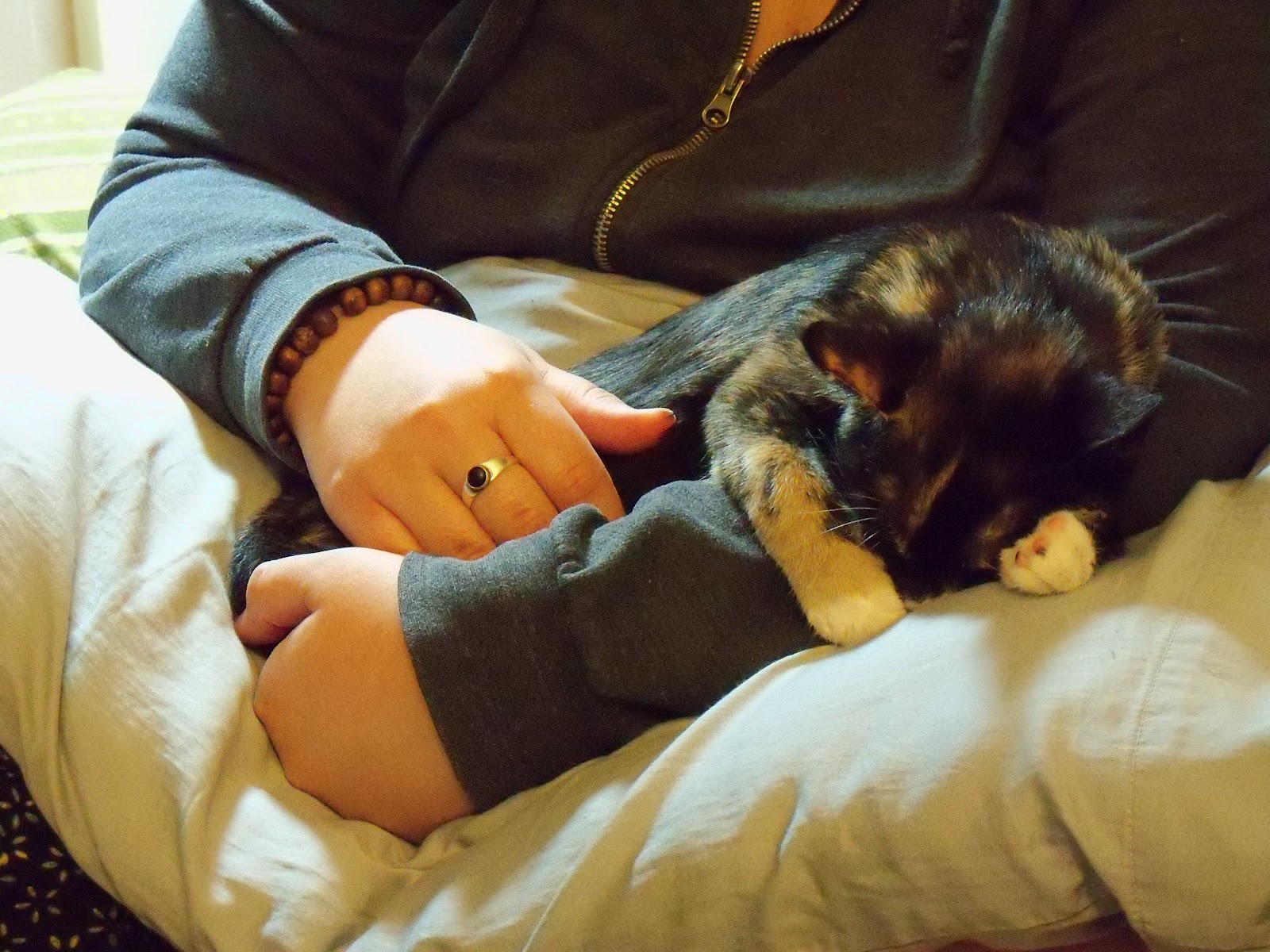
from the neighborhood: sleepy kitten!

07 Tuesday Aug 2012

Posted by Anna Clutterbuck-Cook in our family

≈ Leave a comment

Tags

cat blogging, domesticity, from the neighborhood, photos

It’s Monday evening — have a sleepy kitten!

blogging at In Our Words: holding the space: being good allies for our straight co-conspirators

01 Wednesday Aug 2012

Posted by Anna Clutterbuck-Cook in think pieces

≈ Leave a comment

Tags

gender and sexuality, guest post, in our words, politics, the personal is political

these folks desperately need allies (via)

I’m blogging at In Our Words again this week, with a post on how queer folks can be good allies for straight folks. This was a piece pitched by the blog editors that I thought was an interesting concept, and once I started thinking about it I realized I had some notions (I know, right?!) about how we might go about that. I ended up with one concept, five specific tips, and a word of caution. Here’s one of the tips:

While remembering fluidity is possible, it’s equally important to honor a person’s present self-identification. After all, we expect straight people to respect ours. Regardless of a person’s past relationship history or how they may identify in the future, it’s a basic tenet of respect to accept their self-understanding in the here and now. I’m as guilty as the next queer person when it comes to speculating who might be “on our team,” but too often attempts to uncover queer sexuality in straight-identified folks fall back on harmful stereotypes of sexuality and gender that reinforce, rather than subvert, heteronormativity (e.g. “he’s a ballet dancer, how can he expect us to think he’s straight?” or “that haircut is totally dykey”;  wink wink, nudge nudge). We need to trust straight people, as much as we trust queer people, to name their own desires as best they can.

Check out the rest at In Our Words.

If you’re a straight reader, I’d love to hear what you think queer folks can do to support your own resistance to heteronormative bullshit. And if you’re queer, I’d love to hear how you support your straight family and friends.

Share in comments, here or at IOW.

the dog days of summer [august-september siesta]

01 Wednesday Aug 2012

Posted by Anna Clutterbuck-Cook in admin

≈ Leave a comment

Tags

blogging, boston, domesticity, work-life balance

It’s August 1st (can you believe it?)

And I’ve decided it’s time to give myself a quasi-vacation from the ‘net.

Teazle napping with Hanna

Given that I’m online for eight hours daily at work, total blackout isn’t really a possibility — or something I feel is necessary. But I’ve been feeling pulled in a lot of different directions blogging lately, and I’d like to take some time to reflect on where I want to put my writing energy.

(Rest assured the feminist librarian is my home on the interwebs, and will not be going anywhere anytime soon!)

So this is all to say that — while I’m not going to quit blogging entirely — from now until after our honeymoon in mid-September I’ll be giving myself permission to post more sporadically than usual (when and how, exactly, did I get to the point of generating 5-10 posts per week, across half a dozen blogs?!).

I’m planning to use the offline time to read, write, nap, and enjoy non-work downtime with the future wife and kitten-kids.

Hope y’all are staying cool(ish) and we’ll see ya ’round these parts when time and inclination indicate this is where I’d like to be.

booknotes: confronting postmaternal thinking

31 Tuesday Jul 2012

Posted by Anna Clutterbuck-Cook in book reviews

≈ Leave a comment

Tags

being the change, children, feminism, human rights, politics

I’ve been threatening to write a review of Julie Stephens’ Confronting Postmaternal Thinking: Feminism, Memory, and Care (Columbia University Press, 2012) for over a month now but for some reason my thoughts will not gel. It’s a slim book that is trying to do lots of cultural work, pulling together threads of philosophy, political science, history, memory studies, feminism, and ethics. I had very intense reactions while I was reading it, but those reactions feel … half-digested still. In another six months or a year I may have to go back and give it another pass. A second reading might help clarify my reactions. In the meantime, here are some of my initial impressions and reactions.

  • As I said in my review of Love the Sin, Julie Stephens, in Postmaternal, is likewise critiquing our neoliberal conception of who gets to be a citizen, and who is a good citizen. She is particularly interested in the way care-giving and caregivers are tolerated only insofar as they manage to fit the norm of a citizen-worker. For example, she observes that workplace concessions to working parents — and especially working mothers — are often designed to streamline women’s return to full capacity as workers, to make invisible their care-giving responsibilities, rather than restructuring work and the workplace to accommodate care-giving cycles in family life. Her reflections on the role of  “worker” and the role of “mother” experience unstable moral and market values reminded me of Katha Pollitt’s reflections on how “stay at home mom” and “welfare queen” are two class-based conceptions of the same care-giving responsibilities, dependent on economic resources. Ultimately, care-giving in our society is an activity one only gets to perform if either a) it’s a monetized activity, or b) one’s obligations as a worker-citizen are met by one’s self or a proxy (e.g. husband). 
  • Stephens has made a deliberate choice to focus on care-giving as “women’s work,” a position that reminded me of the way in which Carol Gilliganrecognizes care and empathy as universal human abilities that have, historically, fallen to women in patriarchal culture. I was intensely uncomfortable with this choice — something I’d like to think about more deeply. While I understand her decision not to erase the way our culture genders care-giving, I’m less comfortable with the way respect for historically-feminine care-giving to an emphasis on gender difference. For example, she argues at one point that “the only way to address this failure [of neoliberal societies to account for the necessity of care] would be to reinvigorate the strands of feminism that are attuned to gender difference” (137). I can’t underscore enough how uncomfortable this makes me, and I think there are ways to address the erasure of the bodily aspects of care (e.g. breastfeeding, pregnancy and childbirth) Stephens is concerned about without gender essentialism — a type of feminism I would really rather not see revivified. Which brings me to my next point:
  • In writing about possible policy- and personal-level solutions to the modern-day marginalization of care — solutions that do not rely on the gender binary — I wish Stephens had referenced more queer activists and theorists, such as legal scholar Nancy Polikoff, whose work moved beyond the theoretical to lay out very concrete suggestions about how law and public policy could support and respect networks of care. And birth activist Miriam Perez, whose recent piece on trans birth parents suggests ways to take into account the embodied aspects of nurture without falling back on binary notions of gender.
  • I found Stephens’ use of oral history and memory studies literature an intriguing approach. In what I think is one of the strongest aspects of her analysis, Stephens examines the way mid-twentieth-century feminist activism around maternal and care-giving activities has been erased from cultural memory. She uses oral histories with “second wave” feminists as a way to recover these narratives and explore how their activism was never solely about getting ahead in a man’s world and rejecting the mother/motherhood/maternalism (as backlash culture has often argued). “[My] interviews [with “second wave” feminists] depart from culturally prevailing assumptions about work-centered feminism. Unexpectedly irreverent attitudes toward paid work are expressed,” she writes (91). I wish she had lingered a bit more on this relationship between feminist activism and how feminist activists remember their own life choices (and imagine the life choices of previous generations).
  • Building on these oral histories and the notion of a  forgotten politics of the maternal, Stephens argues that non-market relationships and care-giving are primary sites of moral and ethical development and action. Postmaternal is, in part, a call for neoliberal Western cultures (Stephens is Australian, and her sources are primarily Australian and American) to re-assert non-market values into political culture, reclaiming care as a non-marginal, legitimate activity even if it is not contributing to the national economy. As she writes,

“What a culture chooses to remember and forget has decidedly political character. In the deep discomfort surrounding the maternal in feminist reminiscence, it is possible to see a glimpse of an alternative politics where human dependency and vulnerability are imagined as the primary connection between people, not market performance” (70).

This assertion of an “alternative politics where human dependency and vulnerability are imagined as the primary connection between people,” and the connection Stephens draws between that political imagination and feminist activism is the strongest part of her argument. In revisiting/revising feminist collective memory to re-center a politics of care (which has always been present, but often actively forgotten) is what I would consider to be vitally-important work. And I hope to see her build on this aspect of her thesis — while perhaps letting go some of her reliance on gender essentialism as the path to that politics of connectivity.

I don’t think gender essentialism needed. I think we can honor the embodied experience of persons, even birth-and breast feeeding parents, without linking embodiment and the bodily aspects of care to femaleness and womanhood — at least in any more than an historical sense. I don’t believe there is anything wrong with acknowledging the historically-feminine nature of caregiving; I do believe there is something harmful about basing present-day efforts to re-center care on gendered notions of women’s particular abilities and priorities. I am hoping that we can use Postmaternal as a building block toward a more inclusive, more caring future — without relying on beliefs about gendered bodies and identities that have troubled our past.

All in all, I’m really glad I read Stephens provocative book and I’m looking forward to discussing it with friends — I’ve already promised to lend my copy to Molly (of first the egg) and I’m looking forward to what she has to say after reading it!

from the neighborhood: books and cats

29 Sunday Jul 2012

Posted by Anna Clutterbuck-Cook in our family

≈ 2 Comments

Tags

cat blogging, domesticity, family, from the neighborhood, photos

I just uploaded a batch of photos from our digital camera, so have a few pictures of domestic life around Chez Cook-Clutterbuck.

Teazle is fast out-growing this basket we bought as a kitten bed the day before we brought her home from the shelter. It lives under the chair on Hanna’s side of the bed, and Teazle dutifully climbs into it every evening  as we’re settling down to sleep. Not that she stays there, mind. But this is what the early part of the night tends to look like!

The perspective on this one is a little weird, but this is me looking down to avoid stepping on the cats as I try to feed them their supper. They love to get in the way when tuna is in the offing.

The other day, I happened to notice that the top left-hand corner of our fridge “art” is composed of pictures of Captain Jack Harkness (Torchwood), IKEA instructions, and two postcard ads for St. Germain beer I picked up at the local liquor store because they inexplicably featured vintage lesbian porn.

I feel somehow this picture captures a fair approximation of life around these parts.

Make of that what you will.

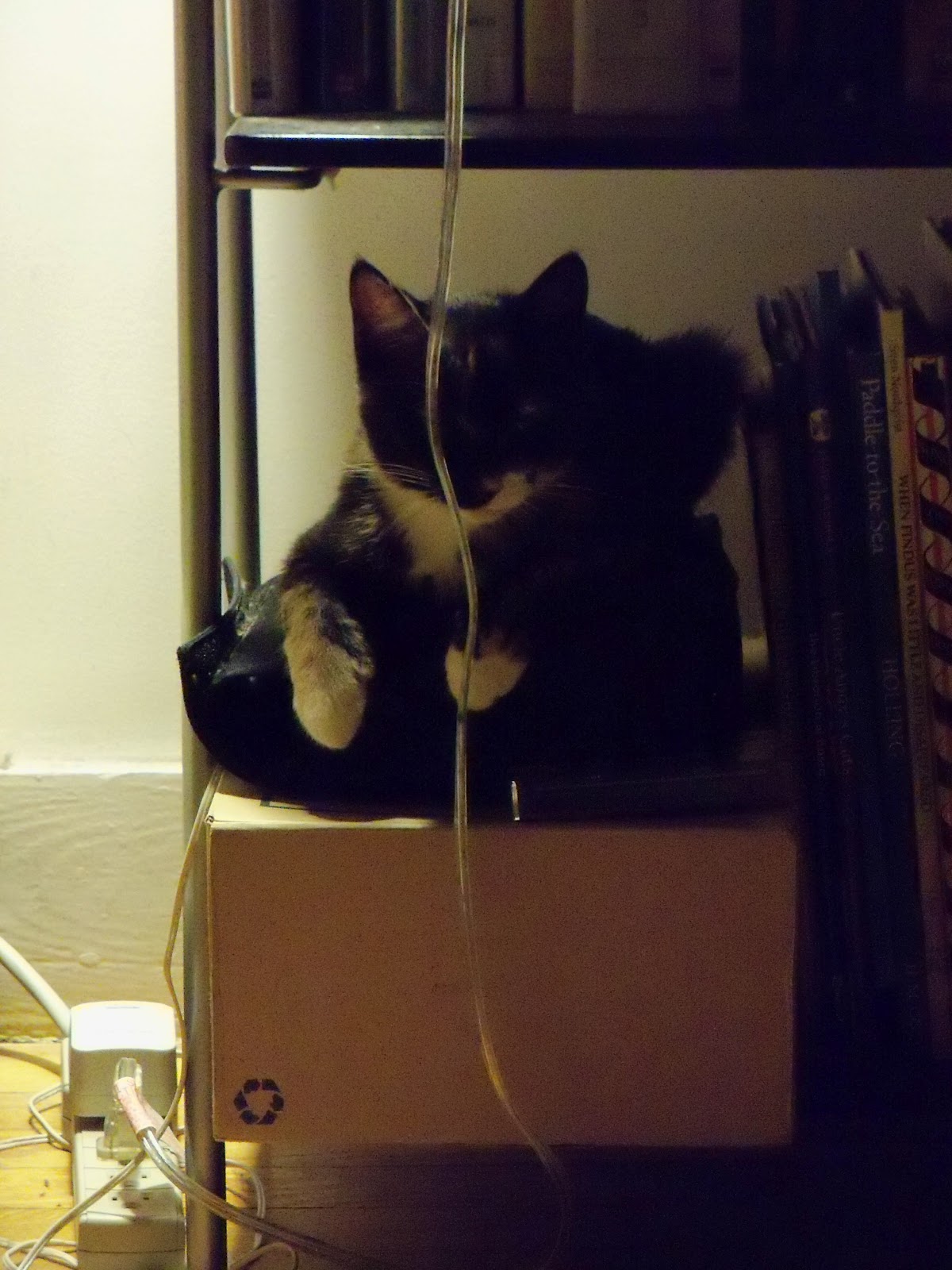
When we were moving everything around to deal with the bed bug scare, Teazle found an out-of-the-way spot on a bookcase in the bedroom to settle in for the evening.

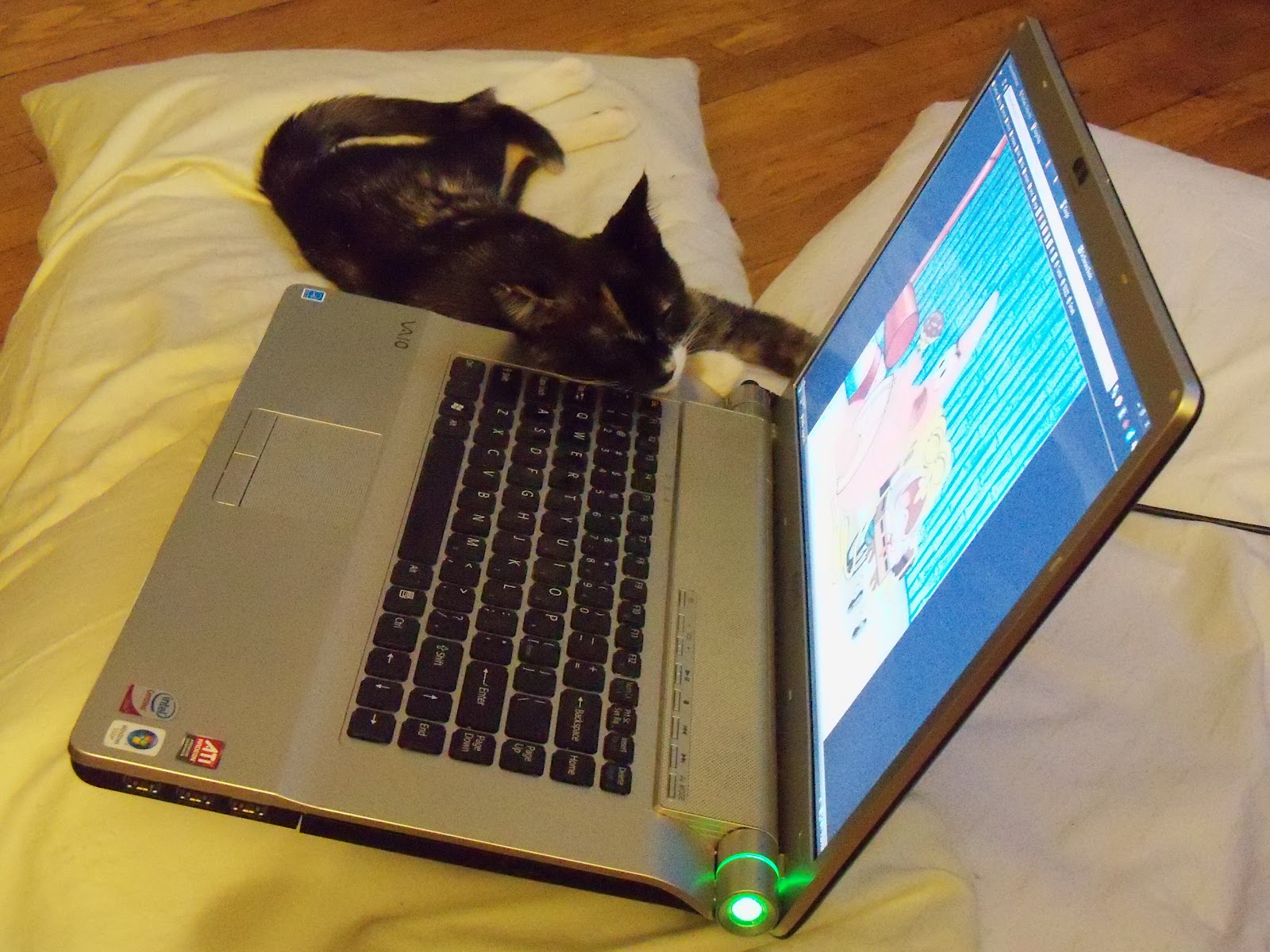
Following the visit to Auntie Shoshana’s (while the exterminator was spraying the apartment), Teazle crashed on Hanna’s laptop — falling asleep to an episode of Sponge Bob Square Pants (she’s a fan; I think she understands Sponge Bob’s manic energy).

We took the opportunity of apartment shuffling to take care of a few outstanding home improvement tasks this weekend, including re-potting some plants which badly needed it. Above is a spider plant Hanna rescued from a windowless office at Northeastern, where it was struggling to survive. It’s since grown to about ten times its previous size and we decided to try letting it live in water (here blue-tinted by nutrient powder).

Turns out that spider plant roots are creepy as hell. If this blog goes inexplicably dark, you’ll know the thing climbed out of its pot and devoured us in the night.

We recently had to mount a rescue mission to Maine to rescue about eight cardboard boxes of books Hanna had stored in an outbuilding on her parents’ land (an outbuilding which had started to leak). The boxes have been living under our kitchen table, but today we spent a few hours unpacking them. Above is the sort of ad hoc shelving you begin constructing when you live in a household with two bibliophiles who have access to all of the $1 used book carts of Boston.

(Last I checked, our LibraryThing account had clocked in around ~1500 books, and only about … half? … of those are the books I left back at my parents’ place in Michigan.)

not punching someone in the face

26 Thursday Jul 2012

Posted by Anna Clutterbuck-Cook in our family

≈ Leave a comment

Tags

domesticity, family, the personal is political

Hanna was telling me a story earlier today from a meditation talk she listens to, in which a small boy is asked — after a class workshop on mindfulness — what “mindfulness” means. “It means not punching someone in the face,” he replies.

The dharma teacher relating this story points out the kid is actually quite accurate. That practicing mindfulness in the world often translates into trying not to be that jerk that hauls off and hits the super-annoying bastard who’s standing beside you on the subway.

Why am I telling this story?

I’m telling it because on Tuesday night, right before I got home from work at 8:30pm, Hanna answered a knock on the apartment door and it was a notice that on Thursday morning (approximately thirty-six hours hence) they landlords were sending in a pest control team to treat the apartment for bedbugs.

what used to be my room (Aug 2008)

Which we don’t have.

But apparently someone in an adjacent unit does, so we’re getting the abbreviated preventative treatment.

Though the two-page preparation leaflet we got handed on Tuesday night didn’t mention anything about “abbreviated.” And it made it sound like we basically had to tear our entire apartment apart and re-arrange it in spatially impossible ways. For example: all furniture at least eighteen inches from the walls, but with things like our bed out in the open where it could be treated. And if we were supposed to empty our closets into plastic bags and set them “aside” while the treatment was going on, um, where exactly was “aside.”

This is a one-bedroom Boston apartment. There’s not a heck of a lot of space going spare.

Thankfully, after some rather strongly-worded emails to the landlord (“We are disappointed that …” and “While we appreciate the seriousness with which you are treating the situation, in future …”) we confirmed our apartment has no bedbugs (whew), and that the exterminators are only treating a few items of furniture. And we don’t have to dismantle and quarantine our entire (material) life.

I spent most of Tuesday night wondering what to do with stuff like this.

So basically, we’ve had a lot of opportunity in the last 24 hours (and will have more opportunity, no doubt, in the next 24 …) to practice not punching people in the face.

While, yes, bitching and angsting about the situation on Twitter — as well as strategizing about what to do about things like keeping the cats safe, I also tried to keep in mind the opportunities for gratitude:

  • WE DON’T HAVE BEDBUGS and don’t have to destroy our belongings, relocate temporarily or permanently, haven’t suffered through the discomfort of an infestation, etc.
  • We have friends who unhesitatingly responded to our rather frantic email asking if our two cats could spend the day with them on such short notice, since humans and pets must be out for at least four hours post-treatment.
  • We have understanding workplaces with generous benefits that mean we don’t lose pay or jeopardize our jobs by calling out at the last minute to prepare the apartment.
  • Did I mention we DON’T HAVE BEDBUGS?
  • The weather is lovely right now in Boston, so we didn’t have to put all our textiles in 30-gallon trash bags in 100-degree heat plus humidity.
  • We can afford to rent a car to transport the pets to/from our friends’ apartment, and
  • This was the kick in the pants we needed to purchase a second cat carrier that we needed anyway.
  • The woman at the management company’s office who went out of her way to answer my (strongly-worded) email requesting clarification and assured us she would keep us, specifically, better informed in the future. Sometimes, it’s worth being the squeaky wheel. Also, I truly appreciated her professionalism.
  • While it’s made for a stressful week, I am glad that our landlords are addressing this issue quickly and thoroughly; WAY better than to actually get bedbugs because they failed to clean up the infestation one flat over. And they’re footing the bill. So. There’s that.
  • NO BEDBUGS.

Of course, the flip-side to all of these slips and slivers of gratitude are the “I’m not going to punch them I’m not going to punch them I’m not going to punch them” moments. To expect your tenants to prepare for toxic chemicals to be applied to their furniture on thirty-six hours’ notice is impolite at best, abuse of authority at worst. Both Hanna and I realize it’s within the landlord’s right (and probably advisable) to do this thing, but we’re not happy about the chemical bit, about the potential short-and-long-term effects for us and the cats, and the fact we have absolutely no say in the matter of where, when, and how.

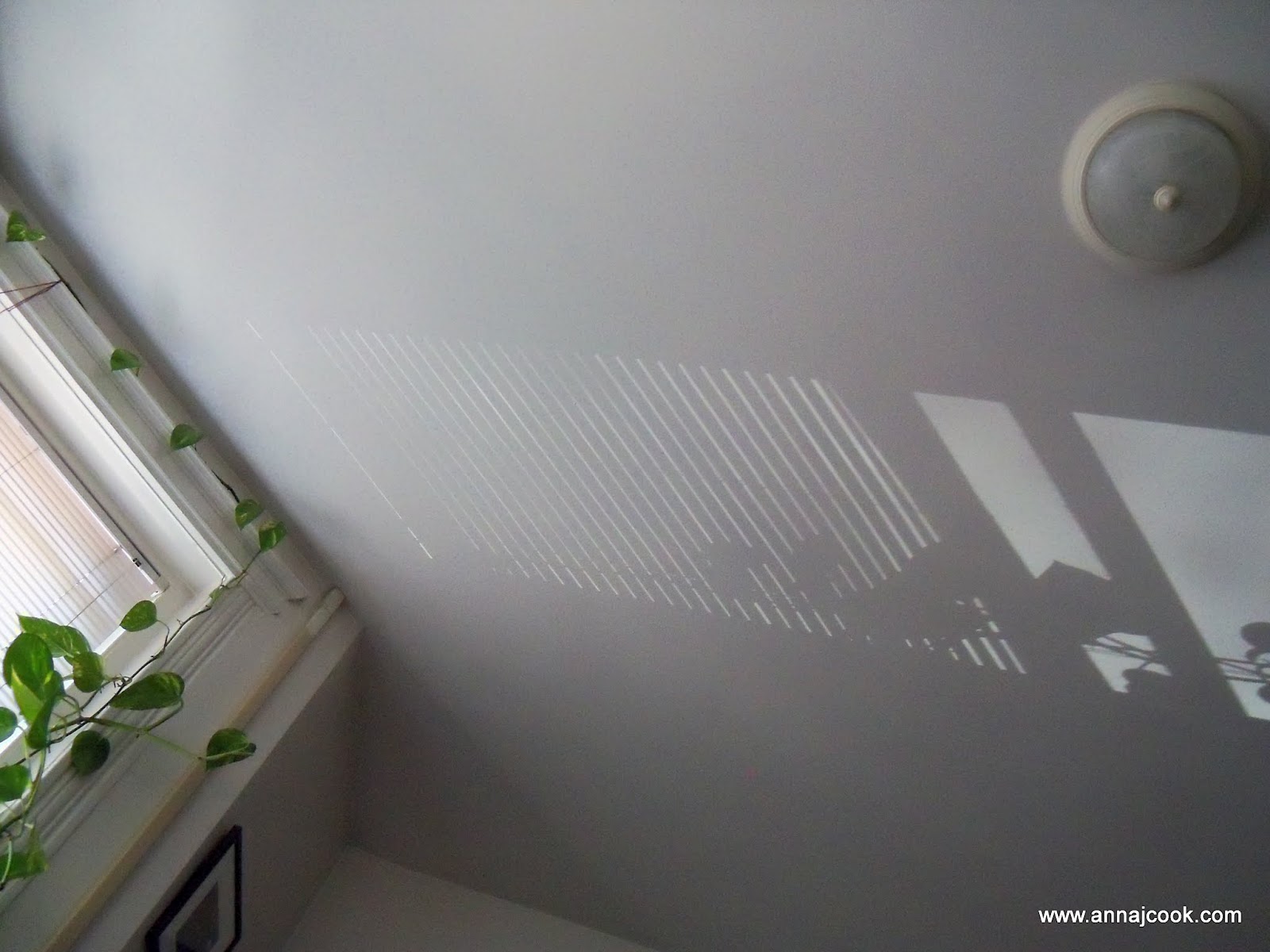
shadows on the living room ceiling,
and Ianto our that-plants-that’s-like-a -philodendron-but-not

Even though the landlord is paying for the treatment, we’re still going to be about $200.00 out of pocket to deal with the situation — it would have been more had we not had friends willing and able and instead had to fall back on a pet boarding service. Hanna and I have enough of a financial cushion that this is manageable. Not fun, but manageable.

For many people, including our colleagues and friends, this would have been a substantial hardship.

Not to mention if said people lost pay due to taking time off work to prep and deal with the aftermath.

Obviously: bedbugs. The landlords probably don’t have much choice, in the end, about how to approach dealing with it. And I’m super-glad they’re on top of the situation so that we don’t get any. Because: bad. But I resent that we were not kept more clearly informed of the developing situation (they inspected for bugs over two weeks ago; we heard nothing post-inspection until the instructions arrived Tuesday night). And I resent the poor and confusing content of (most of) the communication we did receive.

Le sigh. Urban living.

Off to try and practice my mindfulness!

booknotes: here come the brides!

24 Tuesday Jul 2012

Posted by Anna Clutterbuck-Cook in book reviews

≈ Leave a comment

Tags

gender and sexuality, human rights, wedding

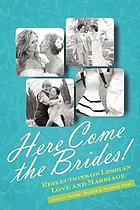
I recently finished reading the heartfelt collection Here Come the Brides: Reflections on Lesbian Love and Marriage, edited by Audrey Bilger and Michele Kort (Seal Press, 2012). After making my way through the super-angsty I Do, I Don’t (2004) earlier in the summer, I was a little burned out on the whole queers and marriage combination. I Do, I Don’t felt — and you know I don’t often say this — too political. Reading the earlier anthology I was left feeling weighed down with the social import of my marriage. Half the authors seemed to feel marrying will contribute to the revolution (I believe it will, but that wasn’t the deciding factor); the other half seemed to feel marrying was tantamount to betraying the revolution (if it is, answer me this: why does it terrify the conservatives so frickin’ much?). Throw in a salting of stories about heart-wrenching breakups and there was a serious deficit of personal joy. 

Here Come the Brides! is far from apolitical. From Heather Purser’s “Suquamish Family Values” (about the role she played encouraging her tribe to recognize same-sex marriage) to “Emily Douglas’ “We Have to Talk About It, Someday” (in which Douglas muses on how her job at GLAD as a recent college grad brought home how important marriage was — queer theories aside — to the actual queer community) Brides! interweaves the political and legal revolution taking place throughout North America as queer couples form legally- and religiously- recognized relationships with one another in the presence of family and friends. Yet overall, the energy of Brides! is much more effervescent and forward-looking than that of I Do — even when the topic was divorce or death. (Yes, I actually wept on the subway while reading Susan Goldberg’s “Four (Same-Sex) Weddings and a Funeral,” in which she describes how her wedding was a race against her mother’s cancer). Artist Patricia Cronin contributes an essay on the creation of her sculpture Memorial to a Marriage, which stands in Woodlawn Cemetery on the plot that will one day serve as Cronin’s grave — as it will the grave of her wife, Deborah Kass. Authors express their doubts and fears about marriage, describe the messiness of gay divorce (how do you get divorced as a lesbian in a state that refuses to recognize your marriage?). They tell hilarious stories of over-involved parents, wedding-cake sagas, and serial weddings — all to the same woman! — made logical or necessary by the patchwork of same-sex marriage laws in our Land of the Free and Home of the Brave.

I think, overall, I was struck by the normality of the essays in Brides! — the way the stories told are (mostly) human marriage-and-relationship stories, perhaps with a queer twist. In the years between 2004 and 2012 we — as a country, as a culture — have moved from a moment in which marriage equality was a dicey political proposition to a moment when it’s become (knock on wood) an historical inevitability. DOMA will eventually be ruled unconstitutional — perhaps as early as next year — and once the federal government is constitutionally required to recognize, once again, all state-sanctioned marriages then states will be able to move forward at their own two-steps-forward-one-step-back pace toward civil marriage for all consenting adult couples (and hopefully poly relationships as well, not long behind). And religious communities can continue their tedious-yet-necessary process of coming to terms with the full spectrum of love that is possible in this world. Brides! rides this wave and treats getting gay-married more or less the same as, well, getting married.

While a part of me enjoys the frisson of rebellion inherent in Hanna and I marrying today (yes, I get a kick out of the notion that by doing what I want in my own private life I’m freaking people out), I’m also grateful to all of the women (and men) who have done the emotional, political, and cultural work necessary to make it possible that our marriage is almost totally unremarkable.

the headlines through fan goggles

20 Friday Jul 2012

Posted by Anna Clutterbuck-Cook in fandom

≈ Leave a comment

Tags

fanfic, humor

Here’s a bit of absolute fluffy fluff for your Friday afternoon …

In my circle of fannish friends we’ve been struck lately by the humorous and occasionally horrifying effects of going through your media-consuming life with fan and/or slash goggles welded to your face.

For example:

text: Guardian headline reading, “Branson starts talks with Universal Music on Virgin Records deal”

This is, sadly, not a story about the Downton Abbey chauffeur switching to a career in music.

And this headline …

text: Guardian headline reading, “Hathaway deserves Catwoman spin-off, says Nolan

… disappointed me mightily last weekend because when I first glanced at it, I thought someone was suggesting there be some sort of Inspector Lewis/Avengers crossover. And then I was like OH ANNE HATHAWAY. RIGHT.

text: email from Fab.com with subject heading, “Vintage Eames Splint, Brownie Box Cameras …”

Hanna saw this one in her inbox last week and said for a second she was hoping for a bit of Arthur/Eames fanfiction involving Eames’ arm or leg in a splint.

Sometimes, the confusion is slightly more awkward and/or embarrassing, such as in these two stories:

text: NPR headline reading, “WHO Says Virus Caused Illnesses in Cambodia”

For a minute I was baffled as to why the latest season of Doctor Who involved Eleven saving the day in Cambodia … not that I would mind, but it would have been a significant shift from its Euro-centric plotlines!

text: Nerdy Feminist blog post titled “The ‘Tosh Sucks’ Roundup”

And because I had no idea who Daniel Tosh was before the recent dust-up, I was saddened by the thought that somewhere, a bunch of people cared enough about hating Toshiko Sato that they were writing multiple blog posts about it. Thankfully — wrong Tosh!

Sometimes, when the real news gets you down, you find yourself wishing the fan-goggle versions were for true! Because of reasons.

Thank goodness it’s Friday, everyone, and I hope you have some rest & relaxation time ahead of you.

placeholder post: hugh masekela’s "ooo, baby baby"

19 Thursday Jul 2012

Posted by Anna Clutterbuck-Cook in media

≈ Leave a comment

Tags

family, memories, michigan, outdoors, web audio, web video

This summer has brought back a lot of memories from the summer before my little sister was born (1987). The summer I learned to swim because we spent — at least in my child’s memory — virtually every day at the “big lake” (Lake Michigan) trying to stay cool by staying wet. The summer we had bonfires and roasted hot dogs and marshmallows on what seemed like a weekly basis, carrying coolers and beach towels up over the dunes in tatty tennis shoes to avoid burning the soles of our feet in the scorching hot sand.

My dad — who in another life must have been a DJ — was the one who provided the boom box and mix tapes (yes: tapes) for these long afternoons at the water’s edge, and this album is one that I will always associate with summertime, heat, sand, and the smell of food cooking on the grill.

Here’s one of my favorite songs from said album.

The latest heat wave broke last night and we’re supposed to have a more manageable weekend ahead of us — hopefully I’ll have enough brain cells left to complete all the half-finished book reviews I’ve got in my queue. Stay tuned!

What are your favorite songs of summer?

← Older posts
Newer posts →
"the past is a wild party; check your preconceptions at the door." ~ Emma Donoghue

Recent Posts

  • medical update 11.11.22
  • medical update 6.4.22
  • medical update 1.16.2022
  • medical update 10.13.2021
  • medical update 8.17.2021

Archives

Categories

Creative Commons License

This work by Anna J. Clutterbuck-Cook is licensed under a Creative Commons Attribution 3.0 Unported License

Meta

  • Register
  • Log in
  • Entries feed
  • Comments feed
  • WordPress.com

Blog at WordPress.com.

  • Follow Following
    • the feminist librarian
    • Join 36 other followers
    • Already have a WordPress.com account? Log in now.
    • the feminist librarian
    • Customize
    • Follow Following
    • Sign up
    • Log in
    • Report this content
    • View site in Reader
    • Manage subscriptions
    • Collapse this bar