• anna j. clutterbuck-cook
  • contact
  • curriculum vitae
  • find me elsewhere
  • marilyn ross memorial book prize

the feminist librarian

the feminist librarian

Author Archives: Anna Clutterbuck-Cook

movienotes: brave

17 Tuesday Jul 2012

Posted by Anna Clutterbuck-Cook in media

≈ 1 Comment

Tags

children, family, feminism, movies

Teenage Merida and her mother Elinor (via)

To escape the heat on Saturday, Hanna and I went to the movies and saw Brave (Disney and Pixar, 2012) which most of you have probably heard much of a muchness about since it was released back in June. There’s been tons of insightful, critical analysis of Brave and what it does and doesn’t do to advance our cultural narratives about girls and women. I’m not going to try and reproduce or summarize the conversation here — but a few of my favorite reviews/reflections come from Amanda Marcotte, Jaclyn Friedman, Heida, and Lili Loofbourow.

What follows are some heat-and-humidity-infused reflections on what moved me about Brave and thoughts about some of the non-Disney cultural narratives the movie may be drawing its inspiration from.

Spoilers below. Also massive rambling.

First and foremost, the most striking thing about Brave — and I’m far from the first person to point this out — is that the story centers on a mother-daughter relationship. Let me say this again: The story centers on a mother-daughter relationship. Just last week, my friend Molly tweeted about how her six-year-old son Noah has just started noticing all of the dead and absent mothers (thanks Freud and Jung!) in children’s literature. When parents aren’t dead, they’re most often either out-of-touch with their children’s lives or actively malicious. Often, for women, there’s a twofer with the dead-mother-evil-stepmother theme.

The lesson in these stories is, so often, that parents and children (and the generations they represent) are inherently in conflict, and that women are naturally rivals with one another — usually for power as represented by male attention/alliances).

In Brave, Merida and her mother are in conflict to begin with: Merida is a rebellious teenager (very much a modern American construct) and Elinor is a mother trying to do what she thinks is best for her daughter and letting her fear muddle her ability to see clearly what is best for her daughter. The narrative tension of Brave revolves around mother and daughter finding their way back to the quality of relationship they have lost, while incorporating into that relationship a greater — more adult — knowledge about themselves and one another.

I think the radical audacity of this storyline finally hit home to me in last act when Merida defends her mother (temporarily turned into a bear) against the clan leaders who believe they’re avenging Elinor’s death. And then when Elinor-as-bear comes to the defense of her daughter who is nearly killed by the real beast, Mordu. It’s a powerful thing to see, on screen, a princess defend her living mother from death rather than speaking in her absent/dead mother’s name. And an equally powerful thing to see a living mother, a fierce mother bear, coming to the defense of her girlchild — not only rescuing her from Mordu, but ultimately listening to Merida’s wish to delay any marriage plot until some nebulous future.

Let’s just say that when Merida says to her father and his soldiers, “I will not let you kill my mother!” I could feel the tears spring into my eyes. How often does a girlchild get a chance to say this in our Western fairy tale canon?

This reworking of the mother-daughter relationship speaks not only to our own interpersonal relationships, but also to the broader social narratives of generational tensions. I’m thinking especially here about feminist “waves” and the way we’re so often encouraged to think of feminist activism in generational terms, with overbearing, bitter, jealous mothers pitted against bratty, sexually-potent, ungrateful daughters. Brave points out that division between mothers and daughters — the failure to listen on both sides — obscures the true villain of the piece: adherence to (patriarchal) tradition borne of fear.* I’d argue that such a message is one we truly can’t get enough of in this world obsessed with generational rebellion and rupture. By seeing each generation as a threat to the one that preceded it, we’re hobbling our chances for deep, progressive change.

A few more (briefer) observations.

Merida owes much of her adolescent truth-telling, I suspect, to fictional fore-sisters such as Jane Eyre and Psyche. As Carol Gilligan argues in The Birth of Pleasure and more recently in Joining the Resistance, children — she would argue particularly girl children on the cusp of adolescence — are bellweathers and truth-tellers, pointing out the deceptions we practice on ourselves and one another, and demanding honesty from themselves and those around them. I’d also suggest that Brave‘s narrative lineage owes debts to Stephen Sondheim’s Into the Woods, and to virtually every film produced by Miyazaki. Particularly Princess Mononoke, Howl’s Moving Castle, and (Hanna tells me, since I haven’t yet seen it) Nausicaa.

As with Into the Woods, we have themes of parents having to let their children grow up and forge their own path (see: Bernadette Peters’ brilliant witch) while not abandoning them wholesale (see: “You Are Not Alone”). The message in Brave as in Into the Woods is that heroes — regardless of gender — are strongest when working in cooperation with others, and that this message of community isn’t incompatible with forging a new path.

As in Miyazaki’s films, the protagonist(s) Merida and Elinor must learn values such as respect for others, harmony with the community, and a balance between the qualities identified as “masculine” and “feminine” in our culture. Merida is fierce and physically fearless, yet needs to learn the art of political persuasion and empathy for others. There is a subtler morality at play in Brave that shares closer kinship with Eastern folk traditions (in my admittedly limited experience) than it does with the fairy tales Disney usually draws on for inspiration.

And, of course, there’s the brilliant freedom of watching a film about a teenage girl that is decidedly not a marriage plot. Merida’s age is indeterminate, though her body is that of a young woman gone through puberty. She isn’t anti-sex, or anti-marriage even — she’s simply not ready to make the choice. As others before me have pointed out, to have a teenage girl in a mainstream film whose sexuality is indeterminate — meaning she could swing straight, gay, bi, fluid, or something else entirely: We don’t know. And, for once, it’s immaterial to the plot! — is a breath of fresh air.

This is the exact opposite of pretty much every princess movie — and even most YA novels! — out there on the market, because romance is a driving force in stories about adolescents. I’m not saying that’s necessarily a bad thing, but when coupled with heteronormative plots it means that girls look at the narratives about young adulthood and they see that they’re expected to be boy-crazy, or at least boy-interested. They could be boy-interested in the most kick-ass, gender-bending guy on the planet — but boys it almost always is expected to be. And if not boys, then girls (or girls and boys), and it’s always, always, always meant to be an all-consuming preoccupation.

Teenagers are expected, in our culture, to be preoccupied — for better or worse — with sex and relationships. And as a teenager who wasn’t personally driven to explore these things (except in a fictional, future-looking sort of way), I often felt really out of step with stories that depicted my concerns in that way. Merida’s maybe someday but certainly not now attitude toward romantic relationships, coupled with her deep, passionate involvement in her familial relationships, show how teenage girls (and, I’d argue, teenagers more generally) are more complex persons than our media so often portrays them to be.

My one frustration with Brave (and then I promise to stop rambling!) was the one-dimensional portrayal of the male characters, particularly Fergus (Elinor’s husband, Merida’s father). It’s understandable in a 90-minute film that some characters get short-shrift, but the buffoonish character of Fergus, coupled with Elinor’s  level-headed political thinking and parental role can all too easily be read according to the “smart woman married to a boorish man” trope of situation comedy fame (Simpsons and Family Guy anyone?). While the teenage boys put forward to compete for Merida’s hand eventually speak up for their own independent choice of spouse** they are also caricatures clearly meant to communicate “brawn but no brains,” “brash, vain hottie,” and “sensitive weakling.” Since Merida’s protests regarding marriage are valid regardless of the merit of her suitors, it seems like a poor choice to recapitulate harmful stereotypes about men in a film that is otherwise quite smart about women and gender.

I suspect that this shortcoming has less to do with Brave in particular than it has to do with the fact that our culture has still not answered the questions of masculinity posed by feminist thinkers and activists. We haven’t figured out how to tell a story about fully-dimensional, human women, that also includes fully-dimensional human men. In order to tell a story in which a mother and daughter are the central relationship, Elinor’s husband, her (much younger) sons, and Merida’s would-be suitors, cannot be taken seriously — must provide, in fact, the comic relief to an otherwise revolutionary plot. Which leaves open the question, of course, what place fathers, sons, and male lovers might have in this brave new world which Merida and her mother are building for the clans?

Some anti-feminists would argue there isn’t a place for men in the world Elinor and Merida seek to build. I’d argue it will be up to the men — and women alongside them — to discover and create that place for themselves.


*As an aside, the historian and feminist in me would really love to know the details of Elinor’s back-story. She and her husband seem to have a loving relationship, yet she clearly sees marriage to some extent as a political alliance. I yearned for a glimpse inside her head, so that we could understand some of the reasons for her fear, and the reasons for the decisions she made — both in pushing Merida toward a betrothal of political expedience, and then later in choosing to support her daughter’s desire to forge her own path.

**And seen through slash goggles, Hanna and I agree that in the final scene it’s clear at least two of them have found each other as potential mates!

trailer for "these are the days we live now" [femslash cont’d]

15 Sunday Jul 2012

Posted by Anna Clutterbuck-Cook in fandom

≈ Leave a comment

Tags

doctor who, fanfic, smut, web video

crumpledquill has posted her beautiful trailer for my Donna/Idris fic at her YouTube channel, so as promised here it is!

My fic has been up at AO3 less than twenty-four hours and already I’ve gotten some lovely positive feedback — fanfic folks are by and large such a generous, passionate, enthusiastic people! I love it.

international day of femslash!

14 Saturday Jul 2012

Posted by Anna Clutterbuck-Cook in fandom

≈ 5 Comments

Tags

fanfic, fun, gender and sexuality, smut, writing

Idris (the TARDIS) in “The Doctor’s Wife”

A few months ago, I discovered there is such a thing in the world as an International Day of Femslash.

o_O

So naturally I had to participate, and my piece went live today over at Archive of Our Own:

Title: These Are The Days We Live Now
Author: ElizaJane
Fandom: Doctor Who
Pairing: Donna Noble/Idris (the TARDIS)
Rating: R / Explicit (AO3)
Length: 5,487 words
Summary: Idris stretches herself thin, across time, across space, threads of consciousness. Searching. A Donna Noble fix-it fic inspired by “The Doctor’s Wife.”
Tags: Loss, Memory Loss, Human/Non-Human Relationship, Pining, Dreams, Hurt/Comfort, Fix-It Fic, Homecoming

You can find it on AO3 (linked above) and eventually it will also be posted at Passion & Perfection and Shatterstorm Productions along with all the other entrants.

As part of the IDF challenge, I was paired with crumpledquill who created a fantastic video trailer for my story (squee!) which you will be able to view on her YouTube channel and as part of the IDF collections at Passion and Shatterstorm. I’ll embed it here when I can!

from the neighborhood: are you tired of teazle yet? (thought not)

12 Thursday Jul 2012

Posted by Anna Clutterbuck-Cook in our family

≈ Leave a comment

Tags

cat blogging, domesticity, from the neighborhood, photos, web video

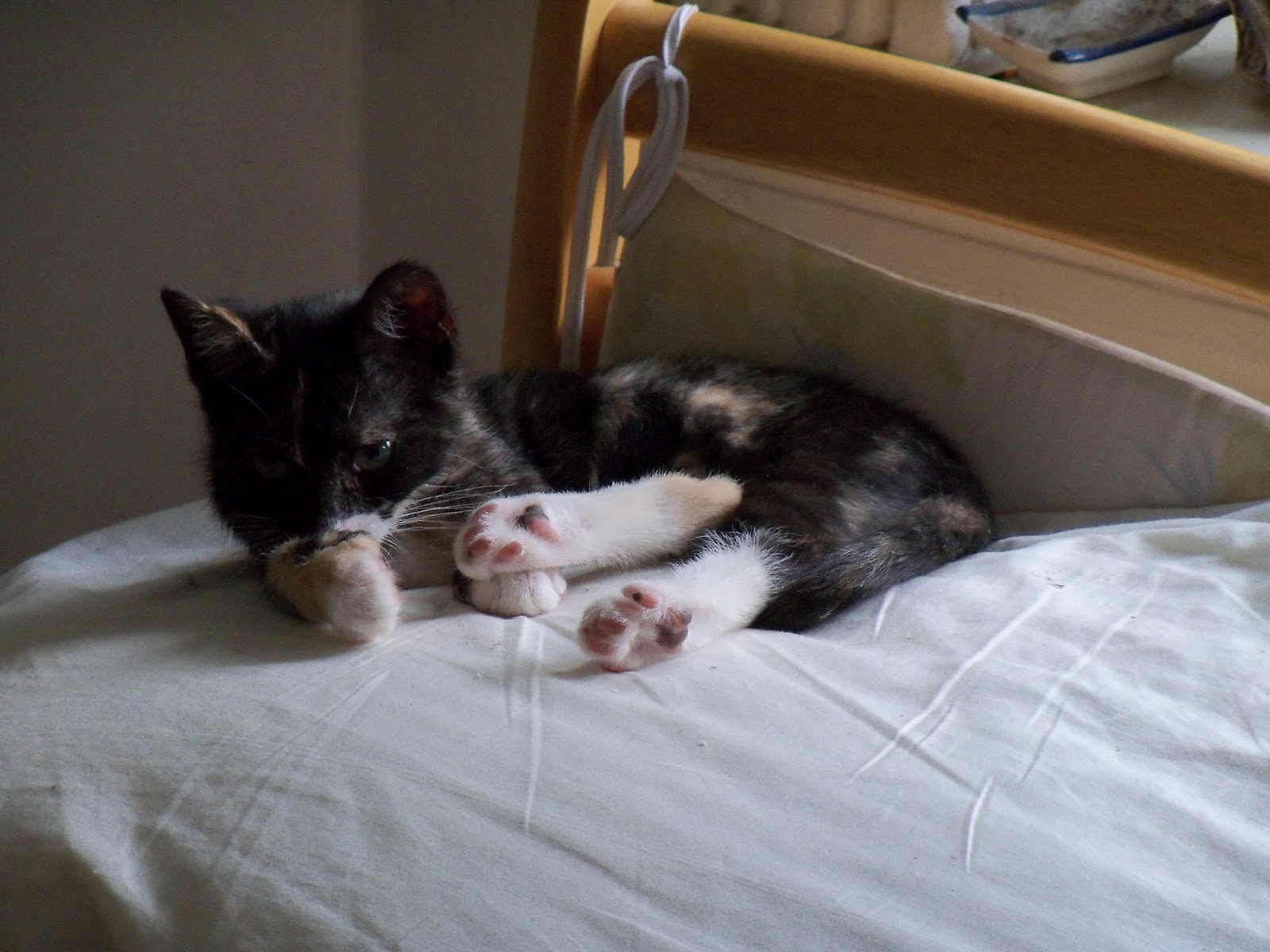
I thought I was going to get a review of Confronting Postmaternal Thinking: Feminism, Memory, and Care out to y’all today, but that clearly didn’t happen. So instead, here are some kitten and cat pictures and videos.

Teazle likes to play under hanging cloth (sheets, couch cover, curtains, our skirts … ) and occasionally gets confuzzled as happened in this video when she tried to leap up onto the couch and found herself under the couch cover instead of on top of it.

plus, she sometimes loses track of her limbs
we’ve discovered birds in the trees outside … 
… and Geraldine has simply given up trying to manage the wee one!

And finally, the video was too large to upload in Blogger, but you can check out the epic struggle of a kitten who sought to reclaim a catnip ball from the bottom of a glass bowl by following the link. I promise it’s worth it (if watching kittens be silly is your sort of thing on a Thursday afternoon!)

Stay tuned for more fun this weekend and (hopefully!) a book review or two next week. Until then, you can check out my thoughts on Transitions of the Heart: Stories of Love, Struggle, and Acceptance by Mothers of Transgender and Gender Variant Children (Cleis Press, 2012) over at the corner of your eye.

blogging at In Our Words: to be and to have (a wife)

10 Tuesday Jul 2012

Posted by Anna Clutterbuck-Cook in think pieces

≈ Leave a comment

Tags

blogging, gender and sexuality, guest post, professional gigs, wedding

lesbianweddings.tumblr.com

This week I have a guest post up at In Our Words on why I wanted to get gay-married:

I’ve learned that being public about our relationship matters to me. That naming has power. I relish naming her my girlfriend my partner my future wife in conversation with others. I want (need?) everyone to know we are a social unit, and exactly what kind of unit we are.

It matters to me that bystanders be in no doubt that we are in each other’s pants on a regular basis, thank you very much, and they will just have to deal. Because the public sphere is mine as much as theirs, and I’m not backing down from making promises to be and to have before witnesses. By just being who we are, building a life together, we change the meaning of marriage – I believe for the better. And that’s an act to be proud of.

So as a queer feminist and historian, I see marrying my fianceé as both an intensely personal act of commitment and also a deeply political act: inventing the future we’re hoping for. Becoming Future Wife’s Wife is a material statement that we have the right to act on our desires, to form families that work for us, and to name our relationships with the rich weight of history behind us, if that language feels right to us.

You can read the whole thing over at IOW. It was a surprisingly difficult piece to keep on focus with, and I’m still not entirely satisfied with the end result — but I learned some stuff about how I think and feel writing it, which is always the ultimate goal! That, and encouraging others to reflect as well. So I hope folks find it a thought-provoking read.

many happy returns of the day

09 Monday Jul 2012

Posted by Anna Clutterbuck-Cook in our family

≈ 1 Comment

Tags

hanna, holidays

It’s Hanna’s birthday today, the fifth I’ve been honored to share with her. She doesn’t like the attention, and there are reasons this time of year is difficult for her, so I will just say I’m grateful every day to be a part of her life’s unfolding.

photo by laura wulf

a few thoughts on my historically-specific perspective on getting married

08 Sunday Jul 2012

Posted by Anna Clutterbuck-Cook in life writing

≈ Leave a comment

Tags

boston, family, history, hope college, michigan, sexuality, wedding

Yesterday, I finished reading an advance review copy of Michael J. Klarman’s From the Closet to the Altar: Courts, Backlash, and the Struggle for Same-Sex Marriage (forthcoming from Oxford University Press, Oct. 2012; review to come). A legal historian, Klarman explores the history of litigation and legislation around gay and lesbian marriage from the 1970s to the present. Reading his historical account prompted me to think about the historical context in which I came of age and into my sexuality and sexual relationship, and how this colors how I think about same-sex marriage particularly, and even more specifically how my historical context shape the decisions Hanna and I have made. Here are my thoughts, in roughly reverse chronological order.

1) I’ll start with the fact that we can get legally married in the specific time (2012) and place (the Commonwealth of Massachusetts) in which we have come together. Massachusetts recognized in same-sex marriage as legal under the state constitution in 2004 (Goodridge v. Dept. of Public Health) and our ability to become, legally, wife and wife, on the state level is normal here. While DOMA still prevents us from being recognized as married nationwide, we will be treated as spouses at the state level. If I hadn’t moved to Massachusetts from Michigan, I would be unable to legally wed without traveling. And given that neither of us are involved in a religious community, we likely would not be planning a private (non-legally-binding) commitment ceremony.

2) I’ve experienced nothing but welcoming acceptance of my relationship with Hanna since we got together in the summer of 2009. The only direct bigotry I’ve encountered has been online; I’ve been comfortable being open about my relationship at work, in public, on both sides of the family, in my home town, blogging, etc. I actually dealt with more directly-homophobic statements and actions before I was visibly queer (see below) than I have in the past three years. This is in part a matter of geography, in part a matter of the circles in which I’ve been moving, and in part a macro-level cultural sea-change in which anti-gay animus is becoming less acceptable by leaps and bounds, at least in the public square.

3) Marriage equality was part of what brought me to Massachusetts. One of my first memories of driving into Boston in the summer of 2006 — when I interviewed at Simmons — was getting turned around and ending up in Harvard Square across from Zero Church Street, where they had a huge banner across the front of the First Parish Church proclaiming support for marriage equality. Even though I understood my sexuality to be primarily hetero at the time, I immediately felt a sense of expansiveness — the ability to be more at ease in the political climate here than I had felt back in Western Michigan where I was reminded daily that my views about human sexuality were at odds with the dominant culture.

lesbian recruitment party, summer 2005

4) I had long-term, same-sex relationships modeled for me. I had friends whose relatives were in same-sex relationships (some of whom had had commitment ceremonies, some who hadn’t). Through my undergrad women’s studies program (oh the irony) I was introduced to lesbians in committed partnerships and had a chance to think about what it would be like to build a life for myself with another woman. I am a person who experiences my sexuality in very contextual ways, and while I don’t discount the notion that having been born in a different time or place I might have fallen in love with a woman without such models, the fact that I knew that lasting, committed same-sex relationships were a possibility by example helped open me to an awareness, a receptivity, that it could be possible for me as well.

5) In my early twenties, I wrote letters to the local newspaper speaking out on topics like abortion and gay rights. I always got incredibly bigoted responses in print (though my friends and relations were supportive). I remember particularly writing in as “a young straight woman” in defense of the summer gathering for gay and lesbian families that happens annually in the little town of Saugatuck twelve miles south of where I grew up (in the “reddest” county in the state of Michigan). In my letter I thanked the newspaper for doing a favorable piece on the camp and preemptively addressed the haters by pointing out that same-sex parents gave me hope for the future. Again, I think it’s note-worthy that even in an incredibly conservative corner of the Midwest, I was participating as a presumptively straight person in normalizing queer families.

That is, I didn’t think “gay” and imagine that being a lesbian would mean custody battles and depression and suicidal impulses. I thought it meant family camp and lesbian communes and sprawling poly households, not unlike the life I was already starting to envision wanting for myself, even if I thought my primary partner would likely be a man.

5) My best friend came out in 2001. I’d say this moment was the start of my serious self-education on issues of human sexuality and the history of homosexuality and the modern gay rights movement. I was twenty and while he wasn’t the first queer person I knew personally, he was the first person I knew intimately and felt more for than a general political commitment in favor of equality. My sense of radical acceptance (borne out of innate stubbornness and feminist theology) and my life-long commitment to fairness had always drawn me toward LGBT rights — but suddenly it was personal. And I discovered my ability to be fiercely political.

7) Because of the college where I went to undergrad, issues of sexuality and gender were deeply intertwined, and both were morally-fraught religious concerns. This deserves its own post (or several), but suffice to say that my introduction to feminist politics as a college student came in the form of a raging controversy my first year at Hope over what and how the chapel program was teaching students about human sexuality generally and homosexuality specifically. My women’s studies faculty were committed Christians and vocal queer allies, and so my trial-by-fire education in organized protest was around these issues. I was able to think deeply about sexual morality, gender and sexual identity and expression, sexism, and homophobia in the midst of a group of LGBT-friendly Christian folk who helped me articulate passionate responses to the homophobia and hate we were experiencing in daily ways on campus.

In effect, I had a queer community around me long before I understood myself to be queer.

8) In the mid-90s, the AIDS quilt came to town. Its stop on national tour was organized, in part, by the gay deacon at my church. In appointing him to an ordained office, the church had broken with the denominational position (which remains in place today) that homosexuality is sinful. Twice during my adolescence, the church went through a contentious period of “dialogue” on the issue and members left the church in protest over the deacon’s ordination. While I don’t remember much about the AIDS epidemic, I do remember the viewing the quilt with my family and others from the church and city when the sections were on display at one of the area high schools. Rather than AIDS being interpreted to me as “the gay disease,” it was simply a deadly illness, like cancer, that killed people and left behind grieving partners, parents, siblings, children.

9) Our Bodies, Ourselves (and feminism!) contextualized being in lesbian relationships as one life path for women to pursue, both sexually and in relationship with one another. In my adolescent reading about the 70s feminist movement, I encountered primary source documents about lesbian activism, lesbianism as a political decision, and same-sex relationships. While I wasn’t politically active on these issues until college, these texts prepared the ground-work for understanding human sexuality more expansively, and lesbian relationships as a viable option, long before I was aware of resistance to homosexual identity and relationships in my community.

10) The earliest memory of I have concerning same-sex sexuality is at age eleven when two friends of mine, over for a sleepover, were giggling together over the word “gay” and I asked my mother what it meant when they refused to tell me. It was obvious from their behavior they thought the word was a naughty one (one girl was from a conservative Wesleyan household, the other a Mennonite). My mother’s factual explanation (along the lines of “someone who falls in love with a person of the same sex”) put gayness on the radar but confirmed that I need not be alarmed about it. Since there were lots of ways in which my family’s values differed from those of our friends and neighbors, I assumed this was just one more thing to add to the list!

I’m sure there are other ways in which my life has shaped how I think about lesbian relationships, lesbian identity, and the viability of marriage as an option for Hanna and I. For starters, the fact that we’ve both remained unmarried until we were over thirty, and don’t plan on having children are also deeply historically-contextual options/decisions. In the 1910s we might both have been college-educated library professionals in a “Boston marriage,” but it would not have been legible to the world at large as a marriage.

We often think of ourselves as historical actors, with the ability to defy social norms and break new ground. And we are. But they manner in which we defy society, and the norms which we are countering, are historically dependent. And self-aware historians, such as myself and my beloved, are no more exempt than anyone else.

(As usual this “few thoughts” post became much longer than I envisioned it!)

booknotes: love the sin

05 Thursday Jul 2012

Posted by Anna Clutterbuck-Cook in book reviews

≈ 6 Comments

Tags

books, gender and sexuality, human rights, politics

It’s frankly been awhile since I read a book on ethics or theory that expanded my brain so that it felt like it was slightly too big for my skull (aka getting intellectually hot ‘n bothered), but in the past ten days I’ve actually read two of them! The first was Janet R. Jacobsen and Ann Pellegrini’s Love the Sin: Sexual Regulation and the Limits of Religious Tolerance (New York University Press, 2003). The second was Julie Stephens’ recently-released Confronting Postmaternal Thinking: Feminism, Memory, and Care (Columbia University Press, 2012), which I’m going to review next week. Both are slim volumes that tackle complex issues of embodiment, identity, the relationship between public and private, between citizens and the state, and ultimately the way in which we understand individual persons in relation to collective cultural and political spaces.

Reading Love the Sin and Confronting Postmaternal Thinking back-to-back brought out a lot of resonances. Both books are critical of the way in which individuals have been constructed in the modern liberal democracy. They ask hard questions about who counts as a full and worthy citizen under the laws and policies of such democracies (particularly in the United States). They point to ways in which the mid-twentieth-century rights movements — especially the gay and lesbian liberation movement and mainstream feminist movement — have been undercut and co-opted by a majority hostile to their more radical re-visioning goals. This is due, both works contend, at least in part because of the narrow “rights” rhetoric these movements have depended upon. In Stephens’ work, we see how the language of feminism has been deployed in order to shore up a neoliberal notion of citizen-as-worker, while political ethics grounded in care and connectedness (“mothering”) are erased from the collective memory and public discourse. In Love the Sin, Pellegrini and Jacobsen argue that notions of liberal “tolerance” and a reliance on innate/natural (“born this way”) justifications for non-normative sexual orientation have unnecessarily compromised our ability to advocate for a robust freedom-of-practice in the public realm.

While I have persistent reservations about Stephens’ framing of the maternal (which I’ll get to in next week’s review), I was thoroughly seduced by Jacobsen and Pellegrini’s passionate and articulate advocacy of “freedom” as a more expansive, humane, way of framing the question of sexual citizenship — and other types of citizenship — than the notion of tolerance. “In a situation framed by the rhetoric of tolerance,” they write,

It becomes impossible to distinguish between the perpetrators of racism or homophobia or misogyny (this list is hardly exhaustive) and the objects of various forms of discrimination. Rather, when the situation is characterized by tolerance, the public is not expected to take a stand against injustice, but merely tolerate both sides of the “conflict,” which is supposedly between opposing groups of people who are circumscribed outside of those who constitute “the public” or “the American people” writ large (59).

Drawing on media coverage of gay and lesbian activism and of violence motivated by anti-homosexual bigotry, Jacobsen and Pellegrini persuasively show how tolerance encourages the same us/them thinking that can lead to violence, despite liberal claims that tolerance is the way out of the hate that leads to violence. For to “tolerate” those who are different from you implicitly assumes alienation, “the other,” a distance between queer folks, for example, and “the public.” The public “tolerates” the homosexual, which means the homosexual is outside of the group. Therefore, as much as we’d like to believe tolerance is our answer to violence, it offers no escape:

Tolerance disavows violence and those who commit heinous crimes, but along the way it offers no exit from the us-them logic that structures hate and tolerance in our society. It also gives us no logical exit from the mandate to tolerate those who hate. (p. 65)

Jacobsen and Pellegrini go one step further and argue that we are further hobbled by the notion that our claims to toleration of homosexuality are grounded in the fact that one’s sexual orientation is supposedly hard-wired and therefore immutable:

Characteristics that are taken to be immutable, such as skin color or sex, will be tolerated. But when traits or behaviors are taken to be discretionary and volitional, people can be asked, indeed compelled, to change their behavior and assimilate to the dominant norm … Gay identity may be protected by the courts … but ‘homosexual conduct’ certainly is not (94).

As they point out, this is hardly simply a problem for left-progressive causes, such as gender or sexuality. The notion that only immutable characteristics are protected, not behavior, means that an Orthodox Jew can be asked to cut his hair, or a Muslim woman asked to remove her headscarf, in order to keep their job. It means that Christians are not protected from being fired for refusing to work on Sunday.

How, then to get ourselves out of the (violence-enabling) cul-de-sac of identity-based tolerance? This is where Jacobsen and Pellegrini’s theorizing takes what I think is a paradigm-expanding turn. They argue that rather than a framework of “human rights,” social justice movements around sexual expression (and potentially other things) would do better to argue on the ground of religious freedom. Essentially, they argue that sexual freedom is analogous to the freedom of religion in that both are practices that express core values, and that not just beliefs but also individual expression of belief deserve protection, in public as well as private.

This shift frees us from the interminable question of what “causes” sexual variation, which — while theoretically interesting —  is actually ultimately unhelpful when it comes to determining what is lawful. Grounding rights claims on the basis of one’s inclinations being “natural” will do little to answer critics who (quite rightly) point out that human beings are not compelled to follow every inclination without thought, and that our ability to regulate impulsive behavior is, in fact, part of what makes us human. Just because something is “natural” doesn’t make it “right” in the moral sense — since morality is a human creation, and deeply embedded in time and place. As Jacobsen and Pellegrini write:

An important virtue of the paradigm shift we are advocating [from identity-based “rights” to freedom to live out ones values] is that it does not force us to finally settle the question of what ’causes’ homoesexuality. In the end it just does not — or should not — matter how an individual came to be homosexual, any more than it matters how heterosexuals became heterosexual. Rather, homosexual life and experience are to be valued, are in fact sources of value. (98).

This shift also helps us to combat arguments to the effect of, “It’s okay for homosexuals to practice their lifestyle as long as they don’t flaunt it in front of me”:

Free exercise does not depend on the boundary between public and private that protects liberal freedom. In a liberal democracy, some people are allowed to live lives freely in both public and private; others are allowed freedom only if they keep significant aspects of their lives private and privatized; and still others … are not allowed even the protections of a ‘private life.’ But if ‘free exercise’ and ‘democracy’ are to mean anything at all, everyone must have access to life both in public and in private (106).

I see productive parallels here with discussions of ability and access, about what it means to work “toward restructuring our public life so that everyone is included in categories like ‘the general public,’ ‘the public at large,’ or ‘all Americans’ ” (72). The majority culture has a strong normative power — sanctioned by the language of “tolerance” — to enforce their own notions of civility, rather than practice radical acceptance and lovingkindness toward those whose behavior as well as identity challenge their notions of propriety. The perennial (and perennially heated) “debate” about children’s behavior in public spaces comes immediately to mind for me: because children are constituted as “other” in our society (as non-workers they are understood as future/potential citizens, but not full participants in their own right), we feel entitled to ask that their behavior meet our own criteria of acceptability, rather than ask how we might re-formulate our public spaces to better serve them. The same could be said for the elderly, the non-English-speaking, the mentally- or physically struggling.

Angus Johnston has a powerful post on this subject, in which he writes:

Here’s my secret: my kid doesn’t actually behave as well as I do. Sometimes she whines. Sometimes she has to be reminded to to keep her voice down, or not to run. So yeah, when I take her to the Museum of Modern Art, we do impose on other patrons, at least a little.

And you know what? A little imposition on other patrons is okay. I’ll apologize sincerely to anyone she disturbs, but I’m not going to apologize for her presence. Because MoMA is her space as much as it is mine.

My [cognitively disabled] sister whines in public sometimes, too. Sometimes she gets overwhelmed and cries. Sometimes she raises her voice. (Running in museums is not an issue with her, I’m happy to say.) If we say that my daughter shouldn’t go to museums because she might whine or cry or raise her voice, then we have to say that my sister can’t go either — and one of the best days I ever spent with my sister was the day that we visited a MoMA exhibit of design for people with disabilities. MoMA is my sister’s space as much as it is mine.

You can (and should) read the whole piece over at Student Activism.

The basic point both Jacobsen and Pellegrini are making here is that in the framework of “tolerance,” in which we tolerate non-Christians, non-straight folks, children, the disabled, in “our” public square is that through the mechanism of toleration we are perpetuating the hierarchy in which some people are more entitled to freedom of expression than others.

“The public” — understood to be the white, male, economically self-sufficient, heterosexual Christian (I’m sure that’s not exhaustive, but you get the idea) — “tolerates” those of us who diverge from that which feels comfortable to. But that toleration is conditional on our normative behavior. Jacobsen and Pellegrini remind us that such conditional acceptance is, well, otherwise known as being an entitled asshole.

I encourage anyone who cares about effective social change toward a more egalitarian, inclusive world to read Love the Sin. Even if sexual freedom isn’t your issue, per se, the framework Jacobsen and Pellegrini lay out is an effective one for any area where the personal and political intertwine.

Related Read: If you’re psyched by the ideas Love the Sin outlines, be sure to check out Kenji Yoshino’s Covering: The Hidden Assault on Our Civil Rights (Random House, 2006) which explores the legal side of these “freedom of expression” issues.

from the neighborhood: MOAR kitten pics!

04 Wednesday Jul 2012

Posted by Anna Clutterbuck-Cook in our family

≈ Leave a comment

Tags

cat blogging, domesticity, from the neighborhood, wedding

You know you want them.

(photo by Hanna)

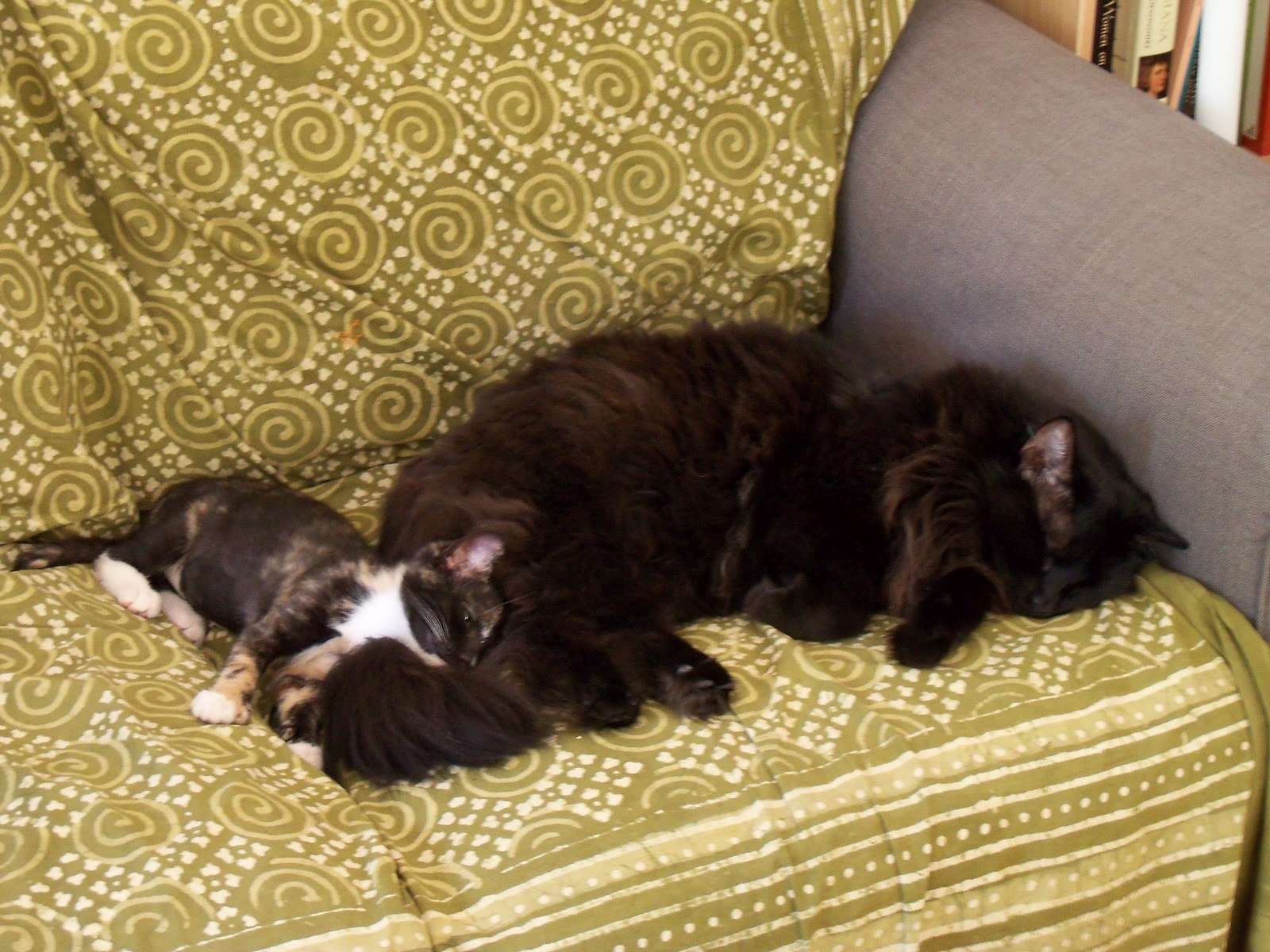
In the past week we’ve moved from grudging toleration to a bit more companionable co-existence, at least when Geraldine is conked out and Teazle decides to use her as a pillow!

They’ve even been caught engaging in mutual grooming (although in this instance it’s Teazle-on-Gerry action only; we promise Geraldine isn’t dead, just very asleep!):

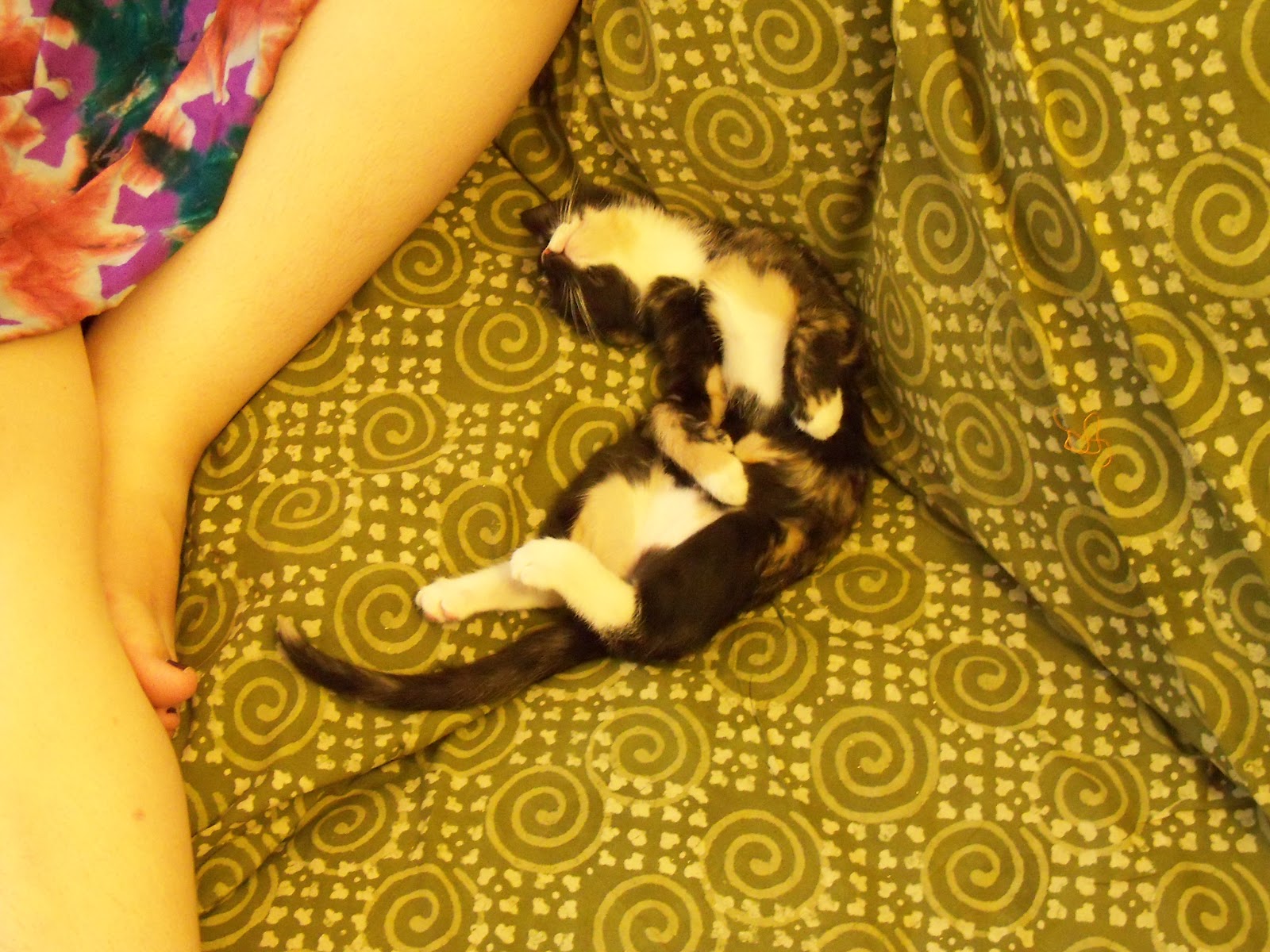
Teazle continues to fall asleep contorted in the most bendy and improbable of positions:

And when we brought home our wedding dresses from Mexicali Blues on Sunday, she investigated immediately and approved of them as suitable napping material.

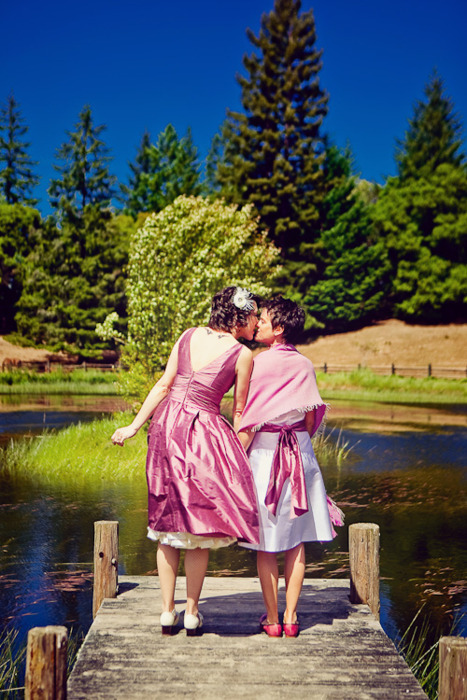
For those interested, the dresses are the Batik Ashley Dress in “plum vine” and “red and green garden.” Hanna will be wearing red and I’ll be wearing the blue-purple.

Happy 4th of July everyone — hope you’re taking the day off and staying cool!

quick hit: the haunted legs!

03 Tuesday Jul 2012

Posted by Anna Clutterbuck-Cook in media

≈ Leave a comment

Tags

art, family, humor

Hanna and I spent the weekend in Maine at her parents’ house, which was a blessed break from the heat of an urban summer and also a two-day stretch of time away from the Internet. Since we were spending time with family, I didn’t get any writing done — so I don’t have the review of Love the Sin for you which I hoped to post today.

Instead, I’m going to give a signal boost to my brother Brian’s wacky month-long art project “Haunted Legs”:

click here for more

Each day will bring a new frame in the … story? web comic? we’ll see as it unfolds! Here is yesterday’s installment:

Ever since I saw the early sketches for this project, I’ve been thinking of the Dr. Seuss story about the pale green pants with nobody inside them; it was one of our favorite stories to read a Grandma’s house growing up — and I bet the resemblance is more than pure coincidence! Click here to check out the page and follow along. Happy reading!

← Older posts
Newer posts →
"the past is a wild party; check your preconceptions at the door." ~ Emma Donoghue

Recent Posts

  • medical update 11.11.22
  • medical update 6.4.22
  • medical update 1.16.2022
  • medical update 10.13.2021
  • medical update 8.17.2021

Archives

Categories

Creative Commons License

This work by Anna J. Clutterbuck-Cook is licensed under a Creative Commons Attribution 3.0 Unported License

Meta

  • Register
  • Log in
  • Entries feed
  • Comments feed
  • WordPress.com

Blog at WordPress.com.

  • Follow Following
    • the feminist librarian
    • Join 36 other followers
    • Already have a WordPress.com account? Log in now.
    • the feminist librarian
    • Customize
    • Follow Following
    • Sign up
    • Log in
    • Report this content
    • View site in Reader
    • Manage subscriptions
    • Collapse this bar