• anna j. clutterbuck-cook
  • contact
  • curriculum vitae
  • find me elsewhere
  • marilyn ross memorial book prize

the feminist librarian

the feminist librarian

Author Archives: Anna Clutterbuck-Cook

from the archive: "the librarian’s image"

28 Monday Jun 2010

Posted by Anna Clutterbuck-Cook in library life

≈ 1 Comment

Tags

archivists, humor, northeastern, politics

I’m processing a collection at Northeastern donated by Michael Meltsner, one of the faculty at the School of Law. On an op-ed page from the New York Times, 13 October 2003, I came across the following letter to the editor.

To the Editor:

Your Oct. 9 Arts pages article about the librarian action figure modeled on Nancy Pearl referred to librarians who found the figure offensive as the ”humorless reaches of librarianship.” A number of my colleagues have taken offense at being described as such. We are opposed to the action figure not because we are ”humorless” but because it perpetuates a stereotype that is demeaning to our profession.

Perhaps public librarians are not directly affected by the dowdy librarian stereotype, but as law librarians we provide library services to some of the most prestigious firms in the country and must maintain a professional image.

The librarian doll with the ”amazing push-button shushing action” damages the professional image that we have worked so hard to achieve.

TANIA DANIELSON

Port Washington, N.Y., Oct. 9, 2003

I think it’s the second to last paragraph that really takes the cake. I’m fascinated by the way it combines a total lack of willingness to enjoy the light-hearted, self-depricating humor embodied by the action figure — not to mention the way the action figure is an ironic commentary on the stereotype she’s unhappy with — and professional snobbery at the expense of public librarianship. I mean really: who in their right mind disses public librarians? I guess now we have our answer!

Given that this was a random letter to the New York Times from seven years ago, I’m not really out to slam Ms. Danielson for what I sincerely hope are now outdated sentiments! But I was really impressed by the elitism this letter was saturated with, and I’m amusing myself on this stifling hot Monday in June by re-posting it here.

sunday smut: links on sex and gender (no. 28)

27 Sunday Jun 2010

Posted by Anna Clutterbuck-Cook in linkspam

≈ Leave a comment

Tags

gender and sexuality, sunday smut

A quiet week in Lake Woebegone, folks … maybe everyone was laid low by the heat? Or busy watching the World Cup? Anyways, here’s a handful of links that jumped out from my feeds these past seven days.

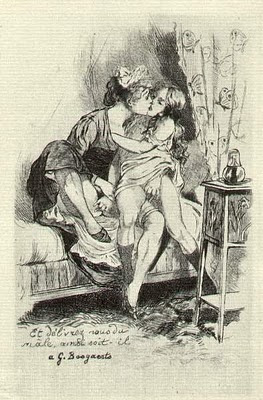
First, a pretty picture (nsfw) which I was unable to use for today’s illustration (damn people protecting their online content!!)

Amanda Marcotte @ Pandagon | How I Stopped Being A Slut, And Learned To Cash Massive Book Advances. “There are some obstacles to overcome. The largest is obviously my boyfriend, who is all about me getting lucrative book deals, but is concerned that the necessary thesis—that my wanton feminist ways have left me loveless and manless—could be construed as insulting to him. I’ve tossed around the idea of kicking him out and only seeing him on the sly, but the cats have raised objections to this, having grown quite fond of him after living with him for most of their lives.”

Aviva Dove-Viebahn @ Ms. Magazine Blog | How to Lose Your Virginity: An Interview with Therese Shechter. “Up until a certain age, you’re not supposed to be sexually active, and then you cross some invisible threshold and suddenly everyone is supposed to be having sex … And I have met so many people that aren’t and feel terrible. Not personally feel terrible—they’re making decisions about their lives—but feel terrible culturally. Like, God forbid anyone should find out about this.”

Miriam @ Feministing | Defining queer virginity. “…But for queer folks, the boundaries are less defined. When two women have sex, when have they ‘done it’? What about two men? What about two genderqueer or trans folks? Is it about penetration, or about orgasms, or nudity, or oral sex? When you expand your ideas of sexuality beyond the confines of straightness, things are more open.”

Amanda Hess @ The Sexist | Talking Sex, With Kink Educators and Anti-Porn Activists. “Since co-founding KinkForAll, Maymay has encountered some complications that don’t figure into his spreadsheets—which is why, even if there’s no live action onstage, he tapes every gathering. ‘I record myself because some people like to say I’m a pedophile, and since I’m not really a pedophile, it helps when they see video of me not being a pedophile,’ he says. ‘I’m like, “Actually, I was just showing a Google doc on the screen.”‘”

Molly @ first the egg | review: The Business of Being Born. “A little over 16 minutes into the film, an adorable doctor explains why doctors tend to prefer the flat-on-the-back-in-bed position and why that’s not okay. This part is just fantastic; I do wish every ‘parent-to-be’ would watch these two minutes.”

Miriam @ Radical Doula | New radical birth magazine: SQUAT.

and, for those looking for comment threads to wile away some time on …

erica @ Feministe | What kind of mirror did your mom make you look at your vagina with? “All this measures up very differently when I hear friends’ stories about how they only really learned about sex in their twenties, or thought that by only having oral, or anal sex they could still remain virgins. So, to expand my horizons a little, I asked everyone I knew to contribute their virginity and/or their how they learned about the birds & the bees stories. They’ll be going up all this week starting later today.”

image credit: La Grande Danse macabre des vifs by Martin Van Maele (1863–1926), made available @ Wikimedia Commons.

weekend fun: the world cup and twitter

26 Saturday Jun 2010

Posted by Anna Clutterbuck-Cook in media

≈ Leave a comment

Tags

fun, npr, web audio

Soccer self portrait by LBott @ Flickr.com. Link at bottom of post.We’re set for another weekend of soccer football at my house this weekend, particularly the Germany vs. UK game, about which I’ve heard via Hanna via StephenFry via CarlTidy on Twitter: “This world cup is like WWII: The French surrendered early the Americans turned up late leaving England to fight the Germans.”

So in honor of this international sporting event, to which I am neophyte follower (having been put through my paces by Hanna), I share this story from last weekend’s On the Media about the World Cup and that internet phenomenon known as Twitter, which is used by human beings worldwide communicating in a polyglot of languages — often (as this story shows) to unintended and, shall we say, très amusant results.

BOB GARFIELD: Carlos Eduardo dos Santos Galvao Bueno is a play-by-play announcer who calls the World Cup matches on Brazil’s largest TV network, Rede Globo. Last weekend, someone in Brazil offered a blunt critique of Galvao’s broadcasting style with a three-word Tweet in Portuguese: “Cala Boca Galvao,” or, in English, “Shut up, Galvao.”

The phrase quickly became one of the top worldwide trending topics in the Twittersphere, and what happened next, says Ethan Zuckerman of the Berkman Center for Internet and Society, was the result of a wired world eavesdropping uncomprehendingly on one another’s conversations.

ETHAN ZUCKERMAN: For the last three or four days, “Cala Boca Galvao” has been absolutely at the top of the topic list. And so, what happened was a lot of non-Portuguese speakers saw this phrase, didn’t know what it meant and started Tweeting, what does Cala Boca Galvao mean?

If there’s a new topic trending on Twitter, there’s probably a significant chance that it has something to do with Lady Gaga. So some of the Brazilians grabbed that idea and started telling the non-Portuguese speakers that Cala Boca Galvao is the new Lady Gaga single.

The fun doesn’t stop there! Sad to say there is no direct embed function for the audio, but you can listen to the story, download the mp3, or read a full transcript over at On the Media.

Have a great weekend!

image credit: soccer self portrait by LBott @ Flickr.com.

evangelicals’ "defining story" = divine child abuse?: some reflections

25 Friday Jun 2010

Posted by Anna Clutterbuck-Cook in think pieces

≈ Leave a comment

Tags

books, religion, thesis

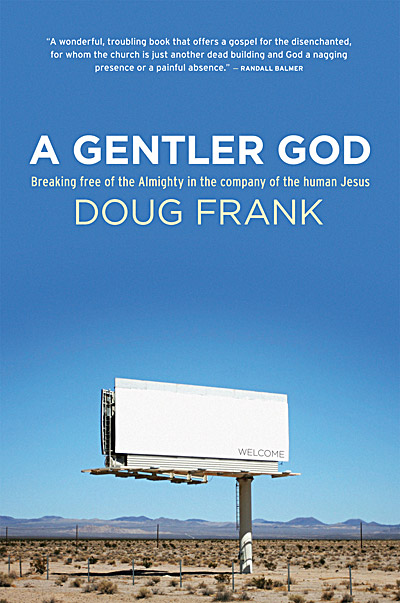
This is a rambling sort of post reflecting on Doug Frank’s recently-released A Gentler God: Breaking Free of the Almighty in the Company of a Human Jesus. Doug is one of the founding faculty members at the Oregon Extension, the community I am researching and writing about for my thesis. I might write a proper book review / booknote about A Gentler God at some point, but for now I want to share a story from my own history of interactions with the church — and Evangelicals particularly — that reading this book reminded me of, and helped me understand in a new light.

Despite growing up in culturally and religiously conservative Western Michigan, I was largely what they call “unchurched” as a child. My paternal grandfather was an ordained minister and professor of New Testament theology at Western Theological Seminary which is affiliated with the Reformed Church in America, a small but mainline protestant denomination. My father was, therefore, a preacher’s kid; my mother — raised by a lapsed Scotch Presbyterian and a Christian Scientist — was sent to Congregational Sunday school as a child and attended confirmation classes but never joined. My parents didn’t have us baptized and pretty much stopped attending church around the time my little brother was born (I was three) because the amount of nurturing they got out of church on Sunday wasn’t worth trying to parent small beings in a child-unfriendly space.

We didn’t return to Hope Church (my father’s childhood RCA congregation) until I was a teenager. We had a few reasons for doing so, including the fact that several of my more conservative, evangelistic friends had attempted to convert me (them: “have you accepted Jesus into your heart?” me: “uh … no.”) and my mother was hoping to inoculate us against fundamentalist, evangelistic theology by giving us a chance to learn the language and messages of Christianity and a scholarly, fairly liberal environment. To give you an idea of what this meant: the congregation had recently gone against denominational practice by ordaining a gay member as a church elder, they had already had a series of women ministers, they had an active pacifist group, and my feminist theology professor at college was a member.

I offer all of this as a preface to the story-story I’m going to tell you, which is about the husband and wife who served as youth group leaders for several years while I was attending Hope Church. This couple were way more theologically fundamentalist-evangelical and socially conservative than the majority of the congregation, and I’m not exactly sure how they landed the position of youth leaders (likely because they volunteered). I did childcare for the family regularly, but used to find myself at loggerheads with them (also regularly) about a number of issues including parenting, feminism, human sexuality, and theology.

And one day at either a youth group meeting or in a Sunday school class they offered — as if it were the best metaphor in the world for God’s love and the power of atonement (Jesus dying for our sins) — the following allegory (I’m paraphrasing from my own memory)

There’s a train full of passengers hurtling down a railroad track toward a bridge that has washed out. God is at the switchboard about to switch the rails so that the train goes onto a side rail (thus saving the passengers). But then suddenly his toddler son (Jesus) wanders out onto the side rail. God has to decide — train full of people or toddler son? And because God is so unselfish, he saves the train full of people rather than his own child.

What. The. Fuck.

That’s what you’re thinking, right? There are just so many things wrong with this story that it sort of stops you dead in your tracks.

This is the story that this couple — with three small children of their own, remember — told with passion and the clear expectation that we would be humbled by the boundless, sacrificial love of God. Whereas, of course, what character in this story is any human being (let alone a child!) going to identify with? The toddler! Whose own parent kills them in order to save a train full of unnamed, faceless persons. What child could possibly fail to be traumatized by a story that tells them the moral “right” is one in which their parent would not save them from death when they had the power to do so?

The take-away message regarding God and Jesus in this story is that God is a violent, murderous parent who has no overriding, irrational love for His own child. It’s a story of divine child abuse. And to me it was absolute crazy-talk.

Well, according to Doug, who describes this very story — or at least the collection of ideas embodied in this story — in the first part of A Gentler God, this is the “defining story” of modern American evangelism. Evangelical Christians, Doug argues, grow up in such close proximity to this story that they have trouble seeing its internal contradictions: the way in which a story that is trotted out to signify God’s boundless love for humanity actually tells a story about extremely conditional love and bloodlust. God demands bloodshed, which is why Jesus is required by God to die for our sins. How can we possibly square this with a God who cares for all of God’s creation unconditionally?

Well, you can’t, which is why Evangelicals (again, according to Doug and other scholars I’ve read) live on some level in perpetual fear of the wrath of an Almighty deity who — but for His willingness to murder his own son — would surely have come after you in vengance.

The story I heard in youth group displaces the personal wrath of God in favor of a fatalistic, mechanical failure — God isn’t causing the train to crash — God simply has to decide between God’s own child and the rest of humanity. But it still does no better at describing a loving, compassionate God — in fact, in my personal opinion it actually reifies the wrongness of the defining narrative by turning Jesus (a full-grown adult who, the Bible if pretty clear, makes the decision to die as a consequence of his actions) into a child who in no way chooses his own death. Instead, this story takes God and shapes Him (definitely “Him”!) into a monstrous parent. This is, I’d argue, even a step beyond the traditional Evangelical God of atonement whose divine sense of justice impersonally demands blood. This isn’t a God overly obsessed with justice at the expense of compassion — but a God who is simply uncaring, sociopathic even.

It appalls me, even all these years later, that this was the narrative of Christianity meant to excite conversion.

A Gentler God gave me a new perspective on the way this story, and its sister-stories in the Evangelical theological landscape, shapes how conservative Christians view their God — and how that view of the divine shapes their interaction with the world around them.

quick hit: more reasons to choose "queer"

24 Thursday Jun 2010

Posted by Anna Clutterbuck-Cook in linkspam

≈ Leave a comment

Tags

feminism, gender and sexuality

Miriam @ Feministing takes up the question of “queer” as an identifier in a post from last week, What’s the difference between lesbian and queer? and invites readers to share in comments what the word means for them and what words they use to speak about their identity.

From my perspective, there are two main reasons to use queer as an identifier. Queer is not as specific as words like lesbian or gay, and it does not explain exactly either your gender or the gender of your partner.

Lesbian implies pretty clearly that you are a woman who partners with other women. You might identify as genderqueer, trans or gender non-conforming, so that kind of specificity might not fit well. Or you might partner with people across the gender spectrum.

If someone partners with people across the gender spectrum, “bisexual” may not feel appropriate because it implies there are just two genders (bi meaning two). Additionally, if a person might not identify themselves with a binary gender (male or female) then a term like lesbian or gay might feel limiting.

Queer is an umbrella term, it really implies “not straight” more than it implies what exactly someone’s sexuality might be. It’s also a political term and many people use it as such, to imply a particular set of political beliefs alongside their orientation.

You can read the whole post at Feministing as well as the comment thread, which is where a lot of the conversation takes place.

"with all due respect, small children"

23 Wednesday Jun 2010

Posted by Anna Clutterbuck-Cook in book reviews

≈ 2 Comments

Tags

children, gender and sexuality

Let’s face it, we all have our favorite books from childhood. (I hesitate to call them “children’s books” because so many authors who write books children enjoy resist being ghettoized and too many children read books originally written for grown-up audiences). And let’s admit we are completely partisan about our golden oldies. I, for example, tend to evaluate any scholarly or reference work on children’s fiction by flipping to the index and discovering whether Arthur Ransome merits an entry. If not? You have to talk awfully fast if you want me to buy it. If Edward Eager is discussed your chances are upped, and Michelle Magorian is really required reading in anything purporting to discuss young adult lit.

Which brings me to this recent op-ed by Alison Flood @ The Guardian. The children of England recently voted Eoin Colfer’s Artemis Fowl, the first in a series featuring a young supergenius antihero. Flood disagrees. “With all due respect, small children,” she writes, “your choice of the admittedly excellent Artemis Fowl as the ‘Puffin of Puffins’ is deranged and wrong. It should clearly be MY choice: Goodnight Mister Tom.”

I also adored Magorian’s Back Home, another story of an evacuee. Rusty is sent to America, and the drama plays out around her return to England to a world and a family who feel like strangers. Anyone else remember that one? I loved the bit where Rusty escapes from boarding school to decorate her own little cabin in the woods.

But Goodnight Mister Tom is better. It should have been the Puffin of Puffins, and I think it has a good claim to be the children’s book of children’s books. (Now that’d be a fun vote, although we may have to exclude anything published after I graduated to grown-up books, else I’ll only get upset again.) I’m imagining that all you discerning adult readers will agree with me about Goodnight Mister Tom being the top Puffin – but please let me know either way. And I’ll try not to cry if you disagree.

I’m not going to weigh in on whether or not Goodnight Mr. Tom should or should not be the top Puffin — to me, book choices are personal, idiosyncratic things. My passion for particular books has (I suspect) less to do with any objective artistry — if any objective measure of artistry exists — than it is tangled up with where I was when I read the book (Our Arcadia) what questions I was asking about life (The Solace of Leaving Early), whom I read and shared the book with (The Blue Sword) and more often than not a single scene — a single passage — a single sentence — that seared itself into my psyche forever simply because it spoke to me. The rest of the book might be a shit book. I might never read it again except to open it up to that passage and remind myself once again why I fell in love so irrevocably with the text.

So here’s what I wanted to say about Michelle Magorian, ’cause I adore her too, and then I’ll open up the comment thread to any of you who feel like sharing your own well-worn favorites from childhood: I’d love to hear about the books you loved and why you loved them.

So: Magorian. Alison Flood leaves off Magorian’s third novel, Not a Swan which is difficult to find (unlike the other two) and, in the United State at least, out of print* (which accounts for, apologies, the sucky cover art image). But my public library had a copy in the young adult section, and I discovered it when I was about twelve. And promptly fell in love. Set during the waning days of the Second World War, in an English seaside town, it’s the story of a sheltered seventeen-year-old schoolgirl, Rose, who longs to be a writer.

There’s a whole long list of plot elements that combined to make this a story that enthralled me (I vividly remember, fifteen years later, the feeling of staying up until 3:00am to finish it because I could not put it down). It was an historical novel (1) set in England (2) during the Second World War (3). It was about an adolescent girl who rebelled against conventional expectations about what young ladies should be (4) and do (5), craved adult independence (6) and wanted to be a writer (6). There was the best friend, pregnant out of wedlock (7) whose birth scene — without giving too much away — was quite possibly what precipitated my adolescent interest in midwifery. There’s an historical mystery (8) involving archival documents (hidden diaries) and above all, there was Alec (9), the bookshop owner (10) who hires Rose as his shop assistant and encourages her in her writing.

And (11) there was sex. Gorgeous, glorious, enthusiastic sex. Tame, to be sure, by the standards of adult erotica, but still pretty damn steamy. Not a Swan, I would argue, is one of a slim, slim handful of novels written for young adults that embraces adolescent sexuality without shaming. Again, without giving details away, I will be forever grateful that one of the first genuinely “YA” novels I read was essentially a story about a young woman claiming her right to enjoy her sexuality on her own terms. (Actually, by my count, at least four women, all in very different circumstances, yet all asserting their independence and their right to happiness and sexual pleasure).

Depending on your perspective on human sexuality and the whole women-as-humans thing, you could say this was the beginning of my coming into myself as an adult woman who embraced feminism and the potential for joy in sexual relationships — or you could see it as the beginning of my long, slow decline into the life of a slutty teen-age bibliophile. Either way, there really was no turning back.

So take it away readers — what books do you enjoy championing and why?

*woodscolt in comments alerted me to the fact that in the UK Not a Swan has been republished under the title A Little Love Song. Thanks woodscolt!

"bibliobimbo": pro-book pulp fiction posters

22 Tuesday Jun 2010

Posted by Anna Clutterbuck-Cook in library life

≈ 2 Comments

Tags

books, fun

Thanks to Anne Bentley, our art curator at the Massachusetts Historical Society for this link. Helfond Book Gallery, Ltd. offers a series of images from the underbelly of the rare book world, otherwise known as “bibliopulp” posters riffing on pulp fiction book covers from the mid-twentieth century. I’m personally torn between the “Bibliobimbo” (pictured above), “Rare Book Tramp” and — with a cover that would make Jack Harkness proud — “They Made Me a Book Collector.”

Happy Wednesday!

multimedia monday: new economy of the poor

21 Monday Jun 2010

Posted by Anna Clutterbuck-Cook in media

≈ Leave a comment

Tags

multimedia monday, npr, politics, web audio

My audio for the week is an interview by Terry Gross of journalist Gary Rivlin, whose new book Broke USA explores the world of marginal finance.

Full transcript available at NPR.

I particularly like the way Rivlin discusses exploitation without flatting out the narrative into one of class warfare. He talks about the ways in which institutions like payday lenders and rent-to-own businesses provide services to poor neighborhoods and rural areas that are often vital and welcomed by their clientele. He doesn’t come across as shaming poor people for being dupes of predatory loan companies or (for that matter) universally condemning financial institutions for providing services that are in high demand.

sunday smut: links on sex and gender (no. 27)

20 Sunday Jun 2010

Posted by Anna Clutterbuck-Cook in Uncategorized

≈ 2 Comments

Tags

gender and sexuality, sunday smut

Sam Leith @ The Guardian (h/t to Hanna) | EM Forster’s work tailed off once he finally had sex. Better that than a life of despair. “Nobody should have to write, or paint, or sing from the depths of despair, no matter how exhilarating the results. I’m sorry we never got to read Forster’s unwritten novels, but I’m much happier he got laid.”

Amanda Marcotte @ Pandagon | New Bulletin: Men Have Hearts That Break. “Both sexes are, gasp, human beings and therefore are sad when they lose a relationship. The reason that men have trouble bouncing back is that our culture doesn’t create enough room for men to heal. Men are discouraged from having close friendships where they can talk this stuff out (at least when they’re younger), and they’re encouraged to put on a stoic face and bury pain deep inside. It’s no surprise to many of us here, I’m sure, that a little crying it out can aid recovery. That men aren’t given that space is just another example of how Patriarchy Hurts Men Too (PHMT).”

Miriam @ Feministing | Is female dominance a success for feminism? “Women’s success at the expense of men is not a feminist success. Flipping the scales in the other direction is just as problematic. So what’s the solution? I don’t think it’s the tactics that Rosin reports on in her article: quiet affirmative action toward men trying to get into higher education, re-segregation of education to cater towards boys learning needs. If we keep up these tactics, we’re going to create a seesaw effect where women outpace men, and then men outpace women. We need a new strategy. A less gendered one.”

Stephanie Zvan @ Quiche Moraine (via Sex in the Public Square) | What Is an Ally? “I’m not really sure how it happened. Allies in the culture wars aren’t appreciably different than military or political allies, but somehow, the meaning of the word has changed online. We’ve gone from ‘In everyday English usage, allies are people, groups, or nations that have joined together in an association for mutual benefit or to achieve some common purpose, whether or not explicit agreement has been worked out between them’ to the assumption that the act of alliance comes with specific obligations and that people are ‘bad allies’ or not allies at all if particular things are done or left undone.”

Sinclair @ Sugarbutch Chronicles | BDSM is Not Abuse. “I am still surprised how often BDSM gets equated with abuse, and this list makes the distinctions so very clear, I like it. I have the feeling I’ll be referencing this quite a bit in various things. Hope the Lesbian Sex Mafia doesn’t mind that I am reprinting it here!”

Greta Christina @ The Blowfish Blog | How Often Should You Ask For Something? and How Often Should You Ask For Something? Part Two: The Specifics. “How do we value the right to say ‘No’ to any kind of sex we don’t want to engage in — while still valuing the right to ask for what we want? How — specifically, practically — can we make this distinction?” and “Example. If my partner asks me, ‘Can I apply hot peppers to your nether regions?” and I say ‘No, I don’t want to try that,’ it’s probably not going to occur to me to bring it up again. Not because I’m traumatized by the very idea . . . but because it simply won’t be on my radar. Even if hot peppers aren’t an absolutely firm No for me — even if they’re something I’d be willing to try if my fears and reservations about it were allayed — once I’ve said ‘No,’ for me the matter is going to be pretty much closed. But that doesn’t make my partner a bad person for opening it up again.”

Cara @ The Curvature | Group Suggests Age Appropriate Sex Education? Time to Freak Out. “Sex education, in my view, shouldn’t be about ‘preventing teen pregnancy.’ It should be about teaching young people how to engage in emotionally and physically healthy, pleasurable, consensual sexual relationships if and when they choose to engage in such relationships at all, and informing them about how to keep themselves as healthy and safe as they can and how to control their reproductive capacities as they see fit as a part of that.”

Rachel @ The Feminist Agenda | Obesity and fun sexy time. “The thing we should be paying attention to is the fact that many fat women are so beat down psychologically and have so thoroughly internalized the message that they are not sexual beings, that they don’t deserve love and sexual fulfillment, and that their bodies are worthless and disgusting, that they often put their sexual health at risk. That is fucked. You know what else is fucked? The fact that many fat people have had such negative experiences with medical professionals that they would rather risk their sexual health than interact with them.”

Vanessa @ Feministing | The sanctioning of child genital cutting at Cornell University. “Alice Dreger and Ellen K. Feder at Bioethics Forum brought recent attention to the controversial (to put it mildly) treatment which Dr. Poppas claims to ‘fix’ the genitals of children as young as 3 months so they can have a more ‘normal appearing vagina’ after the doctor deem their clitoris oversized.” Original post flagged with a strong trigger warning.

And I have to break away from my format-of-the-week here for a little editorializing, because Vanessa shares this appalling quote from the F-Word

One time I asked a surgeon who does these surgeries if he had any idea how women actually reach orgasm. What did he actually know, scientifically, about the functional physiology of the adult clitoris? He looked at me blankly, and then said, “But we’re working on children.” As if they were never going to grow up.

I just want to point out that, not only do children grow up — they actually experience pleasure from their genitalia as children. The fact that the doctors are only secondarily (if that) concerned with the functionality of the clitoris yet primarily concerned with the clit “looking right” (which is a highly subjective observation, given the diversity of human genitalia) tells me just how much they’ve dehumanized these young people — in part, I would argue, because their age makes them supremely vulnerable to exploitation in the name of increasing medical knowledge and “protecting” them from the (apparently irreparable) damage of being deemed abnormal according to our straightjacket codes of gender conformity.

And finally (because I am, after all, a librarian), Danika @ The Lesbrary | Lesbian Canon? “For the last couple days I’ve been thinking about the concept of a lesbian canon. I mean, I know that canons in general are problematic, but I like the idea of trying to identify the books that really steered lesbian writing.”

Which brings me to Isabel @ Feministe | Not a Fish, Not Yet A Human. “Now: I am not interested, here, in trying to reclaim The Little Mermaid as a feminist classic, because I… am never interested, really, in trying to stamp something definitively with Feminist or Not Feminist. There are fucked-up things going on in every Disney movie ever, and The Little Mermaid is no exception. …But right now, I want to focus on The Little Mermaid as a – still poignant to me – story of the painful liminal zone between childhood an adulthood.” Even though The Little Mermaid terrified me as a child and has never been my favorite fairy tale, in my book every work of fiction deserves a second chance — and Isabel musters a damn good defense of this one.

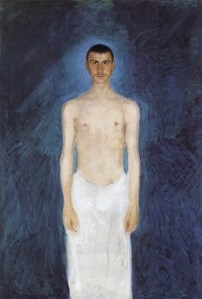
image credit: Gerstl, Richard (1883-1908) – 1901 Self-portrait, half-nude on a blue background (Leopold Collection, Vienna), made available by RasMarley @ Flickr.com.

new spectacles + good vibes (both kinds!)

19 Saturday Jun 2010

Posted by Anna Clutterbuck-Cook in our family

≈ Leave a comment

Tags

boston, domesticity, random kindness

It’s been awhile since I posted something that was just about life in Boston, so here on this hot, humid Saturday — as Hanna and I watch Denmark vs. Cameron at the World Cup — I thought I’d share pictures of my new library lady spectacles. They’re my first new pair in over five years, and I feel like the world just got a little bit clearer! Hopefully, they’ll help with the headaches and eyestrain as well.

Hop over to Twitpic if you want a larger version of the photo (I’m on Hanna’s laptop at the minute and too lazy to edit the .jpg without my usual software).

Hanna says they are very 1950s and reminiscent of the ladies in Farside; perhaps this will help with my fearsome feminist library lady persona? Time will tell!

In other low-key weekend news, we happen to live about a ten minute walk from the only Good Vibrations store on the East Coast and I enjoy stopping in occasionally — mostly to window shop as most high-quality sex toys are simply beyond my modest discretionary budget. So I paid them a visit this morning on my way to the grocery store and while I was browsing a fellow customer came up after making her purchase and offered me a $10-off coupon she’d just received that she said she would never had a chance to use (I assume the was in the Boston area on holiday). I have no idea what her name was or what prompted her to pass the card along to me — but thank you mystery woman for that anonymous treat! I already have a few ideas for how to make use of the gift :).

← Older posts
Newer posts →
"the past is a wild party; check your preconceptions at the door." ~ Emma Donoghue

Recent Posts

  • medical update 11.11.22
  • medical update 6.4.22
  • medical update 1.16.2022
  • medical update 10.13.2021
  • medical update 8.17.2021

Archives

Categories

Creative Commons License

This work by Anna J. Clutterbuck-Cook is licensed under a Creative Commons Attribution 3.0 Unported License

Meta

  • Register
  • Log in
  • Entries feed
  • Comments feed
  • WordPress.com

Create a free website or blog at WordPress.com.

  • Follow Following
    • the feminist librarian
    • Join 36 other followers
    • Already have a WordPress.com account? Log in now.
    • the feminist librarian
    • Customize
    • Follow Following
    • Sign up
    • Log in
    • Report this content
    • View site in Reader
    • Manage subscriptions
    • Collapse this bar