• anna j. clutterbuck-cook
  • contact
  • curriculum vitae
  • find me elsewhere
  • marilyn ross memorial book prize

the feminist librarian

the feminist librarian

Author Archives: Anna Clutterbuck-Cook

to be subjective and scholarly

18 Friday Jun 2010

Posted by Anna Clutterbuck-Cook in think pieces

≈ 1 Comment

Tags

domesticity, education, thesis, work-life balance


Last Friday, I blogged about my frustration with finding balance between my academic research and writing, my wage-work, and my domestic life and loves. This Friday, I thought I would pick up where I left off, after a fashion, and write about the ways I try to balance the academic and the personal within my work as a scholar.

This post has gone through a number of different iterations in my head, but is taking this particular form because of a recent post by Kimberley @ 72-27 who this week wrote a long, reflective piece about her own return to academia and the limitations she sees in rigorous scholarship that neglects the relational in pursuit of the rational.

Before my current program, I came from a small school in Seattle that trained students to be therapists, and thus it placed primary value on inter-personal and intra-personal knowledge. My professors were psychoanalysts and therapists, and they asked their students to delve into the unconscious self and figure out what was there and why it was there. We did intense work understanding our own families of origin and personal narratives, and we received a great deal of feedback on how other people experienced us while in relationship with us. While the program lacked academic rigor in the traditional sense, it demanded a kind of inter-personal and intra-personal rigor that was invaluable.

While I love the rigor that is applied to critical thinking at Yale, I am left envisioning what Yale would be like if that same kind of rigor were applied to self- and inter-personal knowledge. For instance, in my U.S. religious history class, one of my professors shared with us that it took him quite a while in his career to realize that he hadn’t picked his research “objectively.” His research came out of deeply rooted questions based on very personal life experience. Yet, in his graduate training, he had not been encouraged to see the connections between his “objective” research and his own life story. This discussion in class came at the very end of the semester, and it was a relief to me. I had often felt as if historians maintained a pretense of objectivity. It was nice to finally hear that we can actually do better research if we are self-reflective in the process. Knowing ourselves better will also translate to being better collaborators.

Emphasis mine. You can read the whole post at 72-27.

How does this connect to my own work, beyond the skepticism toward an overly-depersonalized academia which I unabashedly share? To begin answering that question, I want to share another lengthy quotation — this time from an email I wrote earlier this spring. When I was at the Oregon Extension in March, doing research for my thesis Doug Frank — one of the faculty there, an historian and mentor of mine — asked me whether my project was a chronicling of “what happened” or whether I was making a specific argument. I stumbled through an immediate response that, from what I remember, emphasized that I was gathering the oral histories as a type of chronicling, but that my thesis would itself have a specific argument to make about the place of the Oregon Extension in American cultural, educational, and religious histories.

Of course me being me, I left the conversation unsatisfied with my response and the following day wrote Doug a long email trying to explain my motivations for this research. I won’t reproduce the email in full here, but I wanted to share two paragraphs that speak to the connections between my “objective” historical analysis of the Oregon Extension and my own life story.

On a more personal note, I will say that this project comes out of my own deep interest in history of non-mainstream education and my very personal quest to find a way to bring together my love of learning (the life of the mind) in some sort of structured environment with the quality of life I experienced as a child and young adult outside of institutional schooling. My original desire to attend the OE as a student (nearly a decade ago now!) was driven, in large part, by my desire to find a way to be a scholar without having to fit myself into the vision of education (the fear-based model you were talking about yesterday, which I believe is still deeply embedded in most schools) and of human nature that ran so counter to the understanding of human life that I had grown up with in my family (and elaborated on through my reading in theology, feminism, and educational theory). I am drawn to examples of intentional community and purposeful work life, in which folks have been able to step outside of the pressures of the mainstream and forge a life for themselves that isn’t grounded in being “anti” (that still retains some sort of relationship with the dominant culture) but nevertheless has some autonomy when it comes to priorities and values — the power to say “you have no power here” to things within the dominant culture which are inimical to human well-being.

When I went back to graduate school, I was taken aback by how much my soul rebelled against being back in an environment of institutional education, surrounded by folks who largely take those traditional frameworks for granted (at the very least) and often champion them (Boston’s educational culture is incredibly status-conscious). I don’t necessarily believe I made the wrong choice to return to school (the factors are myriad), but I do know that when it came time to choose a thesis topic, I intuitively knew I needed to spend my time with a topic that would help me retain critical distance on that culture, that vision of humanity, that understanding of the way human beings learn and what they need to thrive. And as of this writing, at least, I feel pretty proud of the way that this project has helped me to do just that, giving me a certain inner sense of distance from the expectations and values of the institutions within which I work as a student scholar, so that I am sharing these ideas with them (in a form they can accept for credit) but not writing my thesis for them.

As I wrote more concisely (though much more pedantically) in an early draft of my thesis introduction, “The scholarly task of historicizing the college classroom and the expectations of higher education were, in part, a method of coping with the alienation I often felt as a student whose experiences and vision of, not to mention goals for, learning were at odds with the majority of the people whom I encountered at school.”

In other words, this topic matters to me, in a visceral, immediate way. The project of make sense of the history of competing educational theories and practices is as much about finding a place for myself within that world as it is about situating the Oregon Extension within its unique historical context. I am invested in doing my part to enter these folks into the historical record because I believe deeply in the value of what they do. It is important to me that their own unique experiment in living be acknowledged at some level as part of the history of education in the twentieth century — a way of being that runs counter to the stories we tell ourselves about how life has to, or ought to, be.

And the world of academia is definitely divided as to whether this is or is not a good thing. Emotional proximity to one’s subject-matter is often viewed with deep suspicion, as it is seen to cloud the mind, bias the historian whose job (as Kimberley notes about) is ostensibly to be “objective” about her subject. Distance from one’s topic (in time as well as emotion) is supposed to provide you with the dispassionate objectivity to analyze and critique with greater clarity. Even if we recognize (as most scholars do today) that we are all inevitably subjective in our scholarship, the push has been to recognize and attempt to minimize or compensate for those biases, rather than to embrace and work with them as strengths.

I’m less certain that this is the only or the best approach to subjectivity within scholarship. Although I’m still searching for language to articulate it, I think that there are different qualities of emotional proximity or connectedness to one’s research subject that can — depending on how self-aware the researcher is and what their relationship to that connectedness is — help or hinder scholarly analysis.

I am taking a meditation class with Hanna this month (my first ever!) and have been introduced to the practice of metta meditation, in which the quality of loving-kindness toward beings is distinguished from feelings of acquisitive desire for those beings. I’ve been thinking this week about how the same distinction might be made concerning one’s affinity toward a research project: intense feelings of loving-kindness toward the subject and subjects — relatedness that is not conditional upon a particular outcome — could be separated from an emotional investment that was conditional, that required fidelity to a particular outcome, a particular historical narrative that fit pre-conceptions about what story these historical sources were going to tell.

Again, I’m not sure how practically this translates into a real-world relationship between the scholar and her sources, the scholar and her passionate involvement with the work of her subjects. But it is a beginning, a way to open (inside myself, at least) a conversation that values not only my intellectual work but also the personal, emotional, life-story reasons why the pursuit of this particular story is not only an academic exercise but also very much a matter of existential survival.

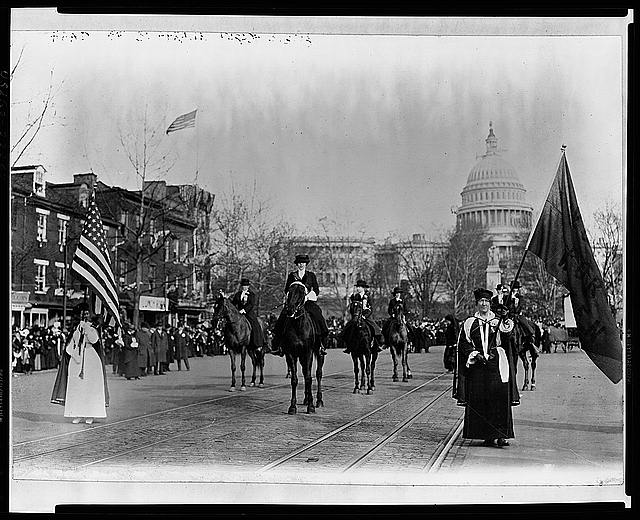
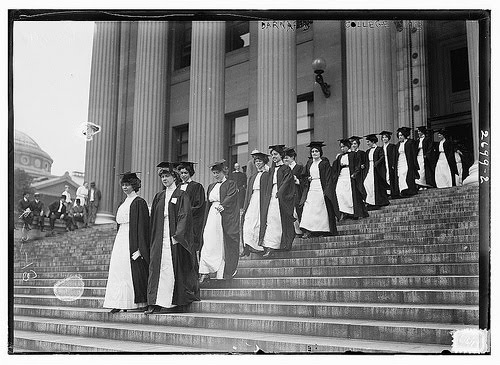
image credit: Barnard College, 1913 (LOC) made available by the Library of Congress @ Flickr.com.

booknotes: sexing the body

17 Thursday Jun 2010

Posted by Anna Clutterbuck-Cook in book reviews

≈ 2 Comments

Tags

gender and sexuality, science

I took a class as an undergraduate in the Cultural History of Victorian Science and Technology, which was one of the most awesome classes of my lengthy undergraduate career. One of the conversations I remember from that class was a discussion about how and why some new technologies and scientific theories succeed and some fail. We tend to have a merit-based vision of innovative success and failure: good ideas succeed, bad idea fail. But this isn’t necessarily so — you might have a bad idea but really good marketing skills. You might have a good idea but fail to file your patent paperwork at the right moment. Usually at the beginning of a new technology (take cars for example) the a multitude of products compete for the industry standard. The gasoline-powered internal combustion engine was only one of a number of automobile technologies developed around the turn of the twentieth century: its hegemony today had everything to do with marketing and the availability of cheap oil, rather than its inherent superiority to, say, an electric motor (which was on the scene simultaneously, even a little bit prior to, gasoline-powered motors).

What does this have to do with Anne Faustos-Sterling’s Sexing the Body: Gender Politics and the Construction of Sexuality (New York: Basic Books, 2000)? I thought of the story of the automobiles and its lesson about the interaction of science, technology, and culture while I was reading Sexing the Body because what my cultural history professor had done for modern technologies, Faustos-Sterling, a trained biologist, does for the scientific exploration of gender and sex in the human body. The work is now a decade old, but still reads (to my eyes anyway) as a fairly current account of how sex and gender have been understood through the lens of science, specifically intersexuality during the twentieth century and how the treatment of intersexual persons is shaped by larger cultural understandings of gender, sex and sexuality.

This exhaustively-researched, amply-footnoted book does a commanding job of balancing the important-yet-technical ins and outs of scientific studies involving rats and hormones with a compelling, readable narrative. Faustos-Sterling documents the way in which the production of scientific knowledge — specifically the knowledge related to human sex and sexuality — is inexorably shaped by the cultural understandings of what is normal sex and gender presentation. She begins with external markers of sexuality and a truly horrific chapter concerning how people with unacceptable genitalia have been treated by the medical establishment in the twentieth century. She then moves internally to look at the less visible ways in which scientists have identified the sex of persons, from gonads to hormones. As you might expect, her argument is that “sex” is far from easily established on a medical level, and the standards by which we have chosen to measure sex are hardly objective, unchanging scientific criteria but rather contingent on the narratives concerning sex and gender that scientists performing their laboratory tests take part in and are influenced by.

Warning to anyone who has experienced hospital or medical-related trauma: the descriptions of medical malpractice that included things like operating on infants without painkiller, operating on people of all ages without consent, and providing misleading or outright erroneous medical information to patients or the parents of underage patients are infuriating and painful to read. I find the idea of any medical professional performing invasive, medically unnecessary surgery on a person without their consent or with coerced consent so upsetting that I had to put the book down several times just to let my blood pressure drop.

Much like Hanne Blank’s history of virginity, Sexing the Body takes a concept (“sex”) that we have come to think of as biologically determined and physically identifiable and questions just how much we really know about what “sex” constitutes. Even if the components of our body that have become markers of “sex” (male or female) are, indeed, physical realities, the decision to establish those particular physical characteristics as markers of sex is, in the end, a socio-cultural decision we make, and one that we can change.

And this, in the end, is Fausto-Sterling’s hopeful call: for us all to look beyond the dualities of male versus female, masculine and feminine, and nature (what we have come to label “sex”) and nurture (what we have come to label “gender”) and acknowledge the reality that we are both and neither, that what we understand as sex and gender identity is both nature and nurture — and, in fact, more. That we cannot hope to gain more knowledge about human biology and behavior if we continue to constrain ourselves to limited, limiting categories and attempt to shoehorn the diversity of humanity into their narrow confines.

from the archive: anti-suffrage activism in Massachusetts

16 Wednesday Jun 2010

Posted by Anna Clutterbuck-Cook in my historian hat

≈ Leave a comment

Tags

feminism, history, MHS


This week, I’ve been doing some background research on a pro-suffrage parade that the Massachusetts Woman Suffrage Association organized in Boston on October 15, 1915. Here at the Massachusetts Historical Society we hold a leaflet distributed to the marchers which will be our object of the month in July (you’ll see a link here when it goes up!)

While feminism continues to be a controversial political movement these days, only rarely do you hear people voice the now radical-seeming notion that the world would be a better place if women did not have the right to elective franchise. Less than one hundred years ago, however, exactly the opposite was true: women who sought the vote were understood to be the radical troublemakers whose quest for elective franchise would bring disaster: divorce rates would rise, domestic life would become a shambles, and the twin threats of Mormonism and Socialism would converge and destroy modern civilization [1].

As the Massachusetts pro-suffage activists geared up for their parade, the “antis” (as they were known) geared up for a counter-protest. As the Boston Daily Globe reported the day before the parade

In their great “victory” parade tomorrow the Woman Suffragists of Massachusetts, who expect to march with 15,000 in line and 30 bands, must pass on their line of march no less than 100 houses decorated with red roses, the symbol of the antisuffragists, and with banners appealing to the men of the State to vote against votes for women.

Hovering about the line of March, like flying cavalry seeking an opening for flank attack on an enemy column, will be many motor cars decorated with red roses, some of them as large as cabbage heads and mounted on long staffs for stems.

In many hotels maids and matrons will sell red roses and with each will give away a red card bearing an argument against Woman Suffrage.

On the streets some hundreds of boys will sell red roses and give with each a similar card.

Among the crowds that are expected to witness the parade will be many hundreds, and it is hoped by the “antisuffs” many thousands, wearing red roses.

…This is the answer of the No Votes for Women workers among the gentler sex in Massachusetts to the suffragist bid for the ballot through a great parade.

It will constitute the only organized demonstration of the antisuffragists against their sisters of the opposite camp. No effort will be made to interrupt the parade in the smallest degree or to embarrass the paraders by any attacks, direct or indirect, except that silent protect of the blushing roses that is worn on each antisuffrage bosom, be it male or female.[2]

I am struck by the tension in this journalist’s story between portraying the anti-suffrage activists as more demur and ladylike in their approach than “their sisters of the opposite camp” and the undercurrent of threat that surfaces in the martial imagery of the motorcars festooned with red roses “hovering about the line of March, like flying cavalry seeking an opening for flank attack on an enemy column.”[3] Note how the anti-suffrage activists are described as both male and female while the suffrage activists (which included men as well as women, notably a contingent of Harvard students) are described as “woman suffragists” and “sisters.” “Maids and matrons” as well as small boys are said to be distributing protest flowers, which evokes a sense of broad cross-class participation, and the number of 15,000 marchers is contrasted with what is hoped to be 100,000 protestors (the number of roses prepared for distribution).

The referendum on woman suffrage was defeated by a 2-1 margin statewide on November 2nd that year and pro-suffrage activists turned their attention to the nation-wide struggle for the Susan B. Anthony constitutional amendment (to become the 19th amendment to the U.S. Constitution in 1919). Massachusetts was the eighth state to ratify the amendment, the state house of representatives voting by an 185 to 47 margin in support of women’s right to vote.

More to come soon with the July object of the month!

FOOTNOTES

1. Massachusetts Anti-Suffrage Committee. The case against woman suffrage: the most important question on the ballot at the state election, November 2, 1915. Boston: The Committee, 1915.

2. “ANTIS PLAN SILENT DEMONSTRATION AT SUFFRAGE PARADE TOMORROW”
Boston Daily Globe (1872-1922); Oct 15, 1915;
ProQuest Historical Newspapers Boston Globe (1872 – 1927)
pg. 1

3. Hanna points out that this makes the anti-suffrage activists sound like the female mosquito women in China Mieville’s novel The Scar (New York: Ballantine Books, 2002) who descend upon male beings and suck them dry of their vital fluids. “”Like a woman bent double and then bent again against the grain of her bones, crooked and knotted into a stance subtly wrong. Her neck twisted too far and hard, her long bony shoulders thrown back, her flesh worm-white and her huge eyes open very wide, utterly emaciated, her breasts empty skin rags, her arms outstretched like twists of wire. Her legs judder insanely fast as she runs until she falls forward but does not hit the ground, continues towards them, just above the earth, her arms and legs dangling ungainly and predatory as…wings open on her back and take her weight, giant mosquito wings, nacreous paddles shudder into motion with that sudden vibrato whine, moving so fast they cannot be seen, and the terrible woman seems borne towards them below a patch of unclear air” (p. 269).

4. image credit: Head of suffrage parade, Washington, D.C.

quick hit: reasons to choose "queer"

15 Tuesday Jun 2010

Posted by Anna Clutterbuck-Cook in linkspam

≈ Leave a comment

Tags

gender and sexuality, politics

Via Amanda Hess @ The Sexist.

Thomas has a post up at Yes Means Yes, Would That Make Me Queer? that dovetails nicely with the post I wrote last week on the limitations of “gay” as a catch-all for non-straight sexual identities and political movements. As commenter paintedstone wrote on my earlier post

The major problem with the LGBTQIA etc. position is that it’s trying to qualitatively define a subgroup which is at its core everything *but* something else.

…Problem is that there isn’t really a term for “everything but X,” when “X” is clearly defined as “good” and “right,” that can’t easily be written off (by Westerners, at least) as “wrong” and “evil”. People like to think in dyads, as problematic as they usually are. But then, it’s usually only those on the receiving end that care about that.

Thomas, in his post, is musing about the utility of the word “queer” as a catch-all for non-privileged sexual practices and identities.

There’s a lot of weight on terms of sexual orientation. They bundle together at least four somewhat different aspects of a person: (1) sexual; (2) affectional or romantic; (3) cultural; and (4) political. (There may be other ways to typologizes this; I’d be interested to see if others break it down differently.)

The first two are often assumed to map each other, and they generally do, but not always exactly. For example, I know women who only feel romantic love for other women, but play with guys a fair amount. The sexual behavior is bi- or pan-sexual, but their hearts are lesbian. Conflating sexual and affectional orientation also erases some asexual folks, who have the ability and desire to love romantically, and often with a gender preference, but whose preferred mode of sexual interaction is none.

And that leaves out the BDSM-that-isn’t-sex stuff; lesbian women who will top men but not fuck them, gay men who occasionally bottom to women but not if the scene is sexual, etc. There’s a whole range from “it’s sex” to “it’s sexual but not sex” to “it’s sensual but not sexual” to “it has nothing to do with sex” within the BDSM community, and this is one of those areas where I just take people at their word about their experiences.

I highly recommend the whole thing.

wilted teacakes and fried green tomatoes: summer movies (part one)

14 Monday Jun 2010

Posted by Anna Clutterbuck-Cook in media

≈ 1 Comment

Tags

fun, hanna, movies

Summer has well and truly arrived in Boston, which means days at a time where the humid heat rises into the 80s and 90s (Fahrenheit) and even after the sun goes down continues to radiate heat up from the ground where we’ve “paved paradise and put in a parking lot.” We don’t have a/c in our apartment, so weather like this means breaking out the fans, taking cold showers long and often, downing gallons of iced tea, and falling asleep with damp washclothes on our foreheads like I used to do as a child back in Michigan. The kind of weather that always makes me think of the passage on Harper Lee’s To Kill A Mockingbird in which Scout observes:

Somehow, it was hotter then: a black dog suffered on a summer’s day; bony mules hitched to Hoover carts flicked flies in the sweltering shade of the live oaks on the square. Men’s stiff collars wilted by nine in the morning. Ladies bathed before noon, after their three-o’clock naps, and by nightfall were like soft teacakes with frostings of sweat and sweet talcum.

How to combat the teacake-y feeling? Or at least distract when there’s nothing to be done but wait it out ’til the next thunderstorm blows through? (again: I’m reminded of Garnet in Elizabeth Enright’s Thimble Summer who lies in her bed every night listening to the distant echoes of thunder in the mountains, from rain that never makes it down to the shriveled plains) Why, watch movies, of course! Movies in which characters suffering from heat and humidity to a greater degree than you are suffering from heat and humidity (a little schadenfreude never hurt anyone, right?)! Movies in which characters are freezing their asses off and can only wish for the warmth you are currently enjoying in surfeit! And of course, for prolonged, multi-part distraction, television shows in which characters suffer heat and cold (sometimes both at once and more besides!)

Hanna and I have, accordingly, drawn up a four-part list of one hundred movies and television shows from which you can choose your distraction in the sweltering months to come. We’ll be delivering it to you in four installments over the next month broken down thusly (links to come as posts go live).

Week One: Movies Wherein Characters Are Hotter Than Blazes
Week Two: Movies Wherein Characters Are Totally Chill
Week Three: Television Shows Wherein Things Happen Which Are Hot
Week Four: Television Shows Wherein Things Happen Which Are Cold

Crandall’s Savoy Theatre

Photo from the Library of Congress Flickr Stream.

Obviously, as with previous such lists, the movies and/or television shows are chosen completely at our discretion and we reserve all rights to bend, twist, knot, reverse and otherwise alter the criteria of each week and the meaning of each movie to fit our desired titles on said list. We make no claims to comprehensiveness or gravity of thought — these lists pretty much end up on paper (er, web pixels) as they pop into our heads, with little by way of composition or editing.

Please feel free to add those titles which you feel we have unjustly overlooked — or merely those which you find help you out in an effort to beat the heat. In the meantime, we hope you enjoy!

Movies Wherein Characters Are Hotter Than Blazes

Jaws (1975)

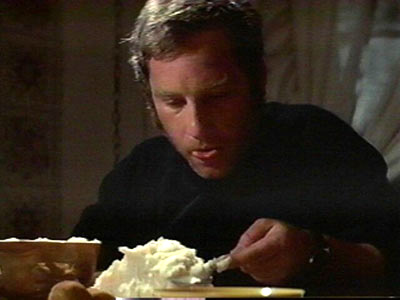
H: jaws must be right up there in the …oh, the top three, i’d say, for “quintessential summer movie watching.” this first list is supposed to be “movies to watch when you want to feel hot” and this should do it for you. just when you’re thinking, “gosh, that water does look nice and cool—” nope, not so much. that water looks nice and sharky. yeah, i know the shark kinda sucks — it bounces and the teeth don’t look right and the tail is a little weird but if you don’t at least twitch when it rears up out of the water beside roy scheider, i think you’re probably wrong in the head on some level.

A: Hanna finally made me watch this on a warm night last summer during which, if I remember correctly, they were performing horrendous road construction activities outside the window. Luckily, the dialog isn’t all this has going for it — though Richard Dreyfuss does a thoroughly charming turn as the enthusiastic shark expert from out of town, brought in on consultation that quickly turns deadly.


Star Wars (1977)

H: well, the first third takes place in a desert. i think that’s reason enough, yes? beyond, you know, just everything else that’s right with the movie.

A: Apparently, being of the female persuasion, we’re supposed to be watching Sex and the City 2 this summer as the girl equivelant of the dudely Star Wars. Since I was pretty much hooked on the original trilogy the first time Leia appropriated Luke’s gun, I cry “foul!” and suggest re-watching all three episodes back to back on a hot summer weekend.

H: everybody remember that scene on the death star when luke approaches chewie with the cuffs and says, “now, i’m going to put these on you—” not his wisest move, right? yeah, picture my reaction to anyone trying to get me to watch s&tc. at least without a healthy dose of irony on hand and, probably, a bottle of wine.

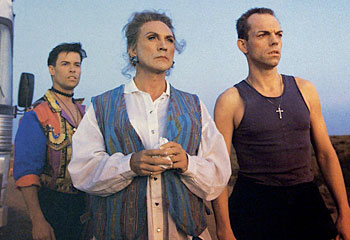
The Adventures of Priscilla Queen of the Desert (1994)

H: “Oh, Felicia. Where the fuck are we.” you want to know a fun way to make someone’s mind bend? find a genre fan; make sure this process won’t make them physically ill and then show them star wars: the phantom menace. then show them priscilla. then ask who they recognize. 🙂 it also works with lord of the rings fans, but often not quite so well.

A: I was introduced to the soundtrack of this movie back when I was about twelve and spent at least one summer listening to it fairly incessantly — on cassette tape no less! Likely on the Sony walkman I thought (when I got it for my ninth birthday) made me look like a totally cool teenager. Hanna (where would I be without her?) finally sat me down to watch the film last fall and I’m so completely glad I did. Really.

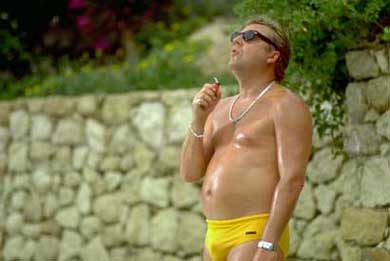
Sexy Beast (2000)

H: “But you’re dead. So shut up.” i’m tempted to say that i’d pay for someone to explain the bunny in this movie to me but…you know what? i’m not sure i want someone to explain the bunny to me. it’s weird and grisly and psychotic and kind of haunting and i think it’s fine just the way it is. i never fully realised how creepy the bunny is until i saw this movie on the big screen last year. not to mention how creepy ian mcshane is. ray winstone comes across as quite cuddly by comparison. ben kingsley as don logan is just so far out in left field it pretty much beggars description. really, the best description of his character is the chill that goes over the dinner table when h — not me — reveals logan’s imminent arrival. there’s a table of four adults who have been chatting about their approaching evening and the mere mention of this man who is coming the next day is enough to change all their expressions, body language, voices, the whole nine yards. to say nothing of the scene in ray winstone’s house in spain where kingsley and winstone are in the kitchen — kingsley is out of shot most of the time, an unseen harangue of profanity and accent from which winstone is physically flinching. he’s the bigger man — he outweighs kingsley by a solid 50 pounds; he has weapons all around himself; and he’s in his own damn house and he is flinching back as though kingsley is hitting him. it’s like watching a badly one-sided boxing match.

A: And Ian McShane is in it! Although only in the London bits. But his character is slightly more understandable than the character he played in the recently-released 44 Inch Chest which was good excepting we aren’t quite sure what the title refers to, what happened to the dog, or what the movie was about, really. So back to Sexy Beast which I promise I really did enjoy except that Hanna took me to see it in the Coolidge Corner theatre back when we were first dating? And to be honest, although I remember thinking the movie was brilliant, thinking back on it I mostly remember how thrilling it was that she let me hold her hand in the dark while we watched it.

To Kill a Mockingbird (1962)

A: This was a “me” addition to the list, and I added it mostly for the quote I referenced in our intro — since it takes places in the hot summer of the South, although that summer stretches into autumn. And when you ask children what they remember about the film, according to Robert Coles, what they remember is not the legal case or the commentary on American racism but the children’s relationship with Boo Radley, the reclusive neighbor next door whom they are frightened of and drawn to and who — in arguably one of the most gripping scenes in the story — rescues Scout on a stormy Halloween night.

H: to be honest, i’ve watched this movie only once, many years ago, and i remember very little about it. i remember the courtroom scene — i remember the last scene with boo radley — and that’s about it. um. this may make me a bad person.
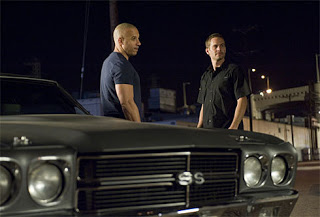
The Fast and the Furious (2001)

A: I defer to Hanna on this one since she has a relationship with cars that, while I thoroughly admire and stand slightly in awe of, I do not intuitively share.

H: i have a theory about movies. it isn’t much of a theory but as far as it goes it runs as follows: every movie has a moment that makes it worthwhile. if you run across a movie that doesn’t, then you have found a true piece of cheese and you should be able to erase it from your brain. excellent movies, of course, are made up of more of these moments — you can see how the rule expands or contracts according to need or personal opinion. f&f has several such moments: brian’s lunch problems in the first half of the movie; dominic’s reaction to the car brian dumps in his garage (“i retract my previous statement.”); and much of the end of the movie. it’s cheesy, yes; it’s simple, yes; but, hey, there’s something likeable about these characters; there is something to watch for other than the tricked-out cars.
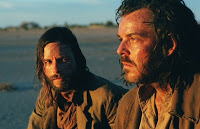
The Proposition (2005)

H: what a movie. hot. every frame of it leaches heat. it’s hot, it’s dry, it’s desert-baked in a way lawrence of arabia never thought of. it is hard to watch. the acting is sharp — there isn’t a dud note in it, down to the extras that populate the half-horse town. strange, violent, strangely violent, depressing, and hopeful.

A: Yeah, I’m with her on the hopeful, though you really, really have to hang in there till the end to get there. Through a really graphic rape scene (for those of you who can’t watch them) and brutal, brutal violence. It’s a movie that pulls no punches, but offers some really fascinating moral dilemmas for its characters to deal with — and refuses to let them off the hook. At all. Meathooks. And you can’t get away from the scenery, which is really a character all its own.

H: well, really, if you can’t handle the first scene, just don’t go further. really. honest advice here, folks. this movie is bloody. nasty. unpleasant. unpicturesque violence. the characters and the story coming through all of that are worth it in my book. the reaction of the townsfolk to the public punishment of an arrested boy alone makes much of the blood, sweat, and tears worthwhile, but there is no use in torturing yourself to get there.


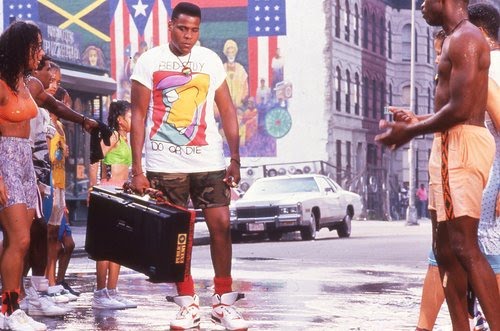
Do the Right Thing (1989)

H: never seen it. er. sorry.

A: This was my pick! My brother Brian, if memory serves, introduced me to this Spike Lee movie a handful of years ago. I’ve lost the specifics now, but remember the contours involving heat, heat in the city, and the short tempers that inevitably break when the heat is so damn hot you can’t remember what it felt like to be cool.
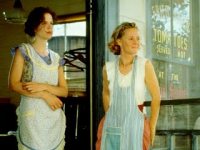
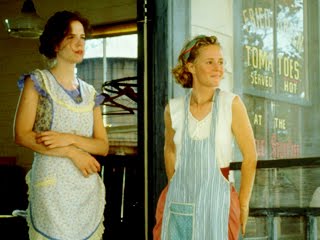
Fried Green Tomatoes (1991)

A: Mary Louise Parker is kick-ass, and really the reason to watch this movie. I mean, okay, there are lots of reasons to watch this movie, but as a young adolescent I mostly watched it to watch Mary Louise Parker kick ass. And cook the bad guy and serve him up for dessert.

H: oh! and there’s that great bit where the tiny little cook whangs the awful rapist child-thieving mean dude with the frying pan! i love that bit! so satisfying! plus the bit where ruth dies in the book made me cry when i read the book in college and understood what was actually happening.
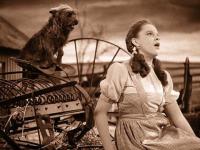

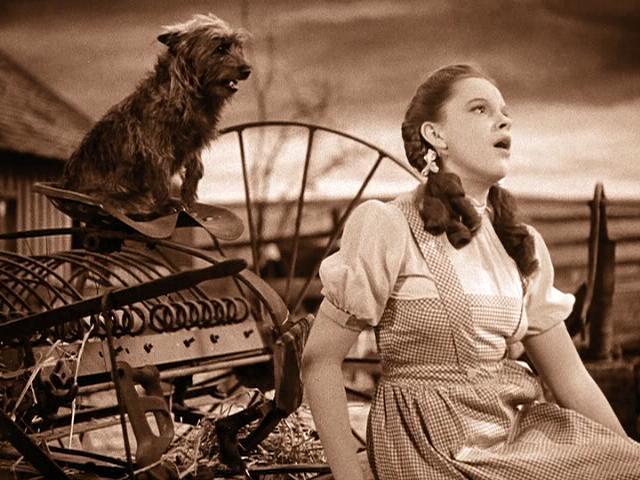
Wizard of Oz (1939)
A: To be honest, Oz scared me as a child — it comes from the same genre of out-of-kilter children’s fiction as Raggedy Ann and Andy stories, in which unhinged characters do things you really wish they wouldn’t, and punishment is meted out unpredictably and by some sort of foreign logic known only by the story creator themselves. L. Frank Baum was not a well man (possibly he spent too much time holed up in his summer cottage located in my home town, writing about the denizens of Oz). I’m with Gregory Maguire on this one: the Wizard of Oz is not a benevolent man, Oz is not a happy place, and the Wicked Witch of the West is not the one we should be frightened of. That having been said: it’s a classic MGM musical with all the bells and whistles, which starts and ends with a tornado in Kansas. What could be more summery than that? Just settle in with a emerald-colored Mojito and enjoy.
H: who wasn’t scared by oz as a kid? seriously — put up your hands so i can fail to believe you. if it wasn’t miss gulch, it was the tornado. if it wasn’t the tornado, it was the munchkins — or glinda — or the trees — or the witch — or — or — or — you gettin’ my drift here?
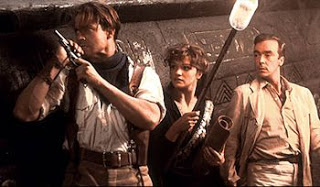

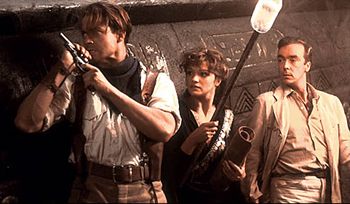
The Mummy (1999)
H: there is rachel weisz. there is brendan fraser. there is john hannah. there are just so many things that make this — and pretty much every other — stephen sommers movie a great ride. i’ve never been able to understand why so many people seem to hate what sommers does — why spend all that time and energy hating something that’s so much silly fun? and so good into the bargain? yeah, he clearly loves him the old universal monster classics — and what’s wrong with that? hell, if they really are going to go ahead with a remake of the gillman, i’d vote for sommers to do it any day. at least i could have faith that he’s seen it! A: What she said. There’s a librarian who (at least some of the time) saves the day, And John Hannah whom I will pretty much follow to the ends of the earth regardless of what he’s in, and Brendan Fraser who always looks like he’s having so much damn fun. And when you’ve finished this homage, go read Elizabeth Peters’ first installment of the Amelia Peabody mysteries, Crocodile on the Sandbank from which so much of these chracters were so obviously and lovingly pilfered.

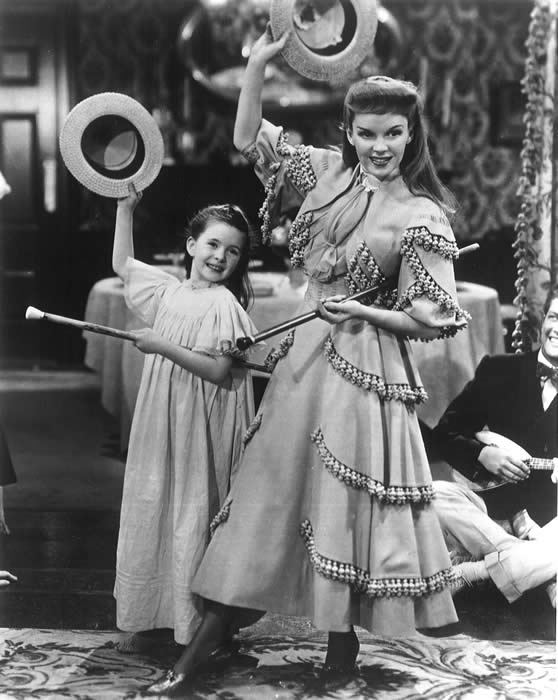
Meet Me In St. Louis (1944)
A: Strictly speaking, this a a film suitable for any season as it is set in four parts, Summer, Fall, Winter, and Spring. but again with the pull-all-the-stops MGM musical genre and it opens with an ice wagon, which is how people used to get ice for their refrigerators (ice boxes) way back when, which is fun. It pedals nostalgia like scalpers selling tickets, but as long as you know that’s what you’re getting it can be fun. And as a bonus, you get the winter bit too–so snow and ice and silly Christmas songs as well.
H: um. never seen this either. but i have seen the trolley song on some documentary about musicals somewhere! that counts, right? A: It totally counts — the trolley song is one of the best things about it. Oh, and little Margaret O’Brien doing soft-shoe.

Twister (1996)
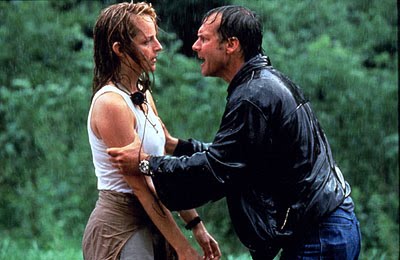
H: “we got cows!” oh, what a silly movie. what a deeply silly, very wrong movie. and yet somehow so deeply, deeply watchable. not least for helen hunt in a frequently soaked tank top but also for the group dynamic and the kind of cheerfully paced action movie that, lets face it, jerry bruckheimer does so well. does it make sense? well– -ish. does it follow established scientific fact? well, there’s that bit where– does a lot of shit go fast? and explode? yes. absolutely yes. and there is philip seymour hoffman. and, bewilderingly enough, cary elwes. and the guy from george of the jungle. explain that one.
A: I was traumatized by Cary Elwes being run through the head by an iron T-bar and can now never, ever drive behind trucks carrying long slender things which might fly off the back of said truck and through my windshield. Other than that, great summer fun and some totally adorable Movie Science(tm), including, if I remember correctly, something beautiful involving lots of ping-pong balls taking flight.
H: you do realize, anna, that you cobbled that scene together in your own head, right? it’s his driver who gets impaled. And it’s through the chest, if memory serves. A: Oh bah.

Fire (1996)
H: i’m out.
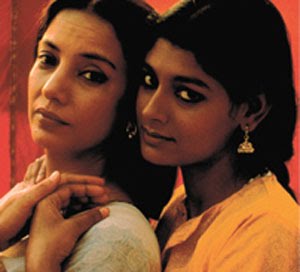
A: Oh, sweetheart, I should really sit you down and make you watch this one sometime :)! It’s the first of a triptych of films by Indian director Deepha Mehta (
Earth and Water being the other two, more historio-political, installments) and tells the story of a woman in a traditional Indian family who falls in love with her brother-in-law’s new wife. It’s a good messy family drama with, ultimately, a fairly happy ending.

H: oh, i’ve heard of it. i’ve just never watched it.
Murphy’s Romance (1985)
H: a romantic comedy from before the days when “romcom” had become one of the worst slurs in film reviewing. A: And at the end of that brief, sweet-sweet era in which gutsy women characters (in this case a woman who’s trying to make it on her own with her teenage son after walking out on an unhappy marriage) could win the man without losing the independence that made them great characters to begin with. Oh whither the day?
H: in all fairness, she hasn’t “walked out” — there has been a divorce. it isn’t like she’s hiding out from “Bad Husband ™.” A: Hehe. True, I was mostly remembering how he showed up later wanting to hang around and patch things up. The ex-who-would-not-leave…

French Kiss (1995)
A: There’s sunshine, I remember that, and cheese. I’m leaving the rest to Hanna.
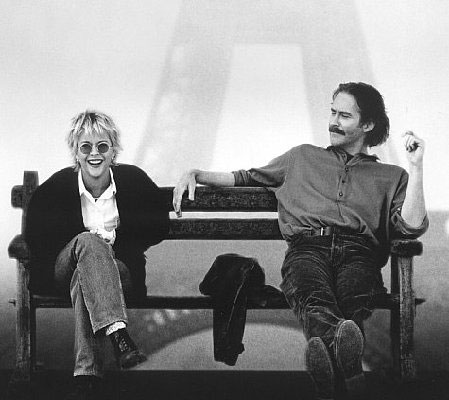
H: this isn’t a very “hot” movie. yes, there are some lengthy walks in the countryside of the south of france where our two protagonists — kevin kline and meg ryan — do look very warm, but that’s about it. no slogging across deserts; no thirst-defying treks. but it is a very sweet, very funny romantic comedy — absolutely perfect for a disgustingly hot evening in the real world when you just about have enough energy to get brie, crackers, and a cold beer (or glass of wine, if that’s your preference) and lie down in front of the tv with a fan blowing on your head. oh, and did i mention there’s a kick-ass soundtrack? and that kevin kline has a french accent? and a black leather jacket? now i have. 🙂
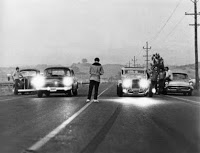
American Graffiti (1973)
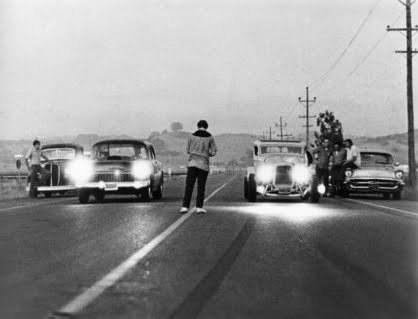
H: god, i love this movie. i really should have been more suspicious of my last ex when i realised she didn’t care for it all that much. this should have been a clue. a lot of the people who started out in this movie now own large chunks of hollywood. really, very large chunks. you get to watch george lucas indulge his antique car fetish; his thing with the ’50s (which he doesn’t try to indemnify or make into a harmless place and time (entirely)); and his fascination with growing up, something i’m not entirely convinced he’s ever done which probably makes him a very happy, contented person.
A: It’s Wolfman Jack, really. Hallie Flanagan, one-time director of the Federal Theater Project during the great depression once said “The power of radio is not that it speaks to millions, but that it speaks intimately and privately to each one of those millions.” Somehow, Lucas makes that point through film, which really deserves a gold star.
Close Encounters of the Third Kind (1977)
H: everyone in this movie is hot, almost 99.99% of the time. if there’s a frame where richard dreyfus isn’t sweating, i can’t remember where it is.A: Maybe they filmed in Texas in August?

Pan’s Labyrinth (2006)
A: This is a hard, hard movie to watch, but absolutely breathtaking in its brutality and (yes) hopefulness, I think. Hopefulness that despite all the overwhelming evil in the world there will be people — often unexpected people — who continue to perform small and courageous acts of kindness, justice, and bravery. “Heat” in this context could, I guess, stand for both the intensity of the situation and the burning passion of those survivors who carry on.
H: um. yes. that. go with that.
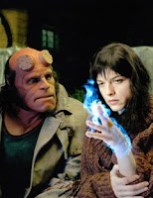

Hellboy (2004)
A: I’d say it was wrong of us to pack the list with two del Toro films, but really, can’t have too much of a good thing and aside from the unmistakable stylistic markers, it really is a world away from Pan’s Labyrinth in tone, though I suspect the same underlying fairytale morality underlies both films. Anyway, how could we possibly skip a film that involves a character who’s a demon from hell and a young woman with a talent for bursting into flames?
H: and the cats. don’t forget the cats. and john hurt. oh! and the seriously creepy clockwork bad guy. can’t forget him.

Gone in Sixty Seconds (2000)
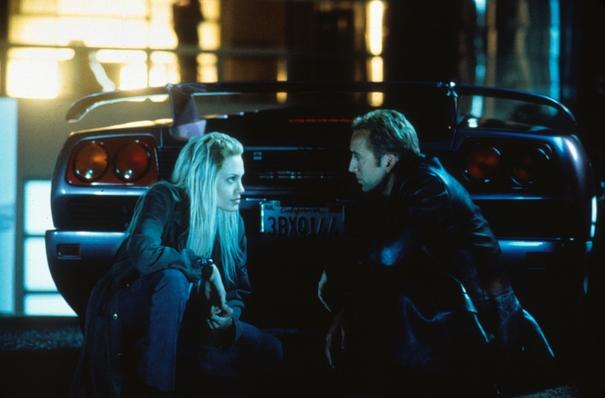
H: god bless this strange little remake. if i hadn’t gone to see it — in the theatre, no less — then when christopher eccleston was announced as the 9th doctor, i wouldn’t have been able to say: “wait — but wasn’t he the bad guy in gone in 60 seconds?” and thought: “oh my god we are so screwed.” and then have to eat both words and thoughts within, oh, approximately, 15 seconds of him showing up on screen in “rose.” anyway, the point here is not to hymn the wonders of christopher eccleston as doctor who (although that is always fun!) but if you’re in the mood for cheap one-liners, great cars and some unexpectedly good acting — mostly from eccleston, giovanni ribisi, vinnie jones, and angelina jolie (“hello, ladies—“) — see this. it is hot — it’s so-cal in the summer time: how much hotter do you want? — and there’s also timothy olyphant playing a gleefully numbskulled cop which, after watching him play an entirely ungleeful law enforcement man in deadwood is worth watching the movie for all on its own. there’s also a kick-ass soundtrack (“flower,” by moby; “too sick to pray,” a3, and “painted on my heart,” by the cult top the list, definitely) and more leather than you know what to do with. oh, and cars. did i mention the cars? this movie cemented my love affair with mustangs and the shelby. god bless eleanor. 🙂
A: I’m out on this one…Hanna hasn’t caught up with me on my delinquency yet!

Apocalypse Now (1979)
H: i’m out.
A: I’m in, mostly because of Martin Sheen whom I will follow to the ends of the earth in necessary (oh, President Bartlet, I do miss you!) and also because I associate
Heart of Darkness with this incredible history of the Belgian Congo I read in undergrad, by Adam Hochshield (Leopold’s Ghost) and the two together pushed me to finally watch this movie — which is basically a remake of Conrad’s novel set in Vietnam. With the heat and the subtropical humidity and the sick, twisted imperialism.
H: well, i’m only “out” because vietnam films make me uneasy. what i know about
apocalypse i know from film documentaries and jarhead which is deeply disturbing.

Predator (1987)
H: as far as atmosphere goes, note-perfect stifling, hot, and sweaty. about as macho as a movie can reasonably get without knotting itself up so tightly it can’t move. i haven’t seen rambo which i suspect might out-testosterone this. but this movie also has one of the all-time great, classic, world-beating creatures. who the hell puts together a sci-fi action thriller where you can’t see the monster for 3/4 of the movie?! john mctiernan and stan winston. of course, they also incidentally created a franchise with a 20+ year span, but we can’t hold them responsible for the second avp abortion. (and i use the word “abortion” advisedly. yuerrgh.) also, this movie falls under my previously mentioned movie rule — the key moment here is, i think, between, bizarrely enough, schwartzenegger as dutch, the nearly-mindlessly tough commanding officer and bill duke as mac, whose sidekick blain has been killed in an encounter with the predator. dutch, trying to make mac feel better, says of blain: “he was a good soldier.” mac pauses for a minute, thinks, looks up at dutch, and says, “he was my friend.” A: I remember lots of jungle and rain and cool hunting sequences.

The Painted Veil (2006)
H: out.
A: It’s a curious film, adapted from a 1925 novel by English author W. Somerset Maugham. It’s a story about an abusive, desperate marriage (adultery on her side, autocratic control on his) between an English debutant (Naomi Watts) and a doctor (Edward Norton) who takes his wife to a remote part of China where they encounter a cholera outbreak and are forced to come to terms with the expectations each of them brought into their hasty marriage. Toby Jones and Liev Schreiber do solid turns as secondary characters, and there is a wonderful cameo appearance by Diana Rigg, who plays a mother superior at a mission school.
sunday smut: links on sex and gender (no. 26)

13 Sunday Jun 2010

Posted by Anna Clutterbuck-Cook in linkspam

≈ Leave a comment

Tags

gender and sexuality, sunday smut

Just the links this week, folks. Enjoy!

LaPrincipessa @ sexgenderbody | Why “The Girl With The Dragon Tattoo” Is So Important.

Ashley Sayeau @ RhRealityCheck | “Sex and the City” Hate: Why Don’t Men Get Slammed for Lavish Spending?

Amanda Hess @ The Sexist | Why Wedding Weight Loss Isn’t About “Health.” Hint: few things are where weddings and People magazine are concerned.

Amanda Hess and Sady Doyle @ The Sexist | Sexist Beatdown: The Chat They Didn’t Want You to Read! Edition. On the discourse surrounding non-consensually publicized sex tapes.

Cara @ The Curvature | Rape, Male Victims, and Why We Need to Care.

irrationalpoint @ Modus dopens | Don’t have answers. On the DSM V and other ways of pathologizing sex and gender nonconforming people and behavior.

Molly @ first the egg | motherbaby, 1981 & 2006. Images of two generations of women and their newborns.

Sinclair @ Sugarbutch Chronicles | On Processing & Analyzing. Ways of communicating, thinking, and writing about relationships.

Courtney @ Feministing | Love across oceans: U.S. government is still a sinking ship. Immigration as a feminist issue.

Ann Friedman @ The American Prospect | It’s Not the End of Men. And I wish to god we’d stop claiming it was.

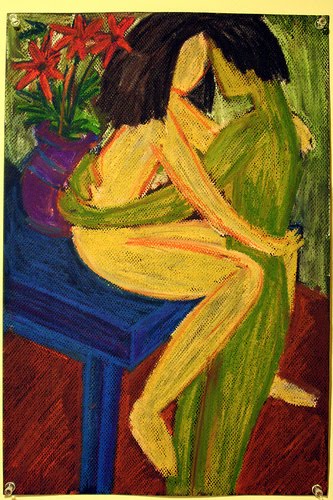
image credit: lovers on the table by .shyam. @ Flickr.com

feeling guilty for wanting a balanced life

11 Friday Jun 2010

Posted by Anna Clutterbuck-Cook in think pieces

≈ 1 Comment

Tags

domesticity, simmons, thesis, work-life balance

I’ve recently been making some decisions about how and when to complete my graduate education. Decisions which have left me feeling one part proud of myself for saying “nope, this isn’t working” and making the necessary changes and one part small and ashamed of being slow and for, well, wanting a balanced life. It is always humiliating (or at least I find it so) to find one’s self buying in, even a little bit, to the cultural pressures and voices in one’s head that pass judgment on the personal life decisions. Decisions that I know, in my gut, are right for me but nevertheless run counter to the mainstream expectations of how we ought to live our lives.

And yet, despite knowing I’m right, I do feel that pressure, and I do hear those voices. As I was trying to make a decision about whether or not to revise my planned thesis-writing deadlines to give myself more time for writing I was acutely aware of those dynamics. And the dynamics of justifying whatever decision I made both to myself and to others (my advisers, my family and colleagues, etc.). So I have a few observations that I’d like to share with you.

As I sit here spelling them out, they all seem rather obvious — but I think in part because of their very ubiquity they become invisible to us. So for that reason I’m going to the trouble of articulating them anyway.

The first observation is that it is really damn hard in our culture to feel comfortable making the argument that I am part of a family and that it is important for me to nurture the relationships that make up that family even while pursuing academic work and wage-work that I also care about. When justifying my thesis extension to my advisers, I emphasized my work schedule and the importance of having enough time for deliberation and revision while writing. I was up-front about the importance to me of having regular leisure time with Hanna during the week, but I was careful to name that desire as one of a number of factors, rather than foregrounding it as one of my primary concerns (which, in fact, it is). And part of me felt ashamed for naming it as a primary concern, even as I persisted in doing so.

A related reason that feels like an admission of failure is naming domestic responsibilities and the amount of time they take: quotidian tasks such as the morning and evening commute, physical exercise, dish-washing, laundry, grocery shopping, cooking, cleaning one’s kitchen and bathroom, attempting to impose some order on a very tiny apartment space in which two grown women, a cacophony of plants and myriad books are attempting to co-exist. As feminists have pointed out repeatedly for the past two hundred years (at least), domestic concerns are not taken care of by magic (sha-zing!), but rather through work, work that takes both time and energy on the part those whose duty it is to complete these tasks — whether those persons are paid domestic servants, unpaid spouses, or (in the case of those with neither the economic resources to outsource or a “separate spheres” arrangement with their partner) someone who comes home from work to a second shift.

Yet, as feminists have also pointed out, our society is still organized on the underlying assumption that these tasks will be completed on an invisible level, but people whose labor doesn’t officially count — or possibly in some gap in the space/time continuum. So it feels shameful to acknowledge openly that these tasks do take time, my time and Hanna’s time, and that these domestic responsibilities do not count as leisure activities. Rather, they too are un-fun duties that detract from rest and relaxation during the week.

Both of these facets of life — time to enjoy relationships and time for domestic tasks — fall under the broader umbrella of self-care, which is really the third life activity that is so very difficult to talk about, much less claim time for, in our culture (more about that in a forthcoming post next week). Despite all of the hue and cry that we are a narcissistic, self-obsessed culture very little in the structure of our society encourages care for, and love of, the self — something that is foundational to being effective in any other aspect of life. Yet it is something that is supposed to happen around the edges of our other obligations — shoved to the early mornings, late evenings, weekends, holidays. Rather than occupying its central place in the fabric of our daily lives.

My advisers were, I would like to be clear, not pressuring me to finish within the original time-frame, and were even supportive of my desire to have a life outside of school. But nonetheless, it was a difficult thing for me to ask for. One of them expressed confidence that I could finish writing in the time originally planned, and suggested that deadlines are important in curbing perfectionist tendencies. Which made the voices in my head start to wonder: was I really just panicking about writing a less-than-“perfect” thesis? Was requesting an extension just delaying the inevitable needlessly? But then I realized that these questions and doubts I was having focused the question back on the thesis itself, once again eliding the life I lead around the thesis project, and how that “extra-curricular” world has a place of equal importance in my life.

To be honest, when push comes to shove, it has a more important place in my life. By which I mean that caring for personal relationships and spending quality time with the people in my life will virtually always academic endeavors, unequivocally.

And that’s what I have the hardest time admitting to myself and the world: that people will always, always come before ideas in terms of my priorities. Why is admitting this so difficult?

In part, at least, it’s because I do, truly, feel passionate about ideas. As anyone who has lived in close proximity with me since I became verbal can attest: I am constantly thinking, processing, analyzing the world around me. It’s something I find endlessly enjoyable, satisfying, meaningful. My thesis, in this particular instance, is a self-chosen research project on a topic that’s been close to my heart for the past fifteen years; it has re-connected me to people for whom I care deeply, and whose own work in the world I admire. I will see this project through to the end, and I will be proud of having contributed my bit to the history of this particular time and place. I am good at what I do, and I believe in making use of my skills as a writer and thinker.

But as much as I love the world of ideas, I do not thrive in the world of academia, and I don’t think I quite understand — at least intuitively — what it takes to be the type of person for whom scholarship is their passion, their lifeblood. And often I feel incredibly guilty about acknowledging this, since I live and work in a world surrounded by such scholars.

It makes me feel, in some obscure hard-to-put-my-finger-on sense, like I’m letting them down. That I’m failing to live up to their hopeful expectations that I become a driven, passionate scholar like them.

Finally, I also think that, as a woman and a feminist, I find it particularly fraught to speak about those instances in which I choose to prioritize personal relationships over what amounts to my professional identity. Part of me struggles with the realization that, in doing so, I am conforming to cultural expectations of what women “naturally” prefer: we’re “naturally” more intuitive and relational, blah blah blah (“rubbish!” as Hanna would say). Another part of me is pissed that I feel ashamed of making those choices because I realize that, on some level, my feeling of shame means I have bought into the (profoundly anti-feminist) cultural idea that those “feminine” realms of being are somehow a lesser choice. And yet a third part of me is haunted by the women academics who have worked so hard to assert their right to be a part of the life of the mind, and I feel saddened by my acknowledgment that I have (more often than not) failed to feel at home in the space they were so triumphant, not so very long ago, to gain entrance to.

In the end, though, I don’t think this is an issue of gender (though it has aspects specific to cultural expectations of women and men) so much as it is an issue of “work” and how we understand what counts as work and what the place of work should be in our society and in our individual lives and self-identities. If anything, I suspect men still have a more difficult time in our culture claiming time for non-work activities, particularly activities that involve relational intimacy and home-making.

Most of all, I think this is an issue of re-claiming the right to make space for things that are not-work in our lives, and make the (radical?) assertion that often these things are more important to us than those things which count as work.

This has been a long, rambling blog post for which I have no tidy concluding remarks. So I thought I would end with some open-ended questions. I hope some of you will take the time to respond to in comments! What things do you find yourself struggling to justify making time for, and why? What do you do when your personal priorities are at odds with society’s priorities?

image credit: awkward by sketch | erase @ Flickr.com.

small announcement: thesis blog goes live

10 Thursday Jun 2010

Posted by Anna Clutterbuck-Cook in my historian hat

≈ Leave a comment

Tags

blogging, simmons, thesis


For those of you who are involved with or otherwise interested in my thesis research, I have established a second blog through which to stay connected with my oral history narrators and keep folks updated on my research activities. The blog can be found at

oeoralhist.blogspot.com

Eventually, I hope the blog will become a gateway for access to the oral history interview recordings and transcripts that I plan to make available online through the Internet Archive. For right now, it’s a bare-bones operation explaining the purpose of the project, how to participate, and where the project now stands.

I’ll continue to post related booknotes and more personal observations here at the FFLA as well, but wanted to make all of you aware that this other resource is out there and that I will be using it down the road as the main portal for making my research available online.

$1 review: portrait of a marriage

09 Wednesday Jun 2010

Posted by Anna Clutterbuck-Cook in book reviews

≈ Leave a comment

Tags

gender and sexuality, history

$1 reviews are posts about books I find (or Hanna finds for me) on the $1 used book carts at the bookstores we visit around Boston.

This past Sunday I happened, for one reason or another, to spend a lot of time in transit on the T here in Boston and anticipating this I had dropped a battered first edition of Nigel Nicholson’s Portrait of a Marriage (1973), about his parents Vita Sackville-West and Harold Nicholson. I had read it once before, a number of years ago, and have also seen the 1990 television adaptation starring Janet McTeer and David Haig (which I highly recommend). But it was fun to read the book again.

This time around, I was struck by a couple of things that I thought might interest y’all (mild historical spoilers ahead for those of you who care).

The first is that, reading with my historian’s (not to mention archivist’s) eyes, I am freshly astonished by the rich depth of the documentary record. Portrait of a Marriage, for those of you who don’t know or need a refresher, takes as its core text and autobiographical narrative written by Vita Sackville-West in her late twenties and discovered by her son, Nigel Nicholson, after her death. It tells the story of her early life, marriage to Harold Nicholson, and her tumultuous romance with Violet Trefusis that threatened to end their marriage but ended by confirming its centrality in her life. This autobiographical text, written when the crisis was still fresh in Vita’s mind, is placed in historical and biographical context by sections authored by Nigel Nicholson and drawn from a seemingly limitless supply of primary source material including family diaries, correspondence, newspaper accounts, photographs and paintings, and oral testimony. This is apparently a family that saved everything rather obsessively. I am not sure if this was because, as part of the titled classes in Britain, they felt somewhat obliged to document their private lives for the (eventually) public record, or whether Vita and Harold’s lives as writers and (in his case) a civil servant fostered the urge to record and preserve, but the Nicholson family has — in the generations since — given rise to a number of authors, many of whom have tackled autobiographical subjects and draw upon the family’s historical record. Portrait is an early example of this type of writing and I think as an example of family autobiography is a remarkable one.

My second observation, during this reading, was the way in which Vita describes her relationships with Violet and Harold, respectively, and the way they are compared within the sections written by Nigel — who is drawing heavily on family narratives concerning the events described. The marriage which this book seeks to provide a portrait of is the relationship between Harold and Vita — for it is that relationship which is seen to have endured and, in a sense, “won out” (maintained priority) in their lives in the face of competing sexual attractions: Vita’s to other men and several women, including Violet whose story is most central to this book (more below), and Harold’s relationships with men. These relationships were openly acknowledged between the couple and at times other family members, and appear to have in some measure been essential components of their shared life: some part of the glue that held them together.

The stability of this marriage — centered as it was around shared family life and a commitment to Knole and Sissinghurt Castle — is contrasted with the vicissitudes of Vita’s lesbian relationships (all comparatively short-lived), most notably her stormy relationship with Violet Trefusis whom she had known since childhood and loved passionately for a period of time in her twenties.

Vita and Violet fell deeply in love after Vita’s marriage to Harold and the birth of her children (according to Vita’s autobiography, Violet had been pursuing her since before the marriage, though Vita seems to have remained semi-oblivious, partially because she was involved in a relationship at the time with a woman named Rosamund (who was crushed when Vita announced her impending marriage). During the intense period of their relationship, Violet actively fantasized about the two going away together to the continent and living their lives together, free from Vita’s ties to family and to place and in an openly-acknowledged committed relationship. Vita, by her own account, seems to have been seduced willingly by this vision of a shared future and the couple ran off together for extended holidays on several occasions, living as a couple and ignoring the pleas of both families for them to return to England and the responsibilities that awaited them there.

It would be likely unfair to see Harold and Vita’s relationship as the key factor in putting an end to that alternate life; Violet sounds like a volatile person, impractically-minded and impatient, who tried a number of back-handed ways of separating Vita from her family life including a sham marriage to a man whom she made promise never to pressure her into sexual relations. But what I found myself wondering, as I read the story, was whether any of the players involved at the time could have imagined an end to the story that had involved Vita and Violet as the couple at the center of the tale. Whether the women, as a couple, could have — in another historical or cultural context — have been the pivotal relationship, the pairing at the center of domestic life.

As I say, it is perhaps an unfair question, given that Violet seems to have viewed Knole as a rival for Vita’s affections and had no interest herself in rural life. But aside from the specific personalities in question, I have a sense from the overarching family narrative that it never would have occurred at the time to this cast of characters (the drama played out in the late 1910s) that a solution might have been found that would not have forced Vita to make a choice between her familiar responsibilities (and, to be fair, clear desires) and her love for Violet. In another time and place it might have been more possible for the pair (and those around them) to incorporate Violet into family life rather than seeing her as a threat to it. And, too, if that had been more possible perhaps Violet would not have felt so desperate as to resort to the manipulative behavior she seems to have engaged in.

I don’t mean to belittle the love and liking that Vita and Harold clearly (through family testimony and personal correspondence) to have felt for one another — yet I mourn the fact that the love and liking of Vita and Violet faced such overwhelming odds — odds that likely contributed to its eventual unraveling.

image credit: image of Vita Sackville-West snagged from the blog Tasting Rhubarb which offers a review of a recent book on the Sissinghurst garden.

why "gay" shouldn’t be the default term

08 Tuesday Jun 2010

Posted by Anna Clutterbuck-Cook in think pieces

≈ 4 Comments

Tags

feminism, gender and sexuality, politics


People of the non-straight variety are having some issues with the “alphabet soup” practice of labeling, as in “LGBT-friendly” or “LGBTQ activism.” In the most recent issue of Bitch magazine, R.F. McCann asks whether “lesbian” is going out of fashion

It makes sense that the straight public and mass media have latched onto “gay” as their go-to term; it’s short, largely inoffensive, and widely understood, making it ideal for headlines, soundbites, and voluble public discourse. While “homosexual” is overly formal (not to mention long) and “queer” strikes some as harsh, “gay” is perky, conveniently monosyllabic, purportedly gender-neutral, and certainly less racy-sounding than “lesbian,” with its silky “zzz” sound. But why exactly has the nonstraight population allowed “gay” to slide so comfortably into ubiquity? Surely the lesbian—scratch that—gay female community could put up a fight if it wanted to. But it doesn’t seem to want to. Are women bored with the word? Do they dislike it? Have labels simply become less relevant?

While McCann’s article is openly inquisitive, seeking to document trends in language usage John Aravosis @ AMERICAblog Gay is arguing for activists to resist inclusive acronyms such as LGBT in place of the “perky, conveniently monosyllabic” (as McCann writes) word “gay” (hat tip to Amanda Hess @ The Sexist). He writes in I’m not an ‘LGBT American’

I think LGBT is a cop out for straight people. Much easier for a politician to laud the LGBT community than the GAY community, because no one outside of the gay community knows what the LGBT community even is. I’ve seen signs at rallies proclaiming something or other about “LGBT”, and I’ll bet everyone at the rally who wasn’t gay was scratching their head. In an effort to be more inclusive, we’ve shoved ourselves back into a sort of linguistic closet.

If we’re all one community, then we don’t need to keep adding letters to divide us.

Hanna and I have this conversation occasionally. I tend to err on the side of inclusivity and trying to be as accurate as possible in naming people with the labels they wish to be named; she tends to err on the side of what’s easiest to communicate in terms of an activist message (even I can’t always remember what the Q in LGBTQ is supposed to mean…!) and also expresses frustration with the need to label ourselves in the first place.

I’m definitely with her on the “it’s clumsy to say” issue and have found myself defaulting more and more to big umbrella terms like “queer,” “non-straight” and “gender nonconforming” when talking about human rights and social justice issues that intersect with sexual orientation and gender identity. I’m also of the fluid, mix-it-up generation (as much as I resist formulaic talk of generations), and variously include myself in groups of folks who identify as “bisexual,” “lesbian,” “non-straight” and “queer,” without the sense that I’m betraying the sisterhood by acknowledging that I’m not exclusively drawn to women in my sexual desiring, or denying my solidarity with a marginalized group by switching up how I identify. (Though I realize this fluidity is easier for individuals than it is for, say, nonprofit organizations that need to choose what terms will end up in the incorporation papers, on their promotional materials and web presence).

Here’s the thing. The bone I have to pick with Aravosis.

Want to argue for inclusivity with a word that helps us avoid the alphabet soup? Totally cool by me. But the solution to the alphabet soup problem is not to revert back to the word “gay.” Gay stopped being the go-to term for a reason, in that it was challenged as being exclusionary by people who do not feel the word (with its strong associations with male-identified homosexuality) really included them. “Gay” sort of, sometimes can include lesbian women (see McCann’s article above), in the way that many male-gendered terms can include female members of the human race. But the same isn’t true for “lesbian” (we sometimes say “gay men and women” but never “lesbian women and men”). Bi folks, of course, have are not exclusively gay and trans folks can be straight or gay or bi (which, really, is true for so many of us as we move through our lives — but that’s another issue entirely).

Arguing that the defult one-word term should be “gay” makes you sound like you’re not aware of this history, and of the reasons the term caused unhappiness within the non-straight community in the first place. If you’re going to pick “gay” as the catch-all term, you need to make a good case for why that word should win out over “lesbian” or “queer” or any of the other identity-labels that make up the alphabet-soup we’re currently stuck with. Gay isn’t the obvious default option, or it shouldn’t be.

Now, of course, in the end, all of this quasi-academic debate might not matter as much as shifts in usage, as McCann points out. As I’ve written about before, the English language, despite the fear-mongering of the Right over political correctness, has no “language police,” and the evolution of language ultimately happens through what words people choose to speak every day and what they understand those words to mean. But that shouldn’t stop us from having these conversations, and thinking about the implications of one usage ultimately winning out over another.

What terms do you like and dislike when it comes to sex- and gender-based identities? Which do you wish we could jettison entirely and which do you have inordinate fondness for? What words have you used to identify yourself and your communities in the past, and have those words changed over time? Why or why not? Feel free to share in the comments!

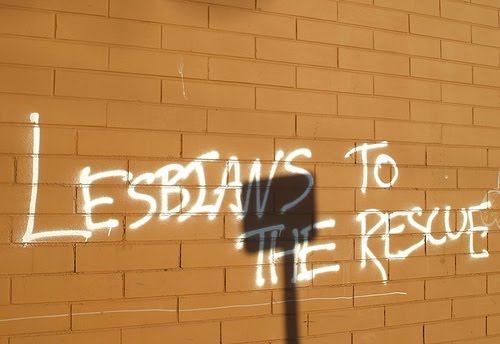
image credit: Lesbians to the Rescue by PinkMoose @ Flickr.com

← Older posts
Newer posts →
"the past is a wild party; check your preconceptions at the door." ~ Emma Donoghue

Recent Posts

  • medical update 11.11.22
  • medical update 6.4.22
  • medical update 1.16.2022
  • medical update 10.13.2021
  • medical update 8.17.2021

Archives

Categories

Creative Commons License

This work by Anna J. Clutterbuck-Cook is licensed under a Creative Commons Attribution 3.0 Unported License

Meta

  • Create account
  • Log in
  • Entries feed
  • Comments feed
  • WordPress.com

Blog at WordPress.com.

  • Subscribe Subscribed
    • the feminist librarian
    • Join 37 other subscribers
    • Already have a WordPress.com account? Log in now.
    • the feminist librarian
    • Subscribe Subscribed
    • Sign up
    • Log in
    • Report this content
    • View site in Reader
    • Manage subscriptions
    • Collapse this bar