• anna j. clutterbuck-cook
  • contact
  • curriculum vitae
  • find me elsewhere
  • marilyn ross memorial book prize

the feminist librarian

the feminist librarian

Tag Archives: being the change

stuff that may be keeping me from blogging (as much) this summer

21 Friday Jun 2013

Posted by Anna Clutterbuck-Cook in life writing

≈ Leave a comment

Tags

being the change, blogging, domesticity, history, work-life balance

During the past few weeks, I’ve been reading stories on the internets about which I have Thoughts and Feels, but for which I have very little (if any) time or energy to blog about. Non-internet stuff has been happening, in that way that takes attention and emotional-mental-logistical energy. In that way that takes up all the brainspace and physical time/space otherwise filled up with typing words that become blog posts.

canoes on the Charles River lagoons, 2008

So blogging might be a little slower around here than it has been in the past few months. Here’s a run-down of some of the things I’ll be doing when not seen in this space:

  • I’ve been getting back into some personal (not-for-work) history research in the cracks between my other obligations. I’m on what we call in the business a “fishing expedition” looking for a project that will yield something interesting and original on the crossroads of gender, sexuality, and religion within the Christian left during the 1950s-1980s (focusing on the early 1970s). My starting point is the Methodist Student Movement publication motive magazine (1941-1972), outspoken on issues such as poverty, civil rights, and cold war politics, the staff of motive experienced a decline in denominational support when they published an issue on women’s liberation in 1969 through to the final two issues, published independent of the church, on gay men’s liberation and lesbian/feminism. My current line of questioning circles around why Christian theology provided a robust vocabulary for speaking about some leftist issues — but seems to have failed its young activists on feminist and queer issues. I’m keeping busy reading motive, some personal papers of its editors, and surveying the secondary literature … a few hours a week, stolen when I can.
  • Against my better (or perhaps simply more self-centered) judgement, I’ve been Getting Involved at work with some advocacy issues related to organizational transparency and employee benefits restructuring. As a small non-profit cultural institution (we employ a staff of about fifty) we’re facing some post-2008 financial fallout that requires reduction in benefits. Questions about how decisions have been (and will be) made, and how employees will (or will not) be involved in the process are a live concern. I’ve been tapped to be part of a staff advisory group, and volunteered to be on a retirement planning committee. If any of you have reading suggestions for good books or articles about worker advocacy in the non-profit, non-unionized workplace I’m happily taking suggestions!
  • General workplace busyness during the summer season, which is when many of our fellowship recipients make time to visit the library to conduct their research, and casual visitors in Boston on holiday make an appearance.
  • For the past two months, Hanna has been working her way through an allergy identification diet which has demanded particular attention to cooking and a lot of learning-on-the-fly about alternate ingredients. So far, the likely suspect is gluten intolerance, which will require a reorganization of the kitchen, our shopping & cooking patterns, and all that jazz. Do you know how hard it is to find non-preachy gluten-free cookery books?
  • I’ve been trying to spend more time reading offline and doing other non-internet activities, particularly on the weekend. Some of those things I’ve blogged about in my book review posts. I’m also enjoying such things as The London Review of Books, The Lesbian Connection, Bitch magazine, and back issues of our various professional journal subscriptions (The American Historical Review and Library Journal and Oral History Review and so forth). 
  • Biking means less time to read offline while commuting. As whingey as this sounds, biking more to and from work reduces my leisure reading time by as much as five hours per week — a not insubstantial amount!
  • I’ve been seeing a wonderful uptick in personal emails over the past few months, as long-distance friendships have evolved from blog-based to email-based exchanges. This is a positive development, in my personal opinion, but also means that much of my writing and discretionary intellectual energy gets pulled in the direction of one-to-one conversations rather than blog posts sent out into the aether.
  • And yep, I’m still fiction (and fan-fiction writing)! For example, the piece of erotica I submitted last weekend, and the series I’m adding to on a weekly basis over at AO3.

And finally, as a reminder, you can generally see/catch me on Twitter (@feministlib) if you’re curious about what I’ve been reading and thinking about in 140 characters per notion. Also, emails (feministlibrarian [at] gmail [dot] com) will usually rouse me (see second-to-last-bullet-point above) since I love correspondence.

In the meantime — hope y’all are doing well and have kick-ass summer plans. I’m sure we’ll see one another around!

post eleventy-hundred: nerd blessings

01 Saturday Jun 2013

Posted by Anna Clutterbuck-Cook in think pieces

≈ Leave a comment

Tags

being the change, blogging, fun, random kindness, thankfulness

Today, after making a trek to Harvard’s library privileges office in the middle of the first heat wave of the summer to apply for spousal library privileges (what could be nerdier than that?) I finally made the time to watch Wil Wheaton’s message to a baby nerd, which Hanna sent to me several weeks ago via the Mary Sue.

I thought it was appropriate to share as my 1100th post here at the feminist librarian.

Stay cool, everyone, and spend some time this weekend loving your favorite things as hard as you can.

comment post: unfinished thoughts on non-consensual sexualization

07 Thursday Feb 2013

Posted by Anna Clutterbuck-Cook in think pieces

≈ 4 Comments

Tags

being the change, bigotry, comment post, feminism, gender and sexuality, moral panic

Regular readers of this blog may remember that over the past year or so I’ve been haunting the conservative Family Scholars Blog hosted by the Institute for American Values (IAV) think tank founded by David Blankenhorn, sometime high-profile opponent of same-sex marriage. In part, I follow the blog because my smart and funny friend Fannie is one of their guest bloggers. I am also deeply interested in the worldview of people whose understanding of how the world works, and what values will increase the well-being of humanity, are so different from my own.

Last week, I found myself sucked into a comment thread at the FSB wrestling with the subject of what I’ll call “non-consensual sexualization.” My working definition of non-consensual sexualization is public expressions which frame another person’s appearance, presence, or actions in a sexual light without their participation or consent. You might also call this plain old “sexual objectification.” I’m using my phrase here because I think it’s important to highlight the non-consensual part of what’s going on here. Continue reading →

you know you’re a giant nerd when …

04 Monday Feb 2013

Posted by Anna Clutterbuck-Cook in linkspam

≈ 2 Comments

Tags

being the change, family, married life, npr

… your NPR membership card arrives in the mail and you’re super excited to a) feel like a grown up again ’cause you can afford to be a member of NPR for the first time since starting graduate school, and b) because WBUR is awesome enough that they actually had a way for us to join as a family and the membership card features both our names.

Um, yeah. That’s it for now. 

comment post: pressure to self-disclose in the classroom

31 Thursday Jan 2013

Posted by Anna Clutterbuck-Cook in think pieces

≈ 7 Comments

Tags

being the change, comment post, education, gender and sexuality

unidentified classroom, possibly in Georgia (Library of Congress)

I subscribe to a number of listservs through H-Net, an online hub for humanities scholars. This past week, on  H-HistSex, the list for History of Sexuality, there’s been a discussion about class exercises for the first day of class in a gender/sexuality course. I can’t link to the conversation “thread” as a stable link, but you can find all of the relevant emails in the January 2013 log with the subject heading Re: Exercise for first day of class in gender/sex course. The resulting conversation was one that I thought some people who read this blog might be interested in. So I’m sharing a few excerpts here (all publicly accessible through the message log above) and wrapping up the post with my own comment which I sent out this afternoon to the group.

Several faculty contributed ideas about “getting to know you” activities that included some sort of topical self-disclosure and/or exercise designed to prompt personal reflection about sexuality and gender. For example:

I teach an introductory class … and it’s often fun to make them stand up and ask them to sit if the statement you make applies to them . . . to see who is the last one standing. You can use all kinds of “gender” statements like “I’ve dressed as the ‘opposite’ sex” or “I’ve seen a drag show.” They seem to like this exercise.

And:

I have found that simple writing a three paragraph first person narrative as an opposite gender as useful exercises. Students have responded initially as very difficult to do. But in the end they find it increased awareness of gender issues.

Or:

Think of a pivotal experience that made you aware of the construction of gender in your own life.  Use details to describe a specific incident or two.  It could be either a positive (empowering) incident, or negative (discriminatory, hurtful) incident…Not only does it get them thinking of the issues we’ll be covering, but it has turned out to be a wonderful “getting to know you” kind of exercise.

To which some people pushed back, suggesting that such activities can be experienced as threatening or alienating to some students:

You don’t want to instantly lose shy, introverted students who have not faced explicit or alternate understandings of sex and gender. Some students do NOT want to talk in front of large groups.  Further, there might be students from very conservative backgrounds who will be lost if they are pushed too quickly.

Or, as another contributor pointed out:

We might want to reconsider activities that require students to self-expose by standing or moving or agreeing/admitting to statements. This can be very problematic for any students who are/identify/gravitate toward the non-normative (i.e., trans- and genderqueer students, students who may be questioning their gender and/or sexual orientations, as well as for students who are disabled). There requires a lot of imposed confession of students. Ditto the activity that requires students to write as the “opposite” gender — what do I write about if I am identifying as trans or gender queer?

What I think is most interesting is the resistance that these cautions provoked among some other contributors. One person wrote:

If students aren’t exposed to this theorization of the personal and personal theorization in our classrooms with forthcoming discussion leaders that role model critical thinking then where exactly will they be exposed to it? A puritanical fear of sharing about gender and sex and sexuality seems to me counter-productive to the very purpose of feminism and women’s/gender/sexuality studies.

That was the contribution that finally prompted me to enter into the discussion myself, from the perspective of someone who has been in the study, not instructor position, as well as someone who has thought deeply and observed closely the power dynamics in the classroom. Here is my full comment [with a few clarifications added in brackets]:

In response to the observation “A puritanical fear of sharing about gender and sex and sexuality seems to me counter-productive to the very purpose of feminism and women’s/gender/sexuality studies,” I would just like to offer a couple of thoughts.

I am a former women’s studies student (B.A., self-designed major) and have experience in graduate school in gender studies classrooms as well, although my advanced degrees are in History and Archives Management. I believe in the power of self-disclosure in the classroom, but I also think that it is important that student[s] feel INVITED rather than REQUIRED to share aspects of their life story, particularly in a classroom setting where there is a power dynamic (all classroom settings) and before trust between students and between each student and the faculty member has been established (e.g. on the first day of class). I have been in situations where there was pressure to share aspects of my life story that I didn’t feel comfortable sharing, and later felt a (low-grade, admittedly) kind of violation [as a result]. I have also been in class with students who do NOT experience schools as safe spaces, OR who experience schools as safe spaces precisely because they don’t require that level of self-disclosure (which the students associate with bullying, etc.).

So while sharing personal experience can be very powerful in the right setting, it can also feel violating and can cause students to turn away from the very type of gender theorizing we hope to encourage them to pursue. Perhaps if such exercises are done early on in class (or, indeed, at any point during the semester), the sharing of reflections by the student could be optional? (And I mean truly optional, with no pressure from the professor to disclose what they don’t feel comfortable disclosing.) Obviously, the professor can do everything possible to model an open and non-judgmental space, but it is impossible to know what baggage every student may carry into the classroom — particularly around experiences of sex and gender which are so deeply personal (and often private, even if not shameful) experiences.

I think the success of such sharing turns on consent. Think, for example, of the psychological difference between choosing to self-disclose one’s sexual orientation or gender identity and being “outed” by someone when you weren’t ready or didn’t feel safe doing so.

I am all for open discussion about gender and sexuality, but I think every student is in a different place in terms of their willingness and ability to speak in deeply personal terms about what those things mean to them. The option for speaking about those ideas with a little more distance and self-protection, particularly at first, seems respectful of that variation among learners.

I had at least one participant email me off-list to thank me for speaking up. I think the entire exchange is a really important example of how mindful we all need to be about the situation nature of self-disclosure and the way that power dynamics can make something that sounds liberating (and might even be liberating for some people in the space) coercive, an abuse of professorial power.

Yes, as the faculty member responsible for teaching the class, you can ask your students to do difficult intellectual and even emotionally-stretching tasks. In a class on sexuality and gender a responsible professor will likely push most of their students to the edge (or beyond) of their comfort zone at some point during the semester. However, there is a difference between requiring students to think critically about gender and sexuality and demand that they share aspects of their identity or experiences in a room full of quasi-strangers, at least some of whom are likely to hold negative beliefs — or at least misconceptions about — those qualities. I would not have felt safe, for example, speaking about my emerging bisexual desires in the women’e studies classes I took as an undergraduate because of remarks other students had made about bisexual promiscuity. I would have not felt safe talking about my interest in pornography or BDSM role-play around some of my women’s studies faculty. In graduate school, I had a trans friend who came out (voice shaking) in order to combat some of the stereotypes being tossed around in class, and felt conflicted about that self-disclosure after the fact. I had friends from working-class backgrounds who struggled with feelings of difference; simply saying as an introductory exercise that they came from a household below the poverty line wouldn’t have made them feel any more like they belonged in the classroom space.

There are ways to allow for self-disclosure without demanding it — mostly by modeling acceptance as a mentor and encouraging students to examine their pre-conceptions about others. When you speak up as a faculty member and challenge a student’s sloppy thinking you’re sending a message to that quiet student in the back room that they can also raise challenges to similar statements, without prefacing those arguments with a litany of self-identity qualifications. And I’d argue that this ultimately makes the classroom a safer space for everyone within it to listen, to speak, and stand a chance of being heard.

baby steps by my alma mater

17 Monday Dec 2012

Posted by Anna Clutterbuck-Cook in think pieces

≈ Leave a comment

Tags

being the change, gender and sexuality, hope college, michigan, wedding

I’ve been critical of my alma mater, Hope College, here on this blog in the past — particularly when it comes to the institutional refusal to affirm the queer faculty and students on its campus. I stand firm on my pledge not to support the college financially until such time as its anti-gay policy changes.

However, I do also believe in giving shout-outs to those at the college who aren’t letting the official policy stand in the way of affirming the humanity and equality of those of us in the Hope College diaspora who happen to be queer.

In that spirit …

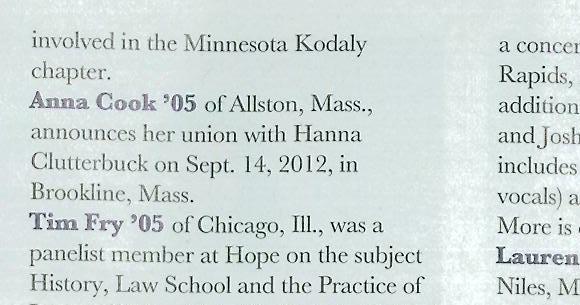
When Hanna and I sent out our wedding announcements in late September, I sent one to the Hope College alumni office; friends and family members were betting on whether or not the announcement would run in the alumni magazine’s list of news from graduates (births, deaths, marriages, advanced degrees, and so forth) that fill the back of each issue.

They had about even odds for and against running the notice at all.

But I got the latest issue of News From Hope College this weekend and there we were on page 27.

Of course, as there is a “Marriages” section of the News, the announcement would have more appropriately gone there since, you know, we got married.

But I imagine someone had to fight to put our “union” in the magazine at all, and I’m all for recognizing baby steps when they’re taken in the right direction.

So thank you, Hope College alumni office — you exceeded my fairly jaded expectations. You’re not going to single-handedly woo me back into the fold, but I do appreciate the acknowledgement that Hope alumni are here (and queer) right in the pages of the News from Hope.

real-life adventures in class, gender, race, and sexuality

01 Saturday Dec 2012

Posted by Anna Clutterbuck-Cook in think pieces

≈ 2 Comments

Tags

being the change, boston, gender and sexuality, MHS, politics, racialization, the personal is political

Last night I was working an event at the MHS that involved spending one portion of my evening standing out on the sidewalk, a few blocks away from the building, holding an electric lantern to light the way for guests moving from one location to another. I was one of about seven lantern-bearers spread out across a quarter-mile path from Point A to Point B.

Standing in one spot for 45 minutes, not soliciting nor waiting for public transit, and holding a lantern, certainly attracts attention in the city. Maybe a dozen individuals and/or groups of people stopped to ask me politely what I was doing, particularly if their path had taken them past one or more of the other lantern-bearers in the chain.

I happened to be standing at a station on a fairly busy stretch of sidewalk near a bus shelter, but on a bridge crossing over the Massachusetts Pike. It was long after dark, about eight o’clock, and my back was against the high fence that stops people from committing suicide off the bridge. I could see my fellow lantern-bearers down the way in both direction, each across an intersection though in plain sight.

(via)

A (likely homeless) man with a shopping cart containing his belongings came up the sidewalk. I nodded to him and he took this as an invitation to stop and talk with me. Continue reading →

please exercise your right to vote

06 Tuesday Nov 2012

Posted by Anna Clutterbuck-Cook in think pieces

≈ 1 Comment

Tags

being the change, boston, feminism, politics

Ohio, 1912 (via)

Hanna and I went up to our local polling station around 7:15am this morning to cast our ballots. The lines were long, but moving quickly and we were in and out of the school cafeteria in about 30 minutes. Everyone was polite and efficient, and for some reason the signs offering translation services (Vietnamese, Russian, Spanish, and more) made me tear up. As brokenly human as our election process is, I’m grateful to have been born in a generation where my right to participate is taken for granted, rather than something I need to fight for. Queer folks who are same-sex marriage supporters have to experience their civil rights up for a vote, and often see those rights rejected by their fellow citizens … but at least we get to cast a vote for our own equal rights. Women during the suffrage campaigns could only batter on the door in righteous anger (or speak words of forceful persuasion) in a long, slow struggle to be let in. I am grateful that so many of them did.

Please vote today. Even if you’re voting for the other guy I sincerely want you to make your preference known. I know there are flaws in the system, and I have friends who are cynical about the process and abstain on principal – and I understand their reasons and respect that it’s their right to do so. But I’m going to encourage you to make your voice heard in a different way today: by making an affirmative decision about which direction you would like our nation — and each state within it — to move. If you don’t cast a ballot in the first place, if there are disputes over voter fraud or recounts there won’t be a ballot from you to re-count.

(via)

Regular readers of this blog will be unsurprised to know I voted a Democratic ticket. At four this morning, when the cats woke me up to demand breakfast, I lay in the dark and enumerated the reasons why — given the two-party system — Democratic candidates are really the only option for leftist me:

1. The social safety net. Welfare and “entitlements” may have become dirty words in contemporary American politics, but my vision for what government is good for actually starts (and largely ends) with provision of basic care for its citizenry, particularly the most vulnerable. I have friends currently surviving in part thanks to government support — food stamps, WIC, unemployment insurance, government-subsidized student loans, social security benefits. Both Hanna and I have benefited from state-subsidized health care and federal student loan programs (say what you will about the cost of higher education, federal loans made our advanced degrees and subsequent financial stability possible at a relatively sustainable price). In our elder years, we will hopefully benefit from whatever iteration of social security is available. As global climate change becomes a reality, disaster relief will be the difference between utter devastation and recovery and resilience for more and more of us. My ethics demand that I support a government that will continue to provide these to the best of its ability, and actively work to bring material security to us when we need it most.

2. Reproductive justice and bodily autonomy. I’m a person with female anatomy; my body these days is the subject of intense debate and scrutiny in the political realm, particularly due to its capacity to sustain a pregnancy. Despite the fact that I do not plan to procreate, I am still deeply affected by a world which sees persons with uteri as individuals whose bodily autonomy is not secure and subject to the political agendas of others. Self-interest demands, therefore, that I vote for politicians who — at least at the party level — recognize my humanity as a complex reality, not just something that exists in the absence of others’ trumping interests.

3. Civil rights and social justice for queer folk. Democratic politicians are not consistently supportive of equal civil rights for queer folks — and not all Republicans are anti-gay. But taken in aggregate, the Democratic party is the only viable political party that is actually making moves toward supporting my rights as a citizen with same-sex desires to not be discriminated against in law because of those desires.

Here in Massachusetts we also had the opportunity to vote on legalization of medical marijuana and physician-assisted suicide. I voted in favor of both. I have known enough people facing difficult end-of-life decisions, including my late grandfather who died in 2007 of aggressive lung cancer, to know that we should all have the right to choose when and how to die, when the opportunity to choose is available to us. Although my grandfather’s condition deteriorated too rapidly for him to reach the point where assisted suicide was actively on the table, he had that conversation with my family and the hospice care folks who helped our family through the process of his death. And when it comes to marijuana, I don’t actually think it should be criminalized at all but will take what I can get in terms of de-criminalization. Hopefully, as medical use becomes more widespread and aboveground the stigma against responsible use will lessen and regulation will move out of the criminal justice system and perhaps into the public health realm.

This is what same-sex marriage looks like

Same-sex marriage is on the ballot in four states today: Maine, Maryland, Minnesota and Washington. E.J. Graff has been writing about the history and prospect of each measure over at The American Prospect, and I encourage you to check out her thoughtful state-by-state analysis. I know two families in Minnesota whose wee ones (ages four and six) are passionately supportive of the same-sex marriage campaigns and I’ll be thinking of them today. I want them both to know – Noah and Lilly I’m talking to you! — that regardless of the political outcome, they’re growing into fine people who are being the change we want in the world. Even if our guys don’t win this time around, that you care about fairness and kindness matters and will still make a difference, now and every day we move forward together.

mobility in the city [a few thoughts]

28 Sunday Oct 2012

Posted by Anna Clutterbuck-Cook in think pieces

≈ Leave a comment

Tags

being the change, bigotry, boston, children, the body, the personal is political, why be judgy?

Warning: This is a rambling post full of thoughts in progress.

My friend Molly is in the process of writing a book about parenting-while-feminist and in our little writing group, #firstthedraft, we’ve been talking about the politics of “babywearing” (carrying your infant and/or small child in a backpack or sling, etc.) versus strollers. My parents generally used packs — front and back — in the mid-80s when I was small, as well as wagons, tricycles, car seats, and various bike attachments, to tote us around. I don’t remember that we ever had a stroller per-se, but then we also lived in a small enough town that for daily getting around a car was essential and strollers were thus less so. But I do remember using strollers as a childcare provider in my teens, as a way to move toddlers I physically couldn’t carry over distances of more than a city block or two (about the distance they had the stamina to walk on their own). I never thought of child transport options as very political in nature.

Here in the city, though, I’ve learned, strollers are a Big Deal. Everyone has Feelings about them: how big they should (or shouldn’t) be, where they should (and shouldn’t) be allowed to travel, when (if ever) they are reasonable to be on public transportation. Parents and non-parents alike take all sides and sometimes blood is shed (or at the very least ill-will is fostered).

Last week, I suggested on Twitter that the whole problem might be solved if only we could create little steampunk baby carriers that were balloon or propeller-powered and could hover at about 7-8 feet from the ground. The caregiver could then walk along tugging the carrier along on a tether and strollers would take up the sidewalks and/or precious room on the T no more!

still from The Red Balloon (via)

(Though I suppose then we’d be arguing about low-hanging trees and awnings on storefronts. Sigh.)

I actually think identifying this social rough-and-tumble as one about strollers and parenting choices  says something about how we, as a society, compartmentalize parents and their (especially wee) children into the category of Other, a group of people who enter the public realm on sufferance from the rest of us — those of us who, we like to believe, only take up an “appropriate” amount of space on the T, on the sidewalk, who move at the right speed from point A to point B, and are able to time our inconvenient errands for those times when, even if we do take up more space then usual, we will somehow magically not slow down, crowd out, or inadvertently invade the personal space of our fellow city dwellers.

Those of us, in other words, who assume we have a right to be in public space when and how we need to … as opposed to those Other folks whose right to the public square only extend as far as their ability to imitate the space-taking habits of the default citizen (Us).

So what I want to talk a little bit about in this post is how, in an urban environment, especially if you do not own a car and/or are trying to get by using it a little as possible, you’re just going to get in peoples’ way. Even if you don’t have dependents to transport. Even if you don’t have serious mobility issues that require extra gear (walker, cane, chairAnd errands are going to take a lot of effort to complete. And chances are you’re going to need some sort of wheeled conveyance to get them done — unless you’re lucky enough that you don’t have a bad back or a bum wrist or weak ankle and can afford a gym membership and the time to bench press on a regular basis.

Errands in the city take much more time and planning, in my experience, than they did in the car-dependent town where I grew up (or perhaps, I should clarify, much more than they did for me and my car-owning family; for the folks in my hometown too poor to own a car, life was further complicated by a crappy-to-nonexistent public transit system). It’s something I’ve had to get used to, as a former smaller-town dweller turned urbanite. And I think perhaps this helps me see more clearly the similarities across types of transport-aides that some other people don’t — because we’re so used to tuning our brainwaves to “judge” when parents-and-children come into view.

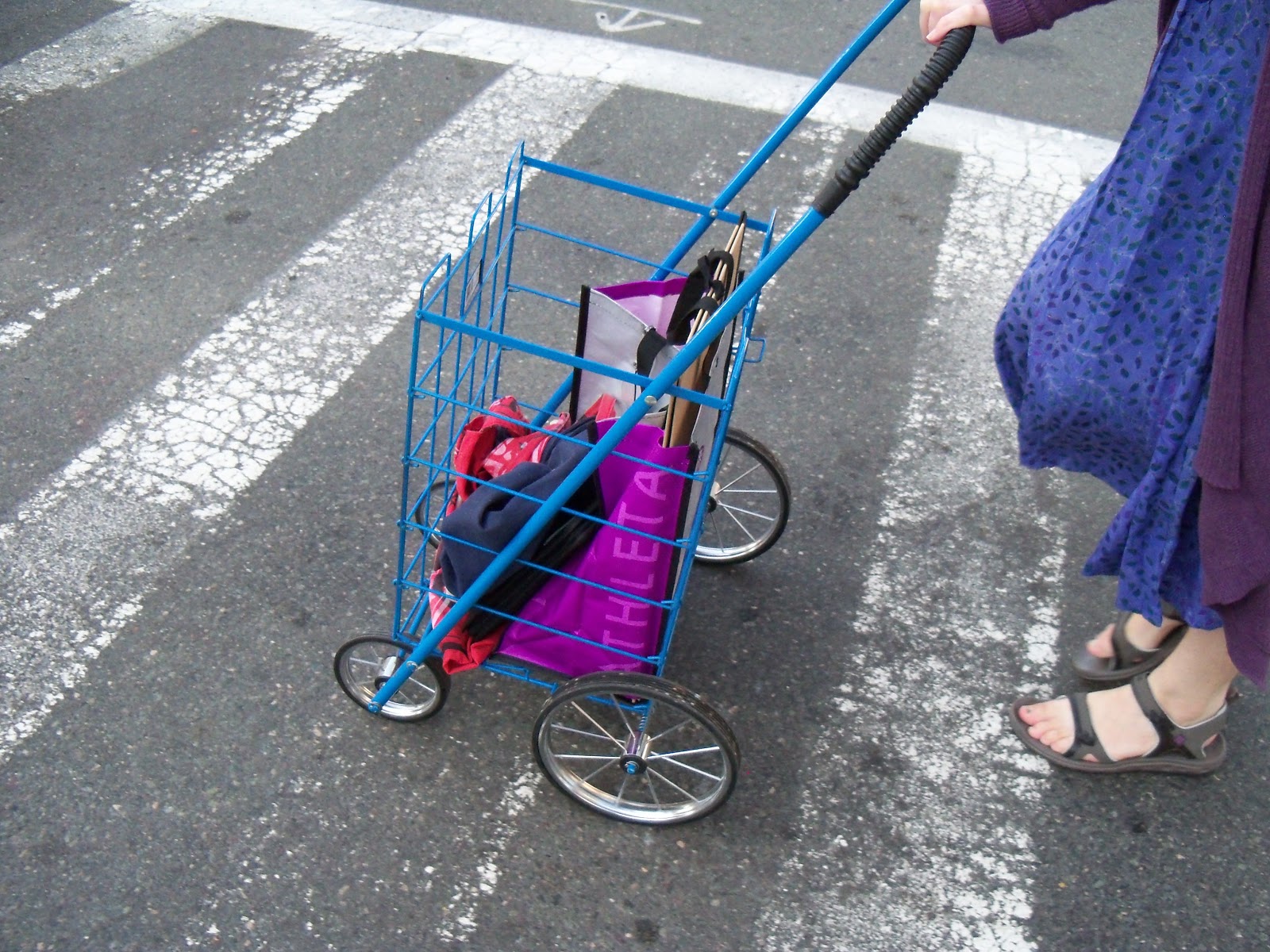
Hanna and I finally bought this shopping cart this year

I’m going to use, as an example, the errand I ran earlier this week to pick up our first monthly allotment of winter veggies from Stillman’s farm where we are CSA subscribers. Stillman’s is out near Fitchburg, Massachusetts, and drives the produce into the city to various pre-scheduled pick-up locations. The closest pick-up point for us was in downtown Boston about two miles from where I work at the MHS. The pick-up time was 2-4pm.

Setting aside, for a moment, the privilege of having a job with a) an hour-long lunch break, and b) the ability to leave on an errand and not worry about getting in trouble if the subway is delayed and I get back a bit late, this sounds like a relatively easy transaction. Take a late lunch, go down, pick up veggies, return to work, take veggies home at the end of the day. If I were living in my home town, this errand would have taken about twenty minutes, maybe, leaving 40 minutes at either end to actually eat lunch.

In Boston, this errand means the following:

1. Remember to take the wheelie-cart with me to work (which means dragging it along on our morning walk of approximately three miles) so that I will be able to transport the heavy winter vegetables on my own.

2. At 2pm, walk to the closest T stop and wait for a train that will take me the right number of stops from Hynes Convention Center to Haymarket (approx. 10 minutes)

3. Maneuver the empty cart into the T, off the T, and up the escalator at Haymarket, and two blocks to the drop point (approx. 15 minutes).

4. Transfer the vegetables from the back of the delivery truck into the cart (approx. 5 minutes).

5. Stop at a nearby sandwich shop for a sandwich and iced tea — admittedly an “optional” step, though to go without would have meant foregoing a midday meal; as it was, I didn’t have time to actually eat the sandwich until I was walking home that evening (approx 10-15 minutes).

6. Carry the cart, maybe 45 pounds fully loaded, down the stairs to Haymarket station; they have an elevator but I didn’t have time to locate it; the elevators to below-ground stops are often poorly marked. The escalators go up, but not down.

7. The first T to pull into the station was headed in the right direction, but not to the appropriate stop. I got on anyway, since I was now starting to feel anxious about getting back to work roughly on time. In order to board the train, I had to lift the cart up the stairs and maneuver it around the other passengers to a quasi-secure “parking” spot midway down the car.

8. At Copley Square I had to transfer trains, meaning I needed to maneuver around standing passengers carrying the laden cart down to the platform, and then repeat the process boarding the train again. All of these situations were made comparatively easy by a) the fact I’m physically able to lift the loaded cart for short bursts of time, b) I was traveling mid-afternoon instead of rush hour, c) I wasn’t getting hate-stares from people who automatically resent the presence of strollers in the subway. (steps 6-8 took maybe 20 minutes).

9. At Hynes, I had to disembark and haul the cart up three flights of stairs (only one of which is equipped with an up escalator) to street level, and then wheel the cart from the station to the MHS. (5 minutes)

10. At the end of the work day, I knew that rush hour on the T precluded trying to get my shopping cart on the T unless I wanted to wait for 45 minutes to an hour for any train empty enough to accommodate me. Since I am able to walk, and didn’t have to rush home for any reason, I walked home — a distance of about 3 miles — pushing the cart ahead of me.

This is the labor it takes to do one errand in the city when you’re relying on public transportation and your own two feet. I’m not writing this post in a bid for folks to pity me — we made the decision to subscribe to the CSA this winter, after all, knowing the time and effort it would take to get our fresh veggies. But I do hope that focusing in on the logistics of one errand this way points out how most of us, at one time or another, even if we are able-bodied adults sans children moving around our environment, are awkward to accommodate. And also point out how the environment is as much “at fault” as the awkward human being in question.

Rather than bitching about those of us who crowd the sidewalk with shopping carts, strollers, or walkers, we might think about the assumptions that led to sidewalks being a certain width (i.e. that all those who use the sidewalk are people who can walk unaided and unburdened with goods). While some of us might be able to carry our children (or our groceries) in wraps or packs or tote bags, others may not be strong enough to carry 45 pounds of produce (or exhausted toddler) for three miles — or time our outings before/after rush hour in order to actually fit on the T without the other passengers complaining or resenting you.

More and more, I find myself thinking about how the ideal citizen-worker in our world these days is the perfectly-able young adult without any dependents, who never gets ill, and is somehow (magically) perfectly self-sufficient. Not only do they never behave awkwardly in public, take up more space than we think they should, turn up their music louder than we’d like, lose their train of thought in the grocery aisle, or fumble with their wallet at the cash register … they manage their bodies (and those of their children) and personal belongings so that the rest of us can imagine they are not there.

Oh, I’ve been there. I’ve been annoyed and judgy and exhausted and angry and in the headspace where I just want to get home and not deal with one more stranger ever anywhere. But that’s just not the way the world works. We’re all awkward, noisy, thoughtless, slow. We all take up more space, sometimes, than others think we should.

And it seems like an important exercise or practice for each of us to — regardless of how we feel and what we think of others’ choices and presence —  realize that they’re probably just trying to get around the city like we are, and that sometimes getting from point A to B is an awkward, clumsy process. One that does, in fact, take up space in the world.

And that we all, in fact, equally entitled to be mobile, and to move around the city when and how we need to in order to live our lives.

support black cat rescue! [wedding giving]

06 Saturday Oct 2012

Posted by Anna Clutterbuck-Cook in our family

≈ Leave a comment

Tags

being the change, wedding

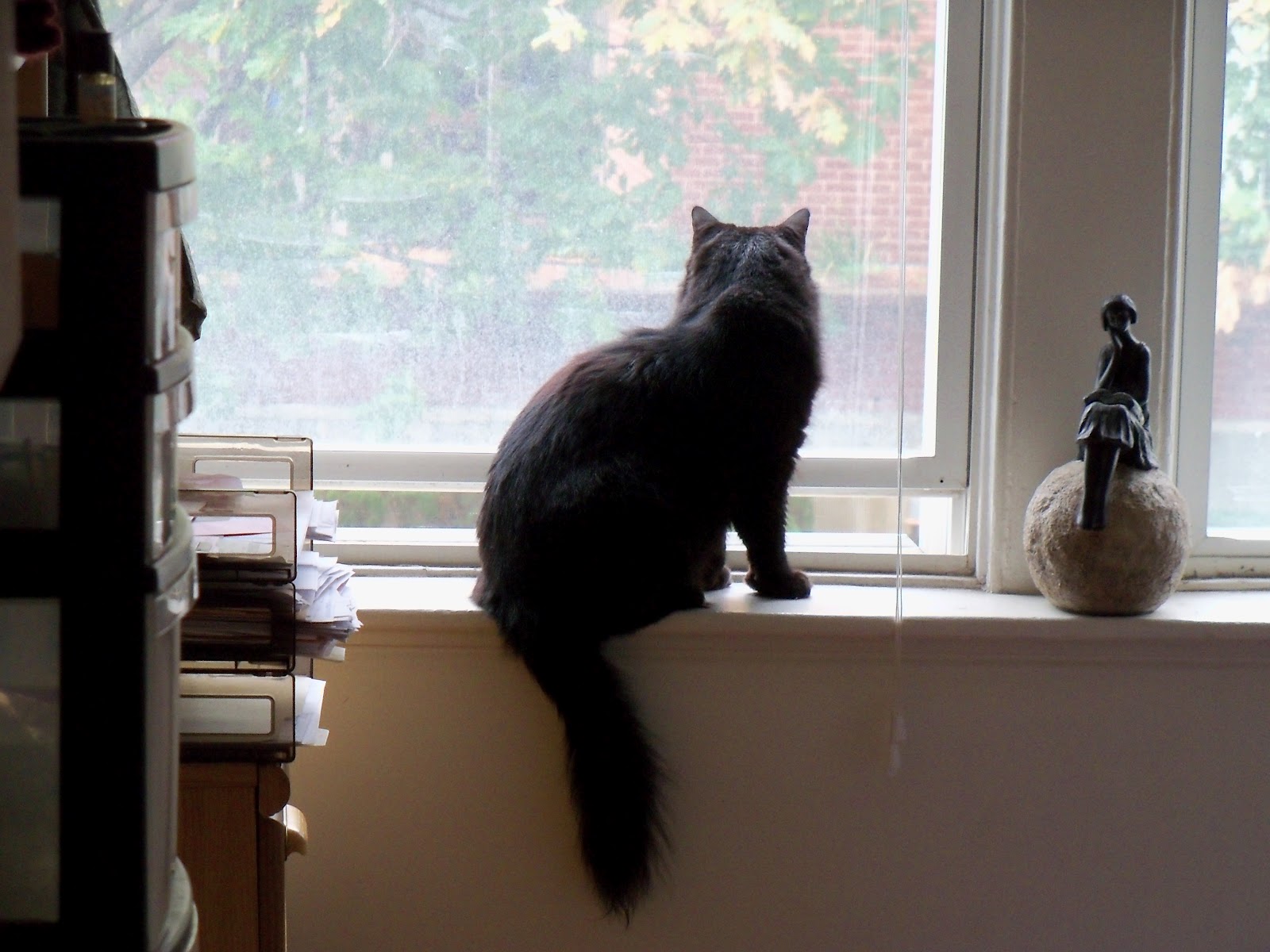
Geraldine, on her first day at our home (Oct 2009)

I went back and forth about whether to put up a shout-out for this fundraiser on my blog – but what’s a fundraiser for if you don’t, you know, raise funds for the charity in question?

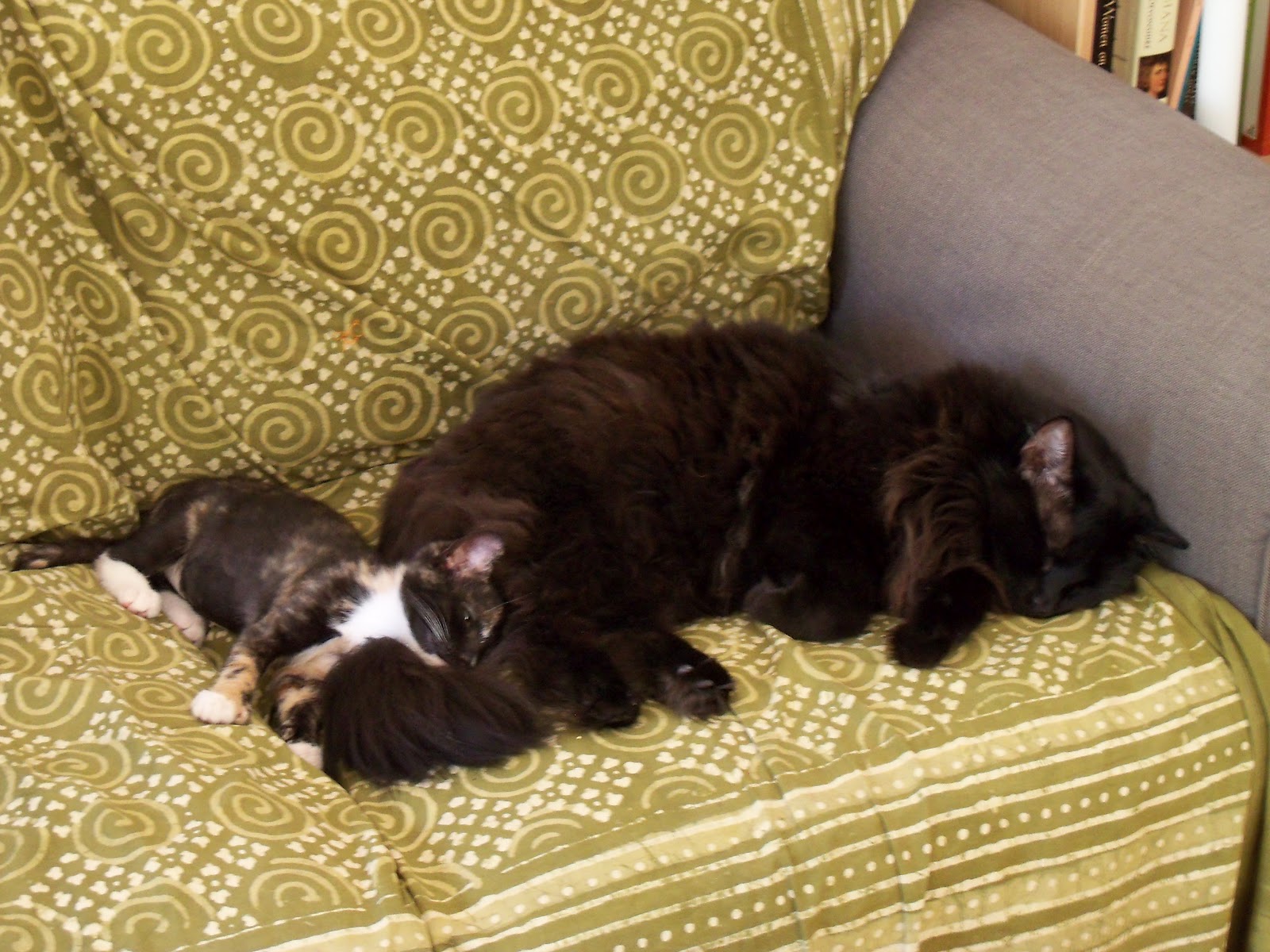
As I shared in my wedding planning posts, in lieu of a gift registry Hanna and I decided to ask people to donate to Black Cat Rescue, the amazing foster organization that took Geraldine and her kittens in off the street and made it possible for us to bring her into our family. She’s been with us three years this weekend, and we hope she’s not too angry at us for adopting her a little kitten-niece in the form of enthusiastic Teazle.

Gerry and Teazle napping
Gerry helps Hanna do yoga

We’ve set up a FirstGiving page to process donations which will go directly to Black Cat Rescue. I hope y’all will at least take a moment to consider giving something small ($1, $5, it’s all good!). They’re good people doing good work on a strictly volunteer basis. The funds we raise will go toward supplies and medical care for the cats they take in.

← Older posts
Newer posts →
"the past is a wild party; check your preconceptions at the door." ~ Emma Donoghue

Recent Posts

  • medical update 11.11.22
  • medical update 6.4.22
  • medical update 1.16.2022
  • medical update 10.13.2021
  • medical update 8.17.2021

Archives

Categories

Creative Commons License

This work by Anna J. Clutterbuck-Cook is licensed under a Creative Commons Attribution 3.0 Unported License

Meta

  • Create account
  • Log in
  • Entries feed
  • Comments feed
  • WordPress.com

Create a free website or blog at WordPress.com.

  • Subscribe Subscribed
    • the feminist librarian
    • Join 37 other subscribers
    • Already have a WordPress.com account? Log in now.
    • the feminist librarian
    • Subscribe Subscribed
    • Sign up
    • Log in
    • Report this content
    • View site in Reader
    • Manage subscriptions
    • Collapse this bar