• anna j. clutterbuck-cook
  • contact
  • curriculum vitae
  • find me elsewhere
  • marilyn ross memorial book prize

the feminist librarian

the feminist librarian

Tag Archives: books

booknotes: love the sin

05 Thursday Jul 2012

Posted by Anna Clutterbuck-Cook in book reviews

≈ 6 Comments

Tags

books, gender and sexuality, human rights, politics

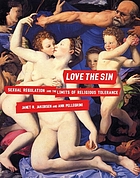
It’s frankly been awhile since I read a book on ethics or theory that expanded my brain so that it felt like it was slightly too big for my skull (aka getting intellectually hot ‘n bothered), but in the past ten days I’ve actually read two of them! The first was Janet R. Jacobsen and Ann Pellegrini’s Love the Sin: Sexual Regulation and the Limits of Religious Tolerance (New York University Press, 2003). The second was Julie Stephens’ recently-released Confronting Postmaternal Thinking: Feminism, Memory, and Care (Columbia University Press, 2012), which I’m going to review next week. Both are slim volumes that tackle complex issues of embodiment, identity, the relationship between public and private, between citizens and the state, and ultimately the way in which we understand individual persons in relation to collective cultural and political spaces.

Reading Love the Sin and Confronting Postmaternal Thinking back-to-back brought out a lot of resonances. Both books are critical of the way in which individuals have been constructed in the modern liberal democracy. They ask hard questions about who counts as a full and worthy citizen under the laws and policies of such democracies (particularly in the United States). They point to ways in which the mid-twentieth-century rights movements — especially the gay and lesbian liberation movement and mainstream feminist movement — have been undercut and co-opted by a majority hostile to their more radical re-visioning goals. This is due, both works contend, at least in part because of the narrow “rights” rhetoric these movements have depended upon. In Stephens’ work, we see how the language of feminism has been deployed in order to shore up a neoliberal notion of citizen-as-worker, while political ethics grounded in care and connectedness (“mothering”) are erased from the collective memory and public discourse. In Love the Sin, Pellegrini and Jacobsen argue that notions of liberal “tolerance” and a reliance on innate/natural (“born this way”) justifications for non-normative sexual orientation have unnecessarily compromised our ability to advocate for a robust freedom-of-practice in the public realm.

While I have persistent reservations about Stephens’ framing of the maternal (which I’ll get to in next week’s review), I was thoroughly seduced by Jacobsen and Pellegrini’s passionate and articulate advocacy of “freedom” as a more expansive, humane, way of framing the question of sexual citizenship — and other types of citizenship — than the notion of tolerance. “In a situation framed by the rhetoric of tolerance,” they write,

It becomes impossible to distinguish between the perpetrators of racism or homophobia or misogyny (this list is hardly exhaustive) and the objects of various forms of discrimination. Rather, when the situation is characterized by tolerance, the public is not expected to take a stand against injustice, but merely tolerate both sides of the “conflict,” which is supposedly between opposing groups of people who are circumscribed outside of those who constitute “the public” or “the American people” writ large (59).

Drawing on media coverage of gay and lesbian activism and of violence motivated by anti-homosexual bigotry, Jacobsen and Pellegrini persuasively show how tolerance encourages the same us/them thinking that can lead to violence, despite liberal claims that tolerance is the way out of the hate that leads to violence. For to “tolerate” those who are different from you implicitly assumes alienation, “the other,” a distance between queer folks, for example, and “the public.” The public “tolerates” the homosexual, which means the homosexual is outside of the group. Therefore, as much as we’d like to believe tolerance is our answer to violence, it offers no escape:

Tolerance disavows violence and those who commit heinous crimes, but along the way it offers no exit from the us-them logic that structures hate and tolerance in our society. It also gives us no logical exit from the mandate to tolerate those who hate. (p. 65)

Jacobsen and Pellegrini go one step further and argue that we are further hobbled by the notion that our claims to toleration of homosexuality are grounded in the fact that one’s sexual orientation is supposedly hard-wired and therefore immutable:

Characteristics that are taken to be immutable, such as skin color or sex, will be tolerated. But when traits or behaviors are taken to be discretionary and volitional, people can be asked, indeed compelled, to change their behavior and assimilate to the dominant norm … Gay identity may be protected by the courts … but ‘homosexual conduct’ certainly is not (94).

As they point out, this is hardly simply a problem for left-progressive causes, such as gender or sexuality. The notion that only immutable characteristics are protected, not behavior, means that an Orthodox Jew can be asked to cut his hair, or a Muslim woman asked to remove her headscarf, in order to keep their job. It means that Christians are not protected from being fired for refusing to work on Sunday.

How, then to get ourselves out of the (violence-enabling) cul-de-sac of identity-based tolerance? This is where Jacobsen and Pellegrini’s theorizing takes what I think is a paradigm-expanding turn. They argue that rather than a framework of “human rights,” social justice movements around sexual expression (and potentially other things) would do better to argue on the ground of religious freedom. Essentially, they argue that sexual freedom is analogous to the freedom of religion in that both are practices that express core values, and that not just beliefs but also individual expression of belief deserve protection, in public as well as private.

This shift frees us from the interminable question of what “causes” sexual variation, which — while theoretically interesting —  is actually ultimately unhelpful when it comes to determining what is lawful. Grounding rights claims on the basis of one’s inclinations being “natural” will do little to answer critics who (quite rightly) point out that human beings are not compelled to follow every inclination without thought, and that our ability to regulate impulsive behavior is, in fact, part of what makes us human. Just because something is “natural” doesn’t make it “right” in the moral sense — since morality is a human creation, and deeply embedded in time and place. As Jacobsen and Pellegrini write:

An important virtue of the paradigm shift we are advocating [from identity-based “rights” to freedom to live out ones values] is that it does not force us to finally settle the question of what ’causes’ homoesexuality. In the end it just does not — or should not — matter how an individual came to be homosexual, any more than it matters how heterosexuals became heterosexual. Rather, homosexual life and experience are to be valued, are in fact sources of value. (98).

This shift also helps us to combat arguments to the effect of, “It’s okay for homosexuals to practice their lifestyle as long as they don’t flaunt it in front of me”:

Free exercise does not depend on the boundary between public and private that protects liberal freedom. In a liberal democracy, some people are allowed to live lives freely in both public and private; others are allowed freedom only if they keep significant aspects of their lives private and privatized; and still others … are not allowed even the protections of a ‘private life.’ But if ‘free exercise’ and ‘democracy’ are to mean anything at all, everyone must have access to life both in public and in private (106).

I see productive parallels here with discussions of ability and access, about what it means to work “toward restructuring our public life so that everyone is included in categories like ‘the general public,’ ‘the public at large,’ or ‘all Americans’ ” (72). The majority culture has a strong normative power — sanctioned by the language of “tolerance” — to enforce their own notions of civility, rather than practice radical acceptance and lovingkindness toward those whose behavior as well as identity challenge their notions of propriety. The perennial (and perennially heated) “debate” about children’s behavior in public spaces comes immediately to mind for me: because children are constituted as “other” in our society (as non-workers they are understood as future/potential citizens, but not full participants in their own right), we feel entitled to ask that their behavior meet our own criteria of acceptability, rather than ask how we might re-formulate our public spaces to better serve them. The same could be said for the elderly, the non-English-speaking, the mentally- or physically struggling.

Angus Johnston has a powerful post on this subject, in which he writes:

Here’s my secret: my kid doesn’t actually behave as well as I do. Sometimes she whines. Sometimes she has to be reminded to to keep her voice down, or not to run. So yeah, when I take her to the Museum of Modern Art, we do impose on other patrons, at least a little.

And you know what? A little imposition on other patrons is okay. I’ll apologize sincerely to anyone she disturbs, but I’m not going to apologize for her presence. Because MoMA is her space as much as it is mine.

My [cognitively disabled] sister whines in public sometimes, too. Sometimes she gets overwhelmed and cries. Sometimes she raises her voice. (Running in museums is not an issue with her, I’m happy to say.) If we say that my daughter shouldn’t go to museums because she might whine or cry or raise her voice, then we have to say that my sister can’t go either — and one of the best days I ever spent with my sister was the day that we visited a MoMA exhibit of design for people with disabilities. MoMA is my sister’s space as much as it is mine.

You can (and should) read the whole piece over at Student Activism.

The basic point both Jacobsen and Pellegrini are making here is that in the framework of “tolerance,” in which we tolerate non-Christians, non-straight folks, children, the disabled, in “our” public square is that through the mechanism of toleration we are perpetuating the hierarchy in which some people are more entitled to freedom of expression than others.

“The public” — understood to be the white, male, economically self-sufficient, heterosexual Christian (I’m sure that’s not exhaustive, but you get the idea) — “tolerates” those of us who diverge from that which feels comfortable to. But that toleration is conditional on our normative behavior. Jacobsen and Pellegrini remind us that such conditional acceptance is, well, otherwise known as being an entitled asshole.

I encourage anyone who cares about effective social change toward a more egalitarian, inclusive world to read Love the Sin. Even if sexual freedom isn’t your issue, per se, the framework Jacobsen and Pellegrini lay out is an effective one for any area where the personal and political intertwine.

Related Read: If you’re psyched by the ideas Love the Sin outlines, be sure to check out Kenji Yoshino’s Covering: The Hidden Assault on Our Civil Rights (Random House, 2006) which explores the legal side of these “freedom of expression” issues.

‘the act of marriage’: ch. 11 (aka "children fulfill the psychic design of your mind")

25 Friday May 2012

Posted by Anna Clutterbuck-Cook in book reviews

≈ 5 Comments

Tags

books, gender and sexuality, live-blogging, religion

See also: intro, ch 1, ch 2-3, ch 4-5, ch 6-7, ch 8-10.

If I had to pick the number-one aspect of The Act of Marriage that situated it in the 1970s, it would be the LaHaye’s attitude toward birth control and abortion. Namely, that they’re not categorically opposed to either. Let me reiterate: The best-selling protestant Christian evangelical sex manual of the 1970s was not anti-abortion or anti-birth control, even hormonal birth control (aka “The Pill”) which today has so many fundies up in arms.

Tomorrow, I’m going to be posting, verbatim, the passage in which The Act of Marriage takes up the question of abortion. I think it deserves its own post because there’s so much interesting stuff going on vis a vis contemporary abortion politics within it. But for now, we’re going to take a brief look at chapter eleven, “Sane Family Planning,” which deals exclusively with pre-conception solutions for controlling pregnancy while sexually active.

“Almost all Christians today seem to believe in limiting the size of their families” (185)

The LaHayes start out with the observation that, given the number of years the average woman is fertile, the vast majority of Christian couples are self-evidently practicing some sort of family planning strategy. And they do not disapprove — nor do they believe God disapproves. The distinction they make is not between contraception vs. no contraception, but rather between parenting and not-parenting. “Christian couples should, if at all possible, have children, they assert” (183). Intention here matters. If one is delaying childbearing, or spacing out children, or deciding that [ideal number] of children is the limit of persons your family resources can provide for, then this is an acceptable (“sane”?) orientation toward parenting.

What’s not acceptable? Deciding that your ideal number of children = 0.* Because “the chief enemy of personal happiness is self-interest” (185) I’ve honestly never understood how realizing you don’t have the resources (material, emotional, or otherwise) to be a good-enough parent is the selfish route while having little ones because they are “a tangible expression of your [marital love]” or because “children fulfill the psychic design of your mind” (I shit you not!) is the unselfish way to go (183-85). But apparently that’s the truth of things, and who am I to argue with God?**

I lose MAJOR lady-spouse points for this (I figure double ’cause I’m getting hitched to someone who’s completely comfortable with the non-parenting state of affairs. More so than I am, actually. So, you know, clearly I went the way of satanic and self-centered temptation there.

What can I say. She has a really great ass.

IN SUM: Adequate Lady-Spouse Metric Returns!

-20 –> for coming to the conclusion that the answer to the question “how many children does God want me to have?” is “Zero” and
-20 –> for getting myself hitched to a partner who believes this even more strongly than I
-20 –> plus the whole “two eggs can’t make a baby” thing, which is surely a strike against us
+15 –> still, I do agree that human being are a pretty awesome “gift of eternal creativity”
+10 –> and that even couples wanting to create babies should have access to family planning tools

Chapter 11: -35

Chapters 8-10: 0 (n/a)
Chapters 6-7: -62
Chapters 4-5: +30
Chapters 2-3: -33
Chapter 1: -50

Cumulative ALSM Score: -150


* Maths people! What would the equation for that look like … “solve for X if  x > 1”?

**See also.

maurice sendak: first memories

08 Tuesday May 2012

Posted by Anna Clutterbuck-Cook in think pieces

≈ Leave a comment

Tags

books, children, family

When I got to work this morning, my Google Reader was rapidly filling with blog posts about the death of author and illustrator Maurice Sendak, at the age of 83.

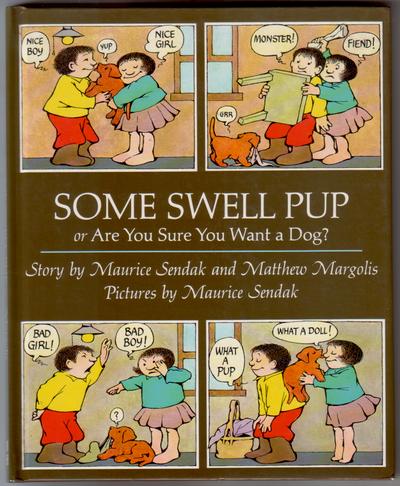
I don’t have any big thoughts about Sendak and his the power for good his work was in the world, so instead I thought I’d share with you a couple of Sendak books that aren’t as well known and are, in fact, two of his works I remember best from early childhood.

Before I was born, my parents adopted a golden retriever named Satch (after jazz musician Louis Armstrong, whose nickname was “Satchmo”). This was one of the books they had in their collection of dog care manuals, and I remember really loving the comic-strip layout, as well as the adorable and mischievous pup.

This lushly-illustrated story with text by Charlotte Zolotow and illustrations by Sendak relates the quest of a child to find the perfect gift for her mother. I remember Mr. Rabbit feeling slightly threatening, even though he’s kind and helpful, perhaps because he is more adult-sized in the illustrations than child-sized. Yet overall, it’s a quiet low-key story with a sweet resolution, and a rhythmic feeling to it that was incredibly soothing when I was small.

Just looking over Sendak’s bibliography of works reminds me how much of my childhood library was touched by his work. So thanks, man, for making my world that much more vivid and Truthful.

Cross-posted at the corner of your eye.

live-blogging ‘the act of marriage’: part the first

02 Wednesday May 2012

Posted by Anna Clutterbuck-Cook in book reviews

≈ 2 Comments

Tags

books, gender and sexuality, live-blogging, religion, wedding

this is the cover art on my edition

When Hanna and I were on our trip to Michigan back in early March, I picked up a vintage copy of The Act of Marriage: The Beauty of Sexual Love by Tim and Beverly LaHaye (Zondervan, 1976). Y’all probably know the LaHayes for their right-wing political organizing and Tim LaHaye’s phenomenally popular Left Behind series. Bet you didn’t know the couple are responsible for one of the mid-twentieth-century’s ground-breaking Christian sex manuals.

Yeah. I’ll let that one sink in for a minute.

And of course I bought it. Duh. Because it’s a perfect confluence of all the shit I’m interested in: sex and Christian evangelical fundamentalism and heteronormativity and the 1970s and sex. All in one book.

This was before Hanna and I decided to get married, but now that we’ve set a date and all, I decided I should probably study up on my wifely duties. The introduction to The Act of Marriage specifically instructs that it “should only be read by married couples, those immediately contemplating marriage, or those who counsel married couples.” I told Hanna over coffee this morning that, since I now fall into category #2 (although does “engaged to be married” count as “contemplating marriage”?) I can safely read this book without jeopardizing my bridal purity.

She looked at me like I’d just turned into a hedgehog and went back to her Spanish latte.

I’ve only read the introduction so far, but two things:

1) Tim assures the readers of TAM that Beverly’s presence as one half of the writing team preserves the respectability of their project — and simultaneously assures his audience that Beverly herself was not harmed in the writing of this book. It’s a fascinating use of ministers wife as moral shield. Sort of like having one around is the equivalent of a personal shield emitter. Haha! You think talking about sex is dirty and un-Christian? Well, you see, I have a minister’s wife on hand to protect me!

2) The introduction puts forth the assertion that Christians have better sex than non-Christians. This is hardly the first time I’ve heard this argument made (and, to be fair, feminists also made the case for better fucking … though I doubt their definition of “better” is the same as the one at chez LaHaye). I’m promised survey data latter in the book that will support this thesis and, frankly, I can hardly wait to find out what they asked the couples they counseled and what “secular” data they compare and contrast their results with.

I’m looking forward to my lunch break so I can see what Chapter One has to offer. Stay tuned for more!

booknotes: straight

27 Tuesday Mar 2012

Posted by Anna Clutterbuck-Cook in book reviews

≈ 3 Comments

Tags

books, gender and sexuality, history, science, the body

Until I fell in love with my partner, Hanna, I generally conceptualized myself as “mostly straight.” This was because, despite the passionate friendships I formed with female friends and the way lesbian sexual fantasies made me go all squishy with excitement, I didn’t feel I was queer enough to be considered authentically out of bounds of straightness. And I passively imagined that, given the statistical odds, chances were I’d fall in love with a person who was a cisgendered man (although I wouldn’t have used the term “cisgendered” back then).

Then Hanna came along, and I realized I was falling for her, and then we were together, a couple in the world, and I had to develop a whole new vocabulary for talking about myself: “mostly straight” no longer felt accurate. But was I lesbian? bisexual? fluid? queer? Should I articulate my sexuality in terms of my kinky fantasies? The gender identity and sexual orientation of my partner? The aggregate attractions I’ve felt but never acted upon for people across the gender and sexuality spectrum? If I’m a person who’s felt squishy feelings for people who identify as male, female, trans, gay, bi, straight, and numerous combinations of the above … how meaningful is it to try and identify something inherently personal (one’s subjective sense of self) in terms of the objects of my affection (which are multivarient, ever-changing). In a strange way, the language I choose to speak of myself has an effect on the identities of anyone I’ve ever felt the thrill of sexual excitement over.

It’s a social dilemma that, three years later, I’ve yet to resolve. These days, when filling out forms I go for the string-of-words approach. The form asks Sexual Orientation? I respond: “lesbian/bisexual/fluid” or the like. Check boxes be damned. In a pinch, “bisexual” is probably the best catch-all (I register attraction to people of multiple gender expressions and sex identities). In biomedical terms, “lesbian” is probably the most accurate in that I’m in a monogamous relationship with a cisgendered woman — so our medical needs will be those of women who have sex exclusively with women. But that isn’t all of who I am — or who my partner is, for that matter, since she identifies as bisexual. “Fluid” helps capture some of the contextual nature of my sexual desires, and my sense of personal change over time. But will provide little information to my primary care provider that “lesbian” doesn’t already communicate — with much less room for confusion.

When blogging or speaking informally, I’ll use lesbian, dyke, bi, gay, queer, fluid, or sometimes opt for phrasing that’s less about who I am and more about what I do: “As someone in a lesbian relationship…,” “As someone who’s partnered with another woman …”

Hanne Blank, in her recently-published (long anticipated!) Straight: The Surprisingly Short History of Heterosexuality (Beacon Press, 2012) recounts similar dilemmas of self-identification as the partner of a male-identified person whose markers of sex and gender are, nonetheless, all over the biological map due to having been born with XXY chromosomes. The author of Virgin: An Untouched History returns to historical and cultural notions of human sexuality in an effort to illuminate what we mean when we talk about “heterosexual” or “straight” identity. As with “virgin,” the answer turns out to be murky at best. The concept of an individual whose identity or nature was built, at least in part, around an exclusive attraction to “opposite”-sexed partners and activities, only came into being in relation to the study of non-normative or “deviant” sexual behavior during the late-nineteenth and early twentieth centuries. Even after the term came into common usage, virtually no research has been done — scientific or otherwise — on heterosexual sexuality. We don’t know how the bodies of heterosexuals differ from those of non-heterosexuals, for example. Research on homosexuality suggests there is no marker of sexual orientation on the body, but no one has ever asked the question “How are heterosexual bodies composed?” Scientists studying non-heterosexuality always assume they know the normal against which they are measuring the non-normal. Yet this assumption is never spelled out, and its markers are never articulated. As Blank writes:

Scientists often look for evidence of non-heterosexuality, what we consider the exception to the rule, while assuming that the heterosexual rule itself requires no evidence. Scientifically speaking, this is precisely backwards. In science, it should technically not be possible to even begin considering whether there might be exceptions to a rule until you have proven that the rule exists (42-43).

The reason why we’ve never inquired into the existence of heterosexuality is that, culturally speaking, it is a category of being that has become commonsensical, so self-evident in our minds that we measure every other sexuality in relation to it. There is power in a category so constructed as simultaneously normative and empty of actual definition. Blank compares heterosexuality to the concept of being not a person of color or not a slut. “Nameless and characterless, the space we can loosely categorize as ‘normal’ is almost completely undefined,” she writes (32):

This is why ‘slut’ and ‘prude, ‘pervert’ and ‘deviant’ all work so well as insults and as ways to police the boundaries of sex doxa [an anthropological term meaning “what everyone knows to be true”]. The labels are effortless to deploy, and hard, even impossible, to defend against … The opposite of ‘slut’ is someone who has not been labeled a slut, someone who has never been charged with violating doxa (32).

If there is a weakness in Straight it is the emphasis on marriage and reproduction as signs of heterosexual identity. I understand why Blank draws upon these cultural examples of heterosexual life — both marriage and parenting are more social activities than, typically, sexual behavior. People are far more likely to record instances of the former rather than the latter. So from an historical perspective, research on heterosexuality will end up documenting those outward signs with much more confidence than it will what people actually did with their bits (and how they felt about doing it). Unless people talk about their sexual self-identities, it’s hard to do more than catalog instances in which sexual acts were recorded — and those acts were usually the ones considered deviant, exceptional, worthy or note or censure.

Still, other books have been written in recent years on the history of marriage, and I felt myself starting to skim in hopes of more discussion of sexological research and taxonomy, a more inventive backward reading from those instances of “deviance” toward what people considered not-deviant. Some of that does appear in the pages of Straight, but I found myself wishing Blank’s editor had pushed her to include less of the well-trodden history of marital practice and more of the specifically sexual practices that fell within the bounds of the acceptable. She does argue, at one point, that “penis-in-vagina intercourse is the only source of sexual pleasure that has never, so far as we can tell from the historical record, has never been challenged … the fortunes of all other sex acts and all other sources of sexual pleasure, have varied widely” (124). I would have liked to see that assertion expanded on, to have these boundaries of sexual activity discussed in relation to the notion of sexual identity in historical understanding. In the 1890s, for example, would a husband and wife who practiced cunnilingus and fellatio with one another been categorized as “normal-sexual” in the eyes of the early sexologists? Blank leaves much of that open to further discussion — which may, I admit, have been her intent.

In the end, Blank has written yet another accessible survey of a sexual concept we think we all know and instead, it turns out, we know little about. I hope the liveliness of her prose and the concrete examples she provides of individuals who defy our binary sex, gender, and sexual categories (man/woman, gay/straight, cis/trans) will encourage people who may not have thought human sexuality in such complex terms to revisit their assumptions and look at their own identities and behaviors with new, and perhaps more forgiving and expansive, eyes.

observations III

08 Thursday Mar 2012

Posted by Anna Clutterbuck-Cook in a sense of place

≈ 2 Comments

Tags

books, family, friends, michigan

1) Went to breakfast at Marie Catrib’s in Grand Rapids this morning with Hanna, my parents, and dear friend Joseph.  Their apple onion tart is to die for (seriously — I’m already hungry for seconds!) and Hanna and I discovered their Turkish coffee. *swoon*

2) At Argo’s used books and Redux Books in East Town, bought Neil Miller’s In Search of Gay America (1989) and Tim and Beverly LaHaye’s The Act of Marriage: The Beauty of Sexual Love (1976). I am taking great pleasure in stacking these one on top of each other. Hanna says she might disown me. I promise my review of the LaHaye will include the mid-70s author photo which totally rocks.

3) While Hanna got a kick-ass black & sparkle manicure (at half the Boston prices!) I read the Miller at lemonjello’s coffee shop and remembered how his Out of the Past: Gay and Lesbian History from 1869 to the Present (1995) was, along with Lillian Faderman’s Surpassing the Love of Men (1985), one of the first books on homosexuality per se I ever purchased or read. I bought them both at Powell’s in Portland (Ore.) on Thanksgiving break in 2001 while I was at the Oregon Extension. Because just that summer Joseph had confided in me he thought he might be gay. Looking back, I’m impressed one of my first impulses was to buy history books!

4) There are ways the logistics of life here feel so much simpler. I don’t mean that in a “rural life is idyllic” way, mostly because it’s not idyllic here — or rural. But in a “running errands doesn’t exhaust me here the way it does in Boston” way. Streets don’t feel crowded and hectic. Sure, the parking can be a bit frustrating, but mostly it’s free and available if you’re willing to walk a block or two. Downtown’s in walking distance. And things are restfully less expensive than in Boston. I know our jobs aren’t here, and some of our favorite book stores, libraries, and indie coffee shops … but I seriously wish there were portkey technology on the horizon, ’cause I feel like my energy level would be so much better if I could live here and work there. I’m just not psychically wired for city life.

5) Off to bake cheddar, beer and mustard pull-apart bread. Food, books, and friendship. At least I can say that our activities on vacation and in non-vacation life are mostly the same, excepting not having to get up for work. And less time spent at the computer, which is restful.

booknotes: delirium

28 Tuesday Feb 2012

Posted by Anna Clutterbuck-Cook in book reviews

≈ Leave a comment

Tags

books, feminism, gender and sexuality, moral panic, politics

After hearing Nancy L. Cohen interviewed by Amanda Marcotte recently on the RhRealityCheck podcast, I requested her most recent book, Delirium: How the Sexual Counterrevolution is Polarizing America (Counterpoint, 2012), from our local library and spent a day reading through it. Cohen is an historian and journalist whose previous research also took as its topic political history in the twentieth century. Delirium looks at what are popularly termed “the culture wars,” beginning with the advent of the birth control pill and rolling up to the current election cycle — with a particular focus on the politicization of sexuality — both behavior and identity — and gender roles. You can read an excerpt of the opening chapter over at AlterNet.

Cohen’s narrative of sexual politics from 1960 to the present seeks, in some measure, to revise our understanding of the conservative revolution of the late 1970s as one led by white male reactionaries like Jerry Falwell and Pat Robertson. Instead, she argues, some of the first — and most successful — sexual counterrevolutionaries were women like Phyllis Schlafly, Lottie Beth Hobbs, and Anita Bryant. These women, like their male counterparts, were opposed to the advancements in gender equality, the changes in (hetero)sexual mores, and the growing visibility of human sexual variety that the feminist and gay liberation movements of the 60s and 70s fought for. In sometimes overwhelming detail, Cohen recounts how political activists and career politicians successfully stopped the Equal Rights Amendment, pushed back advancements made in civil rights for queer citizens, generated moral panics around sexual variation, and stymied the post-Roe landscape of women’s access to sexual health services, especially abortion.

Overall, I felt like Delirium bogged in a blow-by-blow recounting and analysis of presidential campaigns and administrations, from the fall of President Nixon to Barack Obama’s first term. Cohen draws much of her evidence from quantitative polling data and political commentary, which left me wondering how much the understanding of individual Americans support her thesis about who sexual conservatives are and why they support the policies they do. To her credit, Cohen does acknowledge that sexual conservatism, as sociologist Kristin Luker has shown, appears on both sides of the aisle. Moral panic over teenage sexuality and concern-trolling about women’s ability to meaningfully consent to an abortion are equal-opportunity topics for Democrats and Republicans alike. Her narrative, however, mostly charts the sexual conservatism and politicking of Republicans. I waited in vain, for example, for her to talk about feminist anti-porn activism, which often paralleled and intersected with — at least on a policy level — with the work of people with otherwise diametrically opposing political views.

Cohen’s work will be particularly interesting to those who enjoy thinking about strategy of electoral politics and policy negotiations, as well as those who may want a better grip on the broad sweep of sexual politics since the 1960s. However, for scholars and activists well-versed in much of this history, Cohen’s narrative fails to add much of significance to what we already know about our sexual selves in relation to formal politics. That is, that our sex, sexuality, and gender identities and experiences are presently over-determined, or constrained, by the decisions of our elected representatives at the local, state, and federal level.

booknotes: the secret lives of wives

09 Thursday Feb 2012

Posted by Anna Clutterbuck-Cook in book reviews

≈ 3 Comments

Tags

bigotry, books, feminism, gender and sexuality, moral panic

A couple of weeks ago, I posted a pre-review review of Iris Krasnow’s book The Secret Lives of Wives (Gotham, 2011). From those notes, it should be clear to you that I had major issues with the book — and to be fair, I expected to have major issues with any book by someone whose previous books were titled Surrendering to Marriage and Surrendering to Motherhood. Sometimes, you can judge a book by its cover. Or at least, the choice of language by which it is marketed. The breathless wording of the title (“secret lives” and “what it really takes”), along with the temptation-of-Eve cover we’re rocking here, signaled to me we were in for a rocky ride.

And to be honest, that’s part of the reason why I requested the advance review copy of the book. Because on some level I’m fascinated by people who continue to buy into — and actually seem satisfied with — the heteronormative, gender essentialist assumptions about what it means to be men and women, relate sexually, and form families. I didn’t grow up in a household where gender normativity was enforced, and while my parents have enjoyed a 35-year marriage — which at times took a lot of active work to maintain — they have never pressured us kids into partnerships, marriage, or parenthood, hetero or otherwise. So I just don’t get the concern trolling over kids-these-days being somehow unfit and unable to establish intimate partnerships.

Part of me hoped that Secret Lives would offer really interesting first-person narratives about long-term partnerships. I’m an oral historian by training, after all, and even when autobiographical narratives turn on values I strongly disagree with I still find life stories an absorbing read. And a preliminary glance at Krasnow’s website also suggested that at least some of the “secrets” to a successful marriage were going to be fairly benign: maintain strong relationships with male and female friends outside the marriage, don’t expect your spouse to meet every emotional need, make space and time for being alone or pursuing independent projects. Who’s really going to argue with those fairly basic pieces of advice for well-being? So while I went into this book with the expectation that there would be much to disagree with, I was also prepared to find something — anything! — redeeming in its pages.

Wow, that was hard. As my preliminary notes suggest, the “points for” list I started in the front cover was quickly overtaken by the “no points for” list. But I’m going to lay into this book fairly hard in a minute, so let me begin by observing what I felt Krasnow did — if not “well” at least “decently.” She situates herself in the introduction as a curious journalist, not a sociologist or psychologist, and (at least initially) acknowledges the anecdotal nature of her research. She later goes on to consistently generalize from that research, but we’ll deal with that below. In so many words, she acknowledges this is a book about heterosexual couples, though doesn’t talk about her reasons for limiting the study in this way. The fact it’s all about wives rather than husbands and wives is something that is never specifically addressed, though I think it’s tied to the fact Krasnow sees women as primarily responsible for securing and maintaining a marriage (more below).

She does acknowledge that there is no one-size-fits-all formula for marital happiness, writing that “there is no gold standard for marriage,” although I think her later arguments undermine this initial claim. As I said above, she is fairly consistent in maintaining that individual people are responsible for determining — and seeking out — what will help them thrive (in other words, don’t expect a husband to equal instant happiness). She argues for the importance of maintaining adult friendships outside long-term partnerships, and she encourages wives to maintain independent lives through work, travel, exercise, and other activities that will take them out of domestic life. Basically, “It’s okay to do things without your husband sometimes.” Which I think is pretty sane advice for partners of any persuasion (and I’m not sure it really counts as a “secret” given the number of people who know and agree with it).

And I realize this is a super-low bar, but I’m going to offer her maybe half a point for at least acknowledging the existence of women in hetero marriages who don’t have children with their partners, couples who aren’t white, and couples who aren’t upper-middle-class. With the exception of ethnic diversity (which isn’t really clearly delineated, though one woman is identified as African-American and one Bengali) there’s one example of non-parenting, and one example of a non-professional-class couple. Other than that, we’re basically talking about white upper-middle-class wives with children, most of whom have advanced degrees and are married to individuals similarly situated. Couples with the financial resources to support multiple homes or summer-long vacations abroad, hire (and have affairs with) gardening staff, choose to be a single-income family (and not suffer financially for it), etc. Her profiles of individual women include throw-away details about fur coats, caterers, manicures, high-end spas, and other markers of incredibly privileged lives. Granted, social and economic privilege has never proven to shield individuals from emotional distress or relational impoverishment — but I wish Krasnow has been more upfront about the demographic she was actually studying.

Okay, so those are the okay-ish things about Secret Lives. Things that limit the book’s generalizability, but aren’t particularly harmful if you take them for what they are. Several of the life stories Krasnow includes — if you can grit your teeth and get passed her editorializing — are actually really awesome. I particularly appreciated the one interview she did with a married couple, Phil and Pat, since it included both partners’ voices. Phil and Pat were articulate in describing the ways in which sexism made Pat’s career (in the tech industry, alongside her husband) more difficult, and how together they learned how to resist the external forces trying to push Pat out of the business world, or pit them against each other as competitors. Similarly, a couple of women — interestingly enough the wives who used “we” most often — described the way they re-negotiated their marriage arrangements in times of stress, to better share the tasks of child-rearing, or to open their marriage to other partners (more on the one swinger couple below). The women who used “we” were much more likely to describe equal partnerships in which they’d worked with their husbands to build a home life that supported both their individual needs and the nurturing of their relationship. Often through active re-negotiation of terms when the original assumptions or agreements had failed to serve one or both of them adequately.

So what are Krasnow’s secrets for a successful (note: “successful” in Krasnow’s world means long-lasting — no marriage which ended in separation or divorce gets a place in the book, and cautionary tales of people who did divorce feature prominently) hetero marriage? And what ideas concerning gender and sexuality is she promulgating on the way by?

Secret #1: Heterosexual marriage is what every woman “needs” because it is “essential.” So while I have no problem, per se with a study that focuses on one group of people (in this case wives) due to the questions being asked or simple logistics, I became increasingly suspicious of Krasnow’s decision to focus exclusively on “wives” as the book went on. She begins with a chapter about “why marriage,” as in why should she focus on describing successful marriage. “Who needs marriage?” She asks rhetorically, answering herself, “Women do, of this I’m convinced” (8). While Krasnow includes handful of throw-away lines to the effect that some marriages are abusive and should end, the actual message of the book is that marriage, virtually any marriage, is better than dating (and yes, if you’re single you’re assumed to be looking for a partner). The women who fail to keep their marriages intact in Secret Lives are seen as failures who gave up, who had unrealistic expectations, or who made a rash decision they now regret. “Better to stick with the first flawed union if you can; the second could be worse” (32) she concern-trolls over and over. 

This understanding of marriage as something women “need,” and the focus specifically on “wives” also speaks to the pervasive gender essentialism Krasnow offers up, in which women pursue marriage … with men whom she depicts as emotionally unavailable and brutish (I’m serious, she and Caitlin Flanagan should just go to housekeeping together) and frankly not all that appealing. While she insists that marriage is the essential ingredient for ultimate life-long happiness, her own descriptions belie those claims. In other words, Krasnow should be approached as an unreliable narrator.

Secret #2: The work and compromise of making a marriage successful, that is to say life-long, falls to the wife. There’s a telling scene early on in the book where Krasnow describes a point in her own marriage when she was a full-time mother with four children under the age of five and her husband was the full-time wage-earner. She describes her frustration at making breakfasts and lunches for the entire family while her husband sat at the breakfast table with the paper, ignoring the chaos around him, and then disappeared to work leaving her to clean the house and care for the kids. She describes calling her mother and announcing her intention to leave her husband — because anything would be better than the status quo. Yet in the end, she and her husband remained together and things got better. (Sort of. Frankly, the descriptions Krasnow provides of her husband and their interactions are filled with a level of animosity that belies her protestations of marital bliss. I was really uncertain what we were supposed to make of her more personal anecdotes and their place in the story, since they seemed at odds with one another.) But anyway, she fills the book with similar narratives in which women are miserable with the status quo, yet consistently turn back to themselves as the source of the problem. I agree that to focus on assigning blame rather than solving the problem can be counterproductive, but I cringed at sentences like this: “Recently, Alice has been ‘working on herself’ and blaming Chris less, fueling a discovery that he isn’t so bad after all” (66). Relentlessly, the exhausted mother of young children is counseled to stick it out, rather than speak up and say “This isn’t working, can we figure out how to make this more equitable?” These marriages all take place in a vacuum where sex and gender politics on a wider scale don’t exist, and it’s simply women’s lot to be the full-time parent with an unresponsive husband (who will start paying attention to her again once she stops wallowing in self-pity and bothers to put on tight jeans and sexy lipstick).

Lesson #3: Adultery is okay, as long as you keep it secret from your spouse, and having an open marriage is exactly the same as being an adulterer (except people with open marriages are mysteriously happier). So she has a really depressing chapter on women in relationships where either they or their husband maintain the marriage by cheating on one another — and not talking about it. I realize everyone feels different about adultery, but I believe trust and honesty and fidelity are really important in any relationship, and if a marriage is going to involve multiple people in any way, it should be openly negotiated and agreed upon by all parties involved. Which is why the one swinger couple Krasnow profiles, I’d argue, seem so damn pleased with the way they’ve chosen to conduct their sexual lives. Yet Krasnow folds this couple into the chapter on adultery, and seems at a loss to explain why their extramarital relationships aren’t causing anyone angst or despair.

Lesson #4: Youthfulness should be prized while young people are denigrated. Some people might see this as two separate issues, but I’m treating them together ’cause I think it’s two aspects of the pernicious ageism that permeates our culture. Krasnow uncritically accepts that youthful looks are desirable (in women) and should be maintained (by women) in order to keep the interest of their husbands, etc. At the same time, she portrays young people — I’m assuming any cohort younger than about age 35? — as lazy gits who are unwilling or uninterested in putting energy into maintaining relationships. We’ve all grown up with the “divorce epidemic,” I guess, and somehow technology has also made it easier to give up on people (it’s unclear why, but Facebook and iPads feature as emblematic of … whatever the problem is). I feel bad for her kids that she basically thinks they’re uninterested or incapable of connecting. While this book is ostensibly a look at marriage in the “middle years” (read: after your kids have gone away to prestigious colleges), it’s shot through with a heavy, heavy dose of judgement and unsolicited advice for younger folks who might think twice before marrying, not be interested in marrying a man, or who might try to re-negotiate the work/childcare arrangement with their spouse.

The entire book could really be reduced to a banner reading “Be Grateful You Have a Man, Any Man, Girls, Because Without One Life Isn’t Worth Living.” Which (and here’s where my own personal bias might come in a teeny-weeny bit?) is a really weird message to try and send with a shit-ton of examples of hetero marriages that sound fairly dysfunctional and unhappy to me. Even when you discount the one or two that are actually out-right abusive? It’s a fairly dismal bunch. Like I said, there are maybe three or four profiles in which the women speak with confidence about having negotiated a fairly equal arrangement with their spouse, and where the couple seems to be on the same page about their domestic life. But more often than not, there seems to be a lot of despair, resignation, rage, and yes, “secrets” that involve emotional and physical infidelity.

Seriously: I got to the end of this book and I was like, “If this is the world of straight marriage, I’m so glad I’m out.” I am so thankful for all of the people I know who are married to other-sex partners who aren’t actually acting out this sort of misery. Who are living lives of partnership and communication. Who don’t assume all women “need” marriage, and who don’t denigrate their own husbands by making snarky asides about how many hours per weekend they spend watching hockey.

I started out this post by observing that part of the reason I read books like this is to try and understand what people who think like this get out of their portrayal of women and men and marriage in this fashion. This book failed insofar as I still don’t understand it. One could write a perfectly sane, thoughtful, book about the compromises and negotiations one makes in a long-term relationship. One that didn’t hinge on making generalizations about how men and women operate and what they want out of relationships. But this is not that book.


P.S. I originally wrote this review prior to reading Samhita Mukhopadhyay’s Outdated, though the review of that book went live on Tuesday. While I was reading Outdated I kept thinking of Secret Lives and how this book — despite the fact it’s not explicitly marketed as a dating advice manual — fits so well into the paradigm of the hetero dating advice schlock Mukhopadhyay takes to task. Basically, if you’re going to read Secret, keep Outdated close at hand as an antidote!

Cross-posted at The Pursuit of Harpyness.

booknotes: the lives of transgender people

24 Tuesday Jan 2012

Posted by Anna Clutterbuck-Cook in book reviews

≈ Leave a comment

Tags

books, gender and sexuality, sociology

I was super excited to get my hands on an advance review copy of The Lives of Transgender People by Genny Beemyn and Susan Rankin (Columbia Univ. Press, 2011) a couple of months ago. Lives is being touted as a unique and much-needed large-scale study of the identities and experiences of trans* individuals as described in their own words through an online questionnaire and qualitative email, phone, and in-person interviews. Beemyn and Rankin gathered data from 3,474 individuals via the questionnaire, and followed up with over four hundred of those respondents for more lengthy interviews. By encouraging interviewees to articulate their own identities outside of pre-determined research categories, the authors allowed their subjects to provide a rich and nuanced picture of the lived experience of being someone who experiences life outside the sex and gender binaries mainstream culture assumes are innate and largely inflexible. Most studies examining the lives of trans* people to-date, as the authors point out, have focused on the life experiences of people who identify as transsexual; an overwhelming majority of those studies focus on the experience of trans women (women assigned male sex/gender at birth). As the authors point out, this renders invisible those people who do not fall into neat, polarized gender categories (trans* or otherwise). Often, as documented in books such as Brainstorm and Sexing the Body, this stems from the research community seeking discrete identity-groups they can control and measure for difference. It also comes from researchers’ own unexamined assumptions concerning sex and gender difference, assumptions which are then reinforced by the results of studies that have been designed (in part) by jettisoning the data from individuals who don’t fit into the pre-determined sex and gender categories.


The Lives of Transgender People can be read, in part, as providing a model for a much different way of exploring trans* experiences — one which honors the myriad expressions of sex and gender which the human organism manifests. “Throughout the book, we use the language of the survey participants to honor their voices and their own self-descriptions,” write Rankin and Beemyn, insisting that we, as readers, pay attention to the richness of the gendered experiences described by the people who shared their stories (36). Lives seeks to be descriptive rather than prescriptive, synthesizing the data collected in a number of different ways that suggest some patterns to be found in trans* experiences, often differentiated by other variables such as age cohort, race, economic status, and so forth.  Particularly useful was the researchers discussion of gender identity and expression, given their insistence that trans* identities and experiences not be simplified the better to accommodate researchers desire for tidy data. They discuss in great detail their decision to identify four basic categories for analysis: trans men (assigned female at birth, self-identity male), trans women (assigned male at birth, self-identity female), “female to different gender” (FTDG) and “male to different gender,” (MTDG) which allowed them to honor the current identities of respondents which don’t fit into the mainstream system of binary gender. Further chapters discuss race, sexual orientation, and age as variables which further complicate the project of identifying any stable sense of trans* identity or experience.

The researchers, both of whom work in higher education, are particularly interested in age and generational differences as a factor, and put forward some tentative observations concerning the difference in reported experience across generations. For example, older respondents were more likely than younger ones to identify as cross-dressers, while trans men were statistically more likely to be significantly younger than trans women. They also spend a great deal of time was also spent on identifying recurring “milestones” of gender identity development as articulated by the study participants. Much trans* research to-date has focused on modeling the “stages” through which individuals go on the journey to identifying themselves as transgendered, and the authors of Lives offer the more flexible model of “milestones” (which may or may not be relevant for a particular individual) as an alternative model for understanding the process of self-realization.

I hope that in the years to come Lives will be a rich source of data for activists, theorists, and policymakers, as well as one possible model for doing research on sex and gender that allows us to collect meaningful data without depending on the binary male/female, man/woman dichotomies that continue to unhelpfully reduce the variety of human experience to the inflexible straight-jackets of innate gender difference.

e-reading: the pros and cons

02 Monday Jan 2012

Posted by Anna Clutterbuck-Cook in media

≈ 5 Comments

Tags

books, moral panic, technology

this is my new favorite picture of geraldine

Welcome to 2012!

The past week has been full of reading and writing, much of which I’m planning to share with you eventually (a lot of the writing was in the form of reviews of the stuff I’d been reading — it all gets a little circular). In the meantime, I thought I’d kick this year’s worth of posts off with a few musings on that perennially-hot topic of e-books.

I want to preface this post with the disclaimer that while I prefer, on the whole, to read books analog, I am not into the doom-and-gloom prognostications of those who rend their clothes and gnash their teeth over the rise in popularity of digital reading. So while I’m presenting this in a pro/con format I remain agnostic on the general principle of e-books as a thing in the world. Basically, I’m the biblio equivalent of an omnivore: I’ll read wherever, whenever, whatever, as long as it captures and holds my attention.

So: e-reading.

About six months ago, I downloaded Adobe Digital Editions in order to read advance review e-galleys of forthcoming books on my laptop. Using the interface is my first sustained interaction with “e-book” reading — as opposed to reading online content which we’re used to reading on the computer (i.e. this blog). More on that later. But reading books I’d normally read in actual physical paper-and-glue-and-ink form in digital form has given me a chance to think in a more concrete way about reading digital vs. analog texts, what I like and don’t like about the experience, and where I’d love to go from here.

The Pros

  • Price. I already have a laptop, so downloading the software from Adobe incurred no additional expense. Since I’m reading e-galleys for the most part, those are also free. I have only actually purchased one e-book so far (a Laurie King’s short story) but do notice that e-book versions of texts are often significantly less expensive than their analog counterparts. So, assuming one has the budget to purchase and maintain a laptop, tablet, or other e-reader device, I can see where the financial incentive to adopt e-book reading might come from. I’m also grateful for the way the low overhead of producing e-books and e-galleys has made publishers more open to providing advance review copies to bloggers and other reviewers who previously might not have been considered worth contacting.
  • Speed of Access. It’s great to be able to download a galley or e-book and begin reading immediately, I have to say. If an e-version is going to get me an advance review copy of a book I’d otherwise have to wait six months to read, I’m totally down with all the other inconveniences entailed.
  • Compactness. So I don’t really have any portable devices (I carry my netbook to work sometimes, but as Hanna and I walk daily the two miles to work and back and I have to carry lunch, etc., plus there might be errands to run on the way home, I usually think carefully about whether the additional 2-3 pounds of computer is worth it. But I can see the appeal of e-readers for people who want to pack 5-10 titles (or more) and have some options for their lunch-time reading. Similarly, I can see how e-readers appeal to minimalist folks who are looking to strip down their material possessions … though I personally feel no living space is quite complete without the teetering stacks of library books and the overflowing bookcases stacked with $1 cart finds. 
  • Environmental considerations. I haven’t actually looked for any sort of analysis of the “green” rating for various e-reader devices, or the cradle-to-grave environmental impact of electronic vs. analog books. However, if a compelling case could be made that e-reading was somehow less environmentally wasteful than traditional book production, it would be a point in favor of e-books.
  • Co-sleeping. The backlit screen of the laptop makes it a convenient choice for reading when Hanna wants to get to sleep before I do at night. I can cuddle up next to her and finish a chapter or read some fic without having a bedside light on. Obviously there are solutions to this problem for analog books as well, but it’s a nice perk with digital reading.

The Cons

  • More time staring at a screen. I don’t obsess about the number of hours a day or week I stare at a computer screen (it’s 10pm and I’m blogging, for goodness sake), but during the weekdays especially when I spent 7-8 hours at work per day working heavily with computer interfaces, I resent coming home at night and remembering that the book I was in the middle of reading requires that I spend more time looking at a screen. I find I put off reading my electronic books until the weekend, and even then sometimes drag my feet.
  • Marginalia. God, I’m addicted to taking notes — particularly in non-fiction books which I plan to review or otherwise interact with intellectually. And yes, ADE and other interfaces have highlight/comment/bookmark/sticky note functions. I AM NOT CONVINCED. I have yet to find an electronic interface that allows me to scribble notes, underline, annotate, argue with, and generally synthesize my reading experience to the same degree that a plain old pencil or ballpoint and a pack of post-it notes does. This is a serious downside (for me) with the e-reading experience. 
  • Accessing Endnotes. ADE, at least, doesn’t have any sort of dynamic way to access references in a work. Again, this is largely a non-fiction problem, but I love being able to flip back and forth between end-notes and the body of the text (I love footnotes even better for ease of reference). The clumsiness of the interfaces I’ve encountered basically mean I avoid moving back and forth through the text in significant ways because it’s difficult to get back to where you were. This leads to a thinner reading experience, since I’m interacting less with the various portions of the book and thinking less about how they’re related.
  • Physical time/space experience. This is a very specific-to-me sort of complaint, but I read and relate to books in a very physical fashion. When I need to access a particular passage I remember it in a physical way — I remember where it was located on the page, at what point in the text, etc. The book as object is an integral part to how I access the information contained within it. And I find that without that physical object, I digest and retain the information within the e-book with much more difficulty. I’m open to the possibility of re-training myself, but for now … it’s really an inadequate way for me to encounter important texts. 
  • Attention Span. I’m not into the moral panic over digital devices and how they’re changing our brains in horrible ways OMG!! (I’m overdue to write a ranty post about that …) But I do notice for myself that certain kinds of reading are much better done away from the computer and its associated distractions — the constant compulsion to check email, check Google Reader, Twitter, etc. All of the internet reading I do is, I believe, important in its own right. But it requires a different sort of attention and interaction than book-length works of fiction and non-fiction. And reading in a digital interface cues the short-form attention span part of my brain to activate.

What I’d Love to See


So, overall, right now, I find e-reading to be a highly second-rate experience compared to analog books. I’m still more likely to tuck a print book into my bag for reading at lunch, or over coffee in a cafe, or to request a print advance review copy of a book if given the option. Even at reduced prices, I don’t find e-books worth the cover price over an actual physical print book at this point — even setting aside the worrying “who owns a book that isn’t really a physical object” question such a purchase raises. Here are the improvements — including a couple of fantastical ones — I’d like to see when it comes to digital reading in the years to come:

  • Interactive references. Seriously. Wikipedia already does this, and I know other web interfaces as well, where the footnotes are hyperlinks or pop-out text bubbles, anything so that you can access a person’s sources without scrolling to the end of the damn book and back. 
  • Better marginalia options. On the one hand, I love the speed of keypad typing but with marginalia I’m old-school and like that pencil in my hand so I can triple-underline and put in as many outraged exclamation points as I so desire. Also happy and sad faces. Any successful e-reader is going to have to allow me to doodle in the margins of my reading matter, and access said doodles at a later date in order to write those oh-so-serious reviews.
  • A screen that didn’t tire my eyes. Computer screens are getting so much better, and I know the Kindle and other custom e-readers are way better at this than a simple netbook … but as helpful as the light from the computer screen is in bed, the light from the computer screen is also a pain in the ass (or, more accurately, the eye). Half my wearyness for looking at the screen comes from the light. So obviously, the less overtly computer-like a reader screen can be, the better.
  • The ability to transform e-reading to print and back again. Obviously, there are times when e-reading is the most efficient option, and times when print is best for the situation at hand. I personally would love some sort of book-like Teselecta to come along allowing me to turn print books into e-book and digital reading matter into print depending on the most appropriate form for the occasion. I’d love, for example, to be able to turn my favorite fan fiction stories into anthologies to flip through on the T or cozy up with in bed. 
  • An object is an object is an object. There’s something about books qua books that I find to be not only pleasurable on sensual level (ah! the smell and feel of a well-made book!) but also integral to the intellectual act of reading and integrating what I’ve read. I’m not sure how e-books are going to offer a workable alternative to my physical-object-as-intellectual-reference way of taking in and retaining knowledge, but in order for me to make the switch from primarily analog to a higher proportion of digital books, a solution will have to be presented.
Have any of you used digital readers? If so, what kinds and what have your experiences with them been? What do you love and/or hate about them? What do you find easy and/or difficult to read in digital form? Share away in comments.
← Older posts
Newer posts →
"the past is a wild party; check your preconceptions at the door." ~ Emma Donoghue

Recent Posts

  • medical update 11.11.22
  • medical update 6.4.22
  • medical update 1.16.2022
  • medical update 10.13.2021
  • medical update 8.17.2021

Archives

Categories

Creative Commons License

This work by Anna J. Clutterbuck-Cook is licensed under a Creative Commons Attribution 3.0 Unported License

Meta

  • Create account
  • Log in
  • Entries feed
  • Comments feed
  • WordPress.com

Create a free website or blog at WordPress.com.

  • Subscribe Subscribed
    • the feminist librarian
    • Join 37 other subscribers
    • Already have a WordPress.com account? Log in now.
    • the feminist librarian
    • Subscribe Subscribed
    • Sign up
    • Log in
    • Report this content
    • View site in Reader
    • Manage subscriptions
    • Collapse this bar