• anna j. clutterbuck-cook
  • contact
  • curriculum vitae
  • find me elsewhere
  • marilyn ross memorial book prize

the feminist librarian

the feminist librarian

Tag Archives: feminism

minimalist wedding plans [installment the first]

08 Tuesday May 2012

Posted by Anna Clutterbuck-Cook in our family

≈ Leave a comment

Tags

feminism, hanna, wedding

While I loved to dress up and play princess or flower fairy in my babysitters’ hand-me-down prom dresses as a child, I don’t remember having much of a thing for weddings. Even my princess games tended toward the “orphan princesses run away to the magic forest to set up housekeeping together in the Swiss Family Robinson treehouse” feel to them (who me, pre-adolescent passionate friendships? what?). So I can completely and entirely, without any regret, say that I’m thankful beyond belief that Hanna isn’t interested in a bells-and-whistles wedding.

About a month after we decided we were getting hitched on, like, a particular date, the major decisions have been made and the pressing details ironed out. Everything else is just icing-on-the-cake details. (Someone asked me a couple of weeks ago what kind of cake we were going to have and I was like, “Oh, that’s right! An excuse for cake!”)

For folks interested in the process of minimalist wedding planning, here’s what we’ve got sketched out so far.

1. Ceremony. It’s going to be a civil ceremony (neither of us are active in a church/religion), performed either out-of-doors or at the office of the Justice of the Peace we’ve hired for the occasion. The state of Massachusetts requires paperwork to be filed three days in advance of the license being issued, so we’ll be heading down to City Hall to do that together at some point the week before the wedding. As I mentioned already, Massachusetts is one of those easy-peasy states where the fact we’re both women is neither here nor there as far as the bureaucracy is concerned. (Thanks to GLAD for the legal overview; PDF)

The vows are still a work-in-progress, though we’re shooting for impersonal-formal without saying shit we don’t actually believe in. This is harder than you might think.

2. Witnesses. We aren’t required to have witnesses, here in the state of Massachusetts, but we’re talking about who we want in attendance. One problem is that the short list is scattered across at least four states and multiple time zones. So the question of who will be with us on the day, if anyone, is still under discussion and advisement. We do have a work-around in mind we’re pretty happy with; more on that soon.

3. Rings & Things. We’ve decided to have rings, a matching set from an artist in Spain who sells through Etsy. She’s engraving the rings with our new middle names (see below). We fussed a bit about the font for the text before deciding to supply her with the names written in our own hands.

“Sunday best” will probably be in order, just to spruce ourselves up a bit, though neither of us are inclined to spend the time or money necessary for the wedding clothes we might — in our ideal fantasy headspace — enjoy dressing up in (hint: there has, in the past, been talk of knee-high boots, corsets, and waistcoats).

4. Names. We’ve been going back and forth about this for about as long as we’ve been talking about getting married, and finally decided that since children aren’t in the picture and there’s no elegant way of combining Cook and Clutterbuck, we’d go with combining our middle names instead. Hence our new, legal, middle names: Elisabeth Jane.

5. Tattoos. Wedding tattoos, I know. But we’ve both got ink already and since my ability to wear jewelry consistently is a bit dodgy we decided ink was a more permanent way of marking the transition to being wives. Drawing on Hanna’s Buddhist practice and our English-Scottish roots we decided we wanted a knotwork design, and chose the eternal or endless knot. We’re going to have my dad work up some different options incorporating colors we’re both drawn to, including browns, purples, blues, greens, and grays.

6. Announcements. We’re asking our friend Diana to design us letterpress announcements to mail out to family and friends. Photographs of any kind are still under negotiation, but a wedding portrait of some kind may or may not be included.

7. Honeymoon. This part actually came first! Our original plan was to spend a week’s vacation on Cape Cod this fall (our first honest-to-goodness vacation that doesn’t involve travel for professional development or family visits) and it was in planning that vacation that we decided the time was ripe to get married. So we’re renting a tiny studio cottage on the ocean for a week and planning to spend lots of hours wandering around the national shoreline, hanging in coffee shops, reading, watching Supernatural and Stargate: Atlantis, cooking, wading in tidepools, and all the other things one does on a vacation-honeymoon with one’s wife.

8. Family. With my family scattered across the U.S. from Michigan to Texas to Oregon, we’re still working out the details of how to mark the occasion with family members. There’s talk of celebration dinner with the parents of the brides, or a “grand tour” to visit the siblings … basically, we’re not sure yet. Time and money being what they are, a unified family-and-friends gathering probably just isn’t in the cards.

9. Larger Meanings. Getting married. Being a wife. Having a wife. As an historian with an interest in sexuality and gender, and as a queer feminist, I’m obviously acutely aware of the historical specificity of what we’re doing here. It’s living in this time, in this place, that’s making it possible for Hanna and I to conceive of ourselves as being in a relationship that falls within the purview of marital relations — and then makes it possible for us to act on that self-understanding. Without fear of losing our jobs or being shunned by friends. Quite the opposite, in fact: our friends and family have celebrated with and for us, and when I told my colleagues about the nuptials I got a hug from my boss.

There have been other times when, there continue to be other places where, and other couples for whom, this manner of openness, legality, and celebration is not an option.

I’m also aware, and in political sympathy with, many of the people who decry the way the institution of marriage, however equal, has become the gateway to a whole host of civil rights, responsibilities, and benefits — from parental leave to retirement benefits and everything in-between. The navigation of private meaning and personal choices as they interact with and help to shape public dialogue and structural inequalities, for better or worse, is something none of us can escape. Writing about what we’re doing, and why, is part of my commitment to thinking about how the personal and political interact in myriad ways.

10. Cake! When I was a child, my default celebration cake was chocolate chip pound cake; these days I’m a fan of red velvet (is there a better mode of cream cheese frosting delivery? seriously). Clearly important decisions must be made.

I’ll keep you posted!

girl talk 2011 [web video]

19 Thursday Apr 2012

Posted by Anna Clutterbuck-Cook in media

≈ Leave a comment

Tags

being the change, feminism, gender and sexuality, web video

I meant to get a book review up today, but it’s been one of those weeks. So here, instead, is a six minute introduction to Girl Talk 2011, the spoken word event that seeks to bring together queer cis and trans women in dialogue (via Whipping Girl).

In their own words:

Queer cisgender women and queer transgender women are allies, friends, support systems, lovers, and partners to each other. Girl Talk is a spoken word show fostering and promoting dialogue about these relationships.

You can check out the full playlist at YouTube.

booknotes: theorizing twilight

20 Tuesday Mar 2012

Posted by Anna Clutterbuck-Cook in book reviews

≈ 2 Comments

Tags

fanfic, feminism, gender and sexuality, genre fiction, moral panic

Theorizing Twilight: Critical Essays on What’s at Stake in a Post-Vampire World, edited by Maggie Parke and Natalie Wilson (McFarland, 2011), is the latest addition to the growing body of work analyzing Stephanie Meyer’s Twilight franchise from a broad range of literary, cultural, psychological, sociological, and political perspectives. To put my own cards on the table up-front, I have read the first three books of the series, as well as skimming Breaking Dawn (once the vampire pregnancy thing entered the picture, I lost patience). In the beginning, I wanted to like these books. At least a little. I’m not totally opposed to the paranormal romance genre, however cliche it can so often be — think Laurel K. Hamilton for reference; more about that series in a minute — and I, like many readers, found the front-and-center treatment of Bella’s sexual desire a initially compelling alternative to the preponderance of sexually passive/dormant female characters in YA fiction. But stepping back and looking at the series as a whole, many disturbing patterns appear in terms of gender roles, sexuality, romance, family relationships, and more. If you’re interested in my previous reflections, see here, here, here, and here. Below I’m going to talk specifically about the newer questions and concerns that came up for me as I was reading Theorizing.

As with any anthology (me: broken record) there are highlights and lowlights depending on your own personal interest in the Twilight phenomenon. I found myself skimming over the several essays that used psychoanalytic and literary critical frameworks, for example, in favor of pieces that chose to consider the interaction of fans with the books and films, or the political messages embedded in the book concerning gender and sexuality. Pieces that hit a particularly high note in my own estimation were Tanya Erzen’s “The Vampire Capital of the World,” Ananya Mukherjea’s “Team Bella,” Ashley Benning’s “How Old Are You?” and Hila Shachar’s “A Post-Feminist Romance.”  Erzen travels to the real-world town of Forks, Washington, to explore the way in which Twilight tourism has affected the town’s economy, identity, and created internal social tension as the residents react in differing ways to the influx of fans. Mukherjea considers “the interpretive work that Twilight fans do with the text,” with particular attention to those fans whom we might think would feel alienated from the texts: self-identified feminists, queer, and non-white readers. Benning’s “How Old Are You?” de-naturalizes the assumptions the series makes regarding age (for example, that ageing and death are something to be feared and combated). She also considers the cultural and political import of classifying the books as “children’s literature” for adolescents, despite the fact the series has a large following among those over twenty-one. And Schachar suggests that Twilight could be fruitfully considered as part of the backlash against feminist interrogations of feminist analysis of gender relationships, and political challenges to male dominance.

I particularly appreciated, throughout this book, the recognition and engagement with the agency of Twilight‘s fans. For the most part, the authors in Theorizing recognize that readers are not passive receptacles for the conscious and unconscious messages of the books, but rather actively engaged in the project of interpreting, analyzing, and appropriating the narratives for their own ends. Those ends are, of course, constrained and influenced, in part, by the culture through which we all move. Our affinities and desires are hardly established in a vacuum. But much of the coverage of Twilight among its detractors has, troublingly, figured its fans as frivolous, foolish, and dangerously susceptible to the troubling messages about gender, sexuality, race, mortality, religion, and more which we see embedded in narrative. Given that the fan base is overwhelmingly made up of women and girls, I worry about how the construction of Twilight‘s fans feeds into our “common sense” assumption that anything coded feminine is inherently inferior. Add to this our similar assumption that anything coded as juvenile/childish is inherently inferior and it’s all too easy to dismiss Twilight fans in some truly unfortunate ways (I’ve been guilty of this myself in the past, and likely will again). I was glad to see relatively little of that in the pages of Theorizing.

The one aspect of Twilight enthusiasm that I was disappointed to see completely missing from Theorizing‘s pages was any serious treatment of the depictions of violent sex that looked deeper than the obvious problem of consent. As my friend Minerva pointed out, when we were talking about this recently, the Twilight saga reads like a “four book ‘dub-con’ fan fic,” since the series is saturated with sexual narratives which depend on dubious consent, if not out-right non-consensual sex and relationships. As a number of Theorizing‘s authors point out, despite the fact that Bella is scripted as a heroine who, through her own strength of will, creates the life she desires, what the language and symbolism of the series makes clear is that Bella’s “choices” are supernaturally pre-determined. She never could have “chosen” any other path, and therefore the choices she makes are not true choices at all, or a Vampire-esque version of Calvinist predestination.

The problem I see in a lot of critical analysis of this dubious consent problem is that it slips into equating the consent issues with the depiction of sexual intimacy as violent, particularly in the context of Bella and Edward’s infamous wedding-night initiation into an active sexual relationship, which leaves the bed destroyed and Bella’s body bruised. Bella insists the rough sex was desired; Edward is appalled by his behavior and backs away from the implications of his aggression. Such a scene would be a perfect opportunity to introduce readers of the series to enthusiastic negotiation and consent in the context of rough sex and BDSM scenarios. Instead, criticism of the scene usually takes an appalled stance on sex that would leave bruises and broken furniture. I can’t help worrying that girls and women who find fantasizing about such scenarios a turn-on will feel shamed for their “wrong” desires, when instead critics could offer them ways of incorporating those fantasizes into non-abusive, consensual sexual intimacy.

It could be fruitful, for example, to contrast Meyer’s depiction of violent sex with other supernatural romance authors who explicitly incorporate notions of negotiation and consent into their narratives. Laurel K. Hamilton, for example, whose Anita Blake series contains many similar elements to Meyer’s Twilight — including a vamp-human-were love triangle — yet offers much more radical solutions to the heroine’s potentially dangerous desires. This isn’t to say Hamilton’s series offers to completely positive alternative to Twilight — there’s a lot one could critique in terms of its depictions of gender, sexuality, relationships, etc., and even simple construction of a plot. But in contrast to Twilight the Anita Blake series does suggest that non-normative sexual desires and relationship constellations can be healthy and nourishing.

I would also have been interested in more sustained analysis of Bella’s monstrous vampire pregnancy, and how one might place it within the gothic/horror tradition, rather than the romance genre (which most critics draw on most heavily in analyzing the narrative elements of the franchise). I’m intrigued by the fact that the novels figure marriage and motherhood as the source of Bella’s ultimate fulfillment and the key to her immortality (*coughcough*Mormon theology*coughcough*), yet present pregnancy and parenthood as a monstrous, body-destroying enterprise. Put together with the horror of ageing and mortality in the series, I think Bella’s experience of pregnancy could be a potentially fruitful gateway into an examination of our culture’s fears of the process of child-bearing, and our fears of women’s reproductive capacity — particularly the changes it wreaks upon women’s bodies.

Theorizing Twilight will be a worthwhile read for anyone interested in the Twilight phenomenon, in fan culture, and in current iterations of gothic, horror, romance literature.

quick hit: celebrating 100 issues of "feminist review"!

14 Wednesday Mar 2012

Posted by Anna Clutterbuck-Cook in media

≈ Leave a comment

Tags

feminism, librarians

Yesterday, co-worker Liz brought me an announcement from the College & Research Library News advertising the fact that the feminist review has just published its 100th issue! In celebration, the fr has made a selection of twenty articles representing a wide range of topics and eras available for free on their home page. You can also access the current (March 2012) issue for free through the journal’s main page by clicking on the “Current Issue” tab on the left-hand side bar.

For the month of March, Palgrave (the publisher) is also running an “Access All Areas 2012” campaign for librarians to gain access to their full online database on a trial basis — but you have to go through a registration process to take advantage of the offer, and it seems set up for librarians with institutional affiliations. Bah.

Still, I think the articles they do have available without registration shenanigans look promising! Here’s the list of the twenty selected pieces:

  1. rethinking the interplay of feminism and secularism in a neo-secular age FREE

    Niamh Reilly
    Full Text | PDF
  2. The Scent of Memory: Strangers, Our Own, and Others FREE

    Avtar Brah
    Full Text | PDF
  3. beautiful dead bodies: gender, migration and representation in anti-trafficking campaigns FREE

    Rutvica Andrijasevic
    Full Text | PDF
  4. birth, belonging and migrant mothers: narratives of reproduction in feminist migration studies FREE

    Irene Gedalof
    Full Text | PDF
  5. not-/unveiling as an ethical practice FREE

    Nadia Fadil
    Full Text | PDF
  6. maids, machines and morality in Brazilian homes FREE

    Elizabeth Silva
    Full Text | PDF
  7. mothers who make things public FREE

    Lisa Baraitser
    Full Text | PDF
  8. the new woman and ‘the dusky strand’: the place of feminism and women’s literature in early Jamaican nationalism FREE

    Leah Rosenberg
    Full Text | PDF
  9. ‘door bitches of club feminism’?: academia and feminist competency FREE

    Zora Simic
    Full Text | PDF
  10. why queer diaspora? FREE

    Meg Wesling
    Full Text | PDF
  11. Celling black bodies: black women in the global prison industrial complex FREE

    Julia Sudbury, FR 70
    Abstract | PDF
  12. Will the real sex slave please stand up? FREE

    Julia O’Connell Davidson, FR 83
    Full Text | PDF
  13. Discursive and political deployments by/of the 2002 Palestinian women suicide bombers/martyrs FREE

    Frances S Hasso, FR 81
    Full Text | PDF
  14. Challenging Imperial Feminism FREE

    Valerie Amos and Pratibha Parmar, FR 17
    Abstract | PDF
  15. Under Western Eyes: Feminist Scholarship and Colonial Discourses FREE

    Chandra Talpade Mohanty, FR 30
    Abstract | PDF
  16. The Virtual Speculum in the New World Order FREE

    Donna Haraway, FR 55
    Full Text | PDF
  17. Sex and Race in the Labour Market FREE

    Irene Breugel, FR 32
    Abstract | Full Text
  18. Feminism and class politics: a round-table discussion FREE

    Feminist review talks with Michèle Barrett, Beatrix Campbell, Anne Phillips, Angela Weir, and Elizabeth Wilson, FR 23
    Abstract | PDF
  19. The Material of Male Power FREE

    Cynthia Cockburn, FR 9
    Abstract | PDF
  20. Multiple Mediations: Feminist Scholarship in the Age of Muli-National Reception FREE

    Lata Mani, FR 35
    Abstract | PDF

Head on over to feminist review and read away!

observations II

07 Wednesday Mar 2012

Posted by Anna Clutterbuck-Cook in a sense of place

≈ 1 Comment

Tags

family, feminism, hope college, michigan

1) Had a lovely evening on the Women’s Studies panel with fellow Hope College graduates Janet Swim (’83), Anne Lucas (’96), and Susan Kioko (’09). It was humbling to hear how other people have gone on to make use of their feminist coursework in fields as diverse as environmentalism, legal aid, and nursing. They filmed the discussion and I’m hoping it will be available online at some point. You’ll see it linked here if it is! I was impressed by the quality of questions from the audience, and the thoughtfulness of all the panelists’ answers.

2) While we’re on the subject … if you haven’t already signed Bridget McCarthy’s petition to the Board of Trustees regarding Hope’s institutional statement on human sexuality, stop on by Change.org and add your voice to the multitude!

3) In a post-presentation haze this morning, everything felt a bit flat — but biscuits, lemon curd and onion relish from The Biscuit restaurant helped! Also pledging to support Miriam’s Radical Doula Guide project at IndieGoGo.

4) Now time for a nap before going out to Grandma’s to watch Desk Set this evening.

booknotes: delirium

28 Tuesday Feb 2012

Posted by Anna Clutterbuck-Cook in book reviews

≈ Leave a comment

Tags

books, feminism, gender and sexuality, moral panic, politics

After hearing Nancy L. Cohen interviewed by Amanda Marcotte recently on the RhRealityCheck podcast, I requested her most recent book, Delirium: How the Sexual Counterrevolution is Polarizing America (Counterpoint, 2012), from our local library and spent a day reading through it. Cohen is an historian and journalist whose previous research also took as its topic political history in the twentieth century. Delirium looks at what are popularly termed “the culture wars,” beginning with the advent of the birth control pill and rolling up to the current election cycle — with a particular focus on the politicization of sexuality — both behavior and identity — and gender roles. You can read an excerpt of the opening chapter over at AlterNet.

Cohen’s narrative of sexual politics from 1960 to the present seeks, in some measure, to revise our understanding of the conservative revolution of the late 1970s as one led by white male reactionaries like Jerry Falwell and Pat Robertson. Instead, she argues, some of the first — and most successful — sexual counterrevolutionaries were women like Phyllis Schlafly, Lottie Beth Hobbs, and Anita Bryant. These women, like their male counterparts, were opposed to the advancements in gender equality, the changes in (hetero)sexual mores, and the growing visibility of human sexual variety that the feminist and gay liberation movements of the 60s and 70s fought for. In sometimes overwhelming detail, Cohen recounts how political activists and career politicians successfully stopped the Equal Rights Amendment, pushed back advancements made in civil rights for queer citizens, generated moral panics around sexual variation, and stymied the post-Roe landscape of women’s access to sexual health services, especially abortion.

Overall, I felt like Delirium bogged in a blow-by-blow recounting and analysis of presidential campaigns and administrations, from the fall of President Nixon to Barack Obama’s first term. Cohen draws much of her evidence from quantitative polling data and political commentary, which left me wondering how much the understanding of individual Americans support her thesis about who sexual conservatives are and why they support the policies they do. To her credit, Cohen does acknowledge that sexual conservatism, as sociologist Kristin Luker has shown, appears on both sides of the aisle. Moral panic over teenage sexuality and concern-trolling about women’s ability to meaningfully consent to an abortion are equal-opportunity topics for Democrats and Republicans alike. Her narrative, however, mostly charts the sexual conservatism and politicking of Republicans. I waited in vain, for example, for her to talk about feminist anti-porn activism, which often paralleled and intersected with — at least on a policy level — with the work of people with otherwise diametrically opposing political views.

Cohen’s work will be particularly interesting to those who enjoy thinking about strategy of electoral politics and policy negotiations, as well as those who may want a better grip on the broad sweep of sexual politics since the 1960s. However, for scholars and activists well-versed in much of this history, Cohen’s narrative fails to add much of significance to what we already know about our sexual selves in relation to formal politics. That is, that our sex, sexuality, and gender identities and experiences are presently over-determined, or constrained, by the decisions of our elected representatives at the local, state, and federal level.

signal boost: scholarships: feminism & archives unconference

27 Monday Feb 2012

Posted by Anna Clutterbuck-Cook in linkspam

≈ Leave a comment

Tags

call to participate, feminism, librarians

A few weeks ago, I shared an announcement for a feminism and archives unconference March 9-11 in Milwaukee. Conference organizer Joyce Latham has sent me the following:

The UW-Milwaukee Center for Information Policy Research (CIPR) is sponsoring student scholarships for attendance at the “Out of the Attic, Into the Stacks, Feminism and LIS unconference” scheduled for March 9-11, 2012 at the University of Wisconsin, Milwaukee.  To apply for the waiver of the registration fee, please submit your name, student status, and brief statement of how the participation in the conference will support your studies and/or practice to Adriana McCleer . Successful applicants will be notified by March 5, 2012.

So if anyone is planning on attending as a student and feels the waiver of the registration fee will make attendance more possible, do let them know.

the porn debate: further thoughts

23 Thursday Feb 2012

Posted by Anna Clutterbuck-Cook in think pieces

≈ 2 Comments

Tags

feminism, gender and sexuality, moral panic, smut

Note: This is part three of my series of posts related to a screening of The Price of Pleasure and discussion about pornography that took place at the Boston University School of Public Health on Friday, 10 February 2012. Part one can be found here and my review of the film itself was published last Thursday. Today we wrap up* with a more thorough analysis of the post-screening discussion.

On my first thoughts post, I received an anonymous comment in which the reader observed, “That any institute of advanced learning was able to arrange to have a Dworkinite to have a conversation with someone like Dr. Queen is a major step in communication. In almost every case over the last 30 years the sex-negative academics will not allow any other female voice to be heard.” I’m too young to remember first-hand the feminist “porn wars” of the late 1970s and early 80s — times of deep division that, as both Gail Dines and Carol Queen made clear in their stories of relating to pornography, are with us still in a multitude of ways. In Gayle Rubin’s Deviations, she recalls the protests and personal harassment that followed her to various speaking engagements, the fury and fear that met her research into the subcultures of S/m sexuality, and her openness about being a person who enjoyed kink. That the BU School of Public Heath was open to hosting an event in which pornography was openly debated deserves congratulations all ’round — to the faculty who organized the evening, to the invited speakers, and to the students and guests who attended.

There’s no question that exchanges grew heated at times, and opinions were certainly partisan. As a queer woman who creates and enjoys erotic material that would certainly be seen as beyond the pale by Dines, I experienced a profound sense of erasure sitting in that room. And I know from post-event conversations that my experience was not an isolated one. I’ll talk more about that below. But despite that (pretty glaring) marginalization of non-normative sexualities, there were no guests whose object was to bring the evening to an end, there was little interruption or shouting-down of opinions with which some disagreed, and I’d like to hope, from my own pro-erotica perspective, that some of the students that night who went in thinking of porn as something monolithic, evil, and shameful, might at least be aware that there are other interpretations of sexually explicit materials out there, and that not all of those interpretations are talking points from the Porn Industry. I have it on good authority that at least one class last week was given my first blog post as recommended reading (hi everyone, and thanks for stopping by!). So there are signs that an actual respectful communication may eventually be possible.

Yup. Sometimes, you find yourself setting the bar that fucking low. 

And now, to the debate itself.

Following the screening of The Price of Pleasure (review here) Drs. Gail Dines and Carol Queen got up on stage, each with their own podium and mic, and the conversation began with a question from Emily Rothman, who asked:

So I’ll start with this very general question, and this is from Caitlin Masters who’s in my sexual violence class. Caitlin asks, “What past experiences shaped your views of porn? What do you think were the biggest influences on your opinions? Have your views changed from when you first began learning about porn to now?”

Here’s how they both responded. I’m going to reproduce these answers in full because I think each person’s response set the overall tone for the discussion that followed.** Carol Queen got things rolling:

That’s such a terrific question. I was thinking about this earlier today when I was sort of making some notes for myself and thinking about stuff and I actually want to say that I – I didn’t start out with the identity of “anti-porn feminist” but in my late teens and early twenties I definitely would have called myself that. It was the 70s. It was a period of time when that identity was sort of coming forward. I’d begun to see porn when I was in Junior High and High School, but not very much of it. Not in moving pictures – we barely had those in those days! [general laughter] But I did see Penthouse and Playboy and things like that. And I started to see movies with my girlfriend Ellen when I went to college and we were interested in checking out porn. And in those days you came to a theatre with this many people or more and looked at the movie together. The advent of video had not yet happened. And I used to huff that porn insulted my intelligence, my sense of the erotic, and my politics – at least one if not all three. And I’ll be very honest with you, there are days when it still does? I’m pro-porn anyway, in a particular way, or at least I wanna be anti-censorship and I wanna talk more about that as I’m sure the questions are going to bring that up.

The thing that was probably the most important to me as far as porn was concerned, and watching porn, was when I started doing my PhD program at the Institute for Advanced Study of Human Sexuality, which is the sexology grad school in San Francisco that I attended, and I started in the late 80s at a time when I was gearing up to do AIDS work and other kinds of sort of – really sort of public health type stuff. And I got derailed in sexology proper – or improper, depending on how you think about it. And part of that program – I’m going to use this work because it was its real title – was called the “Fuck-o-Rama.” And Fuck-o-Rama is a dozen to twenty-five or so porn images showing on all three walls around you, all at the same time. And it used to be that you couldn’t do this with a video camera, computer, so you can just imagine how many little old machines there were making this happen. All kinds of porn. The kinds of diversity we saw in Price of Pleasure plus other things that weren’t depicted there – ’cause Price of Pleasuredecides to show only certain kinds of porn to you – and all kinds of stuff. And I realized the first time I saw the Fuck-o-Rama that I had never really looked at porn, that I had been afraid of it, that it had not only made me feel sort of overwhelmed in terms of the sexual feelings that I had, but I also didn’t know what to do with feeling those in the context of not sex – or not in a sexual relationship. So it gave me a lot to think about, and I watched – you saw some of the young academics working on that study coding porn. I did that. None of my tic marks said “gender victim” on them but I did a lot of porn coding. And watched a lot and still watch – porn has changed a lot in twenty years but is also very much the same in other respects. So. I’m gonna end it right there and turn to Gail.

And this is Gail Dines’ response:

So I have to wonder, what’s a nice Jewish girl from England doing as one of the most well-known anti-porn activists in the world? And I’m sure everyone in my family, also, who tries to run away from me, also thinks that. [laughter] So I wasn’t destined to do this, I was actually destined to be a radical Marxist, that was my introduction to radical politics, was reading Marx at sixteen and thinking, “This makes absolute sense!” The idea that you have a bourgeoisie and a proletariat and that the bourgeoisie control the means of production – and especially, as Marx said, the means of mental production. So this all made sense to me, and I wasn’t that into looking at pornography. I was into feminism.

And then I got a job at the rape crisis center, my first job out of college, to do the research. And I was reading all these police reports and they kept saying that serial rapists were found with tons of pornography in their home. And this was the first time I’d really thought about pornography. And then one day somebody said to me – I was living in Israel at the time – and somebody said to me, “There’s a feminist from America doing a feminist anti-porn slide show, do you want to come?” And I never really thought about it that much, I said “Why not?” And that night my life forever changed. I could not believe the images I was seeing. I couldn’t believe that a) men made these images, or that b) that other men found them arousing. Now, this is what pornography was for me. It’s like, I had studied patriarchy but nothing delivers patriarchy to you like a bullet between the eyes as when you look at pornography. There it is crisp, clean, succinct. And I, in a way, got an introduction to patriarchy in a way that no book, no Andrea Dworkin, no Catherine MacKinnon, had ever given me.

So what happened was, I was doing my Doctorate at the time on media and I changed my thesis topic to actually do a Marxist theory of culture as applied to pornography. Because my argument was: If capitalism requires a propaganda system to reproduce inequality, then surely patriarchy is the same. And what better propaganda system of patriarchy than pornography? So for me it was such a profound awakening, that moment. Now, had somebody said to me, twenty years ago when I started this, that today mainstream pornography would be as violent and as cruel as it is I would have said, “Absolutely not. There’s no way people are going to sit by and let the culture be taken over like that!” And I would have been wrong. So I have to say, how has my views changed on this? Well, I always make a joke about how good an activist I am. When I started this work, pornography was five billion. Today, it’s ninety-seven billion. So that really speaks volumes about how good my activism is. [general laughter] So, how have my views changed? I think nothing, nothing can ever change from that first day ever when I saw pornography. It was an awakening of a type I’ve never had before.

What strikes me first and foremost about these two responses is that Carol Queen’s narrative is one of change and Gail Dines’ narrative is one of stasis. On the one hand we have openness and curiosity, a sense of self-determined exploration; on the other we have a clear sense of threat and subjection to something unwanted, and the determination from that point forward to make that unwanted thing go away. If you want a thumbnail sketch of the two parallel understandings of pornography running through the evening’s debate, you could do a lot worse than reference these two opening statements.

Queen describes how she began as a young woman who would have identified, in some measure, with anti-porn activism in the feminist movement: “I used to huff that porn insulted my intelligence, my sense of the erotic, and my politics – at least one if not all three. And I’ll be very honest with you, there are days when it still does?” She then describes having to revisit her understanding of what pornography is, in the context of her graduate studies. She describes discovering the “diversity” of pornography, and how she was overwhelmed by the visual images and her response to them — and how this prompted her to go away and think about pornography some more, and to gather further information about it. Throughout the debate that followed, I felt like Queen maintained this dual sense of speaking both for her own subjectivity (her experience of finding pornography both overwhelming and meaningful to sexual exploration) and from her more objective perspective as a sexologist and a sex educator ever-mindful of sexual diversity. She spoke with the voice of a researcher who finds human sexuality — and cultures of sex — complicated and endlessly interesting. As she observed toward the end of the evening:

I think the answer to problematic cultural discourse is always more cultural discourse. We talk about it, we make different kinds of material, we make different things available to people, and we call out what is problematic in the context when we see it’s problematic. I think that’s what we do.

Dines, by contrast, tells a story of political awakening in which there is a single defining moment, a call to action: “So, how have my views changed? I think nothing, nothing can ever change from that first day ever when I saw pornography. It was an awakening of a type I’ve never had before.” Whereas Queen describes her introduction to pornography in the context of mid-century men’s magazines and porn films watched with college friends at the theater, Dines’ introduction to pornography came in a much different form. Her introduction came as part of an anti-pornography slide show at a feminist event in Israel. These slide shows were assembled and sent around on tour as political messages, not as tools for personal sexual exploration or as cultural evidence of human sexual diversity. And if the creators of the slide shows were doing their jobs, the selection of images were assembled purposefully to evoke a negative emotional response. These anti-porn activists were employing the politics of disgust to spur feminists into action. At a time when pornography was far less available to the average consumer than it is now, people who viewed the slide-show would have had fewer previous encounters with pornographic material to measure the slide-show against. There was also a lot less information out there about specific sexual subcultures, so that folks were comparatively more likely to view BDSM scenes as violent non-consensual assault than as a negotiated scenario. Even today, as a general public, we’re woefully illiterate when it comes to human sexual diversity and therefore highly likely to react to stuff we don’t like as if it were stuff that no one would ever like.

I’ve heard some troubling stories about post-debate class discussions in which students and professors both openly suggested that stuff we don’t like shouldn’t be allowed as part of our cultural body of sexual materials (basically because “think of the children!”). This argument erases teenagers who might find non-normative sexual fantasy and experience erotic in positive ways. And I speak as someone who at the age of twelve or thirteen knew I liked certain things which were situated as icky and wrong by Dines & Co. I’m angry that people who think the way Dines does made me feel shamed and guilty for knowing what turned me on and for wanting to find healthy ways to act on those desires. And I’ve been growing increasingly angry on behalf of anyone else in the room that night who was overtly shamed by Dines from her position of authority for experiencing pleasure in ways she finds icky. Such reflexive invocations of a politics of disgust ignores how much we can learn, safely, about what we do and don’t want in our personal sexual lives by reviewing and digesting a wide variety of sexual material.

But back to Dines’ own narrative. She understands herself as a feminist who draws upon the framework of Marxism to understand the culture and political realm in which she lives. She uses Marxism to analyze pornography as work (which, to some extent, I’m cool with — I’m all for workers not alienated from the means of production), and also as propaganda produced by those in power (men) in order to maintain their position of power over the masses (women). This second porn-as-propaganda bit I’m less persuaded by. I’m definitely on board with the notion of media literacy and of encouraging people to think about what messages different types of pornography are conveying. I’m just not willing to accept Dines’ thesis that pornography as a genre is inherently exploitative and inherently patriarchal. Sexually explicit material is just that: sexually explicit material. What we choose to say with that material, and how we choose to respond to it, is our decision both individually and collectively. Porn isn’t the enemy — pornography is merely a cultural medium.

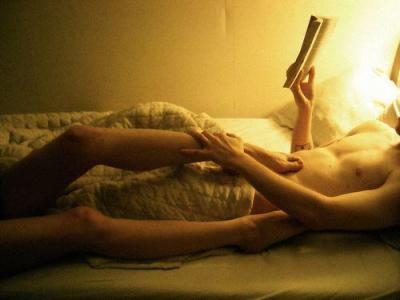
cuddles + sexytime reading = for the win!

But Dines sees pornography as inherently patriarchal, and as a tool of sexual (and racial) inequality. And she approaches it not in an exploratory way, but in a political way. Throughout the debate she responded to questions with rabble-rousing calls to action — although like with The Price of Pleasure I was never quite sure what she wanted us, as an audience, to do. At the end of the evening she challenged the audience in this way:

I would like to think that hopefully you’re going to live your life as activists. And if you believe in gender equality, if you believe in any type of equality, then we simply cannot have this with this juggernaut breathing down our necks. This is destroying women’s lives, it’s destroying children’s lives, it’s telling men that they have a right to fuck women both in and out of the bedroom … If this is the world you want to live in, if this is what you think you can navigate, your children want to navigate, then fine. But I for one feel that we deserve better than this. That we are better than the pornographers, that we have the ability to create a more life-loving sexuality and that these predatory capitalists do not have the right to rob that which is rightfully and authentically ours.

The problem I have with this rabble-rousing call to arms is that Dines doesn’t make clear what she wants if not Queen’s argument that “we make different kinds of material, we make different things available to people, and we call out what is problematic in the context when we see it’s problematic.” As a queer feminist who moves in circles with other queer women, and some men, of various inclinations, I’d argue that we’re already working to create that world Dines says she wants. Except she refuses to acknowledge that work we’re doing because for her, pornography is only created by the evil overload capitalists for use by straight men who see women as objects to fuck. By defining pornography in this way — and ignoring all sexually explicit materials (or producers and consumers of this material) that don’t fit her pre-conceived notion of what porn looks like — she’s actively creating a world in which nothing we do to create alternate forms of sexuality counts.

Seriously: The more I’ve thought about it over the past two weeks, the more frustrated angry I’ve become. Dines and I are never going to see eye-to-eye about what is and is not acceptable sexual fantasy. At one point during the evening, Carol Queen observed, “part of my responsibility [is] to talk about the degree to which, in these kind of discussions, violence and sexualities like BDSM get conflated and mixed up, and to be able to say they’re not always talked about in ways that are clear enough for my comfort.” And I heard Dines making a lot of judgments about other peoples’ consensual sex lives interchangeably with judgments about violence and non-consensuality. Non-consensual sex is a form of violence that we should all be able to agree is not okay, but Dines’ insistence on conflating non-normative sexual material and activities with violence just puts us that much further back in terms of addressing sexual violence in a meaningful way. She’s rendering sexual violence within non-normative communities invisible by insisting that membership in the community itself (basically engaging in sexual activity she finds gross) is itself an act of violence. It renders everyone in that community either a perpetrator or a victim — an act of erasure so angry-making to me, as a queer person involved in several of Dines’ victim/perpetrator subgroups, that I really don’t know how to begin picking apart the problems.

And not even queer sexuality — let’s talk about the poisonous effect of figuring hetero men as predatory addicts. Dines argues that part of the reason she’s on a crusade against pornography is that she refuses to see all men as rapists. Yet in virtually the same breath, she argues that “men very quickly get desensitized to pornography” and need more and more “extreme” scenarios in order to become aroused. This argument subsumes sexually graphic material under the category of violent material, assuming that sex is something morally objectionable or distasteful we need to become desensitized to in order to tolerate. Setting aside the sketchy correlation of exposure to fantastical violence with carrying out actual acts of violence, can we talk about the problem of framing sexual activity as violence? Speaking as someone who enjoys sexually explicit material and discusses the pleasure of erotic material with friends, I’d like to suggest that rather than becoming desensitized to erotic content, exploring sexually explicit materials leads to discovering what you like and seeking out more of it. This the endless well of hurt/comfort, established relationship, first time, or “aliens made them do it” fan fiction on the ‘net. Not to say that what you’re interested in exploring sexually never shifts throughout your life. But those shifts are going to be due to all manner of things, rather than over-exposure to erotica.

In the two weeks that have passed since the debate, I’ve found myself circling back to the question of why Dines doesn’t include the full diversity of sexually explicit materials in her analysis, or seek to complicate her understanding of how we humans interact with erotica. Is it because she just doesn’t know where to look for (oh let’s just take something at random) fan-created m/m first-time ‘making love’ erotica? Do her students at Wheelock College not point out that there’s ethical porn on demand available Smitten Kitten’s website? Wouldn’t it be way more fun (and less overwhelming) to create the world of erotica we want to have, rather than spend so much time and energy trying to take down “the porn industry”? Dines herself seems pessimistic about the effectiveness of her approach when she observes in her opening statement, “When I started this work, pornography was five billion. Today, it’s ninety-seven billion. So that really speaks volumes about how good my activism is.” So why not try a different approach? The cynical part of my brain suggest that Dines is a reactionary who isn’t actually interested in changing our discourse about human sexuality. In her own words, “you can’t put this genie back in the bottle outside of a national organization and a movement of outraged citizens who think the pornographers should not decide our sexuality, outside of that there’s no going genie back in the bottle.” So in her ideal world, we’d be shoving all this sexual diversity — and the difficult conversations around identity, ethics, and politics that come with acknowledging it — “back in the bottle.”

While she’s allowed to have her own opinion (and is given a pretty big soapbox from which to broadcast it), I was struck at the debate by the degree to which Gail Dines refused to engage in good-faith discussion about these complicated issues. She was using the stage to rally her troops and (attempt to) humiliate the opposition. She was a poor listener, responding to questions with sound-bites, and her body language when Carol Queen was speaking telegraphed her simultaneous disinterest and displeasure. When she herself wasn’t speaking, she was checked out. She also repeatedly credential-dropped and hip-checked with identity words and phrases like “as a Marxist feminist” or “as someone who teaches media studies” as a way to discredit Carol Queen’s perspective, despite the fact that no one in the room was actively challenging Dines’ authority to speak or her professional-political identity. At one particularly low point in the evening, Gail Dines took it upon herself to speak for all “impoverished feminists” and challenge Carol Queen (as if she wasn’t also a self-identified feminist doing non-profit educational work) to basically agree to tow Dines’ line when it came to the harm pornography supposedly causes society as a whole. Queen called her on it immediately, but I find it a creepy and toxic move for Dines to have pulled in an academic forum where mutual respect should really be the baseline expectation for conversation.

From my point of view, Dines behaved in an unprofessional manner and while Queen remained civil and refused to play the game of political point-scoring, Dines’ unwillingness to be a genuine participant in a two-way conversation was bullying behavior. I hope that if Boston University holds similar events in future they will look for guest speakers who will participate in full good faith. It’s disgraceful that any students or audience members walked away from the event with the feeling that their sexual selves are somehow fundamentally complicit in the world of violence against women which Gail Dines believes pornography to be. Despite the fact that this debate was a baby step in the right direction, there are much bigger steps we as a culture could be taking toward having a meaningful discussion about human sexual variety and the creative expression we generate around our sexual selves.


*I’m actually working on a forth post (I know! I know!) about how I think porn can be positive. So look for that to go live on Saturday.

**On a brief technical note, all direct quotations from the debate are transcribed from a digital recording I made for personal note-taking purposes. I’m hoping to make the audio and full transcript available eventually, but haven’t gotten the go-ahead from the event coordinator yet. Keep your fingers crossed!

the porn debate: first thoughts

11 Saturday Feb 2012

Posted by Anna Clutterbuck-Cook in think pieces

≈ 2 Comments

Tags

being the change, education, feminism, friends, gender and sexuality, moral panic, smut, the body

but is it porn?

Last night, thanks to my friend Minerva, who is currently at the Boston University School of Public Health, I was able to attend a screening at BUSPH of The Price of Pleasure: Pornography, Sexuality, and Relationships (2008) and the subsequent Q&A-cum-debate with anti-porn activist and author Gail Dines and sexuality educator Carol Queen. Lots to process. I’ll be writing a review of the film and a more coherent summary and reaction to the debate portion of the evening once I’ve had some time to organize my thoughts. But meanwhile, are a few first responses.

  • The Price of Pleasure had an agenda which wasn’t very subtle — and that was to make porn appear monochromatic, exploitative, and seedy. This wasn’t a surprise, but I found myself fascinated by the way the construction of the film itself conveyed that narrative. More about this in the review. It was a fairly masterful piece of propaganda … if you didn’t sit there with your media literacy lenses on and go “what just a minute!” (And if anyone wonders what the scary voice man does between election cycles, he was totally hired to do the voice over in this documentary).
  • I was struck by the level of powerlessness expressed by people interviewed in the film, by Gail Dines in the Q&A, and by some of the audience members who asked questions. Commercially-produced video porn is depicted as an all-powerful, pervasive, thought-controlling medium that somehow renders consumers (and even non-consumers) incapable of imagining or practicing alternative sexualities. Since my experience has been that a) avoiding porn one doesn’t like is relatively simple, and b) finding or creating porn one does like is also pretty easy, I can’t say I understand this line of reasoning. Having just finished Amy Schalet’s new book Not Under My Roof: Parents, Teens, and the Culture of Sex (review forthcoming) I can’t help wondering if this feeling of helplessness doesn’t go back to what Schalet terms the “dramatization” (vs. normalization) of sex in American culture.
  • I understand there’s a larger argument being made about how the narratives in porn reflect and shape some of the crappy narratives of our society (for example, society is racist and sexist — surprise! porn is also racist and sexist), but I don’t understand why the solution presented is not the two-fold critique and creation solution we’d use in virtually any other field. That is, 1) encourage people to watch porn with a critical eye, much like Jenn Pozner encourages people to watch reality television with a critical eye (see Reality Bites Back), and 2) support the creation of better porn. See for example the feminist porn awards and the recent piece by Erika Christakis, Is it Time for Fair Trade Porn? For some reason, when it comes to porn, all of our usual skills for working to change culture are jettisoned out the window? That doesn’t seem right to me.
  • I continue to be frustrated by the way “porn” and even “sexually explicit material” has become short-hand for “video pornography.” I took an online survey recently designed to capture information about women’s consumption of online porn — and it became apparent almost instantly that they were assuming the porn in question was filmed live-action sequences. Why aren’t we talking about sexually explicit fiction and nonfiction, photographs, erotic audio, and other materials that depict sexual activities and are designed to elicit arousal? This isn’t to say video porn is bad either, but I feel our analysis of the genre might be more nuanced if we looked across mediums, rather than focusing just on film.
  • If Carol Queen hadn’t been there, no one in the room would have spoken to the fact that pornography is, in fact, not solely a product of the heterosexual male imagination, created for consumption by heterosexual men. The discourse about porn in the film and throughout most of the Q&A rested on the erasure of women and queer folks who create and consume erotic material without being coerced or exploited into doing so by the patriarchal overlords. Dines seems to believe that in her perfect (socialist feminist) universe, no one would make porn she didn’t like, because of course no one would voluntarily make pornography that squicks her out. I didn’t hear any evidence last night that Dines would have been able to make sense of me as a queer woman who creates and consumes erotic materials, in both solitary and relational contexts. Who has both an incredibly egalitarian, loving sexual relationship with another woman and enjoys some kinky and rough sex fantasies, which work together symbiotically to enrich my relational life. In Dines’ narrative of porn, my experience is rendered completely invisible — and while one person’s experience does not a data-set make, that dissonance makes me doubt her theory’s explanatory power.
  • Also, while we’re at it, men who enjoy sex with women are not, in fact, controlled by their dicks — and men’s penes aren’t somehow inherently threatening and oppressive to women who enjoy having sex with men. Male sexuality is not some mysterious, all-powerful, aggressive, violent, controlling force that must be contained and managed externally (i.e. “domesticated”). I believe people of all sexes, sexualities, and genders, are equally capable of exploring their sexual desires in ways that aren’t — for lack of a better word — “antisocial.”

I come to this conversation with my own experience of pornography, obviously. I’ve seen a vanishingly small amount of video porn — most of it filtered through secondary sources like documentaries or embedded within feature films (where we just call them “sex scenes”). I’ve never experienced sexually explicit materials in the context of emotional coercion or physical abuse, and have never felt the presence of sexually explicit materials compromised my intimate relationships. Aside from some early childhood peer-to-peer situations that made me passingly uncomfortable (and probably deserve a post at some point), I’ve basically felt like I had bodily autonomy and sexual self-determination. My teenage years and young adulthood were characterized by self-directed exploration of human sexuality and my own sexual desires, mostly through fiction and non-fiction, and solitary sex. When I didn’t find sexually explicit narratives that satisfied me, I decided to create my own.

Did I have sexual struggles? Certainly. I was reflexively anti-porn early on because I’d imbibed the cultural narrative of “porn” as relationship destroying, the last resort of the lonely, as anti-feminist objectification. At the same time, I was discovering that mild bondage scenarios and actual mild bondage were a huge turn-on for me. Together, these two conflicting messages me feel like a bad feminist, and made me feel overwhelmed by my own sexual desires. But if pornography hadn’t been demonized by those around me, maybe I would have realized before my mid-twenties that fantasizing about ceding control in a sexual situation isn’t the same as wanting to be literally helpless. I don’t wish my younger self hadn’t been exposed to bondage imagery or narratives — I wish I’d been given better tools with which to analyze both it and my responses to what I saw.

I just don’t experience the existence of sexually explicit materials — even if its porn I’m turned off by — as threatening to my own sexual self-determination or my ability to find, and form meaningful connection with, other sexually-compatible human beings. I don’t see “porn” as an enemy.

Overall, I wish we — as a culture — could move beyond the moral panic that sexually-explicit material seems to engender in a fairly high percentage of the population  and talk instead about all of the tools we already have at our disposal to critique unhelpful cultural narratives in porn, to advocate for workers’ rights, and to develop our own sense of sexual self-determination. I heard Carol Queen making a bid for that shift to take place last night, and I heard Gail Dines resisting it with all her rhetorical might.
Since writing this post, I’ve published a review of the film, The Price of Pleasure, and a more thorough summary and analysis of the debate itself. Finally, some thoughts on the positive potential of porn.

booknotes: the secret lives of wives

09 Thursday Feb 2012

Posted by Anna Clutterbuck-Cook in book reviews

≈ 3 Comments

Tags

bigotry, books, feminism, gender and sexuality, moral panic

A couple of weeks ago, I posted a pre-review review of Iris Krasnow’s book The Secret Lives of Wives (Gotham, 2011). From those notes, it should be clear to you that I had major issues with the book — and to be fair, I expected to have major issues with any book by someone whose previous books were titled Surrendering to Marriage and Surrendering to Motherhood. Sometimes, you can judge a book by its cover. Or at least, the choice of language by which it is marketed. The breathless wording of the title (“secret lives” and “what it really takes”), along with the temptation-of-Eve cover we’re rocking here, signaled to me we were in for a rocky ride.

And to be honest, that’s part of the reason why I requested the advance review copy of the book. Because on some level I’m fascinated by people who continue to buy into — and actually seem satisfied with — the heteronormative, gender essentialist assumptions about what it means to be men and women, relate sexually, and form families. I didn’t grow up in a household where gender normativity was enforced, and while my parents have enjoyed a 35-year marriage — which at times took a lot of active work to maintain — they have never pressured us kids into partnerships, marriage, or parenthood, hetero or otherwise. So I just don’t get the concern trolling over kids-these-days being somehow unfit and unable to establish intimate partnerships.

Part of me hoped that Secret Lives would offer really interesting first-person narratives about long-term partnerships. I’m an oral historian by training, after all, and even when autobiographical narratives turn on values I strongly disagree with I still find life stories an absorbing read. And a preliminary glance at Krasnow’s website also suggested that at least some of the “secrets” to a successful marriage were going to be fairly benign: maintain strong relationships with male and female friends outside the marriage, don’t expect your spouse to meet every emotional need, make space and time for being alone or pursuing independent projects. Who’s really going to argue with those fairly basic pieces of advice for well-being? So while I went into this book with the expectation that there would be much to disagree with, I was also prepared to find something — anything! — redeeming in its pages.

Wow, that was hard. As my preliminary notes suggest, the “points for” list I started in the front cover was quickly overtaken by the “no points for” list. But I’m going to lay into this book fairly hard in a minute, so let me begin by observing what I felt Krasnow did — if not “well” at least “decently.” She situates herself in the introduction as a curious journalist, not a sociologist or psychologist, and (at least initially) acknowledges the anecdotal nature of her research. She later goes on to consistently generalize from that research, but we’ll deal with that below. In so many words, she acknowledges this is a book about heterosexual couples, though doesn’t talk about her reasons for limiting the study in this way. The fact it’s all about wives rather than husbands and wives is something that is never specifically addressed, though I think it’s tied to the fact Krasnow sees women as primarily responsible for securing and maintaining a marriage (more below).

She does acknowledge that there is no one-size-fits-all formula for marital happiness, writing that “there is no gold standard for marriage,” although I think her later arguments undermine this initial claim. As I said above, she is fairly consistent in maintaining that individual people are responsible for determining — and seeking out — what will help them thrive (in other words, don’t expect a husband to equal instant happiness). She argues for the importance of maintaining adult friendships outside long-term partnerships, and she encourages wives to maintain independent lives through work, travel, exercise, and other activities that will take them out of domestic life. Basically, “It’s okay to do things without your husband sometimes.” Which I think is pretty sane advice for partners of any persuasion (and I’m not sure it really counts as a “secret” given the number of people who know and agree with it).

And I realize this is a super-low bar, but I’m going to offer her maybe half a point for at least acknowledging the existence of women in hetero marriages who don’t have children with their partners, couples who aren’t white, and couples who aren’t upper-middle-class. With the exception of ethnic diversity (which isn’t really clearly delineated, though one woman is identified as African-American and one Bengali) there’s one example of non-parenting, and one example of a non-professional-class couple. Other than that, we’re basically talking about white upper-middle-class wives with children, most of whom have advanced degrees and are married to individuals similarly situated. Couples with the financial resources to support multiple homes or summer-long vacations abroad, hire (and have affairs with) gardening staff, choose to be a single-income family (and not suffer financially for it), etc. Her profiles of individual women include throw-away details about fur coats, caterers, manicures, high-end spas, and other markers of incredibly privileged lives. Granted, social and economic privilege has never proven to shield individuals from emotional distress or relational impoverishment — but I wish Krasnow has been more upfront about the demographic she was actually studying.

Okay, so those are the okay-ish things about Secret Lives. Things that limit the book’s generalizability, but aren’t particularly harmful if you take them for what they are. Several of the life stories Krasnow includes — if you can grit your teeth and get passed her editorializing — are actually really awesome. I particularly appreciated the one interview she did with a married couple, Phil and Pat, since it included both partners’ voices. Phil and Pat were articulate in describing the ways in which sexism made Pat’s career (in the tech industry, alongside her husband) more difficult, and how together they learned how to resist the external forces trying to push Pat out of the business world, or pit them against each other as competitors. Similarly, a couple of women — interestingly enough the wives who used “we” most often — described the way they re-negotiated their marriage arrangements in times of stress, to better share the tasks of child-rearing, or to open their marriage to other partners (more on the one swinger couple below). The women who used “we” were much more likely to describe equal partnerships in which they’d worked with their husbands to build a home life that supported both their individual needs and the nurturing of their relationship. Often through active re-negotiation of terms when the original assumptions or agreements had failed to serve one or both of them adequately.

So what are Krasnow’s secrets for a successful (note: “successful” in Krasnow’s world means long-lasting — no marriage which ended in separation or divorce gets a place in the book, and cautionary tales of people who did divorce feature prominently) hetero marriage? And what ideas concerning gender and sexuality is she promulgating on the way by?

Secret #1: Heterosexual marriage is what every woman “needs” because it is “essential.” So while I have no problem, per se with a study that focuses on one group of people (in this case wives) due to the questions being asked or simple logistics, I became increasingly suspicious of Krasnow’s decision to focus exclusively on “wives” as the book went on. She begins with a chapter about “why marriage,” as in why should she focus on describing successful marriage. “Who needs marriage?” She asks rhetorically, answering herself, “Women do, of this I’m convinced” (8). While Krasnow includes handful of throw-away lines to the effect that some marriages are abusive and should end, the actual message of the book is that marriage, virtually any marriage, is better than dating (and yes, if you’re single you’re assumed to be looking for a partner). The women who fail to keep their marriages intact in Secret Lives are seen as failures who gave up, who had unrealistic expectations, or who made a rash decision they now regret. “Better to stick with the first flawed union if you can; the second could be worse” (32) she concern-trolls over and over. 

This understanding of marriage as something women “need,” and the focus specifically on “wives” also speaks to the pervasive gender essentialism Krasnow offers up, in which women pursue marriage … with men whom she depicts as emotionally unavailable and brutish (I’m serious, she and Caitlin Flanagan should just go to housekeeping together) and frankly not all that appealing. While she insists that marriage is the essential ingredient for ultimate life-long happiness, her own descriptions belie those claims. In other words, Krasnow should be approached as an unreliable narrator.

Secret #2: The work and compromise of making a marriage successful, that is to say life-long, falls to the wife. There’s a telling scene early on in the book where Krasnow describes a point in her own marriage when she was a full-time mother with four children under the age of five and her husband was the full-time wage-earner. She describes her frustration at making breakfasts and lunches for the entire family while her husband sat at the breakfast table with the paper, ignoring the chaos around him, and then disappeared to work leaving her to clean the house and care for the kids. She describes calling her mother and announcing her intention to leave her husband — because anything would be better than the status quo. Yet in the end, she and her husband remained together and things got better. (Sort of. Frankly, the descriptions Krasnow provides of her husband and their interactions are filled with a level of animosity that belies her protestations of marital bliss. I was really uncertain what we were supposed to make of her more personal anecdotes and their place in the story, since they seemed at odds with one another.) But anyway, she fills the book with similar narratives in which women are miserable with the status quo, yet consistently turn back to themselves as the source of the problem. I agree that to focus on assigning blame rather than solving the problem can be counterproductive, but I cringed at sentences like this: “Recently, Alice has been ‘working on herself’ and blaming Chris less, fueling a discovery that he isn’t so bad after all” (66). Relentlessly, the exhausted mother of young children is counseled to stick it out, rather than speak up and say “This isn’t working, can we figure out how to make this more equitable?” These marriages all take place in a vacuum where sex and gender politics on a wider scale don’t exist, and it’s simply women’s lot to be the full-time parent with an unresponsive husband (who will start paying attention to her again once she stops wallowing in self-pity and bothers to put on tight jeans and sexy lipstick).

Lesson #3: Adultery is okay, as long as you keep it secret from your spouse, and having an open marriage is exactly the same as being an adulterer (except people with open marriages are mysteriously happier). So she has a really depressing chapter on women in relationships where either they or their husband maintain the marriage by cheating on one another — and not talking about it. I realize everyone feels different about adultery, but I believe trust and honesty and fidelity are really important in any relationship, and if a marriage is going to involve multiple people in any way, it should be openly negotiated and agreed upon by all parties involved. Which is why the one swinger couple Krasnow profiles, I’d argue, seem so damn pleased with the way they’ve chosen to conduct their sexual lives. Yet Krasnow folds this couple into the chapter on adultery, and seems at a loss to explain why their extramarital relationships aren’t causing anyone angst or despair.

Lesson #4: Youthfulness should be prized while young people are denigrated. Some people might see this as two separate issues, but I’m treating them together ’cause I think it’s two aspects of the pernicious ageism that permeates our culture. Krasnow uncritically accepts that youthful looks are desirable (in women) and should be maintained (by women) in order to keep the interest of their husbands, etc. At the same time, she portrays young people — I’m assuming any cohort younger than about age 35? — as lazy gits who are unwilling or uninterested in putting energy into maintaining relationships. We’ve all grown up with the “divorce epidemic,” I guess, and somehow technology has also made it easier to give up on people (it’s unclear why, but Facebook and iPads feature as emblematic of … whatever the problem is). I feel bad for her kids that she basically thinks they’re uninterested or incapable of connecting. While this book is ostensibly a look at marriage in the “middle years” (read: after your kids have gone away to prestigious colleges), it’s shot through with a heavy, heavy dose of judgement and unsolicited advice for younger folks who might think twice before marrying, not be interested in marrying a man, or who might try to re-negotiate the work/childcare arrangement with their spouse.

The entire book could really be reduced to a banner reading “Be Grateful You Have a Man, Any Man, Girls, Because Without One Life Isn’t Worth Living.” Which (and here’s where my own personal bias might come in a teeny-weeny bit?) is a really weird message to try and send with a shit-ton of examples of hetero marriages that sound fairly dysfunctional and unhappy to me. Even when you discount the one or two that are actually out-right abusive? It’s a fairly dismal bunch. Like I said, there are maybe three or four profiles in which the women speak with confidence about having negotiated a fairly equal arrangement with their spouse, and where the couple seems to be on the same page about their domestic life. But more often than not, there seems to be a lot of despair, resignation, rage, and yes, “secrets” that involve emotional and physical infidelity.

Seriously: I got to the end of this book and I was like, “If this is the world of straight marriage, I’m so glad I’m out.” I am so thankful for all of the people I know who are married to other-sex partners who aren’t actually acting out this sort of misery. Who are living lives of partnership and communication. Who don’t assume all women “need” marriage, and who don’t denigrate their own husbands by making snarky asides about how many hours per weekend they spend watching hockey.

I started out this post by observing that part of the reason I read books like this is to try and understand what people who think like this get out of their portrayal of women and men and marriage in this fashion. This book failed insofar as I still don’t understand it. One could write a perfectly sane, thoughtful, book about the compromises and negotiations one makes in a long-term relationship. One that didn’t hinge on making generalizations about how men and women operate and what they want out of relationships. But this is not that book.


P.S. I originally wrote this review prior to reading Samhita Mukhopadhyay’s Outdated, though the review of that book went live on Tuesday. While I was reading Outdated I kept thinking of Secret Lives and how this book — despite the fact it’s not explicitly marketed as a dating advice manual — fits so well into the paradigm of the hetero dating advice schlock Mukhopadhyay takes to task. Basically, if you’re going to read Secret, keep Outdated close at hand as an antidote!

Cross-posted at The Pursuit of Harpyness.

← Older posts
Newer posts →
"the past is a wild party; check your preconceptions at the door." ~ Emma Donoghue

Recent Posts

  • medical update 11.11.22
  • medical update 6.4.22
  • medical update 1.16.2022
  • medical update 10.13.2021
  • medical update 8.17.2021

Archives

Categories

Creative Commons License

This work by Anna J. Clutterbuck-Cook is licensed under a Creative Commons Attribution 3.0 Unported License

Meta

  • Create account
  • Log in
  • Entries feed
  • Comments feed
  • WordPress.com

Create a free website or blog at WordPress.com.

  • Subscribe Subscribed
    • the feminist librarian
    • Join 37 other subscribers
    • Already have a WordPress.com account? Log in now.
    • the feminist librarian
    • Subscribe Subscribed
    • Sign up
    • Log in
    • Report this content
    • View site in Reader
    • Manage subscriptions
    • Collapse this bar