• anna j. clutterbuck-cook
  • contact
  • curriculum vitae
  • find me elsewhere
  • marilyn ross memorial book prize

the feminist librarian

the feminist librarian

Tag Archives: moral panic

booknotes: delirium

28 Tuesday Feb 2012

Posted by Anna Clutterbuck-Cook in book reviews

≈ Leave a comment

Tags

books, feminism, gender and sexuality, moral panic, politics

After hearing Nancy L. Cohen interviewed by Amanda Marcotte recently on the RhRealityCheck podcast, I requested her most recent book, Delirium: How the Sexual Counterrevolution is Polarizing America (Counterpoint, 2012), from our local library and spent a day reading through it. Cohen is an historian and journalist whose previous research also took as its topic political history in the twentieth century. Delirium looks at what are popularly termed “the culture wars,” beginning with the advent of the birth control pill and rolling up to the current election cycle — with a particular focus on the politicization of sexuality — both behavior and identity — and gender roles. You can read an excerpt of the opening chapter over at AlterNet.

Cohen’s narrative of sexual politics from 1960 to the present seeks, in some measure, to revise our understanding of the conservative revolution of the late 1970s as one led by white male reactionaries like Jerry Falwell and Pat Robertson. Instead, she argues, some of the first — and most successful — sexual counterrevolutionaries were women like Phyllis Schlafly, Lottie Beth Hobbs, and Anita Bryant. These women, like their male counterparts, were opposed to the advancements in gender equality, the changes in (hetero)sexual mores, and the growing visibility of human sexual variety that the feminist and gay liberation movements of the 60s and 70s fought for. In sometimes overwhelming detail, Cohen recounts how political activists and career politicians successfully stopped the Equal Rights Amendment, pushed back advancements made in civil rights for queer citizens, generated moral panics around sexual variation, and stymied the post-Roe landscape of women’s access to sexual health services, especially abortion.

Overall, I felt like Delirium bogged in a blow-by-blow recounting and analysis of presidential campaigns and administrations, from the fall of President Nixon to Barack Obama’s first term. Cohen draws much of her evidence from quantitative polling data and political commentary, which left me wondering how much the understanding of individual Americans support her thesis about who sexual conservatives are and why they support the policies they do. To her credit, Cohen does acknowledge that sexual conservatism, as sociologist Kristin Luker has shown, appears on both sides of the aisle. Moral panic over teenage sexuality and concern-trolling about women’s ability to meaningfully consent to an abortion are equal-opportunity topics for Democrats and Republicans alike. Her narrative, however, mostly charts the sexual conservatism and politicking of Republicans. I waited in vain, for example, for her to talk about feminist anti-porn activism, which often paralleled and intersected with — at least on a policy level — with the work of people with otherwise diametrically opposing political views.

Cohen’s work will be particularly interesting to those who enjoy thinking about strategy of electoral politics and policy negotiations, as well as those who may want a better grip on the broad sweep of sexual politics since the 1960s. However, for scholars and activists well-versed in much of this history, Cohen’s narrative fails to add much of significance to what we already know about our sexual selves in relation to formal politics. That is, that our sex, sexuality, and gender identities and experiences are presently over-determined, or constrained, by the decisions of our elected representatives at the local, state, and federal level.

the porn debate: further thoughts

23 Thursday Feb 2012

Posted by Anna Clutterbuck-Cook in think pieces

≈ 2 Comments

Tags

feminism, gender and sexuality, moral panic, smut

Note: This is part three of my series of posts related to a screening of The Price of Pleasure and discussion about pornography that took place at the Boston University School of Public Health on Friday, 10 February 2012. Part one can be found here and my review of the film itself was published last Thursday. Today we wrap up* with a more thorough analysis of the post-screening discussion.

On my first thoughts post, I received an anonymous comment in which the reader observed, “That any institute of advanced learning was able to arrange to have a Dworkinite to have a conversation with someone like Dr. Queen is a major step in communication. In almost every case over the last 30 years the sex-negative academics will not allow any other female voice to be heard.” I’m too young to remember first-hand the feminist “porn wars” of the late 1970s and early 80s — times of deep division that, as both Gail Dines and Carol Queen made clear in their stories of relating to pornography, are with us still in a multitude of ways. In Gayle Rubin’s Deviations, she recalls the protests and personal harassment that followed her to various speaking engagements, the fury and fear that met her research into the subcultures of S/m sexuality, and her openness about being a person who enjoyed kink. That the BU School of Public Heath was open to hosting an event in which pornography was openly debated deserves congratulations all ’round — to the faculty who organized the evening, to the invited speakers, and to the students and guests who attended.

There’s no question that exchanges grew heated at times, and opinions were certainly partisan. As a queer woman who creates and enjoys erotic material that would certainly be seen as beyond the pale by Dines, I experienced a profound sense of erasure sitting in that room. And I know from post-event conversations that my experience was not an isolated one. I’ll talk more about that below. But despite that (pretty glaring) marginalization of non-normative sexualities, there were no guests whose object was to bring the evening to an end, there was little interruption or shouting-down of opinions with which some disagreed, and I’d like to hope, from my own pro-erotica perspective, that some of the students that night who went in thinking of porn as something monolithic, evil, and shameful, might at least be aware that there are other interpretations of sexually explicit materials out there, and that not all of those interpretations are talking points from the Porn Industry. I have it on good authority that at least one class last week was given my first blog post as recommended reading (hi everyone, and thanks for stopping by!). So there are signs that an actual respectful communication may eventually be possible.

Yup. Sometimes, you find yourself setting the bar that fucking low. 

And now, to the debate itself.

Following the screening of The Price of Pleasure (review here) Drs. Gail Dines and Carol Queen got up on stage, each with their own podium and mic, and the conversation began with a question from Emily Rothman, who asked:

So I’ll start with this very general question, and this is from Caitlin Masters who’s in my sexual violence class. Caitlin asks, “What past experiences shaped your views of porn? What do you think were the biggest influences on your opinions? Have your views changed from when you first began learning about porn to now?”

Here’s how they both responded. I’m going to reproduce these answers in full because I think each person’s response set the overall tone for the discussion that followed.** Carol Queen got things rolling:

That’s such a terrific question. I was thinking about this earlier today when I was sort of making some notes for myself and thinking about stuff and I actually want to say that I – I didn’t start out with the identity of “anti-porn feminist” but in my late teens and early twenties I definitely would have called myself that. It was the 70s. It was a period of time when that identity was sort of coming forward. I’d begun to see porn when I was in Junior High and High School, but not very much of it. Not in moving pictures – we barely had those in those days! [general laughter] But I did see Penthouse and Playboy and things like that. And I started to see movies with my girlfriend Ellen when I went to college and we were interested in checking out porn. And in those days you came to a theatre with this many people or more and looked at the movie together. The advent of video had not yet happened. And I used to huff that porn insulted my intelligence, my sense of the erotic, and my politics – at least one if not all three. And I’ll be very honest with you, there are days when it still does? I’m pro-porn anyway, in a particular way, or at least I wanna be anti-censorship and I wanna talk more about that as I’m sure the questions are going to bring that up.

The thing that was probably the most important to me as far as porn was concerned, and watching porn, was when I started doing my PhD program at the Institute for Advanced Study of Human Sexuality, which is the sexology grad school in San Francisco that I attended, and I started in the late 80s at a time when I was gearing up to do AIDS work and other kinds of sort of – really sort of public health type stuff. And I got derailed in sexology proper – or improper, depending on how you think about it. And part of that program – I’m going to use this work because it was its real title – was called the “Fuck-o-Rama.” And Fuck-o-Rama is a dozen to twenty-five or so porn images showing on all three walls around you, all at the same time. And it used to be that you couldn’t do this with a video camera, computer, so you can just imagine how many little old machines there were making this happen. All kinds of porn. The kinds of diversity we saw in Price of Pleasure plus other things that weren’t depicted there – ’cause Price of Pleasuredecides to show only certain kinds of porn to you – and all kinds of stuff. And I realized the first time I saw the Fuck-o-Rama that I had never really looked at porn, that I had been afraid of it, that it had not only made me feel sort of overwhelmed in terms of the sexual feelings that I had, but I also didn’t know what to do with feeling those in the context of not sex – or not in a sexual relationship. So it gave me a lot to think about, and I watched – you saw some of the young academics working on that study coding porn. I did that. None of my tic marks said “gender victim” on them but I did a lot of porn coding. And watched a lot and still watch – porn has changed a lot in twenty years but is also very much the same in other respects. So. I’m gonna end it right there and turn to Gail.

And this is Gail Dines’ response:

So I have to wonder, what’s a nice Jewish girl from England doing as one of the most well-known anti-porn activists in the world? And I’m sure everyone in my family, also, who tries to run away from me, also thinks that. [laughter] So I wasn’t destined to do this, I was actually destined to be a radical Marxist, that was my introduction to radical politics, was reading Marx at sixteen and thinking, “This makes absolute sense!” The idea that you have a bourgeoisie and a proletariat and that the bourgeoisie control the means of production – and especially, as Marx said, the means of mental production. So this all made sense to me, and I wasn’t that into looking at pornography. I was into feminism.

And then I got a job at the rape crisis center, my first job out of college, to do the research. And I was reading all these police reports and they kept saying that serial rapists were found with tons of pornography in their home. And this was the first time I’d really thought about pornography. And then one day somebody said to me – I was living in Israel at the time – and somebody said to me, “There’s a feminist from America doing a feminist anti-porn slide show, do you want to come?” And I never really thought about it that much, I said “Why not?” And that night my life forever changed. I could not believe the images I was seeing. I couldn’t believe that a) men made these images, or that b) that other men found them arousing. Now, this is what pornography was for me. It’s like, I had studied patriarchy but nothing delivers patriarchy to you like a bullet between the eyes as when you look at pornography. There it is crisp, clean, succinct. And I, in a way, got an introduction to patriarchy in a way that no book, no Andrea Dworkin, no Catherine MacKinnon, had ever given me.

So what happened was, I was doing my Doctorate at the time on media and I changed my thesis topic to actually do a Marxist theory of culture as applied to pornography. Because my argument was: If capitalism requires a propaganda system to reproduce inequality, then surely patriarchy is the same. And what better propaganda system of patriarchy than pornography? So for me it was such a profound awakening, that moment. Now, had somebody said to me, twenty years ago when I started this, that today mainstream pornography would be as violent and as cruel as it is I would have said, “Absolutely not. There’s no way people are going to sit by and let the culture be taken over like that!” And I would have been wrong. So I have to say, how has my views changed on this? Well, I always make a joke about how good an activist I am. When I started this work, pornography was five billion. Today, it’s ninety-seven billion. So that really speaks volumes about how good my activism is. [general laughter] So, how have my views changed? I think nothing, nothing can ever change from that first day ever when I saw pornography. It was an awakening of a type I’ve never had before.

What strikes me first and foremost about these two responses is that Carol Queen’s narrative is one of change and Gail Dines’ narrative is one of stasis. On the one hand we have openness and curiosity, a sense of self-determined exploration; on the other we have a clear sense of threat and subjection to something unwanted, and the determination from that point forward to make that unwanted thing go away. If you want a thumbnail sketch of the two parallel understandings of pornography running through the evening’s debate, you could do a lot worse than reference these two opening statements.

Queen describes how she began as a young woman who would have identified, in some measure, with anti-porn activism in the feminist movement: “I used to huff that porn insulted my intelligence, my sense of the erotic, and my politics – at least one if not all three. And I’ll be very honest with you, there are days when it still does?” She then describes having to revisit her understanding of what pornography is, in the context of her graduate studies. She describes discovering the “diversity” of pornography, and how she was overwhelmed by the visual images and her response to them — and how this prompted her to go away and think about pornography some more, and to gather further information about it. Throughout the debate that followed, I felt like Queen maintained this dual sense of speaking both for her own subjectivity (her experience of finding pornography both overwhelming and meaningful to sexual exploration) and from her more objective perspective as a sexologist and a sex educator ever-mindful of sexual diversity. She spoke with the voice of a researcher who finds human sexuality — and cultures of sex — complicated and endlessly interesting. As she observed toward the end of the evening:

I think the answer to problematic cultural discourse is always more cultural discourse. We talk about it, we make different kinds of material, we make different things available to people, and we call out what is problematic in the context when we see it’s problematic. I think that’s what we do.

Dines, by contrast, tells a story of political awakening in which there is a single defining moment, a call to action: “So, how have my views changed? I think nothing, nothing can ever change from that first day ever when I saw pornography. It was an awakening of a type I’ve never had before.” Whereas Queen describes her introduction to pornography in the context of mid-century men’s magazines and porn films watched with college friends at the theater, Dines’ introduction to pornography came in a much different form. Her introduction came as part of an anti-pornography slide show at a feminist event in Israel. These slide shows were assembled and sent around on tour as political messages, not as tools for personal sexual exploration or as cultural evidence of human sexual diversity. And if the creators of the slide shows were doing their jobs, the selection of images were assembled purposefully to evoke a negative emotional response. These anti-porn activists were employing the politics of disgust to spur feminists into action. At a time when pornography was far less available to the average consumer than it is now, people who viewed the slide-show would have had fewer previous encounters with pornographic material to measure the slide-show against. There was also a lot less information out there about specific sexual subcultures, so that folks were comparatively more likely to view BDSM scenes as violent non-consensual assault than as a negotiated scenario. Even today, as a general public, we’re woefully illiterate when it comes to human sexual diversity and therefore highly likely to react to stuff we don’t like as if it were stuff that no one would ever like.

I’ve heard some troubling stories about post-debate class discussions in which students and professors both openly suggested that stuff we don’t like shouldn’t be allowed as part of our cultural body of sexual materials (basically because “think of the children!”). This argument erases teenagers who might find non-normative sexual fantasy and experience erotic in positive ways. And I speak as someone who at the age of twelve or thirteen knew I liked certain things which were situated as icky and wrong by Dines & Co. I’m angry that people who think the way Dines does made me feel shamed and guilty for knowing what turned me on and for wanting to find healthy ways to act on those desires. And I’ve been growing increasingly angry on behalf of anyone else in the room that night who was overtly shamed by Dines from her position of authority for experiencing pleasure in ways she finds icky. Such reflexive invocations of a politics of disgust ignores how much we can learn, safely, about what we do and don’t want in our personal sexual lives by reviewing and digesting a wide variety of sexual material.

But back to Dines’ own narrative. She understands herself as a feminist who draws upon the framework of Marxism to understand the culture and political realm in which she lives. She uses Marxism to analyze pornography as work (which, to some extent, I’m cool with — I’m all for workers not alienated from the means of production), and also as propaganda produced by those in power (men) in order to maintain their position of power over the masses (women). This second porn-as-propaganda bit I’m less persuaded by. I’m definitely on board with the notion of media literacy and of encouraging people to think about what messages different types of pornography are conveying. I’m just not willing to accept Dines’ thesis that pornography as a genre is inherently exploitative and inherently patriarchal. Sexually explicit material is just that: sexually explicit material. What we choose to say with that material, and how we choose to respond to it, is our decision both individually and collectively. Porn isn’t the enemy — pornography is merely a cultural medium.

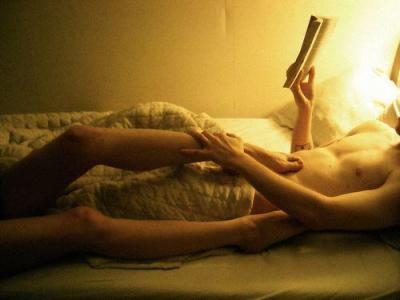
cuddles + sexytime reading = for the win!

But Dines sees pornography as inherently patriarchal, and as a tool of sexual (and racial) inequality. And she approaches it not in an exploratory way, but in a political way. Throughout the debate she responded to questions with rabble-rousing calls to action — although like with The Price of Pleasure I was never quite sure what she wanted us, as an audience, to do. At the end of the evening she challenged the audience in this way:

I would like to think that hopefully you’re going to live your life as activists. And if you believe in gender equality, if you believe in any type of equality, then we simply cannot have this with this juggernaut breathing down our necks. This is destroying women’s lives, it’s destroying children’s lives, it’s telling men that they have a right to fuck women both in and out of the bedroom … If this is the world you want to live in, if this is what you think you can navigate, your children want to navigate, then fine. But I for one feel that we deserve better than this. That we are better than the pornographers, that we have the ability to create a more life-loving sexuality and that these predatory capitalists do not have the right to rob that which is rightfully and authentically ours.

The problem I have with this rabble-rousing call to arms is that Dines doesn’t make clear what she wants if not Queen’s argument that “we make different kinds of material, we make different things available to people, and we call out what is problematic in the context when we see it’s problematic.” As a queer feminist who moves in circles with other queer women, and some men, of various inclinations, I’d argue that we’re already working to create that world Dines says she wants. Except she refuses to acknowledge that work we’re doing because for her, pornography is only created by the evil overload capitalists for use by straight men who see women as objects to fuck. By defining pornography in this way — and ignoring all sexually explicit materials (or producers and consumers of this material) that don’t fit her pre-conceived notion of what porn looks like — she’s actively creating a world in which nothing we do to create alternate forms of sexuality counts.

Seriously: The more I’ve thought about it over the past two weeks, the more frustrated angry I’ve become. Dines and I are never going to see eye-to-eye about what is and is not acceptable sexual fantasy. At one point during the evening, Carol Queen observed, “part of my responsibility [is] to talk about the degree to which, in these kind of discussions, violence and sexualities like BDSM get conflated and mixed up, and to be able to say they’re not always talked about in ways that are clear enough for my comfort.” And I heard Dines making a lot of judgments about other peoples’ consensual sex lives interchangeably with judgments about violence and non-consensuality. Non-consensual sex is a form of violence that we should all be able to agree is not okay, but Dines’ insistence on conflating non-normative sexual material and activities with violence just puts us that much further back in terms of addressing sexual violence in a meaningful way. She’s rendering sexual violence within non-normative communities invisible by insisting that membership in the community itself (basically engaging in sexual activity she finds gross) is itself an act of violence. It renders everyone in that community either a perpetrator or a victim — an act of erasure so angry-making to me, as a queer person involved in several of Dines’ victim/perpetrator subgroups, that I really don’t know how to begin picking apart the problems.

And not even queer sexuality — let’s talk about the poisonous effect of figuring hetero men as predatory addicts. Dines argues that part of the reason she’s on a crusade against pornography is that she refuses to see all men as rapists. Yet in virtually the same breath, she argues that “men very quickly get desensitized to pornography” and need more and more “extreme” scenarios in order to become aroused. This argument subsumes sexually graphic material under the category of violent material, assuming that sex is something morally objectionable or distasteful we need to become desensitized to in order to tolerate. Setting aside the sketchy correlation of exposure to fantastical violence with carrying out actual acts of violence, can we talk about the problem of framing sexual activity as violence? Speaking as someone who enjoys sexually explicit material and discusses the pleasure of erotic material with friends, I’d like to suggest that rather than becoming desensitized to erotic content, exploring sexually explicit materials leads to discovering what you like and seeking out more of it. This the endless well of hurt/comfort, established relationship, first time, or “aliens made them do it” fan fiction on the ‘net. Not to say that what you’re interested in exploring sexually never shifts throughout your life. But those shifts are going to be due to all manner of things, rather than over-exposure to erotica.

In the two weeks that have passed since the debate, I’ve found myself circling back to the question of why Dines doesn’t include the full diversity of sexually explicit materials in her analysis, or seek to complicate her understanding of how we humans interact with erotica. Is it because she just doesn’t know where to look for (oh let’s just take something at random) fan-created m/m first-time ‘making love’ erotica? Do her students at Wheelock College not point out that there’s ethical porn on demand available Smitten Kitten’s website? Wouldn’t it be way more fun (and less overwhelming) to create the world of erotica we want to have, rather than spend so much time and energy trying to take down “the porn industry”? Dines herself seems pessimistic about the effectiveness of her approach when she observes in her opening statement, “When I started this work, pornography was five billion. Today, it’s ninety-seven billion. So that really speaks volumes about how good my activism is.” So why not try a different approach? The cynical part of my brain suggest that Dines is a reactionary who isn’t actually interested in changing our discourse about human sexuality. In her own words, “you can’t put this genie back in the bottle outside of a national organization and a movement of outraged citizens who think the pornographers should not decide our sexuality, outside of that there’s no going genie back in the bottle.” So in her ideal world, we’d be shoving all this sexual diversity — and the difficult conversations around identity, ethics, and politics that come with acknowledging it — “back in the bottle.”

While she’s allowed to have her own opinion (and is given a pretty big soapbox from which to broadcast it), I was struck at the debate by the degree to which Gail Dines refused to engage in good-faith discussion about these complicated issues. She was using the stage to rally her troops and (attempt to) humiliate the opposition. She was a poor listener, responding to questions with sound-bites, and her body language when Carol Queen was speaking telegraphed her simultaneous disinterest and displeasure. When she herself wasn’t speaking, she was checked out. She also repeatedly credential-dropped and hip-checked with identity words and phrases like “as a Marxist feminist” or “as someone who teaches media studies” as a way to discredit Carol Queen’s perspective, despite the fact that no one in the room was actively challenging Dines’ authority to speak or her professional-political identity. At one particularly low point in the evening, Gail Dines took it upon herself to speak for all “impoverished feminists” and challenge Carol Queen (as if she wasn’t also a self-identified feminist doing non-profit educational work) to basically agree to tow Dines’ line when it came to the harm pornography supposedly causes society as a whole. Queen called her on it immediately, but I find it a creepy and toxic move for Dines to have pulled in an academic forum where mutual respect should really be the baseline expectation for conversation.

From my point of view, Dines behaved in an unprofessional manner and while Queen remained civil and refused to play the game of political point-scoring, Dines’ unwillingness to be a genuine participant in a two-way conversation was bullying behavior. I hope that if Boston University holds similar events in future they will look for guest speakers who will participate in full good faith. It’s disgraceful that any students or audience members walked away from the event with the feeling that their sexual selves are somehow fundamentally complicit in the world of violence against women which Gail Dines believes pornography to be. Despite the fact that this debate was a baby step in the right direction, there are much bigger steps we as a culture could be taking toward having a meaningful discussion about human sexual variety and the creative expression we generate around our sexual selves.


*I’m actually working on a forth post (I know! I know!) about how I think porn can be positive. So look for that to go live on Saturday.

**On a brief technical note, all direct quotations from the debate are transcribed from a digital recording I made for personal note-taking purposes. I’m hoping to make the audio and full transcript available eventually, but haven’t gotten the go-ahead from the event coordinator yet. Keep your fingers crossed!

movienotes: the price of pleasure

16 Thursday Feb 2012

Posted by Anna Clutterbuck-Cook in media

≈ Leave a comment

Tags

gender and sexuality, moral panic, movies, politics

Note: This is part two of my series of posts related to a screening of The Price of Pleasure and discussion about pornography that took place at the Boston University School of Public Health on Friday, 10 February 2012. Part one can be found here and my discussion of the post-screening debate can be found here.

The Price of Pleasure: Pornography, Sexuality, and Relationships (2008) is a documentary with a message. Although it can’t quite decide what that message is. The many-tentacled porn industry is fucking with our minds and our sexuality? Men who watch porn are more likely to be misogynist racists and sexual predators? All women are victims of porn, both in its production and its consumption? One way or another, pornography — we gather from the film — is bad. The Price of Pleasure tells the following story: In the hands of unscrupulous corporations run by men, the “porn industry” exploits female performers and relentlessly pushes a commercialized version of (heterosexual) sex that is, in turn, consumed by (heterosexual) men. The sexuality of male consumers is shaped by the narratives of “porn” — narratives which are sexist, racist, and violent, in short about different types of domination and control. Then these men turn around and bring pornography’s poisonous narratives into their own (heterosexual) sex lives. Individuals in the world of Pleasure — both porn-watching men and the women these men are in relationship with — are figured as populations almost totally lacking in self-determination and agency. And the documentary clearly wants us to get upset about this state of affairs — and I would, if I thought it were true! What the film’s audience might do to resist the porn industry’s grip on human sexuality is much less clear.

How did The Price of Pleasure make its argument for pornography as harmful to our sexuality? In part through interviews. Women interviewed in Pleasure describe feeling subjected to watching porn with their male partners (or sometimes abusers), or feeling pressure to conform to the hypersexualized imagery of womanhood peddled in consumer culture. Men describe sexual behavior that is shame-ridden, secretive, obsessive. The men and women interviewed about their consumption of pornography were all young Those in the porn industry, interviewed largely at an industry expo in Las Vegas, come across as product pushers, while the anti-pornography talking heads (interviewed against a black backdrop, in professional dress) come across as measured, authoritative experts. The talking heads are, for anyone who follows the discussion of pornography and culture, a cast of usual suspects: Gail Dines, Robert Jensen, Pamela Paul, Ariel Levy. While I’ve read some of these authors’ work, and find much to admire there, I also depart from their final analysis about what porn is and how it works as a cultural medium. So I definitely felt cranky, while watching the film, about how these authors were positioned relative to those in the porn industry — about the lack of any dissenting voices who were similarly situated as credentialed researchers. I might disagree that an individual with a doctorate and a long list of publications is a more authoritative source than the owner of a porn production company — but there’s no way that the industry insider is going to carry the same weight of someone positioned as an objective researcher.

I found myself noticing the visual choices being made in the film, and how these visual choices worked to support the documentary’s main porn-is-a-threat argument. The visuals we got of both the porn itself and of porn producers were rapid out of context clips. As a viewer, I felt visually assaulted by the rapid change of images that lacked any explanation, other than the understanding that these were typical images in porn. The scary voice man hired to narrate the film (if you’ve wondered what he does between election cycles, now you know) describes what you’re seeing — i.e. a female porn actress sucking off a group of men before the ejaculate on her face. But documentary context is very different from pornographic film context. “Porn” in The Price of Pleasure is synonymous with exploitative working conditions that, in turn, produce visual images and narratives that encourage men (and always men) to replicate those exploitative scenes in their own lives. We’re shown what does, much of the time, look like a violent, non-consensual sexual assault or torture scene. And as viewers we’re not given the information needed to evaluate the particular example of pornography in any meaningful way.

For example: Was everyone on the set consenting, in a meaningful, non-coerced way, to being there and engaging in the activities depicted? Were the activities specifically negotiated prior to shooting the scene by everyone, and were the activities and conditions agreed to in that negotiation adhered to? Were all of the individuals hired for the production paid a working wage? Were health and safety concerns addressed and ensured throughout production? In terms of the depiction of sex the film conveys, is it clear to the viewer of the film that these activities are consented to and negotiated, that adequate safety measures are being taken? These things matter. Does the woman (or subordinate partner) in the scene enjoy being bound and gagged, in the context of a role-playing scenario, or not? Power play doesn’t have to be exploitative as long as it’s play, and clearly demarcated as such. But The Price of Pleasure never acknowledges these distinctions, instead choosing to use shocking, non-contextualized imagery in support of its argument about how pornography is, in and of itself, an assault on our sexual selves.

The other, most glaringly obvious, problem with The Price of Pleasure was that the film-makers never defined their terms. What did they mean by “porn”? From the examples shown in the documentary, it was clear that “porn” meant very specific types of pornography videos, usually produced with an archetypal heterosexual male consumer in mind. In the world of Pleasure only men willingly produce pornographic films, only men who desire women consume pornographic films, and any other type of producing/consuming demographic and/or genre of sexually explicit materials is rendered invisible — because (I would argue) it fails to fit within the scope of the film-maker’s argument — namely, that “the porn industry” is destroying our sexual self-determination and ability to find sexual pleasure in non-destructive, equitable ways. Their argument thus becomes somewhat circular: limiting the discussion of porn to porn which appears, as presented, grounded in narratives of sexual dominance, abuse, and inequality, then it seems self-evident that pornography equals these things. And from there, it is but a small leap of logic to argue that consuming these messages about gender, race, and sexuality inform how we approach race-, gender- and sexual relations in our real lives (though the film makes this seem like a very simple causal relationship, when in fact I would argue the dialogue between fantasy and reality is much, much more complicated!).

Where, in the narrative this film is constructing, are the many genres of gay male and m/m erotica (film, textual, photographic, and otherwise?) Where is the feminist porn, the lesbian porn, the porn created within and for the many sexual identity communities — from swinging couples to polyamorous lovers to trans-identified queer folk to asexy kink lovers? Where, in this film, is there space to talk about amateur porn, whether in the form of the home videos once circulated via mail-order catalogs or xtube porn videos made by couples of all persuasions who have fun getting it on in front of the camera? What about amateur and professional erotica writers? Textual erotica is the pornographic medium I’m the most personally familiar with, and I can tell you that the variety of flavors is pretty much endless. And while “non-con” and “dub-con” erotica exists, the volume of fiction produced in which people consensually and joyfully get it on attests to our overwhelming desire, as a readership/authorship, to construct sexual worlds in which sexual intimacy most often means a surfeit of needs being met rather than alienation or social control.

There is a very interesting documentary to be made — or even more than one! — comparing and contrasting the various pornographic mediums, porn creators, and porn consumers. There are, to my mind, endlessly fascinating questions to be asked about how erotic materials figure into our sexual lives — whether we’re talking about our individual sexual selves or those selves in sexual relationship. Instead, by depicting both pornography and the creators of pornography in a monochromatic, sinister light — and by depicting male consumers (and all women) as victims of “porn” — this film closes the door on any conversation about the productive intersection of sexually explicit, erotic materials with human sexual expression. In Pleasure, pornography is constructed in opposition to authentic human sexuality, as the producer of false sexual selves. These false selves then serve to obscure, rather than open a pathway for, our (authentic) desires and the realm of possibility for acting on those desires. I was disappointed (though not surprised) that alternate narratives of pornography as a more positive force in society were absent.

I concur with the film, and with porn’s many critics, that there is a serious and urgently important conversation to be had about the economics and politics of sex work, and the exploitation of individuals through the making of pornography. Just like with any other industry, worker exploitation should not be countenanced, and employers should be held accountable by law for ensuring workplace safety and respect for workers rights. However, I don’t believe these conversations are at all advanced by positioning all men as the aggressors, all women as the victims, and pornography as the medium through which patriarchal oppression is produced and reproduced in culture. People of all sex, gender, and sexual orientations and identities work in pornographic production, and we should be supporting those workers on a community level to articulate their needs and goals for improvement to their lives. But although The Price of Pleasure makes clear its belief that workers (women particularly) in the porn industry are, as a class, badly done to, there are no solutions put forward in the film about how to go about supporting porn actors who want to change their (individual or collective) situations.

This is perhaps the final problem with The Price of Pleasure: that they fail to offer any sense of direction for change. If the problem, as the documentary film-makers see it, is the strangle-hold of “the porn industry” on our means of sexual expression, as a viewer I would have appreciated more explicit suggestions offered as to what the solution to this problem might be. As it is, The Price of Pleasure leaves us with an ominous sense of pervasive subjection, of helplessness, and no explicit pathways to liberating ourselves. I have my own suggestions, of course, for alternatives to non-consensual, unsafe, and exploitative sexual narratives — but I suspect the makers of Pleasure would not appreciate them. Thus, this film, in the end, simply reinforces the very sense of victimization the film purports to document.

Cross-posted at The Pursuit of Harpyness.

the porn debate: first thoughts

11 Saturday Feb 2012

Posted by Anna Clutterbuck-Cook in think pieces

≈ 2 Comments

Tags

being the change, education, feminism, friends, gender and sexuality, moral panic, smut, the body

but is it porn?

Last night, thanks to my friend Minerva, who is currently at the Boston University School of Public Health, I was able to attend a screening at BUSPH of The Price of Pleasure: Pornography, Sexuality, and Relationships (2008) and the subsequent Q&A-cum-debate with anti-porn activist and author Gail Dines and sexuality educator Carol Queen. Lots to process. I’ll be writing a review of the film and a more coherent summary and reaction to the debate portion of the evening once I’ve had some time to organize my thoughts. But meanwhile, are a few first responses.

  • The Price of Pleasure had an agenda which wasn’t very subtle — and that was to make porn appear monochromatic, exploitative, and seedy. This wasn’t a surprise, but I found myself fascinated by the way the construction of the film itself conveyed that narrative. More about this in the review. It was a fairly masterful piece of propaganda … if you didn’t sit there with your media literacy lenses on and go “what just a minute!” (And if anyone wonders what the scary voice man does between election cycles, he was totally hired to do the voice over in this documentary).
  • I was struck by the level of powerlessness expressed by people interviewed in the film, by Gail Dines in the Q&A, and by some of the audience members who asked questions. Commercially-produced video porn is depicted as an all-powerful, pervasive, thought-controlling medium that somehow renders consumers (and even non-consumers) incapable of imagining or practicing alternative sexualities. Since my experience has been that a) avoiding porn one doesn’t like is relatively simple, and b) finding or creating porn one does like is also pretty easy, I can’t say I understand this line of reasoning. Having just finished Amy Schalet’s new book Not Under My Roof: Parents, Teens, and the Culture of Sex (review forthcoming) I can’t help wondering if this feeling of helplessness doesn’t go back to what Schalet terms the “dramatization” (vs. normalization) of sex in American culture.
  • I understand there’s a larger argument being made about how the narratives in porn reflect and shape some of the crappy narratives of our society (for example, society is racist and sexist — surprise! porn is also racist and sexist), but I don’t understand why the solution presented is not the two-fold critique and creation solution we’d use in virtually any other field. That is, 1) encourage people to watch porn with a critical eye, much like Jenn Pozner encourages people to watch reality television with a critical eye (see Reality Bites Back), and 2) support the creation of better porn. See for example the feminist porn awards and the recent piece by Erika Christakis, Is it Time for Fair Trade Porn? For some reason, when it comes to porn, all of our usual skills for working to change culture are jettisoned out the window? That doesn’t seem right to me.
  • I continue to be frustrated by the way “porn” and even “sexually explicit material” has become short-hand for “video pornography.” I took an online survey recently designed to capture information about women’s consumption of online porn — and it became apparent almost instantly that they were assuming the porn in question was filmed live-action sequences. Why aren’t we talking about sexually explicit fiction and nonfiction, photographs, erotic audio, and other materials that depict sexual activities and are designed to elicit arousal? This isn’t to say video porn is bad either, but I feel our analysis of the genre might be more nuanced if we looked across mediums, rather than focusing just on film.
  • If Carol Queen hadn’t been there, no one in the room would have spoken to the fact that pornography is, in fact, not solely a product of the heterosexual male imagination, created for consumption by heterosexual men. The discourse about porn in the film and throughout most of the Q&A rested on the erasure of women and queer folks who create and consume erotic material without being coerced or exploited into doing so by the patriarchal overlords. Dines seems to believe that in her perfect (socialist feminist) universe, no one would make porn she didn’t like, because of course no one would voluntarily make pornography that squicks her out. I didn’t hear any evidence last night that Dines would have been able to make sense of me as a queer woman who creates and consumes erotic materials, in both solitary and relational contexts. Who has both an incredibly egalitarian, loving sexual relationship with another woman and enjoys some kinky and rough sex fantasies, which work together symbiotically to enrich my relational life. In Dines’ narrative of porn, my experience is rendered completely invisible — and while one person’s experience does not a data-set make, that dissonance makes me doubt her theory’s explanatory power.
  • Also, while we’re at it, men who enjoy sex with women are not, in fact, controlled by their dicks — and men’s penes aren’t somehow inherently threatening and oppressive to women who enjoy having sex with men. Male sexuality is not some mysterious, all-powerful, aggressive, violent, controlling force that must be contained and managed externally (i.e. “domesticated”). I believe people of all sexes, sexualities, and genders, are equally capable of exploring their sexual desires in ways that aren’t — for lack of a better word — “antisocial.”

I come to this conversation with my own experience of pornography, obviously. I’ve seen a vanishingly small amount of video porn — most of it filtered through secondary sources like documentaries or embedded within feature films (where we just call them “sex scenes”). I’ve never experienced sexually explicit materials in the context of emotional coercion or physical abuse, and have never felt the presence of sexually explicit materials compromised my intimate relationships. Aside from some early childhood peer-to-peer situations that made me passingly uncomfortable (and probably deserve a post at some point), I’ve basically felt like I had bodily autonomy and sexual self-determination. My teenage years and young adulthood were characterized by self-directed exploration of human sexuality and my own sexual desires, mostly through fiction and non-fiction, and solitary sex. When I didn’t find sexually explicit narratives that satisfied me, I decided to create my own.

Did I have sexual struggles? Certainly. I was reflexively anti-porn early on because I’d imbibed the cultural narrative of “porn” as relationship destroying, the last resort of the lonely, as anti-feminist objectification. At the same time, I was discovering that mild bondage scenarios and actual mild bondage were a huge turn-on for me. Together, these two conflicting messages me feel like a bad feminist, and made me feel overwhelmed by my own sexual desires. But if pornography hadn’t been demonized by those around me, maybe I would have realized before my mid-twenties that fantasizing about ceding control in a sexual situation isn’t the same as wanting to be literally helpless. I don’t wish my younger self hadn’t been exposed to bondage imagery or narratives — I wish I’d been given better tools with which to analyze both it and my responses to what I saw.

I just don’t experience the existence of sexually explicit materials — even if its porn I’m turned off by — as threatening to my own sexual self-determination or my ability to find, and form meaningful connection with, other sexually-compatible human beings. I don’t see “porn” as an enemy.

Overall, I wish we — as a culture — could move beyond the moral panic that sexually-explicit material seems to engender in a fairly high percentage of the population  and talk instead about all of the tools we already have at our disposal to critique unhelpful cultural narratives in porn, to advocate for workers’ rights, and to develop our own sense of sexual self-determination. I heard Carol Queen making a bid for that shift to take place last night, and I heard Gail Dines resisting it with all her rhetorical might.
Since writing this post, I’ve published a review of the film, The Price of Pleasure, and a more thorough summary and analysis of the debate itself. Finally, some thoughts on the positive potential of porn.

booknotes: the secret lives of wives

09 Thursday Feb 2012

Posted by Anna Clutterbuck-Cook in book reviews

≈ 3 Comments

Tags

bigotry, books, feminism, gender and sexuality, moral panic

A couple of weeks ago, I posted a pre-review review of Iris Krasnow’s book The Secret Lives of Wives (Gotham, 2011). From those notes, it should be clear to you that I had major issues with the book — and to be fair, I expected to have major issues with any book by someone whose previous books were titled Surrendering to Marriage and Surrendering to Motherhood. Sometimes, you can judge a book by its cover. Or at least, the choice of language by which it is marketed. The breathless wording of the title (“secret lives” and “what it really takes”), along with the temptation-of-Eve cover we’re rocking here, signaled to me we were in for a rocky ride.

And to be honest, that’s part of the reason why I requested the advance review copy of the book. Because on some level I’m fascinated by people who continue to buy into — and actually seem satisfied with — the heteronormative, gender essentialist assumptions about what it means to be men and women, relate sexually, and form families. I didn’t grow up in a household where gender normativity was enforced, and while my parents have enjoyed a 35-year marriage — which at times took a lot of active work to maintain — they have never pressured us kids into partnerships, marriage, or parenthood, hetero or otherwise. So I just don’t get the concern trolling over kids-these-days being somehow unfit and unable to establish intimate partnerships.

Part of me hoped that Secret Lives would offer really interesting first-person narratives about long-term partnerships. I’m an oral historian by training, after all, and even when autobiographical narratives turn on values I strongly disagree with I still find life stories an absorbing read. And a preliminary glance at Krasnow’s website also suggested that at least some of the “secrets” to a successful marriage were going to be fairly benign: maintain strong relationships with male and female friends outside the marriage, don’t expect your spouse to meet every emotional need, make space and time for being alone or pursuing independent projects. Who’s really going to argue with those fairly basic pieces of advice for well-being? So while I went into this book with the expectation that there would be much to disagree with, I was also prepared to find something — anything! — redeeming in its pages.

Wow, that was hard. As my preliminary notes suggest, the “points for” list I started in the front cover was quickly overtaken by the “no points for” list. But I’m going to lay into this book fairly hard in a minute, so let me begin by observing what I felt Krasnow did — if not “well” at least “decently.” She situates herself in the introduction as a curious journalist, not a sociologist or psychologist, and (at least initially) acknowledges the anecdotal nature of her research. She later goes on to consistently generalize from that research, but we’ll deal with that below. In so many words, she acknowledges this is a book about heterosexual couples, though doesn’t talk about her reasons for limiting the study in this way. The fact it’s all about wives rather than husbands and wives is something that is never specifically addressed, though I think it’s tied to the fact Krasnow sees women as primarily responsible for securing and maintaining a marriage (more below).

She does acknowledge that there is no one-size-fits-all formula for marital happiness, writing that “there is no gold standard for marriage,” although I think her later arguments undermine this initial claim. As I said above, she is fairly consistent in maintaining that individual people are responsible for determining — and seeking out — what will help them thrive (in other words, don’t expect a husband to equal instant happiness). She argues for the importance of maintaining adult friendships outside long-term partnerships, and she encourages wives to maintain independent lives through work, travel, exercise, and other activities that will take them out of domestic life. Basically, “It’s okay to do things without your husband sometimes.” Which I think is pretty sane advice for partners of any persuasion (and I’m not sure it really counts as a “secret” given the number of people who know and agree with it).

And I realize this is a super-low bar, but I’m going to offer her maybe half a point for at least acknowledging the existence of women in hetero marriages who don’t have children with their partners, couples who aren’t white, and couples who aren’t upper-middle-class. With the exception of ethnic diversity (which isn’t really clearly delineated, though one woman is identified as African-American and one Bengali) there’s one example of non-parenting, and one example of a non-professional-class couple. Other than that, we’re basically talking about white upper-middle-class wives with children, most of whom have advanced degrees and are married to individuals similarly situated. Couples with the financial resources to support multiple homes or summer-long vacations abroad, hire (and have affairs with) gardening staff, choose to be a single-income family (and not suffer financially for it), etc. Her profiles of individual women include throw-away details about fur coats, caterers, manicures, high-end spas, and other markers of incredibly privileged lives. Granted, social and economic privilege has never proven to shield individuals from emotional distress or relational impoverishment — but I wish Krasnow has been more upfront about the demographic she was actually studying.

Okay, so those are the okay-ish things about Secret Lives. Things that limit the book’s generalizability, but aren’t particularly harmful if you take them for what they are. Several of the life stories Krasnow includes — if you can grit your teeth and get passed her editorializing — are actually really awesome. I particularly appreciated the one interview she did with a married couple, Phil and Pat, since it included both partners’ voices. Phil and Pat were articulate in describing the ways in which sexism made Pat’s career (in the tech industry, alongside her husband) more difficult, and how together they learned how to resist the external forces trying to push Pat out of the business world, or pit them against each other as competitors. Similarly, a couple of women — interestingly enough the wives who used “we” most often — described the way they re-negotiated their marriage arrangements in times of stress, to better share the tasks of child-rearing, or to open their marriage to other partners (more on the one swinger couple below). The women who used “we” were much more likely to describe equal partnerships in which they’d worked with their husbands to build a home life that supported both their individual needs and the nurturing of their relationship. Often through active re-negotiation of terms when the original assumptions or agreements had failed to serve one or both of them adequately.

So what are Krasnow’s secrets for a successful (note: “successful” in Krasnow’s world means long-lasting — no marriage which ended in separation or divorce gets a place in the book, and cautionary tales of people who did divorce feature prominently) hetero marriage? And what ideas concerning gender and sexuality is she promulgating on the way by?

Secret #1: Heterosexual marriage is what every woman “needs” because it is “essential.” So while I have no problem, per se with a study that focuses on one group of people (in this case wives) due to the questions being asked or simple logistics, I became increasingly suspicious of Krasnow’s decision to focus exclusively on “wives” as the book went on. She begins with a chapter about “why marriage,” as in why should she focus on describing successful marriage. “Who needs marriage?” She asks rhetorically, answering herself, “Women do, of this I’m convinced” (8). While Krasnow includes handful of throw-away lines to the effect that some marriages are abusive and should end, the actual message of the book is that marriage, virtually any marriage, is better than dating (and yes, if you’re single you’re assumed to be looking for a partner). The women who fail to keep their marriages intact in Secret Lives are seen as failures who gave up, who had unrealistic expectations, or who made a rash decision they now regret. “Better to stick with the first flawed union if you can; the second could be worse” (32) she concern-trolls over and over. 

This understanding of marriage as something women “need,” and the focus specifically on “wives” also speaks to the pervasive gender essentialism Krasnow offers up, in which women pursue marriage … with men whom she depicts as emotionally unavailable and brutish (I’m serious, she and Caitlin Flanagan should just go to housekeeping together) and frankly not all that appealing. While she insists that marriage is the essential ingredient for ultimate life-long happiness, her own descriptions belie those claims. In other words, Krasnow should be approached as an unreliable narrator.

Secret #2: The work and compromise of making a marriage successful, that is to say life-long, falls to the wife. There’s a telling scene early on in the book where Krasnow describes a point in her own marriage when she was a full-time mother with four children under the age of five and her husband was the full-time wage-earner. She describes her frustration at making breakfasts and lunches for the entire family while her husband sat at the breakfast table with the paper, ignoring the chaos around him, and then disappeared to work leaving her to clean the house and care for the kids. She describes calling her mother and announcing her intention to leave her husband — because anything would be better than the status quo. Yet in the end, she and her husband remained together and things got better. (Sort of. Frankly, the descriptions Krasnow provides of her husband and their interactions are filled with a level of animosity that belies her protestations of marital bliss. I was really uncertain what we were supposed to make of her more personal anecdotes and their place in the story, since they seemed at odds with one another.) But anyway, she fills the book with similar narratives in which women are miserable with the status quo, yet consistently turn back to themselves as the source of the problem. I agree that to focus on assigning blame rather than solving the problem can be counterproductive, but I cringed at sentences like this: “Recently, Alice has been ‘working on herself’ and blaming Chris less, fueling a discovery that he isn’t so bad after all” (66). Relentlessly, the exhausted mother of young children is counseled to stick it out, rather than speak up and say “This isn’t working, can we figure out how to make this more equitable?” These marriages all take place in a vacuum where sex and gender politics on a wider scale don’t exist, and it’s simply women’s lot to be the full-time parent with an unresponsive husband (who will start paying attention to her again once she stops wallowing in self-pity and bothers to put on tight jeans and sexy lipstick).

Lesson #3: Adultery is okay, as long as you keep it secret from your spouse, and having an open marriage is exactly the same as being an adulterer (except people with open marriages are mysteriously happier). So she has a really depressing chapter on women in relationships where either they or their husband maintain the marriage by cheating on one another — and not talking about it. I realize everyone feels different about adultery, but I believe trust and honesty and fidelity are really important in any relationship, and if a marriage is going to involve multiple people in any way, it should be openly negotiated and agreed upon by all parties involved. Which is why the one swinger couple Krasnow profiles, I’d argue, seem so damn pleased with the way they’ve chosen to conduct their sexual lives. Yet Krasnow folds this couple into the chapter on adultery, and seems at a loss to explain why their extramarital relationships aren’t causing anyone angst or despair.

Lesson #4: Youthfulness should be prized while young people are denigrated. Some people might see this as two separate issues, but I’m treating them together ’cause I think it’s two aspects of the pernicious ageism that permeates our culture. Krasnow uncritically accepts that youthful looks are desirable (in women) and should be maintained (by women) in order to keep the interest of their husbands, etc. At the same time, she portrays young people — I’m assuming any cohort younger than about age 35? — as lazy gits who are unwilling or uninterested in putting energy into maintaining relationships. We’ve all grown up with the “divorce epidemic,” I guess, and somehow technology has also made it easier to give up on people (it’s unclear why, but Facebook and iPads feature as emblematic of … whatever the problem is). I feel bad for her kids that she basically thinks they’re uninterested or incapable of connecting. While this book is ostensibly a look at marriage in the “middle years” (read: after your kids have gone away to prestigious colleges), it’s shot through with a heavy, heavy dose of judgement and unsolicited advice for younger folks who might think twice before marrying, not be interested in marrying a man, or who might try to re-negotiate the work/childcare arrangement with their spouse.

The entire book could really be reduced to a banner reading “Be Grateful You Have a Man, Any Man, Girls, Because Without One Life Isn’t Worth Living.” Which (and here’s where my own personal bias might come in a teeny-weeny bit?) is a really weird message to try and send with a shit-ton of examples of hetero marriages that sound fairly dysfunctional and unhappy to me. Even when you discount the one or two that are actually out-right abusive? It’s a fairly dismal bunch. Like I said, there are maybe three or four profiles in which the women speak with confidence about having negotiated a fairly equal arrangement with their spouse, and where the couple seems to be on the same page about their domestic life. But more often than not, there seems to be a lot of despair, resignation, rage, and yes, “secrets” that involve emotional and physical infidelity.

Seriously: I got to the end of this book and I was like, “If this is the world of straight marriage, I’m so glad I’m out.” I am so thankful for all of the people I know who are married to other-sex partners who aren’t actually acting out this sort of misery. Who are living lives of partnership and communication. Who don’t assume all women “need” marriage, and who don’t denigrate their own husbands by making snarky asides about how many hours per weekend they spend watching hockey.

I started out this post by observing that part of the reason I read books like this is to try and understand what people who think like this get out of their portrayal of women and men and marriage in this fashion. This book failed insofar as I still don’t understand it. One could write a perfectly sane, thoughtful, book about the compromises and negotiations one makes in a long-term relationship. One that didn’t hinge on making generalizations about how men and women operate and what they want out of relationships. But this is not that book.


P.S. I originally wrote this review prior to reading Samhita Mukhopadhyay’s Outdated, though the review of that book went live on Tuesday. While I was reading Outdated I kept thinking of Secret Lives and how this book — despite the fact it’s not explicitly marketed as a dating advice manual — fits so well into the paradigm of the hetero dating advice schlock Mukhopadhyay takes to task. Basically, if you’re going to read Secret, keep Outdated close at hand as an antidote!

Cross-posted at The Pursuit of Harpyness.

in which I write letters: tattoos aren’t body vandalism

03 Friday Feb 2012

Posted by Anna Clutterbuck-Cook in think pieces

≈ 1 Comment

Tags

i write letters, moral panic, random ranting, the body

Dear Ms. Khoury,

A friend of mine brought your opinion piece, “Why Put a Bumper Sticker on a Ferrari” (The Spectrum 2/2/2012), to my attention yesterday. I appreciate that you are trying to encourage women to celebrate their bodies as they are, without need for adornment. However, I’m troubled by the way you target women specifically, by your argument that tattoos are “vandalism” of the body, and by your assertion that “nothing [productive] comes out of getting a tattoo.”

As a thirty-one-year old woman who made the decision to have my first ink done about a year ago, I’d like to share a very different perspective on body modification and meaning with you. While I don’t believe that being a person with tattoos is in any way superior to being a person without them, I also don’t believe that people (of any gender!) usually choose ink out of body insecurity or in a vacuum of meaning. On the contrary, you only have to follow the Tumblr blog Fuck Yeah, Tattoos! for a few days to witness the incredible breadth and depth of the individual stories behind peoples’ tats. I’d encourage you to check some of those stories out. And while you’re at it, I highly recommend the indie romantic comedy Tattoo: A Love Story (2002). It’s cheesy, yes, but the best part about it are the sequences in which real people tell the stories behind their own tattoos. The person who recommended the film to me was a lesbian in a long-term relationship who got her first tattoo done in honor of her sixty-fifth birthday — hardly someone performing for hetero male attention.

While we’re talking about hetero male attention, I’d like to take a moment to note that I’m very troubled by your framing of body art as a particularly troublesome trend among “ladies.” If the body is, as you write, “the temple [we’ve] been blessed with,” doesn’t that go for male-identified folks as much as it goes for female-identified ones? I would argue that your emphasis on women’s beautiful form, specifically, while ignoring male bodies reinforces our cultural obsession with gender difference — imagining that women’s bodies are somehow public property (expected to be pleasing in the eyes of others) while men’s bodies aren’t a subject of social debate — at least not where decoration is concerned.

As for myself, I tell the story behind my own tattoo on my blog. In the past year, I’ve also written a post about the evolution of my views on body modification. I share your concern over the fact that some peoples’ body modification seems to come from a sense of self-hatred, insecurity, and the desire for conformity or performance for others, rather than self-knowledge, body acceptance, and self-expression. However, as I’ve grown older I’ve come to believe that we are only really in a position to understand the motivations of one person — ourselves. Unless someone tells you the story behind their own physical appearance, you can’t tell by looking at them whether their tattoo is the result of thoughtless whimsy or the manifestation of months — or years — deliberation.

for example go read the story behind this tattoo

I would argue that even those tats acquired in haste — ill-considered, possibly regretted, maybe images or placements their owners feel are a little tacky now — are part of a life story. I know a number of people who have tattoos they commissioned in their teen years which they are now re-working ten, fifteen, twenty years later to invest the ink with new and different meanings.

I’d encourage you to spend some time exploring the myriad reasons why people across time and space have found body modification meaningful. I certainly support your right to celebrate your body as it is, and to choose not to alter it with piercings, tattoos, or any other form of more permanent decoration. I believe that every human being is forever and always beautiful, regardless of how closely they adhere to any one culture’s normative standards of beauty. I believe all human beings have worth, even when they feel (or are deemed by others to be) “ugly.” And that includes people who’ve chosen tats to help them express, to themselves as well as others, who they are in this world we share.

Thanks for taking the time to hear another person’s viewpoint.

Sincerely,
Anna

live-blog: caitlin flanagan on WBUR

20 Friday Jan 2012

Posted by Anna Clutterbuck-Cook in media

≈ Leave a comment

Tags

feminism, gender and sexuality, humor, live-blogging, masculinity, moral panic, npr, random ranting, technology

via

I got home from one of those days in which I was dashing hither and yon doing work-related stuff and found what I really wanted to do was listen to Caitlin Flanagan fulminate in front of Tom Ashbrook and the ever-articulate Irin Carmon on On Point (WBUR). Basically, I listened to the episode so you don’t have to. Here’s are my “live blog” responses to the conversation.

For more considered reviews of Flanagan’s Girl Land see here and here, and while you’re at it read Amanda Marcotte’s reflections on this same interview over at Pandagon.

Update: Irin’s own reflections on the interview, and Caitlin Flanagan’s concern trolling of Irin’s girlhood, can be found here.

1:57 – Caitlin Flanagan (CF): “Across time and culture there are certain things about [female adolescence] that are constant.” Wait, what? People making claims about anything being “constant” across time and culture is a huge red flag in my book. Especially when it’s something as historically situated as “adolescence” which, as historians of the family will tell you, is an invention of modernity.

2:48 – CF: “[Adolescence is an] emotionally exquisite experience.” For all girls? Fess up to the fact that you’re talking about yourself, not everyone. At least, I think she was talking about herself? It was confusing. The rose colored glasses were coming out big time here. And I speak as someone who was pretty happy with my life between the ages of twelve and twenty.

3:32 – But then she acknowledges that teenage/adolescent period is a twentieth century phenomenon. So she’s already contradicting her argument about things being constant “across time and culture.”

4:25 – CF is wishing to bring back “protective” mechanisms for girls. She keeps saying “girls” when she’s actually talking about teenagers. Children are not being discussed here.

4:48 – CF talks about how teenagers today are “steeped in pornography,” “sexting” and “hook-up” culture. She’s using the language of moral panic here, which is particularly interesting given the recent data which suggest that the people doing the most “sexting” aren’t teenagers, but adults.

5:46 – CF presents princess culture as innate girlhood, rather than culturally shaped. She should do her homework and read Peggy Orenstein’s book Cinderella Ate My Daughter (or listen to this 40 minute interview) about how princesses are being relentlessly marketed to girls.

6:29 – Tom Ashbrook (TA) uses the phrase “time immemorial.” Oh, Tom, please. She doesn’t need help universalizing this supposed phenomenon.

6:52 – Only six minutes in and I’m already hating the erasure of boys. What about boys who are “drawn to romance”? I knew boys who loved Austen novels and who were sweet and nurturing and interested in sustaining meaningful relationships (of sexual and non-sexual kinds) throughout adolescence. It makes me sick that the only way CF can picture cross-gender relationships is to sexualize them, and the only way she can contain those scary sexualized relationships is to require them to be “dating” relationships.

7:25 – CF: “All she’s thinking about is attracting the attention of other boys that she knows.” So … when teenage girls experiment with gender presentation and dressing up and sexuality, it’s all about male attention? What year is it again, and what rock have you been hiding under?

7:40 – CF: “She’s opened up to a world of sexual threat” … but not joy also? Developing sexuality is going to be entirely framed by fear and threat? “It’s almost not politically correct to admit that it is [threatening].” Oh kill me now. Seriously? The “politically correct” card is such a lame disclaimer to play. Way to make me stop taking anything you say after said disclaimer seriously.

8:05 – CF: “It has been through the ages” again with the universalizing. SO WRONG.

8:30 – TA asks what would be an ideal world [for “girls”] in CF’s eyes, and uses nice qualifiers. Specifically asks for her opinion, not as if she’s an expert. CF looking for “protection.”

9:20 – She keeps circling back to the Internet. Seriously. Like it’s this totally overwhelming thing we as human beings don’t mediate as users.

9:45 – Are girls not capable of making their own rooms a protected space? She keeps talking about how adults have to force their daughters into using their rooms as retreats, when shouldn’t the daughters themselves be making that call? My parents weren’t forcing me to spend hours and hours in my room reading novels and exchanging (totally private, emotionally intense) letters (and later emails) with my closest friends. Why do parents need to enforce this, if it’s what girls want? She doesn’t explain this disconnect.

10:08 – CF: “The school day is so intense for them” – girls specifically? And again, if adults are able to make this space for themselves, why can’t teenagers, if they need it. If CF walks away from “the Internet” when she’s overwhelmed, can’t she just model good self-care to her children?

10:48 – CF [about college students having mementos of childhood in their dorm rooms]: “Men in college don’t have that”? On what basis do you make this assertion?? Have you looked at any young man’s life recently? It makes me wonder how much you know about your own sons, because the men in my life are all over the treasured memories of their childhood. It’s equal-opportunity nostalgia in my own social circle.

11:13 – CF: “There’s no more dating as we knew it” and therefore girls are totally at risk. Again, I wonder where is the trust that young women will make the world the way they want it? Where is the agency? Dating was somehow this magical land of unicorns and rainbows, and this new land of (allegedly) no dating is a nightmare that is being forced on girls? I think straight women might have had something to do with the evolution of hetero courtship?

11:57 – TA acknowledges “pushback” from feminists (thanks TA!), asks is this “just life” that you’re protecting girls from? Good question!

12:27 – CF talks like there’s only “two schools” for raising girls/children — either you’re totally controlling or totally permissive. Her language is one of moderation, as if she’s offering an alternative to all-or-nothing, as if she wants the gains of the feminist movement without the … well, it’s unclear what, but whatever it is, it’s BAD THINGS … but her word choices are all those of moral panic over SEX and girls and SEX.

12:41 – CF talks about “imperatives of male sexuality” which is such a total red flag to me. It’s gender essentialism and it’s bioreductive bullshit. As an example of the loaded language: girls are now “servicing boys”?! TA pushes back on her equation of “freedom” with “oral sex” (and oral sex that is about “servicing,” making it sound like sex is something girls do to comply with manly sexual urges when they’re forced to do so by this awful new freedom thing).

13:50 – I find myself wondering why CF things “support” for girls and young women equals “protection” and control?

15:00 – Again, she’s promulgating a very extreme duality here, despite her tone of moderation: either parents “protect” their girls by limiting their girls’ access to avenues of exploration, or they’re pushing their (unwilling?) daughters into having wild, meaningless sex with bestial boys.

15:39 – A call-in listener introduced as Vica observes that a “dichotomy has been set up” by Flanagan, and that as an Armenian immigrant who’s done cross-cultural research on women, she questions whether freedom is a bad thing. “I’ve had the freedom to explore,” she says, observing that her mother gave her the “same sorts of freedom that she now gives my little brothers.” She points to the risk of socializing women into fear, inferiority.

18:02 – Another listener, Caroline, starts out on a good note: “I’ve found it impossible to actually shield her… you have to talk to them about it.” She argues it’s important to find “talking opportunit[ies] with your daughter” … “you have to equip them” for going out into the world. Then, she describes going through her daughter’s computer history to check for porn access. What. The. Fuck. Invasion of privacy. Not okay.

20:41 – CF: “I think everything that Caroline said is fantastic” … says all parents should be asking their daughters “what are you going to require in a boy?” (God she’s so relentlessly heteronormative) … “[Boys will do whatever it takes to get access to female companionship and ultimately female sexuality.” UM WHAT? FUCK YOU. If girls don’t hold high expectations, “that’s what you’ll end up with.” Basically, if partner mistreats you, it’s all your fault for not demanding better treatment. Places girls in the role of the gatekeeper. She totally needs to hook up with got on a date with Iris Krasnow.

[Irin Carmon joins the program]

23:44 – Irin Carmon (IC): “We need to talk more about how we’re raising our boys and not have such a low opinion of them” … “there’s only so much you can protect girls” and so it’s important to model critiquing the culture, for both girls and boys.

25:04 – IC: “I don’t recognize the girl land CF describes” … Irin’s teenage years were a “fertile time” for her, recognizing that she was lucky to be in safe, supportive community of people. It was okay to talk about sex, to have Instant Messager in her room, etc.

26:17 – IC argues that the real question is “how do you create a dialogue around sexuality that’s about knowledge and not shame” — and how do we bring boys into that dialogue. I love her talking point here, and how it relentlessly calls attention to the fact that CF is relentlessly focused on policing girls’ lives, even as she places the main threat for girls on the shoulders of over-sexed boys.

26: 56 – CF: “I’m the last person to demonize boys” (you smarmy snake-oil saleswoman). Yet she goes right on to say that boys will “follow cues” that girls give them (what are they, pets?).  “Boys will be thrilled with hook up culture,” with “pornified culture.” Like, all boys? All boys are totally interested in sex the way it’s depicted in mainstream, mass-marketed porn? Why exactly do you think boys are “thrilled” with hook-up culture? Because they’re led by their dicks? And what their dicks want is access to pussy 24/7? Please check your research, listen to some actual boys and men (and the researchers who listen to those boys and men) and then we’ll talk. ‘Cause that’s not what I’m hearing. I happen to think men and boys are just as varied in their sexual desires as women, and that it’s irresponsible to start any sentence with “Boys will …” if it’s going to end with a generalization about sex or relationship desires.

28:04 – IC: “I feel like you’re conflating pornified culture with safe sex education.” AMEN.

29:40 – TA questions CF about her argument that the shift from boy/girl dating (in her idealized past) to group activities (which makes it sound like group sex, but I think she means, like, people hanging out together in friendly ways?) hurts girls. What I’m struck by is that back in the very period she’s idealizing (the 50s!), adults were concerned about the very opposite trend. The worry back in the 50s and 60s was that  teenagers were doing too much pairing off, when really they should be hanging out in groups and dating around before “going steady.” Really, I wish she’d done some basic research. Like, any research. At all. Into this period she’s supposedly harkening back to.

29:46 – CF on IC’s adolescent boyfriends: “They didn’t really treat her very well…” Oh. My. God. is she concern trolling!! Poor Irin apprently needs to be “treated nicely,” to “find a way that boys would treat her kindly.” It’s like we’re supposed to train boys like circus animals or something. Jesus H. Christ.

31:42 – IC (kicking ass, as usual): “Frankly, my adolescence was fine and so were some of the growing-up boys that I dated” … “I feel really okay … I feel fine about it because I was in a community of really supportive parents” … We’re not doing girls any favors “if we lock them up in their rooms without an internet connection.”

33:05 TA asks CF point-blank: “Is that really the measure of a good adolescence, if you had a boyfriend in high school?” THANK YOU TA.

33:25 – IC: our job is to help teenagers to be “resilient in the face of humans hurting each other.” Because sometimes people are shit even when we do everything right. Newsflash Ms. Flanagan! Women and girls (some of whom aren’t that kindly themselves) can’t domesticate the entire world and make sure no one ever, ever gets hurt by exuding perfect femininity. Or something.

34:55 – CF: “Talking about date rape is almost useless now because kids don’t go on conventional dates”??

35:20 – IC likes TA’s question about what makes a good adolescence: “I emerged feeling happy and connected and with healthy relationships” … and while she says “date rape” as a term is problematic, it’s because (duh) the qualifier makes it seem like there’s gradations of rate. “What we should be talking about is sexual violence” full stop.

36:32 – IC: “My job to actively critique and push back on” the assault on women’s rights. To ask “how do we send girls and boys out into the world … with the resilience to respond” to corrosive messages about what it means to be masculine and feminine, and to be in relationship with one another?

Again, I find myself wondering where, in Flanagan’s view of the world, is the trust that young people will know their own limits? Will grow and learn about themselves? Will say “no, I’ve had enough,” or “that’s not for me”? Why are parents depicted as the enforcers?

38:58 – CF: “If you’re in a marriage and you’re raising children that is the model they will follow.” Um … what about abusive families? What about kids who don’t want their parents’ marriage? What if a girl likes her dad, but actually wants a different sort of man as a sexual partner or … gasp! … a woman? Or both?

39: 35 – TA pushes back against CF’s characterization of IC’s childhood (THANK YOU). Again, CF uses loaded language like “unfettered” and “untrammeled” when talking about access to the Interwebs. “Parenting a teenager [is hard] … now we need to be as vigilant and hardworking as when they were toddlers.”

41:31 – CF: girls are asking “am I capable of being loving and loved by an adult man.” … um. hello? queer women? TA pushes back on the privilege bleeding all over this portrait of family life and CF places responsibility on the wife to keep marriage intact (I’m telling you: Flanagan needs to shack up with Krasnow and they can totally get off one one anothers’ view of wifely responsibility).

42:08 – IC: CF has “nostalgic ideas about family” … while she had a great two-parent home growing up, what “if one of my parents had happened to be abusive,” or “incarcerated”? “You’re setting up a value ‘what do nice girls do'” as if they can create that whole world around themselves. Yet often things happen to us that are beyond our direct control.

43:48 – CF is pretty clearly blaming women for marrying jerks, arguing that we engage in “magical thinking” about how easy marriage is, and become “self-defeating” (I’m telling you: Krasnow/Flanagan is all I can see now, and I totally wish I could erase that from my brain).

44:28 – TA: “I don’t know who’s describing [marriage] as a crap shoot …”. I love how he’s trying to be impartial, but is so clearly skeptical of Flanagan’s hyperbole.

45:06 – CF: “It’s a hardship to be raised without a father.” And … we’re out.

Yeah, I know. It was a little like shooting fish in a barrel. But I had a glass of wine and needed to unwind for an hour. No need to thank me :).

Thankfully, no actual adolescent girls were harmed in the making of this blog post. Or boys either. Or folks who haven’t decided what their gender is. I hope Flanagan’s sons find their own way in the world, and learn to make up their own minds about what it means to be a guy. ‘Cause frankly, their mother’s picture of manhood is depressing as hell.

booknotes: post-holiday round-up

12 Thursday Jan 2012

Posted by Anna Clutterbuck-Cook in book reviews

≈ Leave a comment

Tags

gender and sexuality, history, moral panic, politics, religion

It’s that time again! Time for another round-up of books I’ve been reading that for some reason or another haven’t made it into a post-length book review. Most of these, let me be clear, deserve a full-length review. Many of them are well-researched, well-argued, or otherwise lovely reads. I just don’t have the temporal time/space to write them all up. So here’s everything that’s fallen through the cracks in the past few months.

Corey Robin | Fear: The History of a Political Idea (Oxford U.P., 2004) and The Reactionary Mind: Conservatism from Edmund Burke to Sarah Palin (Oxford U.P., 2011). I first heard of Corey Robin thanks to an episode of Amanda Marcotte’s RhRealityCheck podcast in which she interviewed Robin about The Reactionary Mind. I was impressed with what he had to say about gender and power, so I hunted up his books and got reading. Fear was the volume that came in first at the library. It’s dense political history and theory, examining the theorizing and deployment of fear in the political realm from the Thomas More to Hannah Arendt and into the twenty-first century. Robin’s core argument is that politicians (left and right) have positioned fear as an external threat to civil society and democracy and therefore obscured the way in which fear is deployed within our society to keep power hierarchies in place (e.g. in the workplace, in race and gender relations, through law enforcement, etc.). The Reactionary Mind is a collection of essays — many which began as book reviews in publications like The Nation and The London Review of Books — that explore specific reactionary thinkers. I’d recommend dipping into Robin’s work with Reactionary and then moving on to Fear if you’re really intrigued, since Reactionary is certainly the easier (though no less insightful) read. My favorite essay in Reactionary might just have been the one on Antonin Scalia in which he observes:

Scalia’s mission, by contrast, is to make everything come out wrong. A Scalia opinion, to borrow a phrase from Margaret Talbot, writing in the New Yorker, is ‘the jurisprudential equivalent of smashing a guitar on stage’. Scalia may have once declared the rule of law to be the law of rules – leading some to mistake him for a traditional conservative – but where others look for stabilising checks or reassuring supports, Scalia looks for exhilarating impediments and vertiginous barriers. Rules and laws make life harder, and harder is everything. 

David K. Johnson | The Lavender Scare: Cold War Persecution of Gays and Lesbians in the Federal Government (Univ. of Chicago Press, 2004). Following footnotes from Corey Tobin’s Reactionary Mind, I stumbled across this detailed and well-constructed history of the McCarthy era purge of non-straight civil servants. Johnson’s book documents the way in which fears about national loyalty and psychological fitness blended together in the Cold War era and led to a mass expulsion of queer folks from the government (often destroying careers, precipitating family fissures, and causing psychological and emotional trauma on the way by). What surprised me was the relatively relaxed attitude Johnson describes toward sexual deviance immediately prior to the 1950s, when few feared loss of their job or social ostracism for homosexual identity or behavior.

Paul Russell | The Unreal Life of Sergey Nobokov (Cleis Press, 2011). Cleis Press sent me a review copy of this densely atmospheric historical novel, which attempts to reconstruct the life of Sergey Nobokov, the obscure younger brother of novelist Vladimir Nabokov of Lolita fame. I admit a certain amount of dubiousness when confronted with a historical novel that attempts to piece together the life of an actual historic person — particularly when the person in question was homosexual. The temptation for presentism (reading our own expectations onto the past) is always a danger, and often intensifies when we’re talking about the act of “recovering” queer history. The novel is also forbidding in that one anticipates, from the opening pages, Nabokov’s inevitable death at the hands of the Gestapo. To be honest, I’ve rather bogged in the middle (though I mean to go back!) just because midwinter is not really the time to be reading about the inevitable demise of a forgotten gay man under the Nazi regime.

Patricia Faith Appelbaum | Kingdom to Commune: Protestant Pacifist Culture Between World War I and the Vietnam Era (Univ. of North Carolina Press, 2009). Hanna found this one for me at the Harvard Book Store off Harvard Square. It’s a meticulously researched study of pacifism during the first half of the twentieth century, focusing — as the title suggests — on the influence of mainline protestant culture on the ways in which pacifism was articulated and enacted by women and men across the United States (and to some extent internationally as well). I’m only up to roughly the start of the Second World War thus far, but am finding it very readable history. I’m particularly interested in her focus on material and “folk” culture as a way of practicing and passing along traditions of Protestant pacifism, even in more secular pacifist communities and activism.

Joseph Cummings | Ten Tea Parties: Patriotic Protests That Time Forgot (Quirk Books, 2012). This early reviewer book from LibraryThing that is a lesson in “read more than the title when requesting your advance review copies.” I thought the book was going to be about ten unique protests that time forget; instead, it was about ten pre-revolutionary protests about tea and import taxes. Which, okay, if your thing this might be fun. Cumm ings has an engaging narrative voice and it looks like he’s done a credible amount of background research. His scant two-page bibliography is made up of secondary resources, however, and the lack of even end note citations is frustrating to those of us who like our quotations sourced!

Jeffrey Weeks | Making Sexual History (Blackwell, 2000). Following citations from Gayle Rubin’s Deviations, I tracked down this retrospective anthology of British historian and theorist of sexual politics Jeffrey Weeks’ essays on historical conceptions of human sexuality. This is a lively and articulate — if somewhat theoretically dense — collection which provides a solid picture of the work of historians of sexuality since the 1960s, and also reflects back on the work of sexologists from the 19th and early 20th centuries, and the long legacy of their contributions to research and cultural perceptions of human sexuality and how it is organized. Weeks was one of the pioneering scholars to retrieve the study of sex from the realm of nature/biology (where it was assumed to be ahistorical) and asserted the importance of understanding how human sexuality itself — not just our understanding of it — is shaped by culture.

Christopher Turner | Adventures in the Orgasmatron: How the Sexual Revolution Came to America (Farrar, Straus & Giroux, 2011). I was only able to get through about half of this ambitious history of psychoanalyist Wilhelm Reich’s work on human sexuality before the library demanded it back. However, the half that I did read was a thoroughly researched examination of Reich’s approach to psychoanalysis — one which placed orgasm at the center of both psychological and political health. Since Reich had only just arrived in America when I had to interrupt my reading, I remain dubious concerning the title’s claim (that Reich precipitated the sexual revolution in the U.S.). Nevertheless, Reich’s insistence that sexual pleasure was healthy and to be encouraged — and his placement of pleasure close to the heart of humanity’s essential character — becomes central to a number of post-WWII psychoanalytic and cultural currents that I am interested in (he was connected to, among others, A.S. Neill, Fritz Perls, and Erich Fromm).

Rachel Maines | The Technology of Orgasm: “Hysteria,” the Vibrator, and Women’s Sexual Satisfaction (Johns Hopkins, 1998). Um … are you sensing a pattern in my recent reading yet? Pursuing research for an MHS “object of the month” essay, I checked out this slim volume on the medical treatment of women’s sexuality through electromechanical technology. It appears to be the only book-length work on this subject to-date, and although I found some of her arguments about male physicians and their power to be slightly simplistic, on the whole she avoids turning this into a narrative of male physicians vs. female patients, or husbands vs. wives, and instead offers a nuanced argument about the displacement of female sexual pleasure from marital intimacy to the doctor’s office due to what she terms the “androcentric model” of sex that insisted intercourse to male orgasm was sex, and women’s needs (clitoral stimulation anyone?) outside of those activities were excessive and therefore a medical issue for which one sought treatment from the professionals.

booknotes: deviations

10 Tuesday Jan 2012

Posted by Anna Clutterbuck-Cook in book reviews

≈ 1 Comment

Tags

children, feminism, gender and sexuality, moral panic, politics, reading lesbian classics, sociology, the body

find table of contents here

For the past couple of months I’ve been making my way through Deviations: A Gayle Rubin Reader (Duke University Press, 2011), an anthology of writings by anthropologist and feminist theorist Gayle S. Rubin whom I’m ashamed to admit I didn’t actually know anything about before I stumbled upon the advance review galleys of this book. Rubin  is a cultural anthropologist whose research delves into the history and culture of urban sexual subcultures, particularly BDSM communities. As a newly-out lesbian in the 1970s in Ann Arbor, Michigan, she designed her own Women’s Studies major at the University of Michigan and became active in the Women’s Movement and also the Gay Liberation Movement. In the late 70s and early 80s — in part because of her academic research into BDSM — she drew the ire of anti-porn feminist activists for her insistence that (wait for it) not all pornographic materials are inherently degrading to women. Yeah, I know. The more I read about it, the more it seems like the early 80s must have been a really weird time to be a self-identified feminist. Not to mention one who was also a lesbian and open about her s/M desires and practices.

Deviations is arranged in chronological order, beginning with Rubin’s first attempt to construct a theory of gender relations rooted in anthropological methodology — “The Traffic in Women: Notes on the ‘Political Economy’ of Sex,” written and revised between the late 60s and early 70s and first published in 1975. It is very much an artifact of its time and to be honest I bogged in this piece for the better part of a month after joyfully burning my way through the eminently readable introduction. Perhaps recognizing the opacity of “Traffic,” Rubin includes a piece reflecting back on the writing and reception of the original piece and includes it in the anthology — something she does several times throughout the book to great effect. After “Traffic” and its contextual essay comes a much more accessible piece on the English author Renee Vivien, originally written as an introduction and afterward to a new edition of Vivien’s A Woman Appeared Before Me, which is a fictionalized account of her tumultuous relationship with fellow author and outspoken lesbian-feminist Natalie Barney.

By the late 70s, Rubin was deep into the ethnographic research for her dissertation on the gay male leather bars of San Francisco, for which she received her PhD in 1994 from the University of Michigan. The majority of pieces in Deviations, therefore, wrestle not with the politics of gender or specifically lesbian-feminist history, but the politics of sexual practices, sexual subcultures, and the relationship between feminist theory and practice and human sexuality. As someone who is, like Rubin, committed to understanding the world through both a feminist and queer lens, I really appreciate her determination to remain engaged in feminist thinking and activism even as she was reviled by certain segments of the feminist movement for her “deviations” in sexual practice, and her openness to thinking about sexual subcultures that — for many in our culture, even many self-identified feminists — elicit feelings of disgust and generate sex panics. While the “porn wars” of the 1980s are largely a thing of the past, feminists continue to find sexuality, sexual desires, sexual practices, and sexual fantasy (whether private or shared via erotica/porn of whatever medium) incredibly difficult to speak about. Rubin calls upon us to think with greater clarity about the politics of sex, and how we police other peoples’ sexual activities, many of them consensual, simply because we find them distasteful.

Particularly controversial, I imagine, are Rubin’s writings on cross-generational sexual activities and children’s sexuality. Coming out of the BDSM framework, Rubin foregrounds the basic ethic of consent and argues that children have just as much right to consent to sexual activities as adults. Furthermore, within the framework of 1980s anti-pornography legislation, she emphasizes the difference between fantasy/desire and reality/action (that is: depiction of non-consensual sex in the context of a fantasy does not equal non-consensual sex and shouldn’t be treated in the same fashion). This leads her to speak up in defense of adults who express sexual desire for young people (but don’t act on that desire), and also to suggest that not all instances of underage/overage sexual intimacy should be treated as sexual abuse or assault. Read in tandem with Rubin’s insistence that we take children seriously as human beings with the right to sexual knowledge, this advocacy is clearly not a call to minimize the trauma of sexual violence (at whatever age) or a glossing over of age-related power dynamics. “The notion that sex per se is harmful to the young has been chiseled into extensive social and legal structures,” she writes, “designed to insulate minors from sexual knowledge and experience” (159). Like Judith Levine in Harmful to Minors (2002), Rubin argues that our cultural insistence on keeping young people separated from sexuality and sensuality — with a vigilance that often spills over into panic and hysteria — does little to protect them from sexual violence and exploitation while cutting them off from the means to conduct their own (safe, consensual) sexual explorations or name and resist the violence and exploitation that may come their way. Sexting panics anyone? The Purity Myth?

Overall, I highly recommend Deviations to anyone interested in the development of feminist and sexual political theory and practice over the last forty years — if nothing else, Rubin’s bibliography has already given me a handful of other thinkers whose books and articles I wish to pursue.

Cross-posted at the corner of your eye and The Pursuit of Harpyness.

e-reading: the pros and cons

02 Monday Jan 2012

Posted by Anna Clutterbuck-Cook in media

≈ 5 Comments

Tags

books, moral panic, technology

this is my new favorite picture of geraldine

Welcome to 2012!

The past week has been full of reading and writing, much of which I’m planning to share with you eventually (a lot of the writing was in the form of reviews of the stuff I’d been reading — it all gets a little circular). In the meantime, I thought I’d kick this year’s worth of posts off with a few musings on that perennially-hot topic of e-books.

I want to preface this post with the disclaimer that while I prefer, on the whole, to read books analog, I am not into the doom-and-gloom prognostications of those who rend their clothes and gnash their teeth over the rise in popularity of digital reading. So while I’m presenting this in a pro/con format I remain agnostic on the general principle of e-books as a thing in the world. Basically, I’m the biblio equivalent of an omnivore: I’ll read wherever, whenever, whatever, as long as it captures and holds my attention.

So: e-reading.

About six months ago, I downloaded Adobe Digital Editions in order to read advance review e-galleys of forthcoming books on my laptop. Using the interface is my first sustained interaction with “e-book” reading — as opposed to reading online content which we’re used to reading on the computer (i.e. this blog). More on that later. But reading books I’d normally read in actual physical paper-and-glue-and-ink form in digital form has given me a chance to think in a more concrete way about reading digital vs. analog texts, what I like and don’t like about the experience, and where I’d love to go from here.

The Pros

  • Price. I already have a laptop, so downloading the software from Adobe incurred no additional expense. Since I’m reading e-galleys for the most part, those are also free. I have only actually purchased one e-book so far (a Laurie King’s short story) but do notice that e-book versions of texts are often significantly less expensive than their analog counterparts. So, assuming one has the budget to purchase and maintain a laptop, tablet, or other e-reader device, I can see where the financial incentive to adopt e-book reading might come from. I’m also grateful for the way the low overhead of producing e-books and e-galleys has made publishers more open to providing advance review copies to bloggers and other reviewers who previously might not have been considered worth contacting.
  • Speed of Access. It’s great to be able to download a galley or e-book and begin reading immediately, I have to say. If an e-version is going to get me an advance review copy of a book I’d otherwise have to wait six months to read, I’m totally down with all the other inconveniences entailed.
  • Compactness. So I don’t really have any portable devices (I carry my netbook to work sometimes, but as Hanna and I walk daily the two miles to work and back and I have to carry lunch, etc., plus there might be errands to run on the way home, I usually think carefully about whether the additional 2-3 pounds of computer is worth it. But I can see the appeal of e-readers for people who want to pack 5-10 titles (or more) and have some options for their lunch-time reading. Similarly, I can see how e-readers appeal to minimalist folks who are looking to strip down their material possessions … though I personally feel no living space is quite complete without the teetering stacks of library books and the overflowing bookcases stacked with $1 cart finds. 
  • Environmental considerations. I haven’t actually looked for any sort of analysis of the “green” rating for various e-reader devices, or the cradle-to-grave environmental impact of electronic vs. analog books. However, if a compelling case could be made that e-reading was somehow less environmentally wasteful than traditional book production, it would be a point in favor of e-books.
  • Co-sleeping. The backlit screen of the laptop makes it a convenient choice for reading when Hanna wants to get to sleep before I do at night. I can cuddle up next to her and finish a chapter or read some fic without having a bedside light on. Obviously there are solutions to this problem for analog books as well, but it’s a nice perk with digital reading.

The Cons

  • More time staring at a screen. I don’t obsess about the number of hours a day or week I stare at a computer screen (it’s 10pm and I’m blogging, for goodness sake), but during the weekdays especially when I spent 7-8 hours at work per day working heavily with computer interfaces, I resent coming home at night and remembering that the book I was in the middle of reading requires that I spend more time looking at a screen. I find I put off reading my electronic books until the weekend, and even then sometimes drag my feet.
  • Marginalia. God, I’m addicted to taking notes — particularly in non-fiction books which I plan to review or otherwise interact with intellectually. And yes, ADE and other interfaces have highlight/comment/bookmark/sticky note functions. I AM NOT CONVINCED. I have yet to find an electronic interface that allows me to scribble notes, underline, annotate, argue with, and generally synthesize my reading experience to the same degree that a plain old pencil or ballpoint and a pack of post-it notes does. This is a serious downside (for me) with the e-reading experience. 
  • Accessing Endnotes. ADE, at least, doesn’t have any sort of dynamic way to access references in a work. Again, this is largely a non-fiction problem, but I love being able to flip back and forth between end-notes and the body of the text (I love footnotes even better for ease of reference). The clumsiness of the interfaces I’ve encountered basically mean I avoid moving back and forth through the text in significant ways because it’s difficult to get back to where you were. This leads to a thinner reading experience, since I’m interacting less with the various portions of the book and thinking less about how they’re related.
  • Physical time/space experience. This is a very specific-to-me sort of complaint, but I read and relate to books in a very physical fashion. When I need to access a particular passage I remember it in a physical way — I remember where it was located on the page, at what point in the text, etc. The book as object is an integral part to how I access the information contained within it. And I find that without that physical object, I digest and retain the information within the e-book with much more difficulty. I’m open to the possibility of re-training myself, but for now … it’s really an inadequate way for me to encounter important texts. 
  • Attention Span. I’m not into the moral panic over digital devices and how they’re changing our brains in horrible ways OMG!! (I’m overdue to write a ranty post about that …) But I do notice for myself that certain kinds of reading are much better done away from the computer and its associated distractions — the constant compulsion to check email, check Google Reader, Twitter, etc. All of the internet reading I do is, I believe, important in its own right. But it requires a different sort of attention and interaction than book-length works of fiction and non-fiction. And reading in a digital interface cues the short-form attention span part of my brain to activate.

What I’d Love to See


So, overall, right now, I find e-reading to be a highly second-rate experience compared to analog books. I’m still more likely to tuck a print book into my bag for reading at lunch, or over coffee in a cafe, or to request a print advance review copy of a book if given the option. Even at reduced prices, I don’t find e-books worth the cover price over an actual physical print book at this point — even setting aside the worrying “who owns a book that isn’t really a physical object” question such a purchase raises. Here are the improvements — including a couple of fantastical ones — I’d like to see when it comes to digital reading in the years to come:

  • Interactive references. Seriously. Wikipedia already does this, and I know other web interfaces as well, where the footnotes are hyperlinks or pop-out text bubbles, anything so that you can access a person’s sources without scrolling to the end of the damn book and back. 
  • Better marginalia options. On the one hand, I love the speed of keypad typing but with marginalia I’m old-school and like that pencil in my hand so I can triple-underline and put in as many outraged exclamation points as I so desire. Also happy and sad faces. Any successful e-reader is going to have to allow me to doodle in the margins of my reading matter, and access said doodles at a later date in order to write those oh-so-serious reviews.
  • A screen that didn’t tire my eyes. Computer screens are getting so much better, and I know the Kindle and other custom e-readers are way better at this than a simple netbook … but as helpful as the light from the computer screen is in bed, the light from the computer screen is also a pain in the ass (or, more accurately, the eye). Half my wearyness for looking at the screen comes from the light. So obviously, the less overtly computer-like a reader screen can be, the better.
  • The ability to transform e-reading to print and back again. Obviously, there are times when e-reading is the most efficient option, and times when print is best for the situation at hand. I personally would love some sort of book-like Teselecta to come along allowing me to turn print books into e-book and digital reading matter into print depending on the most appropriate form for the occasion. I’d love, for example, to be able to turn my favorite fan fiction stories into anthologies to flip through on the T or cozy up with in bed. 
  • An object is an object is an object. There’s something about books qua books that I find to be not only pleasurable on sensual level (ah! the smell and feel of a well-made book!) but also integral to the intellectual act of reading and integrating what I’ve read. I’m not sure how e-books are going to offer a workable alternative to my physical-object-as-intellectual-reference way of taking in and retaining knowledge, but in order for me to make the switch from primarily analog to a higher proportion of digital books, a solution will have to be presented.
Have any of you used digital readers? If so, what kinds and what have your experiences with them been? What do you love and/or hate about them? What do you find easy and/or difficult to read in digital form? Share away in comments.
← Older posts
Newer posts →
"the past is a wild party; check your preconceptions at the door." ~ Emma Donoghue

Recent Posts

  • medical update 11.11.22
  • medical update 6.4.22
  • medical update 1.16.2022
  • medical update 10.13.2021
  • medical update 8.17.2021

Archives

Categories

Creative Commons License

This work by Anna J. Clutterbuck-Cook is licensed under a Creative Commons Attribution 3.0 Unported License

Meta

  • Create account
  • Log in
  • Entries feed
  • Comments feed
  • WordPress.com

Create a free website or blog at WordPress.com.

  • Subscribe Subscribed
    • the feminist librarian
    • Join 37 other subscribers
    • Already have a WordPress.com account? Log in now.
    • the feminist librarian
    • Subscribe Subscribed
    • Sign up
    • Log in
    • Report this content
    • View site in Reader
    • Manage subscriptions
    • Collapse this bar