
Tags
being the change, education, feminism, friends, gender and sexuality, moral panic, smut, the body

but is it porn?
Last night, thanks to my friend Minerva, who is currently at the Boston University School of Public Health, I was able to attend a screening at BUSPH of The Price of Pleasure: Pornography, Sexuality, and Relationships (2008) and the subsequent Q&A-cum-debate with anti-porn activist and author Gail Dines and sexuality educator Carol Queen. Lots to process. I’ll be writing a review of the film and a more coherent summary and reaction to the debate portion of the evening once I’ve had some time to organize my thoughts. But meanwhile, are a few first responses.
- The Price of Pleasure had an agenda which wasn’t very subtle — and that was to make porn appear monochromatic, exploitative, and seedy. This wasn’t a surprise, but I found myself fascinated by the way the construction of the film itself conveyed that narrative. More about this in the review. It was a fairly masterful piece of propaganda … if you didn’t sit there with your media literacy lenses on and go “what just a minute!” (And if anyone wonders what the scary voice man does between election cycles, he was totally hired to do the voice over in this documentary).
- I was struck by the level of powerlessness expressed by people interviewed in the film, by Gail Dines in the Q&A, and by some of the audience members who asked questions. Commercially-produced video porn is depicted as an all-powerful, pervasive, thought-controlling medium that somehow renders consumers (and even non-consumers) incapable of imagining or practicing alternative sexualities. Since my experience has been that a) avoiding porn one doesn’t like is relatively simple, and b) finding or creating porn one does like is also pretty easy, I can’t say I understand this line of reasoning. Having just finished Amy Schalet’s new book Not Under My Roof: Parents, Teens, and the Culture of Sex (review forthcoming) I can’t help wondering if this feeling of helplessness doesn’t go back to what Schalet terms the “dramatization” (vs. normalization) of sex in American culture.
- I understand there’s a larger argument being made about how the narratives in porn reflect and shape some of the crappy narratives of our society (for example, society is racist and sexist — surprise! porn is also racist and sexist), but I don’t understand why the solution presented is not the two-fold critique and creation solution we’d use in virtually any other field. That is, 1) encourage people to watch porn with a critical eye, much like Jenn Pozner encourages people to watch reality television with a critical eye (see Reality Bites Back), and 2) support the creation of better porn. See for example the feminist porn awards and the recent piece by Erika Christakis, Is it Time for Fair Trade Porn? For some reason, when it comes to porn, all of our usual skills for working to change culture are jettisoned out the window? That doesn’t seem right to me.
- I continue to be frustrated by the way “porn” and even “sexually explicit material” has become short-hand for “video pornography.” I took an online survey recently designed to capture information about women’s consumption of online porn — and it became apparent almost instantly that they were assuming the porn in question was filmed live-action sequences. Why aren’t we talking about sexually explicit fiction and nonfiction, photographs, erotic audio, and other materials that depict sexual activities and are designed to elicit arousal? This isn’t to say video porn is bad either, but I feel our analysis of the genre might be more nuanced if we looked across mediums, rather than focusing just on film.
- If Carol Queen hadn’t been there, no one in the room would have spoken to the fact that pornography is, in fact, not solely a product of the heterosexual male imagination, created for consumption by heterosexual men. The discourse about porn in the film and throughout most of the Q&A rested on the erasure of women and queer folks who create and consume erotic material without being coerced or exploited into doing so by the patriarchal overlords. Dines seems to believe that in her perfect (socialist feminist) universe, no one would make porn she didn’t like, because of course no one would voluntarily make pornography that squicks her out. I didn’t hear any evidence last night that Dines would have been able to make sense of me as a queer woman who creates and consumes erotic materials, in both solitary and relational contexts. Who has both an incredibly egalitarian, loving sexual relationship with another woman and enjoys some kinky and rough sex fantasies, which work together symbiotically to enrich my relational life. In Dines’ narrative of porn, my experience is rendered completely invisible — and while one person’s experience does not a data-set make, that dissonance makes me doubt her theory’s explanatory power.
- Also, while we’re at it, men who enjoy sex with women are not, in fact, controlled by their dicks — and men’s penes aren’t somehow inherently threatening and oppressive to women who enjoy having sex with men. Male sexuality is not some mysterious, all-powerful, aggressive, violent, controlling force that must be contained and managed externally (i.e. “domesticated”). I believe people of all sexes, sexualities, and genders, are equally capable of exploring their sexual desires in ways that aren’t — for lack of a better word — “antisocial.”
I come to this conversation with my own experience of pornography, obviously. I’ve seen a vanishingly small amount of video porn — most of it filtered through secondary sources like documentaries or embedded within feature films (where we just call them “sex scenes”). I’ve never experienced sexually explicit materials in the context of emotional coercion or physical abuse, and have never felt the presence of sexually explicit materials compromised my intimate relationships. Aside from some early childhood peer-to-peer situations that made me passingly uncomfortable (and probably deserve a post at some point), I’ve basically felt like I had bodily autonomy and sexual self-determination. My teenage years and young adulthood were characterized by self-directed exploration of human sexuality and my own sexual desires, mostly through fiction and non-fiction, and solitary sex. When I didn’t find sexually explicit narratives that satisfied me, I decided to create my own.
Did I have sexual struggles? Certainly. I was reflexively anti-porn early on because I’d imbibed the cultural narrative of “porn” as relationship destroying, the last resort of the lonely, as anti-feminist objectification. At the same time, I was discovering that mild bondage scenarios and actual mild bondage were a huge turn-on for me. Together, these two conflicting messages me feel like a bad feminist, and made me feel overwhelmed by my own sexual desires. But if pornography hadn’t been demonized by those around me, maybe I would have realized before my mid-twenties that fantasizing about ceding control in a sexual situation isn’t the same as wanting to be literally helpless. I don’t wish my younger self hadn’t been exposed to bondage imagery or narratives — I wish I’d been given better tools with which to analyze both it and my responses to what I saw.
I just don’t experience the existence of sexually explicit materials — even if its porn I’m turned off by — as threatening to my own sexual self-determination or my ability to find, and form meaningful connection with, other sexually-compatible human beings. I don’t see “porn” as an enemy.
Overall, I wish we — as a culture — could move beyond the moral panic that sexually-explicit material seems to engender in a fairly high percentage of the population and talk instead about all of the tools we already have at our disposal to critique unhelpful cultural narratives in porn, to advocate for workers’ rights, and to develop our own sense of sexual self-determination. I heard Carol Queen making a bid for that shift to take place last night, and I heard Gail Dines resisting it with all her rhetorical might.
Since writing this post, I’ve published a review of the film, The Price of Pleasure, and a more thorough summary and analysis of the debate itself. Finally, some thoughts on the positive potential of porn.
in which I write letters: tattoos aren’t body vandalism
03 Friday Feb 2012
Posted in think pieces
Dear Ms. Khoury,
A friend of mine brought your opinion piece, “Why Put a Bumper Sticker on a Ferrari” (The Spectrum 2/2/2012), to my attention yesterday. I appreciate that you are trying to encourage women to celebrate their bodies as they are, without need for adornment. However, I’m troubled by the way you target women specifically, by your argument that tattoos are “vandalism” of the body, and by your assertion that “nothing [productive] comes out of getting a tattoo.”
As a thirty-one-year old woman who made the decision to have my first ink done about a year ago, I’d like to share a very different perspective on body modification and meaning with you. While I don’t believe that being a person with tattoos is in any way superior to being a person without them, I also don’t believe that people (of any gender!) usually choose ink out of body insecurity or in a vacuum of meaning. On the contrary, you only have to follow the Tumblr blog Fuck Yeah, Tattoos! for a few days to witness the incredible breadth and depth of the individual stories behind peoples’ tats. I’d encourage you to check some of those stories out. And while you’re at it, I highly recommend the indie romantic comedy Tattoo: A Love Story (2002). It’s cheesy, yes, but the best part about it are the sequences in which real people tell the stories behind their own tattoos. The person who recommended the film to me was a lesbian in a long-term relationship who got her first tattoo done in honor of her sixty-fifth birthday — hardly someone performing for hetero male attention.
While we’re talking about hetero male attention, I’d like to take a moment to note that I’m very troubled by your framing of body art as a particularly troublesome trend among “ladies.” If the body is, as you write, “the temple [we’ve] been blessed with,” doesn’t that go for male-identified folks as much as it goes for female-identified ones? I would argue that your emphasis on women’s beautiful form, specifically, while ignoring male bodies reinforces our cultural obsession with gender difference — imagining that women’s bodies are somehow public property (expected to be pleasing in the eyes of others) while men’s bodies aren’t a subject of social debate — at least not where decoration is concerned.
As for myself, I tell the story behind my own tattoo on my blog. In the past year, I’ve also written a post about the evolution of my views on body modification. I share your concern over the fact that some peoples’ body modification seems to come from a sense of self-hatred, insecurity, and the desire for conformity or performance for others, rather than self-knowledge, body acceptance, and self-expression. However, as I’ve grown older I’ve come to believe that we are only really in a position to understand the motivations of one person — ourselves. Unless someone tells you the story behind their own physical appearance, you can’t tell by looking at them whether their tattoo is the result of thoughtless whimsy or the manifestation of months — or years — deliberation.
 |
| for example go read the story behind this tattoo |
I would argue that even those tats acquired in haste — ill-considered, possibly regretted, maybe images or placements their owners feel are a little tacky now — are part of a life story. I know a number of people who have tattoos they commissioned in their teen years which they are now re-working ten, fifteen, twenty years later to invest the ink with new and different meanings.
I’d encourage you to spend some time exploring the myriad reasons why people across time and space have found body modification meaningful. I certainly support your right to celebrate your body as it is, and to choose not to alter it with piercings, tattoos, or any other form of more permanent decoration. I believe that every human being is forever and always beautiful, regardless of how closely they adhere to any one culture’s normative standards of beauty. I believe all human beings have worth, even when they feel (or are deemed by others to be) “ugly.” And that includes people who’ve chosen tats to help them express, to themselves as well as others, who they are in this world we share.
Thanks for taking the time to hear another person’s viewpoint.
Sincerely,
Anna
movienotes: orgasm, inc
02 Thursday Feb 2012
Posted in media
During the winter holiday, I finally had a chance to screen Liz Canner’s Orgasm, Inc., a documentary which examines the development of “female sexual dysfunction” (FSD) as a disease in need of medical intervention, and the pharmacological and surgical remedies being marketed to the public in often unethical ways.
The full documentary is available via Netflix streaming.
I thought Canner’s documentary was engaging, thoroughly researched, and managed to be harshly critical of unethical medical practices while not dismissing women’s desire for sexual satisfaction. I realize that the issue of medical intervention for women unsatisfied with their sexual response is a highly contentious issue within feminist circles, and I want to say up-front that I am not against medication or surgery per se if it is proven to be effective, responsibly marketed and prescribed, and offered not as a magical fix but as one of a wide array of possible solutions.
The problem with medication and surgery to heighten women’s sexual pleasure is that sexual response is complicated and variable (in human beings generally, not just women) and the medical “fixes” so far on offer are high on risk while potential benefits remain unknown. In addition, patients are often seeking medical treatment for something they perceive as broken or wrong with their bodies which, in fact, are well within the range of human variation — and the doctors treating these patients are (I would argue unethically) using medicine to treat a non-disease. For example, one woman whom Canner follows in the documentary signs up to be part of a clinical trial for an electrical implant in her spine that is supposed to help her achieve orgasm. Let me be clear: invasive spinal surgery.* The potential side-effects and risks are numerous. The woman is physically healthy, not suffering from any sort of nerve or spinal column damage that would cause a loss of feeling in her genitals. In fact, Canner interviews the woman and discovers that she is perfectly capable of reaching orgasm just not during intercourse. Which is a “dysfunction” that roughly 70% of people with clits share. In other words, this woman was accepted as a participant in a clinical trial to a physical deficiency that wasn’t actually there.
Canner’s perspective as a film-maker is clearly sympathetic to the anti-medicalization camp, whether it’s authors skeptical of Big Pharma advertising or activists fighting against the over-medicalization of women’s sexuality and elective genital surgery. Her visual technique highlights the production not only of the film but of the medical industry’s media message concerning women’s sexuality. The company spokespeople, medical talking head “experts” pushing pharmacological and surgical solutions, and other advocates of medical intervention are consistently shown off-balance, evasive, unable to answer critical questions, and glib about women’s “choices,” even as they admit to uncertain outcomes. In contrast, the sex educators and activists who advocate a more comprehensive approach to sexual pleasure — one that takes into account emotional well-being, trauma history, relationship health, and sexual knowledge — come across as trustworthy, knowledgeable and comfortable with the variety of human sexual experience. As the founder of Good Vibrations observes in an interview, many of the women who visit Good Vibes store are so unfamiliar with their own bodies that they can’t locate their own clitoris. “Is a drug going to help them?” She asks rhetorically, “Maybe if it has a sex map of the clitoris on the box!” Before we resort to medical intervention — particularly unproven medical intervention — Canner’s film argues, we might do better to explore non-medical ways of improving our sexual well-being.
On the downside, I feel like this film in some ways perpetuated the widespread belief that Women’s Sexuality Is Confusing, in contrast to men’s sexuality which can be reduced to erection/orgasm. This framing is somewhat inevitable given that the drug companies developing medical solutions to “female sexual dysfunction” have Viagra as their model for success. And Viagra is marketable precisely because our culture views the ability to reach and maintain an erection as the be-all and end-all of satisfying men’s sexual desire. In contrast to this measurable goal of sustaining erections, women’s bodies have culturally legible markers of sexual satisfaction. When it comes to women we’re going for the much muddier category of “higher sexual satisfaction” rather than “stronger pelvic contractions” or “more vaginal secretions” or “engorged labia.” The research surrounding sexual satisfaction is highly subjective, recalling the medical discourse around what is to be considered “normal looking” genitalia. The so-called experts Canner interviews are evasive about their standards of measurement, and when pushed often fall back on the language of proprietary trade secrets. In other words, women are being told they’re “normal” or “not normal” based on tests developed by an industry invested in providing (expensive) treatment for women who fall outside the “normal” range.
I would also have been interested in information about the population of women seeking treatment for “female sexual dysfunction.” While several individual women are profiled, there is little discussion of the demographic as a whole. I found myself wondering, as I watched, if one would find differences based on age, sexual orientation and/or sexual relationships, and the other usual markers such as race/ethnicity and class background. Obviously the people able to afford medical treatment for sexual difficulties are likely to be economically secure-to-well-off. But I wonder if women in same-sex relationships, for example, are less likely to seek medical solutions to perceived abnormality, then women in heterosexual relationships — and if so, what we could discover by exploring that difference. I was also disappointed in the invisibility of trans* women from the narrative, though I understand that this adds a whole different level of complication to the story of women’s sexuality. At one point, when an ob/gyn is interviewed about elective genital surgery she says, “I can’t think of any rational reason for it,” a statement which either puts gender confirmation surgery in the non-elective/medically necessary category or dismisses trans* women’s particular needs as “irrational.” Likewise, I feel like the discussion of pharmacological treatment might have benefited from a discussion of hormone treatment for trans* folks and their experience of evolving desires as they transition. It seemed, from the documentary itself, that the doctors and companies involved in treating women’s sexual dissatisfaction were highly un-interested in gender, sex, or sexual variance of any kind — and therefore would probably resist learning from the trans* community. On the other hand, I imagine trans* folks might represent a potential market for the medical entrepreneurs, and I found myself wondering if there was any overlap in treatment of women diagnosed with FSD and trans* people. And, if so, what that overlap looks like.
Overall, at a brief 78 minutes I found this a highly watchable documentary that would be a really good jumping-off point for further discussion in a classroom, discussion group, or other discursive setting.
first, we’d actually have to find a pro-choice politician … [blog for choice 2012]
22 Sunday Jan 2012
Posted in think pieces

For previous Blog for Choice posts see 2011, 2010 and 2008. This post has also been cross-posted at The Pursuit of Harpyness.
Thanks to all the Harpies who contributed to the discussion that led to this post.
\
The theme for the 2012 Blog for Choice action day is “what will you do to help elect pro-choice candidates in 2012?” Which frankly is something I don’t have a whole lot of energy to blog around.
Bad feminist activist me.
I’ve voted Democrat in every election since I could vote, so it’s not like I can make the radical decision to start voting “pro-choice.” And I’m not a big political organizer, so door-to-door canvassing is pretty much out. And to be be perfectly honest, most of the politicians out there aren’t speaking my language anyway. I talked with my mother on the telephone last Sunday and she asked when my partner and I were going to make plans to move to Canada. It was a joke, but only quasi in jest, since my mother and I — though not identical in our political thinking — share a politics that’s to the radical left of the Obama administration, and certainly shares little in common with any of the Republican candidates.
So how do you go about taking action to “help elect pro-choice candidates” when, essentially, you don’t feel there are any pro-choice candidates?
 |
| via |
You work to change the culture. Which sometimes has the feeling of being that dung beetle from Microcosmos. It’s a long, slow slog and you’re probably never going to get the majority of folks to agree with you. At least, I know I’m not. If I woke up one morning and the majority of Americans suddenly shared my priorities for health and well-being I’d be flabbergasted, gobsmacked, and tongue-tied — not to mention bewitched and bewildered. But, you know: Not going to happen. And I accept that — or, at least, have learned to live with it the way one learns to live with a bum knee.
And this isn’t even a question of “feminists” vs. “everyone else” ’cause it’s clear that self-identified feminists are anything but 100% unified on the question of abortion, on the question of reproductive rights and justice, on the question of what “pro-choice” politicians should emphasize. When I asked Harpy readers to describe their ideal pro-choice politician, here are some of the responses I received:
- Drahill: “The first thing I’m going to look at is whether they support policies that make it easier to be a mother… to be pro-choice, a candidate needs to support comprehensive maternity leave reform, favor WIC, favor food aid for mothers, favor comprehensive healthcare reform, favor reforming housing laws to make it easier to own a home and stay in your home, favor educational reform to make it easier for women and children to go to school, be invested in promoting preventive and mental health services… you get the idea “
- BearDownCBears: “My fellow Americans, as of this morning I have exercised extraordinary executive privilege by dissolving the United States Congress and establishing martial law. All private insurance will be nationalized and reorganized and doctors’ medical debt will be socialized to make up for the lower compensation they will receive. Publicly funded parental leave will be instated and an abortion clinic will be available within every 100 miles.”
- baraqiel: “Pro-choice has to come with pro-the ability to make choices to be meaningful … for example, pro-comprehensive sex ed (required in public schools, private schools, homeschooling…). Pro-education about contraception and access to contraception. Pro-enthusiastic consent.”
- Jenn_smithson: “I want a candidate who understands that the right to control my own body is the foundation of all other rights … Any candidate who is prochoice needs to not only understand this but needs to articulate it as well. My rights are not a bargaining chip, full stop, and I’m sick of them being treated as though they are.
- BeckySharper: “It’s essential that we keep the church, the state, and everyone else OUT the business of policing women’s uteri.”
While I won’t replicate the whole conversation here, since it went to 50+ comments, the salient difference that emerged in our own little corner of the feminist blogosphere was the divide between those who focus on abortion rights qua abortion rights and those who see the issue of abortion access as part of a much larger, densely interwoven, set of issues surrounding reproduction, family formation, and human rights. This exchange captures, in a nutshell, the larger disagreement:
mischiefmanager argues that:
Historically, the term “choice” was used by women’s advocacy groups to avoid the loaded word “abortion.” If you want to expand it to mean other things, that’s your own personal interpretation. Check the websites of pro-choice groups and you’ll see that although safety net questions are sometimes discussed, the focus of their work is on keeping abortion legal and accessible. That’s hard enough these days without bringing anything else into the equation.
to which Drahill responded:
Pro-Choice, now, is a political slogan. That does not mean that’s what pro-choice SHOULD mean. It sounds better and softer than “pro-abortion rights.” Let’s face it. Just as pro-life sounds nicer than “anti-abortion rights.” But that’s what they are, and I don’t see how you can argue otherwise. I’d really suggest you take up reading some blogs (seriously, Womanist Musings) that address pro-choice as reproductive justice. Because that is all about helping women in whatever choice they make. In reproductive justice, if a woman who wants to parent has an abortion because she fears not being able to find a place to live, the movement is regarded as having failed her. Because the movement did not fight for her choice and what she needed to exercise it. That’s why just defining pro-choice as abortion rights is easier – because once you look at reproductive justice and what it means, it’s so HUGE it can feel hopeless. But I think we still have an obligation to those women who want to parent. It’s thinking about all the women you DON’T see at the clinic and their families.
So on the one hand, we have folks who argue that “pro-choice” equals eliminating legal barriers to reproductive care and abortion specifically. So: focus on keeping abortion legal, obstructing fetal personhood amendments, keeping Planned Parenthood and other women’s health clinics open, and critiquing the misinformation campaign of Crisis Pregnancy Centers. All of this is important, obviously. Yet in my mind it stops short of what a robust “pro-choice” agenda should look like, because it does nothing to address pre-existing inequalities. Keeping abortion services legal, safe, and available across the nation is awesome and important — but that alone doesn’t ensure that those without resources or with constrained autonomy (prisoners, minors, women in the military, trans* folks, women of color, immigrants, those with limited financial resources, disabled women, queer women … the list could go on and on) will be able to access those clinics.
We always have choices, but our ability to make meaningful choices is limited by our material circumstances, by knowledge, and by fear. Some choices are over-determined by the systems (sociocultural and material contexts) in which we live and deliberate. As Talk Birth so eloquently argues, in a recent post on birthing and informed consent:
While it may sound as if I am saying women are powerlessly buffeted about by circumstance and environment, I’m not. Theoretically, we always have the power to choose for ourselves, but by ignoring, denying, or minimizing the multiplicity of contexts in which women make “informed choices” about their births and their lives, we oversimplify the issue and turn it into a hollow catchphrase rather than a meaningful concept.
Women’s lives and their choices are deeply embedded in a complex, multifaceted, practically infinite web of social, political, cultural, socioeconomic, religious, historical, and environmental relationships.
And, I maintain that a choice is not a choice if it is made in a context of fear.
(via Molly @ first the egg)
I’m with Drahill and others on the discussion thread, then, when I argue that to be “pro-choice” in our world can and should mean actively fostering an environment where women will be trusted to make decisions, and have the material ability to meaningfully act on the choices they make. Our material resources — as individuals, as a society, as a globe — are not infinite. Many people on the comment thread pointed this out, and I agree. Yet our ability to prioritize, to re-shuffle the cards and place human health, well-being, and individual agency at the top of our list of what government at its best can ensure for its citizens … that is endless and constant. To return to the rhetoric of “choice,” we — as a society — have chosen to prioritize certain types of activities (wars of aggression, banking, environmental plunder) over others (sustaining human and environmental well-being). I believe as a society we aren’t hostage to those previous choices — though some of the consequences will continue to ripple for generations to come. We can make new choices, and craft new priorities.
That’s what I will continue to push for in 2012: The ideas of those people — inside and outside of the political machine — who want us to build a future in which all human beings will be able to make meaningful choices about their lives, their families, and their futures.
booknotes: deviations
10 Tuesday Jan 2012
Posted in book reviews
Tags
children, feminism, gender and sexuality, moral panic, politics, reading lesbian classics, sociology, the body
 |
| find table of contents here |
For the past couple of months I’ve been making my way through Deviations: A Gayle Rubin Reader (Duke University Press, 2011), an anthology of writings by anthropologist and feminist theorist Gayle S. Rubin whom I’m ashamed to admit I didn’t actually know anything about before I stumbled upon the advance review galleys of this book. Rubin is a cultural anthropologist whose research delves into the history and culture of urban sexual subcultures, particularly BDSM communities. As a newly-out lesbian in the 1970s in Ann Arbor, Michigan, she designed her own Women’s Studies major at the University of Michigan and became active in the Women’s Movement and also the Gay Liberation Movement. In the late 70s and early 80s — in part because of her academic research into BDSM — she drew the ire of anti-porn feminist activists for her insistence that (wait for it) not all pornographic materials are inherently degrading to women. Yeah, I know. The more I read about it, the more it seems like the early 80s must have been a really weird time to be a self-identified feminist. Not to mention one who was also a lesbian and open about her s/M desires and practices.
Deviations is arranged in chronological order, beginning with Rubin’s first attempt to construct a theory of gender relations rooted in anthropological methodology — “The Traffic in Women: Notes on the ‘Political Economy’ of Sex,” written and revised between the late 60s and early 70s and first published in 1975. It is very much an artifact of its time and to be honest I bogged in this piece for the better part of a month after joyfully burning my way through the eminently readable introduction. Perhaps recognizing the opacity of “Traffic,” Rubin includes a piece reflecting back on the writing and reception of the original piece and includes it in the anthology — something she does several times throughout the book to great effect. After “Traffic” and its contextual essay comes a much more accessible piece on the English author Renee Vivien, originally written as an introduction and afterward to a new edition of Vivien’s A Woman Appeared Before Me, which is a fictionalized account of her tumultuous relationship with fellow author and outspoken lesbian-feminist Natalie Barney.
By the late 70s, Rubin was deep into the ethnographic research for her dissertation on the gay male leather bars of San Francisco, for which she received her PhD in 1994 from the University of Michigan. The majority of pieces in Deviations, therefore, wrestle not with the politics of gender or specifically lesbian-feminist history, but the politics of sexual practices, sexual subcultures, and the relationship between feminist theory and practice and human sexuality. As someone who is, like Rubin, committed to understanding the world through both a feminist and queer lens, I really appreciate her determination to remain engaged in feminist thinking and activism even as she was reviled by certain segments of the feminist movement for her “deviations” in sexual practice, and her openness to thinking about sexual subcultures that — for many in our culture, even many self-identified feminists — elicit feelings of disgust and generate sex panics. While the “porn wars” of the 1980s are largely a thing of the past, feminists continue to find sexuality, sexual desires, sexual practices, and sexual fantasy (whether private or shared via erotica/porn of whatever medium) incredibly difficult to speak about. Rubin calls upon us to think with greater clarity about the politics of sex, and how we police other peoples’ sexual activities, many of them consensual, simply because we find them distasteful.
Particularly controversial, I imagine, are Rubin’s writings on cross-generational sexual activities and children’s sexuality. Coming out of the BDSM framework, Rubin foregrounds the basic ethic of consent and argues that children have just as much right to consent to sexual activities as adults. Furthermore, within the framework of 1980s anti-pornography legislation, she emphasizes the difference between fantasy/desire and reality/action (that is: depiction of non-consensual sex in the context of a fantasy does not equal non-consensual sex and shouldn’t be treated in the same fashion). This leads her to speak up in defense of adults who express sexual desire for young people (but don’t act on that desire), and also to suggest that not all instances of underage/overage sexual intimacy should be treated as sexual abuse or assault. Read in tandem with Rubin’s insistence that we take children seriously as human beings with the right to sexual knowledge, this advocacy is clearly not a call to minimize the trauma of sexual violence (at whatever age) or a glossing over of age-related power dynamics. “The notion that sex per se is harmful to the young has been chiseled into extensive social and legal structures,” she writes, “designed to insulate minors from sexual knowledge and experience” (159). Like Judith Levine in Harmful to Minors (2002), Rubin argues that our cultural insistence on keeping young people separated from sexuality and sensuality — with a vigilance that often spills over into panic and hysteria — does little to protect them from sexual violence and exploitation while cutting them off from the means to conduct their own (safe, consensual) sexual explorations or name and resist the violence and exploitation that may come their way. Sexting panics anyone? The Purity Myth?
Overall, I highly recommend Deviations to anyone interested in the development of feminist and sexual political theory and practice over the last forty years — if nothing else, Rubin’s bibliography has already given me a handful of other thinkers whose books and articles I wish to pursue.
Cross-posted at the corner of your eye and The Pursuit of Harpyness.
booknotes: see me naked
30 Wednesday Nov 2011
Posted in book reviews

One of the books I consulted for my thesis was Amy Frykholm’s Rapture Culture: Left Behind in Evangelical America (Oxford U.P., 2004). In Rapture, Frykholm traveled around the nation interviewing readers of Tim LaHaye’s Left Behind series, exploring the effect of rapture narratives in Evangelical culture. Frykholm — who grew up Evangelical and now attends an Episcopal church — studies her former subculture with a keen and empathetic eye. In her latest book, See Me Naked: Stories of Sexual Exile in American Christianity (Beacon Press, 2011), Frykholm turns to personal narratives of sexuality, embodiment, and Christian spirituality. The slim volume contains nine profiles of Protestant Christians struggling in various ways to integrate their physical, sexual selves with their concepts of Christian “purity” or righteousness.
As much as possible, Frykholm backs away from any larger-scale analysis in the interest of allowing her subjects to make meaning of their own lives. However, it seems clear that all of her interviewees have struggled to integrate their sexual selves with their theological beliefs. Some because they experience same-sex desires, some because they’re struggling to live up to demanding Christian ideologies of chastity or modesty, some because anything associated with bodily desires became the enemy.
One of my favorite essays was less about sexual activity or relationships, per se, than it was about our sense of embodiment and the sensual experience of being and expressing oneself in flesh. “Monica” recounts her experience of attending a life-drawing class while studying abroad — an experience that challenged her understanding of propriety and ultimately helped her re-evaluate her expectations of what beautiful bodies should look like and how women’s bodies should behave. At first repulsed by the normal-looking nude model (to the point where she almost dropped the class), Monica perseveres and eventually exhibits her drawings in the college library upon returning to her home campus:
Monica heard two things in the comments [about her art show]. She heard the same fear and revulsion that she had experienced in herself when first encountering the model. It was a disgust that human beings exist in this form … she also heard in the comments that Christianity and nakedness were incompatible — that somehow being clothed and being Christian were necessary to each other (84).
At that point in her own journey, Monica has grown enough to be critical of these assumptions, and by the end of the piece has challenged herself to volunteer as a nude model for community life drawing classes — an act of bravery that seems to be very intertwined with her developing sense of spiritual practice.
What I think may surprise non-Christian readers of these narratives is their familiarity: in many ways, the discomfort with embodiment is a malaise that is more American than Christian, though obviously practicing Christians will express their struggles in theological language. The individuals here struggle with unrealistic beauty standards, with the commercialization of sexuality, with questions of attraction and desire and what their bodies want versus what they’re being taught they should want by their parents, youth leaders, peers. The process of coming into one’s own bodily self and finding a voice for our desires is rarely an easy one, regardless of the faith tradition we’re raised in.
On the other hand, See Me Naked does put those struggles in a particularly Christian theological and social context, and illuminate some of the ways Christian language — particularly theology which seeks to construct rigid definitions of “right” and “wrong” sexual expression — fails believers. Reading stories about young women starving themselves to the brink of death in the name of “modesty” and young men told their interest in pornography was sinful, brought to mind the recent post, How Modesty Made Me Fat, by Sierra of No Longer Quivering in which she writes:
Modesty made me “fat” because it defined my relationship with my body in terms of appearance. Not action. Not gratitude. Not the joy of movement. Just appearance. It also defined my relationship with men as one of predator and prey. It was my job to hide from men so that their sex drive would lie dormant, like a sleeping wolf. But if that wolf ever awakened, it was not because it had been sleeping for a long time and its circadian rhythm kicked in, or it was just naturally hungry. It was my fault because I had done something to “bait” the wolf. Just by being visibly female, or by moving in “unladylike” ways. You cannot consider women full human beings unless you recognize that their lives do not revolve around the male sex drive. Modesty is a philosophy that dehumanizes. It incites constant fear and vigilance in one sex while excusing the other of all responsibility. It’s immoral.”
See Me Naked offers similar examples of the way in which our religious language falls perilously short in its ostensible effort to increase well-being for all. Naked tells stories of women starving themselves close to death for the sake of being pure, stories of women and men who feel lost when faced with the task of integrating queer attractions with their Christian faith, and stories of men who are taught to hate and fear their feelings of sexual desires as something inherently impure or incompatible with living a righteous life.
At the very end of See Me Naked, Frykholm does offer some reflections on an alternative ethic of sexuality, one that I think is worth contemplating whether or not you’re interested in the explicitly Christian language in which she couches her suggestions. “True, deep, real pleasure is an avenue to the Holy,” Frykholm writes. “Through discernment, wonder, and aliveness we will know what real pleasure is … and when we sense true pleasure, we will trust it and be able to act bodily in it and with it.” She recounts the counsel of a parent to her soon-to-be adolescent daughter, “Your body will know more pleasure than you can even now imagine. You are going through a period when your body is going to learn to feel pleasure, and you will be amazed” (176) While I’d argue that children, too, have the bodily capacity to feel pleasure — though of a different kind than adults — I like this invitation to an emerging teenager to embrace that part of her growing-up. Too often, we’re quick to associate teenage embodiment with danger, not pleasure. As Frykholm says, “We all know that puberty, adolescence, adulthood are not solely about pleasure … But pain we know well. Pleasure we sometimes need help attending to” (177). Such an invitation crosses the boundaries of faith traditions and is a reminder to us all how much better we could be, as a culture, at living embodied and joyful lives.
Cross-posted at the oregon extension oral history project blog.
our bodies, ourselves @ forty (+ me!)
05 Wednesday Oct 2011
Posted in my historian hat
 |
| (photo by Hanna) |
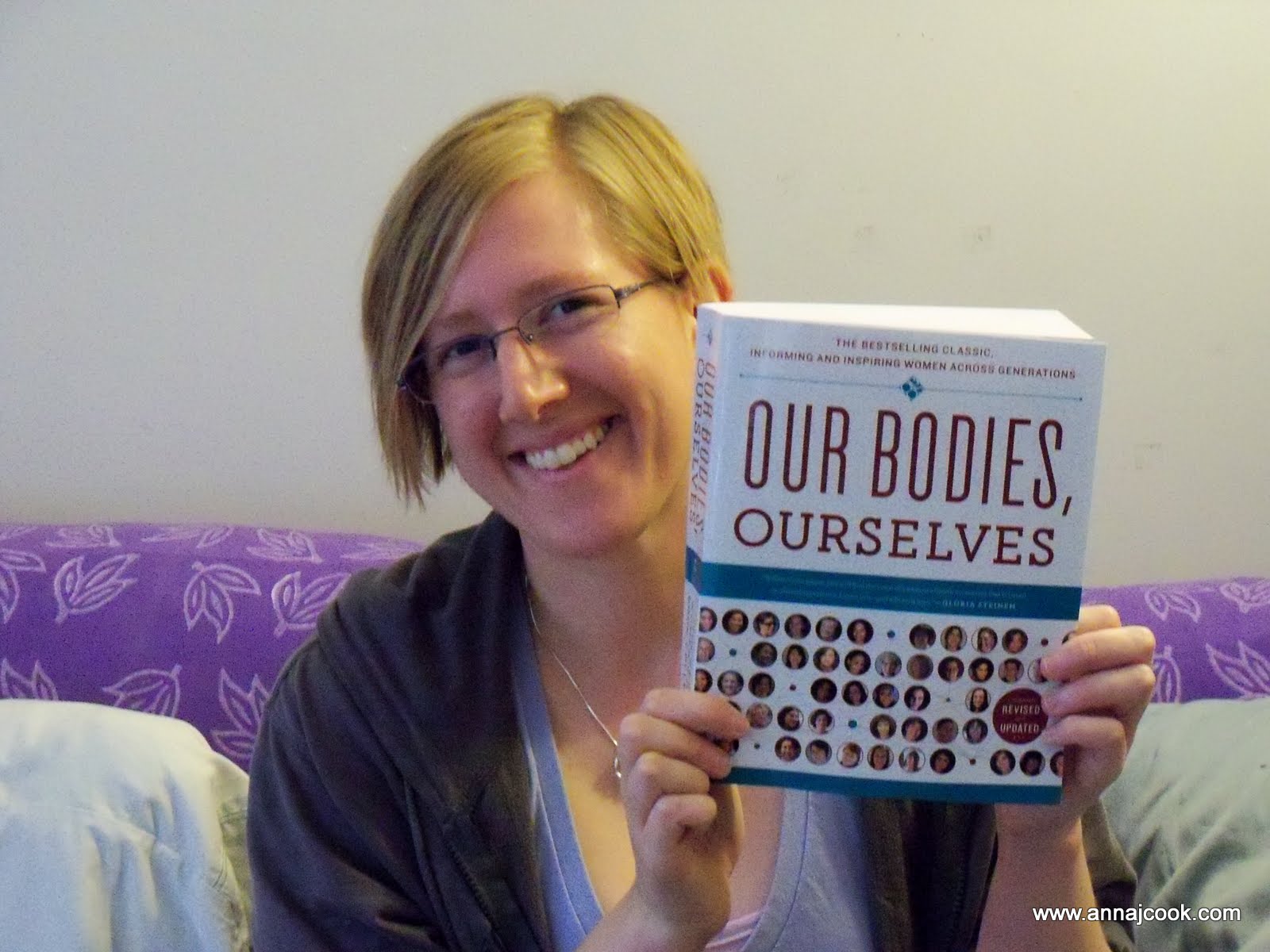
The feminist classic, Our Bodies, Ourselves, turns forty this year and has just been issued in a revised edition that was multiple years in the making. How do I know this? Because I got to be a part of the process! Long-time readers might remember when I posted a call for participants in the revision process back in January 2010. Well, in addition to broadcasting the call I also submitted my own name to the editors and was invited to join them in a virtual focus group discussion on intimate relationships. This conversation eventually turned into the “Relationships” chapter in the new edition, and many of the passages that didn’t make it into that chapter have been used in other sections — I found bits and pieces from my contributions in the chapters on sexual orientation and on sexuality, for example.*
 |
| my contributor’s copy, signed by the editorial team! (photo by Hanna) |
I don’t think I can adequately convey to you how proud I am to be a part of the OBOS project. My mother’s battered copy of Our Bodies, Ourselves was my constant companion through adolescence and, among other things, was my first exposure to explicitly feminist analysis, my first exposure to the idea of same-sex relationships, and my introduction to masturbation and how to do it. One of the first things I did when I moved out to Boston in 2007 was to visit the Schlesinger library at Radcliffe and browse the records of the Boston Women’s Health Book Collective — the group that put together the first mimeographed edition of OBOS back in 1970. It’s an incredible honor to have had the opportunity to add my perspective to the myriad other voices that have been part of this international endeavor throughout the past forty years.
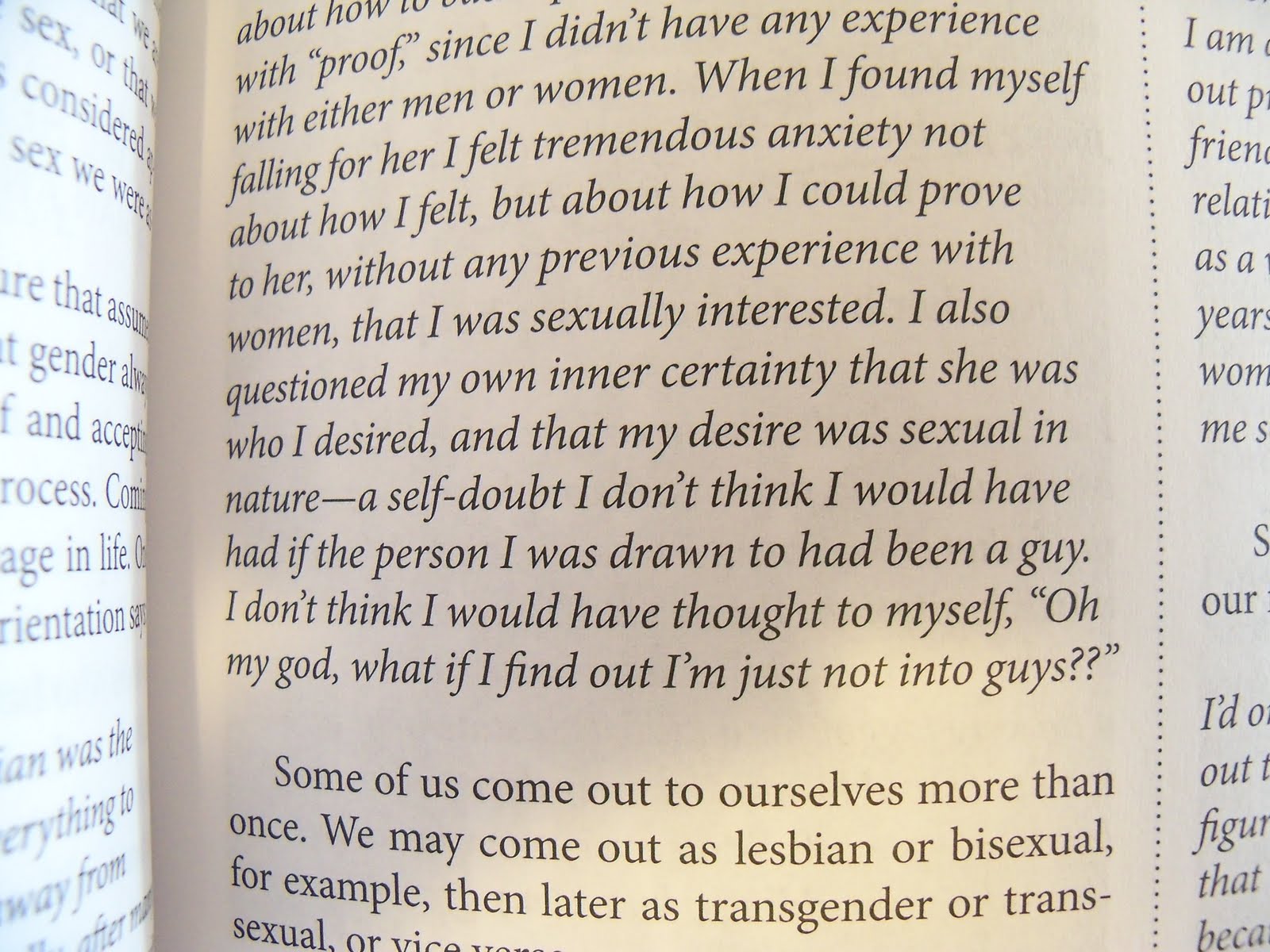 |
| It’s so strange to see your own words on the printed page… |
This past Saturday, women from around the globe gathered here at Boston University for a symposium in honor of the new edition. I wasn’t able to make the gathering because of a scheduling conflict (and, frankly, because it sounded like a long day with too many new people to make small talk with!) … but I’m looking forward to checking out the web video of the talks once those go up online. If/when they become available, I’ll be sure to post a link here!
Here’s hoping that OBOS (and I!) will be around in another forty years to celebrate eighty incredible years of women teaching and learning one another about their bodies, their sexuality, their relationships, their values, and their lives.
Update: Thanks to OBOS for mentioning this post in their introduction to the Relationships chapter online! Welcome to anyone who’s come to visit the feminist librarian via their link. You are most welcome.
*It’s standard OBOS practice to keep all of the in-text quotations anonymous in order to protect contributors’ privacy. For the “Relationships” chapter we all chose pseudonyms; if you know me and you care to figure it out you’ll be able to identify me through my bio at the beginning of the chapter.
the puzzle of heterosexual women [placeholder post]
14 Wednesday Sep 2011
Posted in Uncategorized
No thirty at thirty post today — simply because I didn’t get my act together to write one. So look for the “work and vocation [#9]” installment next week. In its place, I offer this three minute clip from the World Science Festival (via io9). It’s part of a 90-minute panel on the origins of orientation: sexuality 2011 which I fully intend to watch sometime in the near future.
There is not a transcript currently available; sorry for that.
The researcher in the clip, Meredith Chivers, describes how self-identified heterosexual women are actually the most puzzling population for sexologists who are seeking correlation between identity and arousal. That is, women who identify as lesbian, bi (or anything other than 100% straight in their attractions) usually show a strong correlation between their self-identified attractions and patterns of arousal when shown erotic images of men or women (the more same-sex attraction you articulate, the stronger your arousal to same-sex imagery). But heterosexual women show no correlation between their interest in men and differential arousal: their baseline is equal attraction to men and women (in the physical arousal sense).
I have lots of questions about this type of research as a measure of someone’s orientation — for starters, how can researchers tell whether the person studied is reacting to the erotic nature of the pictures or the sex/gender of the body on display? — but I do think the data are an interesting starting point for asking more questions.
30 @ 30: body modification [#2]
20 Wednesday Jul 2011
Posted in life writing
Tags
 |
| or possibly a fourth earring? |
I thought after my post last week that took on the fairly weighty question of identity, I’d turn to something comparatively lighter this week and talk about body modification. Why? Well, it’s actually something about which my personal feelings have changed substantially over time … in that as a child and young teenager I was pretty categorically opposed to any bodily alteration, and today I find myself trying to decide where exactly my second tattoo should go, and whether or not a nose or nipple piercing is a wise investment.
Mostly, my youthful opposition to such things was a pretty simple matter: I was not a fan of pain. I was not anti-girly things as a child (though I insisted they went hand-in-hand with traditionally unfeminine things; more on that later). I was in love with my grandmother’s clip-on earring collection, for instance. But pierced ears sounded to me like the quintessential example of a bad time. Voluntarily allow someone to punch holes in your ears with a staple gun type thingy? I think not.
But the summer I was twelve this friend of mine visited from Canada, a fellow homeschooler from whom I learned a lot of worldly things. Such as what exactly a hickey was, and why it would be uncool to ask your mother what it was, or allow her to see that you’d received one from your boyfriend with the purple hair. Actually, the hickey-and-hair incident wouldn’t happen until we were a year or two older. The summer of 1994 we were thirteen years old and still spending our lazy afternoons reading through the vast canon of L. M. Montgomery and arguing over which of the young men in the cast of Swing Kids made our hearts flutter most fervently (I had a soft spot for Arvid myself). The point, though, is that my friend was, to my mind, a more worldly adolescent. While I was not entirely sure I wanted to be more worldly myself, I also knew I wished to impress upon her the fact I was not un-worldly.
Which is where pierced ears come in, insofar as she convinced me that to grow any older in our sophisticated day and age without pierced ears was simply not to be tolerated. And therefore, I screwed up my courage and we trouped down to a local jewelry shop to have the deed done. (The shop is still there on 8th street and still pierces ears, I saw the sign in the window when I was back in Holland last May). I wave brave, and it hurt less than I anticipated. Though I didn’t repeat the process until the summer of 2009 when, almost completely on a whim, Hanna and I went into a Claire’s in Downtown Crossing here in Boston and added to the collection (two more holes in my left ear, one additional one in the right). I can’t say I do a lot with them, since I can’t be bothered to change out the rings, but I do take pleasure in the fact that I’m a professional librarian with five ear piercings.
 |
| there will be a no. 2 I’m just not sure where, what or when |
And now a tattoo. I’ll be upfront and say I harbored, for way too long, social prejudice against tattoos as something tacky and faintly unhygienic and frighteningly permanent. In my early twenties a friend of a friend got an ankle tattoo for her sixtieth birthday and I thought that maybe I could picture something like that … far into the future … when I had a better sense of who I was, and what I might want to say with ink worked into the very fabric of my skin. Maybe.
But in my mid-to-late thirties, my opposition started to melt. In part due to exposure to some exceptionally gorgeous ink on friends and acquaintances. I won’t lie: beautiful tats are much more visible here in Boston than they were in West Michigan. I see them on co-workers, professional colleagues, the coffee shop baristas, commuters on the T. When you see that much beautiful art around you, it’s hard not to start thinking, “If I ever … then I might …”.
I figured completing graduate school was as good a place as any to start. You can read all about why, what and how here.
Maybe I grew into myself faster than I used to imagine I would. Or perhaps I’m more comfortable with the notion that we are continually changing but that it’s okay if our bodies carry the scars of our previous selves: joyful and visible ones as well as painful and/or invisible ones. Chosen as well as involuntarily acquired. Human-created rather than physiologically made.
I’m still wary of body modification, in part because I’m just not that into pain and also because I try to be as accepting as I can be of my body as it is, rather than attempting through intervention to make it conform to my own (or to societal) expectations of how a body should be.
But ink, particularly, is something I’ve grown to believe can serve to celebrate the body as it is. After all, it draws attention to one’s physical presence, and insofar as it is a self-chosen form of visual symbolism communicates aspects of ourselves that go far beyond what we have been trained to assess when we visually assess our fellow human beings on the street. Tattoos demand that we be understood not just as bodies of a certain shape, skin color, weight. They also demand that we be understood as bodies. As physical presences that have been purposefully decorated in ways that are meaningful to the individual body in question. Tattoos are a way of tying our metaphysical, meaning-making selves to our corporeal, physical, taking-up-space selves. Much of their power, I would argue, comes from the fact that they are an art form that bridges that boundary between metaphysical and material being-in-the-world, and grounds that bridge-building in individual human flesh.
Not sure where I’ll be inking (or piercing) myself next, but you’ll likely hear about it on this blog. So stay tuned!
wrong wrong wrong wrong wrong
03 Thursday Dec 2009
Posted in think pieces
This story is a little old (Inside Higher Ed carried the story on 20 November), but I can’t stop thinking about the levels of wrong involved, so I’m hauling it out in order to be pissed about them, and to enumerate them in public. Nothing like a blog to get things off your chest!
First up, here’s the low-down on what happened, according to Inside Higher Ed:
More than two dozen seniors at Lincoln University, in Oxford, Pa., are in danger of not being able to graduate this spring — not because they’re under disciplinary probation or haven’t fulfilled the requirements of their majors, but because they were obese as freshmen.
All had body mass index (BMI) scores above 30 — the U.S. Department of Health and Human Services’ threshold for obesity — when they arrived on campus in the fall of 2006, but none have taken college-sanctioned steps to show they’ve lost weight or at least tried. They’re in the historically black university’s first graduating class required to either have a BMI below 30 or to take “Fitness for Life,” a one semester class that mixes exercise, nutritional instruction and discussion of the risks of obesity.
Now, there is a long tradition of colleges having physical health and well-being requirements as part of students’ general course of study — my undergraduate college, for one, had such a requirement (more on this below). While I have opinions about what definition of “health and well-being” a given school promotes, I see nothing egregious about encouraging students to be physically active and health-conscious, and giving them the information they need to make decisions about self-care and health care (for example: a component on patient advocacy might not go amiss!)
Singling individual students out, based solely on their body mass index (BMI) is something wholly different and wholly fucked up. As Kate Harding over at Salon wrote in You Must be Thin to Graduate
Like most such debates, [the Lincoln University story is] being framed quite simplistically — as a matter of public health vs. individual freedoms — with a number of important questions going unasked. Such as: Does BMI actually give a clear indication of an individual’s fitness level? No, for a number of reasons — e.g., BMI is only meant to give a general idea of weight distribution across a population; a large amount of muscle mass can make a person with relatively little body fat technically obese (Lincoln also uses waist measurements in an effort to weed these people out); and above all, fitness and fatness are not mutually exclusive.
On that last point, consider that Lincoln students are given the option of testing out of the class. If a number of students with BMIs over 30 can demonstrate a level of fitness that would make the course redundant, that should tell you right there that targeting fat people for remedial phys ed is discriminatory bullshit. If Lincoln wants to make a certain fitness level a general requirement for graduation, then blatant ableism aside, I guess that’s its prerogative. But why not test people irrespective of weight, and offer the course to those who are demonstrably unfit, rather than starting with the deeply flawed assumption that fat people are ignorant about physical activity, while everyone who falls below the obesity threshold is already sufficiently active?
I would add to what Harding says here (which I think is pretty much right on target) by pointing out that not only is this policy targeting people seen by our culture as overweight, it is ignoring people whose health is in jeopardy because of disordered eating or other health issues that put them below a body weight that would help them optimally flourish. Not to mention people who look and weigh a “normal” weight according to our culturally-conditioned filters, but who may be struggling with life-threatening conditions, either diagnosed or un-. Or whose quality of life is chronically undercut by a disordered relationship with food, exercise, and/or their own physical embodiment. (I speak from the perspective of someone for whom what I ate on a given day often during undergrad often had more bearing on my mood than any academic performance).
A fellow Women’s Studies major in my undergraduate program did her senior-year project on our own health class requirement (one that was expected of all students, regardless of physical health or body type), showing how obsessed the supposedly holistic curriculum was with thinness, and how it often exacerbated the disordered eating and exercise patterns of students already prone to obsessive or self-destructive behaviors. While modifications were made in the course curriculum to include resources on eating disorders and the dangers of being undernourished, when I took the class as a senior in 2005 the in-class message was blatantly and repeatedly the following:
1) As a college student you are surrounded by opportunities and pressures to make bad decisions about what to eat, with “bad decisions” primarily meaning “deciding to eat fatty foods.
2) As a college student, you are also surrounded by opportunities and pressures not to exercise, and therefore,
3) Between the lack of exercise and the fatty foods, unless you maintain constant vigilance you will become fat and unhealthy.
4) Oh, and by the way it’s also not good to be too skinny and if you think you might have an eating disorder contact the counseling center.
I have a beloved sister and several close friends with diagnosed eating disorders. Most of the women I know (myself included) have chronic — though less-than-clinically-critical — disordered relationships with food and our bodies. I can name half a dozen women who put off, or simply refuse to meet with, health professionals because they know that the first thing the doctor will see — regardless of their overall health — is how much they weigh. All health recommendations will be filtered through the doctor’s personal perception of whether the woman (or man) standing in front of him (or her) meets our cultural standard of “thin.” (Yes, I mean “cultural standard” not “science-based”; go read Courtney Martin’s Perfect Girls, Starving Daughters.)
Beyond arguments about the relationship between physical health and body weight, I think it’s critically important to highlight, bold, capitalize and underline the following: WEIGHT IS NOT A SIGN OF MORAL AND PROFESSIONAL FITNESS. People who suffer from physical or mental illness and disability are fully capable of completing programs of higher education and finding work in which they excel. To screen college students by weight and place an extra academic burden upon students deemed physically unfit is NOT OKAY.
To reiterate what Harding said in her piece at Salon, this should not be framed as a a case of individual rights versus collective well-being: neither is being furthered here by this policy. Helping young people to grow into compassionate, self-aware individuals who will (hopefully) have the generosity of spirit to make the world a better place should never, at any time, involve publicly punishing them for their physical appearance, health, or athletic capacity. Goodness knows, if they fail to meet the narrow standards of physical perfection demanded by our culture students already know before they hit college exactly, precisely, where they have failed at unattainable goal of effortless perfection. The last thing in the world they need is one more voice — this time with the weight of institutional authority — telling them they are less-than-worthy. Ceasing to harass them achieves the double goal of protecting individual rights to personal privacy while simultaneously making the case for a vision of the common good that encompasses all of our imperfect humanity, not just those who magically mystically meet the current physical ideal.
 the feminist librarian