• anna j. clutterbuck-cook
  • contact
  • curriculum vitae
  • find me elsewhere
  • marilyn ross memorial book prize

the feminist librarian

the feminist librarian

Tag Archives: history

booknotes: public vows

05 Saturday Jan 2013

Posted by Anna Clutterbuck-Cook in book reviews

≈ Leave a comment

Tags

feminism, gender and sexuality, history, politics

I thought I’d kick off my 2013 book reviews with a few thoughts about the last book I read in 2012. That would be Nancy F. Cott’s Public Vows: A History of Marriage and the Nation (Harvard U.P., 2000), which I picked up at the Montague Book Mill last week. A slim volume, Public Vows explores the ways in which local, state, and national culture and regulation have shaped the meaning and utility of marriage in the U.S. from the Revolution to the dawn of the 21st century.

Cott’s overall point is that while marriage in the United States has been considered a private zone — affectually and contractually — it is also constrained by public custom and legal regulation. As she writes in the introduction:

In the marriage ceremony the public recognizes and supports the couple’s reciprocal bond, and guarantees that this commitment (made in accord with the public’s requirements) will be honored as something valuable not only to the pair but to the community at large. Their bond will be honored even by public force … the public sets the terms of marriage (2).

Those terms have been paradoxically remarkably tenacious and constantly in flux. As Cott demonstrates, Americans have generally privileged the monogamous Christian marriage as the “common sense” of marriage relationships, despite the fact that at the time of the United States’ founding “the predominance of monogamy was by no means a foregone conclusion” (9).

In the years of the Early Republic, this relationship was one of coverture, in which the wife’s political identity was subsumed by that of her husband upon marriage; the husband was charged with representing his wife in the public realm much as a member of Congress (the founding generation of American political theorists drew this analogy) represented his constituents. As women and free blacks struggled for citizenship status throughout the 19th century, the terms of marriage (who could marry and the rights and duties marriage entailed) shifted to meet — or at times to combat — these new demands. Waves of immigration and anti-immigrant sentiment shaped laws around marriage as politicians determined what foreign marriage practices would be recognized as valid, and the changing economic landscape shaped and re-shaped understandings of how work and marriage inter-related.

Much of what Cott has to say will come as no surprise to historians of women’s and gender history, or even social and labor history: notions of citizenship and personhood are uniquely tied up, in United States law and social custom, with one’s status not only as an individual but also as the member of an acceptable family unit. Conformity to marriage norms can have real impact on one’s status as a citizen (as any first-generation immigrant can tell you), and while women’s political lives are no longer subsumed under their husband’s at the altar, the assumption that women will be (hetero)wives continues to endure in tax codes and other legacies of coverture in the legal-political realm.

Cott touches only lightly on same-sex marriage in the final chapter of Public Vows, underscoring how little “gay marriage” actually has to do with the revolution(s) in modern family organization that the last two centuries of American history have seen. Feminist agitation has, indeed, played a much bigger role in shifting marriage onto new ground. As Cott observes, “So far as it is a public institution, [marriage] is a vehicle through which the apparatus of the state can shape the gender order…. Turning men and women into husbands and wives, marriage has designated the ways both sexes act in the world and the reciprocal relationship between them” (3). These designations often reach beyond the actually married, constraining the lives of the non-married as well. As women gained more equal footing as citizens, the shape of marriage as an economic, political, and personal relationship was fundamentally changed. In the context of this long sweep of change, the extension of civil marriage rights to same-sex couples is but a small step in the direction of equal citizenship status for all, regardless of gender or affectional ties.

Conversely, the fact that same-sex marriage evokes such strong reactionary feelings points toward the centrality of the Christian monogamous marriage plot to the organization of American civic life: as a key aspect of our project to differentiate ourselves from European and other world governments. By governing who is let in (and who kept out) of marriage we — as a nation-state — are often simultaneously identifying who — both symbolically and literally — is allowed to be a citizen.

I’m following my reading of Public Vows with E.J. Graff’s contemporaneous What Is Marriage For? (Beacon Press, 1999). Like Cott, Graff explores the historical shape of marriage and discovers heterogeneity rather than some ur- form of “traditional” marriage … I’m looking forward to limning the similarities and differences between their arguments, so look for a review here soon!

booknotes: histories of food, women’s colleges, queers in Canadian & US law, and Victorian porn

04 Tuesday Dec 2012

Posted by Anna Clutterbuck-Cook in book reviews

≈ Leave a comment

Tags

education, food, gender and sexuality, history, politics

With four weeks to go in the year, I’ve got fourteen books to read in order to make my 2012 goal of one hundred and four titles (two books per week). I don’t think I’ll make it. If there were a way to count reading of a non-book sort (journals, blogs, fan fiction) I’d be golden, but while I’ll about match my 2011 level of book consumption, I probably won’t read fourteen volumes by midnight on December 31st. Particularly since I’d like to put in some quality time on my epic, currently 30k and climbing, Carter/Stark fic, have a book review due for the NEHA News, and Hanna and I hope to get out for some good long walks.

BUT. The fear of “failure” has not deterred me from reading, as always (I’m really not sure what could actually. It’s sort of what I do, the way some people can’t think without music on in the background). So here are some brief reviews of books I read during the month of November.

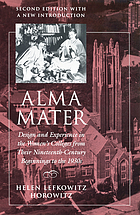
Horowitz, Helen Lefkowitz. Alma Mater: Design and Experience in the Women’s Colleges from Their Nineteenth-Century Beginnings to the 1930s (University of Massachusetts Press, 1984; 1993).  For a book originally researched in the 70s and published nearly thirty years ago, Alma Mater feels refreshingly current — not that I doubted Helen Horowitz’s skill in research and writing (I’ve long been a fan), but historiography just as much as any other field has its tells for certain eras. Perhaps Horowitz lucked out by coming of academic age after the reign of Freud (see my review of The Other Victorians below) and before the ascendancy of Foucault in the 1980s. This history of the Seven Sisters is an exploration of the culture of education through the lens of architecture: how the spatial organization of seminaries like Mount Holyoke and Vassar, colleges like Smith and Wellesley, Bryn Mawr, and the university affiliates Radcliffe and Barnard, reflect the assumptions, expectations, and fears about women and higher education across roughly a century of change. I was particularly fascinated by the way in which each institution’s administrators sought to both foster and manage female intimacy: the single-sex environment was both encouraged (for its protective and training purposes) and feared (for its potential for same-sex romantic and sexual intimacy, and  the way it led to “unfeminine” roles). In other words, the tension between the value of an all-female environment and its perceived downsides — whether because it turns young women into lesbians (!) or because it perpetuates a separate-yet-equal passivity concerning gender equality — have changed only in variation and not in substance since the 1830s. It will be interesting to see what the state of single-sex education is by the time we begin to reach the two-hundredth anniversary of women’s higher education in this country. I really can’t recommend Horowitz enough; as an historian of higher education in America I know of few more thoughtful or articulate.

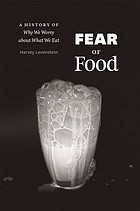
Levenstein, Harvey A. Fear of Food: A History of Why We Worry About What We Eat (University of Chicago Press, 2012). This slim, engaging volume is less a history of “why” twentieth-century Americans fear food than how we choose to do so: each chapter presents a case of food fear, beginning with Progressive Era fears about food contamination spread by flies and infected milk for infants and ending with the present-day lipid-phobia (fear of dietary fat). An historian of food culture, Levenstein is on solid footing here in terms of research and a lively storyteller. My one complaint is that at times it is difficult to distinguish between food claims made in the context of a particular food scare and the more recent, evidence-based knowledge that Levenstein sometimes draws upon to refute or revise the basis of historical food scares. For example, in the chapter on “vitamania,” it can be difficult to parse out what benefits of vitamains are still supported by the evidence, and what claims by vitamin manufactures have no solid backing in research and outcomes. In the end, though, I really appreciated that this narrative was not triumphalist the way so many health and science histories are: Levenstein’s argument is not that American science has triumphed over superstision — quite the contrary, he argues that we persist in demonizing (and celebrating) certain foods beyond all evidential backing. He also makes the key point that time and again throughout the twentieth century, the food industry and medical industry (including the public health sector) have powerful lobbies with their own profit-driven agendas, successfully exploiting food fears to their own gain (and American citizens’ loss). I’d be making this essential reading in all public health programs around the country, and required reading by anyone who uncritically parrots the phrase “obesity epidemic.”

MacDougall, Bruce. Queer Judgements: Homosexuality, Expression, and the Courts in Canada (University of Toronto Press, 1999). I picked this volume up while we were honeymooning on the Cape, but it took a while to wade through — while thoroughly interesting, the textual analysis was dense and the Canadian legal framework just different enough that I needed to do some on-the-fly cultural translation to make sense of the arguments. MacDougall’s central argument is that judicial opinions concerning homosexuality matter as much as, if not more than, the material effects of their rulings. Combing through written decisions involving homosexual identity or expression from the 1960s to 1997, MacDougall finds that the Canadian courts have consistently framed homosexuality as disordered and marginal, a sexuality that is of potential threat to children, something that (because of its shameful nature) needs particular policing. For example, he points to the ways in which divorce court judges often express concern about a gay or lesbian parent’s sexuality being evident to the children of the family in a way that they would not likely fret about straight parents bringing an opposite-sex partner home. Likewise, a whole chapter is devoted to the erasure of speech about homosexuality from institutions of education (primary, secondary, and higher education alike). While works such as The Right to Be Out and Queer (In)Justice have — at least for a U.S. context — superseded this volume, I did find it a worthwhile addition to my queer studies/queer history collection.

Marcus, Stephen. The Other Victorians: A Study of Sexuality and Pornography in Mid-Nineteenth-Century England (xxx, 1966; 2009). In the early 1960s, scholar of Victorian literature Stephen Marcus was approached by the Kinsey Institute to write a study of Victorian erotic literature. The Other Victorians is what emerged: an oddly episodic work that has aged well in some aspects more than others. He begins with a study of  doctor William Acton’s works on sexual function and advice on sexual well-being, moves into an examination of Henry Spencer Ashbee’s extensive bibliography of known pornographic literature, published in the 1870s-1880s, and then spends two lengthy chapters on a delightful, anonymous eleven-volume erotic autobiography My Secret Life, published in the 1880s-1890s. These chapters are for the most part grounded in specific texts and hold up fairly well. Marcus’s own sexual tastes and knowledge gaps seep through every now and then — such as when he is baffled by the autobiographer’s interest in BDSM, and when he insists that the autobiographer is exaggerating because women don’t ejaculate — but overall he was more aware of gender and class and the nuances of authorial voice than I might have expected. It’s the chapter on the literature of flagellation and his concluding remarks that really let him down. I’m not exactly sure why he chose to take up flagellation narratives other than that they were apparently prevalent in the pornography of the period. His descriptions of the literature’s conventions is quite fascinating, but then he gets all sorts of judgy and Freudian about how flogging fantasies are sad and infantile and coded homosexuality. He also claims, in passing, that the Victorians produced no homosexual pornography — an assertion that runs directly counter to the many passages depicting same-sex sexual encounters he has detailed in previous chapters, so I was baffled by the sudden reversal. And his final conclusions about pornography are, it seemed to me anyway, clearly written by a person who ultimately has no innate passion for or interest in the genre which he is studying. He argues that pornography lags behind fiction in its development, that it lacks in emotion and relational development, that the point of pornography is to depict acts outside of time and space, rather than human sexuality in the context of a deeper lived experience. Again, these assertions seem to run counter to the examples he himself has selected for review in the preceding chapters.*

Vaid, Urvashi. Irresistible Revolution: Confronting Race, Class and the Assumptions of Lesbian, Gay, Bisexual, and Transgender Politics (Magnus Books, 2012). This collection of essays by movement organizer Urvashi Vaid is a quick read — I finished it in an afternoon — and a bracing one. A national figure in LGBT politics, Vaid calls the mainstream queer movement to task on its unwillingness to engage in social justice activism that is not explicitly “gay.” That is, activism around issues of racism, class disparity and poverty, misogyny, gender policing (particularly trans* issues), the prison-industrial complex, labor organizing, immigration, and freedom of family formation and sexual expression not necessarily grounded in heternormative marriage rights. My own feelings reading Irresistible Revolution were complicated. On the one hand, I am basically on the same page with Vaid in terms of wanting a broad-based social justice movement that centers the most vulnerable among us and doesn’t rest until all are treated with respect and have the basic provisions necessary for well-being (healthcare, housing, food security, access to education, workplace safety, a healthy environment, etc.). And I feel comfortable with her lesbian-feminist roots and her critique of mainstream organizations (the Human Rights Campaign, National Gay and Lesbian Task Force, etc.) which may pay lip service to caring for all — but in reality speak only to middle- and upper-middle-class priorities and aspirations. However, as a radical voice working from within these organizations, she fails to draw upon and engage with the scrappy, marginalized groups and individuals who are doing the work she longs to see done. At least as much as she could have. The result is a book that feels like a lot of finger-wagging at the self-satisfaction of the elder generations of activists (and those with the most material resources) and the complacency of the younger generations — without enough acknowledgement of the people who do not fit into either of those categories, and who are doing transformative and back-breaking labor being the change they wish to see.** Vaid is a high-profile voice whose commitments are key to a more just future, so I hope she is listened to by the “insider” audience she wishes to reach.

And that’s all for now, folks! Off to see what else I can read before to clock for 2012 runs out.


*I couldn’t help wondering if such judgmental attitudes came out of an extreme desire to be “objective” about the subject matter — to the extent that he was unable to examine the material with an eye toward what an eager reader might get out of the experience. For example, he excerpts a lengthy and charming passage from My Secret Life in which the autobiographer and a friend arrange a visit to a flogging parlor to watch a gentleman be spanked by the “abbess” in charge. Also present is a prostitute. All five people are participants in the action on some level, and although the autobiographer evinces no interest in being beaten himself, he is clearly curiously engaged and pleased (and aroused on some level) to be participating in someone else’s erotic scene. Marcus, however, dismisses the scene as one “we” modern-day folk would obviously find sad and grim. Whoops!

**And to be clear, I don’t include myself in this category. People who have the stamina and vision for professional movement work are brave and better souls than I; I’m glad they do what they do and I will support them as I am able … but I have never been, and likely will never be, a queer organizer.

booknotes: ethics, politics, sex, and death

02 Friday Nov 2012

Posted by Anna Clutterbuck-Cook in book reviews

≈ Leave a comment

Tags

history, memoir

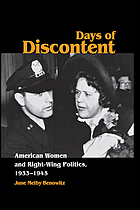
Benowitz, June Melby. Days of Discontent: American Women and Right-Wing Politics, 1933-1945 (Northern Illinois University Press, 2012). Days is positioned at the intersection of two growing fields: the history of conservative and right-wing grassroots political activism and the political activities of women between the passage of the 19th amendment in 1920 and the return to domesticity in the postwar Fifties (followed by the well known “second wave” of feminist activism in the Sixties). Benowitz surveys the activities of right-wing organizers Elizabeth Dilling, Grace Wick, Catherine Curtis and Agnes Waters among others. At times the narrative falls into repetitive sequence-of-events recounting. I found myself wishing to slow down certain chapters and delve deeper into, for example, the class dynamics and race fears of individual women who were profiled. Hopefully, such further exploration will be taken up by future scholars who build on the foundation laid by Days of Discontent.

Buechner, Frederic. Now & Then: A Memoir of Vocation (HarperCollins, 1983). My late paternal grandfather, who passed away in 2007, was a one-time graduate student in English literature who turned to the seminary after a year at University of Michigan and eventually became a professor of New Testament theology. His favorite course to teach, however, was a seminary elective titled “Christianity and Literature,” which examined the power of literature (and later, film) to grapple with matters of faith. When I was nineteen, I audited the course and spent the semester reading, and arguing about, Billy Budd, Lord of the Flies, the work of Flannary O’Connor, and Frederick Buechner’s Godric, the fictionalized account of the life of an English hermit. Buechner was one of my grandfather’s favorite writers, and when Hanna and I married this fall my grandmother sent us an essay by Buechner on the sacrament of marriage. It was this collection of personal memories and relationships I brought to my reading of Buechner’s slim memoir. In Now & Then Buechner reflects on his time at Union Seminary, his teaching at Exeter Academy, and his years of writing, lecturing, and preaching in rural Vermont. While I appreciated his reminiscences about his time at Union and his own personal faith journey, he occasionally veers into the preachy — particularly, for some inexplicable reason, his insistence that Buddhism is a religion that fails to appreciate the power of love. I may not be a scholar of Buddhism, but say what? All-in-all, recommended for those interested in mid-twentieth-century American protestantism and personal reflections on the writing life.

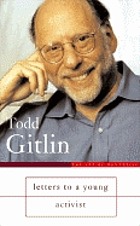
Gitlin, Todd. Letters to a Young Activist (Basic Books, 2012; 2003). Having read Gitlin’s seminal history of mid-century movement politics, The Sixties, for my thesis research a few years ago, I picked up this slim volume at the Brattle book carts on the “it’s only $1” theory. I don’t generally like the “letters to a…” premise, which has become overplayed in recent years, and I can’t say that format did a lot for this particular piece. But Gitlin manages (I think, though I’m now in the “over thirty” set myself) to skirt condescension and offer some useful reflections on the organizing, activist, or “movement” life. I particularly appreciated the way he wrestled with the complicated legacy of Sixties leftist movements and reactionary backlash, as well as the importance of practical (and often boring) action to balance out idealism. I think I will leave it to young activists themselves to weigh in on whether Gitlin succeeds in offering the wisdom of a mentor without the know-better attitude with which elder generations so often look upon the work of brash youth (so often judged and found wanting). Either way, his work is valuable as the thoughtful reflections of a once-young activist turned historian attempting to articulate his own lessons learned.

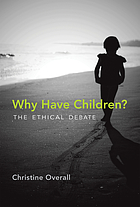
Overall, Christine. Why Have Children? The Ethical Debate (MIT Press, 2012). In our society, it is generally the non-parents among us who bear the brunt of curiosity and often censure. We scrutinize the motivations of the non-parents by choice and invest the resources of entire industries to enable those who have difficulty procreating to become parents. Yet philosopher of ethics Christine Overall — herself a mother of two children — argues that the burden of moral justification should fall not on those who do not procreate, but rather on those who do. Systematically, she explores the commonplace justifications for procreation — continuing the family line, parental happiness, elder care, providing siblings for existing children, etc. — and finds them insufficient to morally support the creation of new life. In the end, she makes the case that the only ethically justified reason for freely-chosen procreation is the desire to enter into a relationship with the future child. A committed feminist, Overall also spends a great deal of time exploring issues of bodily autonomy and reproductive justice — careful to weigh the work of pregnancy as a female-bodied burden, as well as acknowledging the many situations in which procreation takes place under various levels of coercion — for which I am grateful. Her arguments are logical, progressive, dense, and the boundaries of her consideration carefully delineated (she sets aside, for example, the ethics per se of assisted reproductive technologies, while acknowledging they deserve serious ethical consideration on their own), so readers looking for concise soundbite arguments will not find them here: her work requires careful attention and some measure of reflection to digest. My one serious point of divergence with Overall is in her discussion of unconditional love as both unsustainable and misleading. She argues that parental love is always conditional in that it is necessarily directed toward a particular child who is loved as an individual, not in a more universal sense. She and I differ in our understanding of unconditional love, which I have always understood to be both universal and particular. However, this is a small quibble with what at the end of the day is an extremely compelling and valuable addition to feminist ethics.

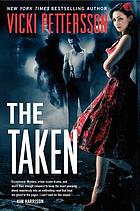
Pattersson, Vicki. The Taken (Harper Voyager, 2012). Last weekend I picked up Vicki Pattersson’s Taken, a supernatural noir involving an intrepid lady journalist, Kit Craig, and a former P.I., Griffin Shaw, who for the past fifty years has been working as a Centurian ushing murder victims’ souls to the afterlife. I had hopes Pattersson might be another Cherie Priest or Seanan McGuire, but this first installment, at least, of what promises to be a series, wasn’t Bloodshot or Rosemary and Rue. For one, the supernatural aspect of the story (Griffin’s post-mortal state) doesn’t really factor into the story in a major way. It’s what he is, and sets the plot in motion, but isn’t really developed as part of the cosmology. The Taken is a fairly straightforward investigative drama. Likewise, the character of Kit Craig feels like a sketched-out caricature: a newspaper heiress deeply involved in rockabilly culture, she has a fascination for the Fifties that is introduced but has no material bearing on the plot. The crime upon which the novel hinges (predictably, these days) on sex work and secret religious societies that rather embarrassingly harkens back to Arthur Conan Doyle’s A Study in Scarlet.

a few thoughts on my historically-specific perspective on getting married

08 Sunday Jul 2012

Posted by Anna Clutterbuck-Cook in life writing

≈ Leave a comment

Tags

boston, family, history, hope college, michigan, sexuality, wedding

Yesterday, I finished reading an advance review copy of Michael J. Klarman’s From the Closet to the Altar: Courts, Backlash, and the Struggle for Same-Sex Marriage (forthcoming from Oxford University Press, Oct. 2012; review to come). A legal historian, Klarman explores the history of litigation and legislation around gay and lesbian marriage from the 1970s to the present. Reading his historical account prompted me to think about the historical context in which I came of age and into my sexuality and sexual relationship, and how this colors how I think about same-sex marriage particularly, and even more specifically how my historical context shape the decisions Hanna and I have made. Here are my thoughts, in roughly reverse chronological order.

1) I’ll start with the fact that we can get legally married in the specific time (2012) and place (the Commonwealth of Massachusetts) in which we have come together. Massachusetts recognized in same-sex marriage as legal under the state constitution in 2004 (Goodridge v. Dept. of Public Health) and our ability to become, legally, wife and wife, on the state level is normal here. While DOMA still prevents us from being recognized as married nationwide, we will be treated as spouses at the state level. If I hadn’t moved to Massachusetts from Michigan, I would be unable to legally wed without traveling. And given that neither of us are involved in a religious community, we likely would not be planning a private (non-legally-binding) commitment ceremony.

2) I’ve experienced nothing but welcoming acceptance of my relationship with Hanna since we got together in the summer of 2009. The only direct bigotry I’ve encountered has been online; I’ve been comfortable being open about my relationship at work, in public, on both sides of the family, in my home town, blogging, etc. I actually dealt with more directly-homophobic statements and actions before I was visibly queer (see below) than I have in the past three years. This is in part a matter of geography, in part a matter of the circles in which I’ve been moving, and in part a macro-level cultural sea-change in which anti-gay animus is becoming less acceptable by leaps and bounds, at least in the public square.

3) Marriage equality was part of what brought me to Massachusetts. One of my first memories of driving into Boston in the summer of 2006 — when I interviewed at Simmons — was getting turned around and ending up in Harvard Square across from Zero Church Street, where they had a huge banner across the front of the First Parish Church proclaiming support for marriage equality. Even though I understood my sexuality to be primarily hetero at the time, I immediately felt a sense of expansiveness — the ability to be more at ease in the political climate here than I had felt back in Western Michigan where I was reminded daily that my views about human sexuality were at odds with the dominant culture.

lesbian recruitment party, summer 2005

4) I had long-term, same-sex relationships modeled for me. I had friends whose relatives were in same-sex relationships (some of whom had had commitment ceremonies, some who hadn’t). Through my undergrad women’s studies program (oh the irony) I was introduced to lesbians in committed partnerships and had a chance to think about what it would be like to build a life for myself with another woman. I am a person who experiences my sexuality in very contextual ways, and while I don’t discount the notion that having been born in a different time or place I might have fallen in love with a woman without such models, the fact that I knew that lasting, committed same-sex relationships were a possibility by example helped open me to an awareness, a receptivity, that it could be possible for me as well.

5) In my early twenties, I wrote letters to the local newspaper speaking out on topics like abortion and gay rights. I always got incredibly bigoted responses in print (though my friends and relations were supportive). I remember particularly writing in as “a young straight woman” in defense of the summer gathering for gay and lesbian families that happens annually in the little town of Saugatuck twelve miles south of where I grew up (in the “reddest” county in the state of Michigan). In my letter I thanked the newspaper for doing a favorable piece on the camp and preemptively addressed the haters by pointing out that same-sex parents gave me hope for the future. Again, I think it’s note-worthy that even in an incredibly conservative corner of the Midwest, I was participating as a presumptively straight person in normalizing queer families.

That is, I didn’t think “gay” and imagine that being a lesbian would mean custody battles and depression and suicidal impulses. I thought it meant family camp and lesbian communes and sprawling poly households, not unlike the life I was already starting to envision wanting for myself, even if I thought my primary partner would likely be a man.

5) My best friend came out in 2001. I’d say this moment was the start of my serious self-education on issues of human sexuality and the history of homosexuality and the modern gay rights movement. I was twenty and while he wasn’t the first queer person I knew personally, he was the first person I knew intimately and felt more for than a general political commitment in favor of equality. My sense of radical acceptance (borne out of innate stubbornness and feminist theology) and my life-long commitment to fairness had always drawn me toward LGBT rights — but suddenly it was personal. And I discovered my ability to be fiercely political.

7) Because of the college where I went to undergrad, issues of sexuality and gender were deeply intertwined, and both were morally-fraught religious concerns. This deserves its own post (or several), but suffice to say that my introduction to feminist politics as a college student came in the form of a raging controversy my first year at Hope over what and how the chapel program was teaching students about human sexuality generally and homosexuality specifically. My women’s studies faculty were committed Christians and vocal queer allies, and so my trial-by-fire education in organized protest was around these issues. I was able to think deeply about sexual morality, gender and sexual identity and expression, sexism, and homophobia in the midst of a group of LGBT-friendly Christian folk who helped me articulate passionate responses to the homophobia and hate we were experiencing in daily ways on campus.

In effect, I had a queer community around me long before I understood myself to be queer.

8) In the mid-90s, the AIDS quilt came to town. Its stop on national tour was organized, in part, by the gay deacon at my church. In appointing him to an ordained office, the church had broken with the denominational position (which remains in place today) that homosexuality is sinful. Twice during my adolescence, the church went through a contentious period of “dialogue” on the issue and members left the church in protest over the deacon’s ordination. While I don’t remember much about the AIDS epidemic, I do remember the viewing the quilt with my family and others from the church and city when the sections were on display at one of the area high schools. Rather than AIDS being interpreted to me as “the gay disease,” it was simply a deadly illness, like cancer, that killed people and left behind grieving partners, parents, siblings, children.

9) Our Bodies, Ourselves (and feminism!) contextualized being in lesbian relationships as one life path for women to pursue, both sexually and in relationship with one another. In my adolescent reading about the 70s feminist movement, I encountered primary source documents about lesbian activism, lesbianism as a political decision, and same-sex relationships. While I wasn’t politically active on these issues until college, these texts prepared the ground-work for understanding human sexuality more expansively, and lesbian relationships as a viable option, long before I was aware of resistance to homosexual identity and relationships in my community.

10) The earliest memory of I have concerning same-sex sexuality is at age eleven when two friends of mine, over for a sleepover, were giggling together over the word “gay” and I asked my mother what it meant when they refused to tell me. It was obvious from their behavior they thought the word was a naughty one (one girl was from a conservative Wesleyan household, the other a Mennonite). My mother’s factual explanation (along the lines of “someone who falls in love with a person of the same sex”) put gayness on the radar but confirmed that I need not be alarmed about it. Since there were lots of ways in which my family’s values differed from those of our friends and neighbors, I assumed this was just one more thing to add to the list!

I’m sure there are other ways in which my life has shaped how I think about lesbian relationships, lesbian identity, and the viability of marriage as an option for Hanna and I. For starters, the fact that we’ve both remained unmarried until we were over thirty, and don’t plan on having children are also deeply historically-contextual options/decisions. In the 1910s we might both have been college-educated library professionals in a “Boston marriage,” but it would not have been legible to the world at large as a marriage.

We often think of ourselves as historical actors, with the ability to defy social norms and break new ground. And we are. But they manner in which we defy society, and the norms which we are countering, are historically dependent. And self-aware historians, such as myself and my beloved, are no more exempt than anyone else.

(As usual this “few thoughts” post became much longer than I envisioned it!)

booknotes: the straight state

03 Thursday May 2012

Posted by Anna Clutterbuck-Cook in book reviews

≈ Leave a comment

Tags

gender and sexuality, history, human rights, moral panic, politics

Modern-day campaigns for civil rights and equal citizenship for queer folks tend to conjure up a progressive trajectory from exclusion to inclusion: from a dark past when the homosexual was excluded from equal citizenship (or forced to live closeted) to a not-yet-realized future in which one’s sexual identity, desires, and behaviors, do not exclude one from enjoying the rights and responsibilities of the American citizenry. The ability to apply for citizenship in the first place, the responsibility to serve in the armed forces, the personhood status to form legally-recognized kinship networks and access the welfare benefits distributed through those kinship systems. In our collective memory, we look backward in time to a period during which homosexual acts were illegal and homosexual identity stigmatized; we look forward to a period during which our bodies and relationships won’t ipso facto criminalize us (at worst) or shuffle us off as second-class or invisible citizens (still a precarious state of affairs).

Yet as Hanne Blank pointed out, in her recently-released Straight: The Surprisingly Short History of Heterosexuality, the notion of the heterosexual being (in opposition to the homosexual being) only developed in the late nineteenth century. While certain sexual activities (most obviously sodomy, commonly interpreted as anal penetration) were criminalized, the homosexual person was not constituted in either cultural or legal understanding until well into the twentieth century. In The Straight State: Sexuality and Citizenship in Twentieth-Century America (Princeton University Press, 2009), historian Margot Canaday argues, in fact, that the identity category of “homosexual” developed in symbiosis with the United States’ state-building activities to such an extent that it was, in part, the legal conception of homosexual persons that led to the mid-century emergence of our modern-day gay or queer political identities:

An increasingly invasive state would in time also help to create rights consciousness for some queer individuals who, embracing the state’s own emphasis on legal rather than medical categories, began to ask not whether they might be sick, but whether they might be citizens. They came to agree with the state’s simple common sense definition of homosexuality, then, but could see less and less that was commonsensical about its placement outside national citizenship (254).

This is a fascinating argument, well-grounded in historical evidence. Canaday’s footnotes exhaustively document the hours she spent in the National Archives reading through years worth of military court marshals, personnel files, proceedings from immigration hearings, congressional records, and Works Progress Administration memoranda. What this detailed historical research reveals is how much our “common sense definition of homosexuality” was created through a process of trial and error, through attempts to police the bodies and social lives of those individuals coded undesirable. In example, let me glean from Canaday’s evidence a few instances of such creation that I found particularly delightful and thought-provoking.

First, in her chapter on immigration and “perverse” bodies during the first quarter of the twentieth century, Canaday discovered in reading INS records that aliens were generally turned away at the border or deported not for homosexual acts but for gender non-conformity.  This is merely the most recent book in my readings on the history and politics of sex and gender that has made me think about how much policing of our sexual lives speaks to a (larger?) fear of bodies that fail to fit our ever-changing yet stubbornly dualistic notions of appropriate gender performance. As Tanya Erzen observes in her study of ex-gay conversion therapy literature, for people and institutions concerned with gender role divisions, same-sex sexual behavior becomes a marker of gender inversion or confusion, rather than something of primary concern. That is, a woman who has sex with another woman is worrying because she is becoming masculine or enacting a “male” role. Not because she’s enjoying same-sex sex in and of itself.

Along similar lines, Canaday suggests that those policing same-sex sexual acts among men in the military, particularly during the early years of the twentieth century, distinguished between men who penetrated during sex (the “male” role) and men who were — willingly or unwillingly — penetrated either orally or anally (the “female” role). Rather than imagining lovemaking as a more fluid series of encounters in which one might penetrate and be penetrated in turn, military police imagined that men’s sexual identities were constituted and static. To some extent, they were following the lead of the men whose activities they were punishing, since barracks culture appears to have encouraged the tom/bottom hierarchical dynamic. However, Canaday’s narrative suggests that the policing of same-sex sex, and the differential punishment meted out according to who fucked whom reinforced the notion that what one did somehow followed from (or led to) who one was. It made me wonder if, in these military proceedings, we were seeing the nascent beginnings of our modern-day notion (in some circles) that gay men are either “tops” or “bottoms.”

While the military was fairly clear about the illegality of same-sex acts between men (though their policing of such activity was uneven), some of the most hilarious passages in the book deal with the inability of military police to agree on what exactly women do together when making love. The perplexity with which society responds to lesbian sex never fails to amuse me. Is it really that difficult to understand? Seriously? Like — clits and tongues and fingers and natural lubricant? Hello? But apparently, for mid-century MPs, women doing it was just beyond the realm of possibility. When, in 1952, two military police on patrol happened across two women having energetic oral sex in the back of a vehicle, they were so “bewildered” by what was happening that they turned and went away in “shock.” “It was just one of those things that you read about and hear about but never see,” one of the MPs admitted during testimony when asked why the incident had gone unreported (191-192). Because of this mystification of female sexuality, Canaday demonstrates, the anti-gay purges of women in the military relied not on evidence of acts (as it did with men) but on extensive documentation of women’s homosociality, emotional ties, and gender performance. Canaday observes that, while men and women alike were harassed during the lavender scare (see David K. Johnson), discharge files for men are typically 1/4-1/2 inch thick while women’s routinely run 2-3 inches. Not a commentary on the relative suffering of men and women accused of homosexuality, this difference represents the comparable difficulty of evidence gathering when what you’re trying to document is something as nebulous as tendencies and identities rather than trying to answer the question of whether so-and-so gave John Smith a blow job.

Finally, in her two chapters on the Depression-era welfare state, Canaday explores the long-term effects of structuring the social safety net in such a way as to reinforce the heteronormative family. A precursor to the destructive obsession with marriage as an alternative to unemployment and welfare benefits, federal programs targeting the unemployed and itinerant in the 1930s, and the benefits of the G.I. Bill post-WWII, became tied to an individual’s ability and/or willingness to fulfill a role (mother, father, husband, wife, son, daughter) within the ideal “straight” family. While this had little per se to do with one’s sexual identity, it had everything to do with domesticating individual human beings whose free-floating sexual desires were closely associated with criminality. Work programs for unemployed men, for example, often included some sort of requirement that the individual’s monthly allotment be sent to a designated “dependent,” usually a family member along the order of a parent, a wife, or children (118). Some “unattached” men were able to work around this requirement by designating a male friend as their dependent, but overall the government structured twentieth-century benefits schemes to encourage hetero-familial ties and discourage both sustained single-ness and unorthodox relationships. In the postwar era, this structural dis-incentive was joined by overt discrimination as those who had been discharged from the military for homosexuality were denied veterans benefits and experienced widespread stigma and economic hardship for suspected or actual same-sex attractions, behavior, and relationships.

Overall, Canaday’s study is one of the most impressive examples of historical inquiry into sex and gender that I’ve read in recent years, and I highly recommend it to anyone interested in the historical context of our present-day notions of gender, sex, sexual orientation, and citizenship.

Cross-posted at The Pursuit of Harpyness.

"in their graves because of false modesty"? [neha spring 2012]

24 Tuesday Apr 2012

Posted by Anna Clutterbuck-Cook in my historian hat

≈ Leave a comment

Tags

gender and sexuality, history, professional gigs, science, the body, writing

This past Saturday, I presented a paper at the spring meeting of the New England Historical Association (NEHA) at Rivier College in Nashua, New Hampshire. You can check out the full text of the presentation here: “In Their Graves Because of False Modesty?”: An Allegation of Sexual Assault in Boston, 1914-1915 (PDF, via DropBox).

The paper was my first attempt to pull together a research project I’m working on into a coherent narrative. The research concerns a mysterious deposition I stumbled upon in the Godfrey Lowell Cabot Papers at the Massachusetts Historical Society. As I write in the opening paragraphs:

Mediated, it is true, by the framework of legal testimony, the narrative voice of the deposition is nevertheless an active one. [Nellie] Keefe [the deposed] describes herself purposefully seeking medical treatment and intervening in that treatment when it goes contrary to her expectations. She positions herself as a consumer of medical services, with the ability to select a treatment plan with which she feels comfortable, rather than the passive recipient of medical care with which she is uncomfortable — from a medical professional whose authority she should not, or cannot, challenge. She evokes the spectre of sexual aggression by describing how Dr. Underhill “turned the light out [and] inserted his finger in my vagina,” yet ultimately circumscribes Underhill’s actions by indicating that she successfully ordered him to stop.

To the modern reader, the deposition feels both remarkably contemporary, yet also deeply embedded in an historically-specific set of social and medical expectations surrounding patient-doctor interactions. While Keefe’s self-reported actions make clear that she was dissatisfied with Underhill’s professionalism, she also indicates that Dr. Underhill was similarly dissatisfied with her performance of the role as patient. “During the treatments he would pull the blanket off me and I would pull it on again and he would pull it off again leaving me stark naked,” she testified, vividly illustrating the battle between patient and doctor over the circumstances under which Keefe’s treatment should proceed. Keefe was clearly unhappy with Dr. Underhill’s methods, yet returned to his office multiple times to try and negotiate a more satisfactory interaction. What appears at first to be a straightforward account of a doctor’s unprofessional conduct is, I would argue, a more complicated document containing multiple and uncertain meanings.

You can download the full paper from DropBox.

Like my past appearances at NEHA, it was great to spend a morning talking history with a diverse and encouraging group of practicing historians from all over New England. I particularly enjoyed the presentation of my co-panelist Allison Hepler (University of Maine, Farmington), whose research into the life of “Communist hussy librarian” Mary Knowles not only paralleled my own project in unexpected ways, but also gave me a certain amount of professional pride (who wouldn’t want to be known as a “Community hussy librarian”?!).

While we had very little time for Q & A at the session, I had warm words of encouragement from folks for the continuation of my research. What questions and reflections I did field helped clarify how I might move forward from here. I’m particularly motivated to explore the network of female friendships and associations that seem to be such a central part of the Keefe-Underhill case. Time to roll up my sleeves and get to work exercising my reference and historical research skills!

booknotes: not in this family

10 Tuesday Apr 2012

Posted by Anna Clutterbuck-Cook in book reviews

≈ Leave a comment

Tags

gender and sexuality, history

So I’ve got a backlog of books to review here, which I’m going to try and get to over the next month or so. But I thought I’d begin tackling them this week with the most recently-read: a history of the relationships between queer children and their parents in North America, 1945-1990. In Not in This Family: Gays and the Meaning of Kinship in Postwar North America (University of Pennsylvania, 2010), historian Heather Murray explores the way in which parents and children navigated — personally, politically, culturally — the subject of homosexuality in the children’s lives between the end of World War II and the latter days of the twentieth century.

Murray begins in the 1950s by examining the relationships between homosexual adults and their ageing parents, as seen through existing correspondence and children’s memories. She suggests that queer individuals who had come of age during the 1920s and 30s shared with their parents an assumption that familial relationships would not include candid discussion of sexuality, be it straight or non-straight. When one daughter profiled attempts to broach the subject with her mother, her mother’s response expresses discomfort with discussing sexuality at all, and appears genuinely confused by her daughter’s insistence that her mother acknowledge that the younger woman’s close female friendships include sexual intimacy.

From that point forward, Murray traces the expectations and real-life experiences of parents and children navigating various levels of openness regarding the child’s sexuality. For readers familiar with the history of gay liberation, lesbian-feminism, and AIDS activism, this book will provide a fascinating perspective on familiar events, seen through the lens of parent-child interactions. I particularly enjoyed the chapter on lesbian-feminism, which explored the ways in which mothers and daughters struggled to communicate across a chasm of politics and understandings of identity and performance. One mother-daughter pair Murray examines corresponded back and forth about the daughter’s newly-proclaimed lesbian identity, with the mother focusing on what she feels is her daughter’s rejection of her female self. Wrapped up in discussions of lesbian sexuality was the (to many mothers apparently more urgent) question of gender presentation. One exchange between lesbian journalist Penny House and her mother highlights this mis-communication between the generations:

For [Mrs. House], appearance was certainly not a simple matter of vanity or an instance of the oppression of women; rather it was an obligation, or as Alice Munro put it, a kind of housekeeping. This interpretation was at odds with her daughter’s view of beautifying as social brainwashing. Her daughter even chastised her mother for “self-devaluatory notions” by wearing makeup to cover up her wrinkles (94).

Both mother and daughter read each other’s actions as self-rejecting: the daughter valuing her mother’s wrinkles as authentic markers of beauty and age, while the mother understood bodily “housekeeping” as a signifier of personal respect and valuation. In such exchanges, explicitly sexual attraction, desires, and behaviors are a secondary concern, playing only a supporting role as further evidence of a child’s gender-nonconformity.

The primary sources Murray employs in Not in This Family are an impressive range of personal papers (diaries, correspondence), gay and lesbian newspapers, queer-authored fiction and poetry, published memoirs, literature from organizations like PFLAG, editorial cartoons, television shows, and other artifacts of popular culture. As an archivist, it’s particularly exciting for me to see twentieth-century materials not only made accessible but actually utilized by historians of the period to contribute to our understanding of not only the public face of gay liberation and activism, but also the quality of relationship and personal meaning-making that happened in more private, inter-personal settings. Among people who weren’t necessarily a central part of “the Movement.”

While Murray’s narrative ends in the early 1990s, the question of parent-child relationships and how they intersect with the lived (and particularly sexual) lives of the children has not gone away. Reading Not in This Family I couldn’t help thinking about my own familial relationships and how they do or do not reflect the trends Murray outlines. There was never really a “coming out” moment for me, with my family, since I’d been open about my thoughts on sexual identity and desire throughout adolescence. Thus my parents were up to speed, so to speak, when I connected with Hanna. My siblings (both in other-sex relationships) and I have a similar quality of relationship with our parents regarding relationships and sexuality — that is, my queerness doesn’t trigger particular anxieties or reticence in my family of origin. We’re all six of us understood and honored as couples. But I’d suggest that my experience is an outlier. Queer kids still fear their parents’ reactions, and gender non-conformity continues to incite panic among parents and the wider society.

What we have ended up with, in the early twenty-first century is a culture that places a premium on “coming out” to one’s parents (and society more broadly), as a central marker of queer adulthood. Whether or not that current emphasis is warranted, Heather Murray shows that it is historical contextual — that what queer children and their parents expect from each other in relation to sexuality and identity varies over time. All in all Not in This Family is highly recommended both for historians of sexuality and for those with a more casual interest in the politics of queerness as it related to kinship cultures.

quick hit: queer community archives in california since 1950

29 Thursday Mar 2012

Posted by Anna Clutterbuck-Cook in my historian hat

≈ Leave a comment

Tags

friends, gender and sexuality, history, librarians, oral history

more about Diana

On March 19th our good friend (and Hanna’s former roomie) Diana Kiyo Wakimoto became the first PhD candidate in the Queensland University of Technology and San Jose State University’s joint  Gateway PhD Program to reach the point of making a final seminar presentation before revisions and submission of dissertation research. Congratulations Diana!

Her topic, queer community archives in California since 1950, makes her research a valuable contribution to the fields of library science/archives, queer history, and queer activism. And of obvious interest to the folks who read a blog titled “the feminist librarian.” Happily, she’s made her final presentation slides and the text of her talk available over at her blog, The Waki Librarian. In her own words:

For many decades, the records that have been forgotten are those of the queer communities, which were not collected by institutional archives. In response to this neglect, community groups created their own archives to collect and preserve their records (Barriault, 2009a; Flinn & Stevens, 2009; Fullwood, 2009). Without the activism shown by the pioneers who created these personal collections and community archives, much of the record of the queer community organizations, movements, and individuals would have been lost. Multiple queer community archives have been created in California to combat the historical neglect and silencing of queer voices in institutional archives. My thesis focuses on the little studied area of the histories of these queer community archives in California and their relationships to institutional archives. 

… As archivists continue to debate the role of the archivist as a professional, this study lends support to the scholars and practitioners who see the archivist as an activist and a non-neutral player in the construction of history and community identities. It bears repeating that without the activists and archivists within the queer communities who saved records and completed oral history projects, much of the record of the communities’ histories would have been lost. Therefore activism is important to saving records of the past and the archives profession must act to ensure a diversity of voices are found in the archives. We could learn much from the community archivists and volunteers about connecting with community members and creating archives and spaces that reflect community needs and interests.

Congratulations, Diana, and I can’t wait to read the final dissertation in full! 

booknotes: straight

27 Tuesday Mar 2012

Posted by Anna Clutterbuck-Cook in book reviews

≈ 3 Comments

Tags

books, gender and sexuality, history, science, the body

Until I fell in love with my partner, Hanna, I generally conceptualized myself as “mostly straight.” This was because, despite the passionate friendships I formed with female friends and the way lesbian sexual fantasies made me go all squishy with excitement, I didn’t feel I was queer enough to be considered authentically out of bounds of straightness. And I passively imagined that, given the statistical odds, chances were I’d fall in love with a person who was a cisgendered man (although I wouldn’t have used the term “cisgendered” back then).

Then Hanna came along, and I realized I was falling for her, and then we were together, a couple in the world, and I had to develop a whole new vocabulary for talking about myself: “mostly straight” no longer felt accurate. But was I lesbian? bisexual? fluid? queer? Should I articulate my sexuality in terms of my kinky fantasies? The gender identity and sexual orientation of my partner? The aggregate attractions I’ve felt but never acted upon for people across the gender and sexuality spectrum? If I’m a person who’s felt squishy feelings for people who identify as male, female, trans, gay, bi, straight, and numerous combinations of the above … how meaningful is it to try and identify something inherently personal (one’s subjective sense of self) in terms of the objects of my affection (which are multivarient, ever-changing). In a strange way, the language I choose to speak of myself has an effect on the identities of anyone I’ve ever felt the thrill of sexual excitement over.

It’s a social dilemma that, three years later, I’ve yet to resolve. These days, when filling out forms I go for the string-of-words approach. The form asks Sexual Orientation? I respond: “lesbian/bisexual/fluid” or the like. Check boxes be damned. In a pinch, “bisexual” is probably the best catch-all (I register attraction to people of multiple gender expressions and sex identities). In biomedical terms, “lesbian” is probably the most accurate in that I’m in a monogamous relationship with a cisgendered woman — so our medical needs will be those of women who have sex exclusively with women. But that isn’t all of who I am — or who my partner is, for that matter, since she identifies as bisexual. “Fluid” helps capture some of the contextual nature of my sexual desires, and my sense of personal change over time. But will provide little information to my primary care provider that “lesbian” doesn’t already communicate — with much less room for confusion.

When blogging or speaking informally, I’ll use lesbian, dyke, bi, gay, queer, fluid, or sometimes opt for phrasing that’s less about who I am and more about what I do: “As someone in a lesbian relationship…,” “As someone who’s partnered with another woman …”

Hanne Blank, in her recently-published (long anticipated!) Straight: The Surprisingly Short History of Heterosexuality (Beacon Press, 2012) recounts similar dilemmas of self-identification as the partner of a male-identified person whose markers of sex and gender are, nonetheless, all over the biological map due to having been born with XXY chromosomes. The author of Virgin: An Untouched History returns to historical and cultural notions of human sexuality in an effort to illuminate what we mean when we talk about “heterosexual” or “straight” identity. As with “virgin,” the answer turns out to be murky at best. The concept of an individual whose identity or nature was built, at least in part, around an exclusive attraction to “opposite”-sexed partners and activities, only came into being in relation to the study of non-normative or “deviant” sexual behavior during the late-nineteenth and early twentieth centuries. Even after the term came into common usage, virtually no research has been done — scientific or otherwise — on heterosexual sexuality. We don’t know how the bodies of heterosexuals differ from those of non-heterosexuals, for example. Research on homosexuality suggests there is no marker of sexual orientation on the body, but no one has ever asked the question “How are heterosexual bodies composed?” Scientists studying non-heterosexuality always assume they know the normal against which they are measuring the non-normal. Yet this assumption is never spelled out, and its markers are never articulated. As Blank writes:

Scientists often look for evidence of non-heterosexuality, what we consider the exception to the rule, while assuming that the heterosexual rule itself requires no evidence. Scientifically speaking, this is precisely backwards. In science, it should technically not be possible to even begin considering whether there might be exceptions to a rule until you have proven that the rule exists (42-43).

The reason why we’ve never inquired into the existence of heterosexuality is that, culturally speaking, it is a category of being that has become commonsensical, so self-evident in our minds that we measure every other sexuality in relation to it. There is power in a category so constructed as simultaneously normative and empty of actual definition. Blank compares heterosexuality to the concept of being not a person of color or not a slut. “Nameless and characterless, the space we can loosely categorize as ‘normal’ is almost completely undefined,” she writes (32):

This is why ‘slut’ and ‘prude, ‘pervert’ and ‘deviant’ all work so well as insults and as ways to police the boundaries of sex doxa [an anthropological term meaning “what everyone knows to be true”]. The labels are effortless to deploy, and hard, even impossible, to defend against … The opposite of ‘slut’ is someone who has not been labeled a slut, someone who has never been charged with violating doxa (32).

If there is a weakness in Straight it is the emphasis on marriage and reproduction as signs of heterosexual identity. I understand why Blank draws upon these cultural examples of heterosexual life — both marriage and parenting are more social activities than, typically, sexual behavior. People are far more likely to record instances of the former rather than the latter. So from an historical perspective, research on heterosexuality will end up documenting those outward signs with much more confidence than it will what people actually did with their bits (and how they felt about doing it). Unless people talk about their sexual self-identities, it’s hard to do more than catalog instances in which sexual acts were recorded — and those acts were usually the ones considered deviant, exceptional, worthy or note or censure.

Still, other books have been written in recent years on the history of marriage, and I felt myself starting to skim in hopes of more discussion of sexological research and taxonomy, a more inventive backward reading from those instances of “deviance” toward what people considered not-deviant. Some of that does appear in the pages of Straight, but I found myself wishing Blank’s editor had pushed her to include less of the well-trodden history of marital practice and more of the specifically sexual practices that fell within the bounds of the acceptable. She does argue, at one point, that “penis-in-vagina intercourse is the only source of sexual pleasure that has never, so far as we can tell from the historical record, has never been challenged … the fortunes of all other sex acts and all other sources of sexual pleasure, have varied widely” (124). I would have liked to see that assertion expanded on, to have these boundaries of sexual activity discussed in relation to the notion of sexual identity in historical understanding. In the 1890s, for example, would a husband and wife who practiced cunnilingus and fellatio with one another been categorized as “normal-sexual” in the eyes of the early sexologists? Blank leaves much of that open to further discussion — which may, I admit, have been her intent.

In the end, Blank has written yet another accessible survey of a sexual concept we think we all know and instead, it turns out, we know little about. I hope the liveliness of her prose and the concrete examples she provides of individuals who defy our binary sex, gender, and sexual categories (man/woman, gay/straight, cis/trans) will encourage people who may not have thought human sexuality in such complex terms to revisit their assumptions and look at their own identities and behaviors with new, and perhaps more forgiving and expansive, eyes.

review of "hillbilly nationalists"

22 Thursday Mar 2012

Posted by Anna Clutterbuck-Cook in book reviews

≈ Leave a comment

Tags

history, oral history, professional gigs

I have a book review of  Amy Sonnie and James Tracy’s Hillbilly Nationalists, Urban Race Rebels and Black Power: Community Organizing in Radical Times (Melville House, 2011) in the Spring 2012 issue of the newsletter of the New England Historical Society (NEHA). Sonnie and Tracy explore, through oral history and archival research, the history of working-class white activism, primarily in the Chicago area, during the 60s and 70s, with an emphasis on the alliances between poorer whites and non-whites to work for social change.

The co-authors of Hillbilly Nationalists have taken on the ambitious project of researching and describing the under-documented efforts of white, working-class community organizers in the urban North during the 1960s and 70s. Sonnie is an educator, librarian, and author who co-founded the Center for Media Justice; Tracy is a social justice organizer in the San Francisco Bay area who focuses on issues of poverty, racism, and the environment. Drawing on extensive archival research and over sixty oral history interviews, these two practiced scholars map out the short-term politics and long-term effects of inter-racial community organizing in the era of Black Power.

Read the rest in the PDF newsletter, which you can download from the NEHA website.

← Older posts
Newer posts →
"the past is a wild party; check your preconceptions at the door." ~ Emma Donoghue

Recent Posts

  • medical update 11.11.22
  • medical update 6.4.22
  • medical update 1.16.2022
  • medical update 10.13.2021
  • medical update 8.17.2021

Archives

Categories

Creative Commons License

This work by Anna J. Clutterbuck-Cook is licensed under a Creative Commons Attribution 3.0 Unported License

Meta

  • Create account
  • Log in
  • Entries feed
  • Comments feed
  • WordPress.com

Blog at WordPress.com.

  • Subscribe Subscribed
    • the feminist librarian
    • Join 37 other subscribers
    • Already have a WordPress.com account? Log in now.
    • the feminist librarian
    • Subscribe Subscribed
    • Sign up
    • Log in
    • Report this content
    • View site in Reader
    • Manage subscriptions
    • Collapse this bar