• anna j. clutterbuck-cook
  • contact
  • curriculum vitae
  • find me elsewhere
  • marilyn ross memorial book prize

the feminist librarian

the feminist librarian

Author Archives: Anna Clutterbuck-Cook

vacation reading! (aka #bibliojoy)

12 Friday Sep 2014

Posted by Anna Clutterbuck-Cook in our family

≈ 3 Comments

Tags

books, holidays

22024-book_cat

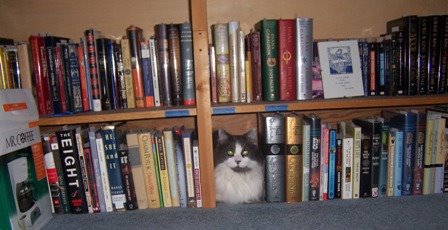
Toby camouflaged as a book in my pre-Boston library! Very sneaky.

Hanna and I are starting our vacation-at-home today, and will be enjoying a wage-work-free ten days here in JP while Hanna puts on her historian’s hat to finish a conference paper on memes in Irish nationalists’ life writing (damn cool, huh?) and I get my reading on. I super happy to be spending ten days reading books that I specifically do not plan on reviewing. Anywhere. I need to do some reading purely for fun, and that’s what this vacation is gonna be about.

I’ve made some heavy use of the delightful Brookline Public Library’s inter-library loan system and assembled myself the following titles:

Briggs, Patricia. Shifting Shadows: Stories from the World of Mercy Thompson. Ace, 2014.

Feder, Ellen K. Making Sense of Intersex: Changing Ethical Perspectives in Biomedicine. Indiana University Press, 2014.

Harris, Charlaine and Toni L. P. Kelner. Home Improvement: Undead Edition. Ace, 2011.

Kohn, Alfie. The Myth of the Spoiled Child: Challenging the Conventional Wisdom about Children and Parenting. Da Capo Press, 2014.

Rybczynski, Withold. Home: A Short History of an Idea. Viking, 1986.

Susanka, Susan. Not So Big Solutions for Your Home. Taunton Press, 2002.

And we will also be binge-watching season two of Orphan Black which has been sitting on my desk since mid-July. Hell yeah.

in which I write letters: open letter to SAA re: #thatdarnlist

10 Wednesday Sep 2014

Posted by Anna Clutterbuck-Cook in library life

≈ 15 Comments

Tags

archivists, being the change, i write letters

Society of American Archivists
Attn: Council members
17 North State Street
Suite 1425
Chicago, IL 60602-4061

10 September 2014

Dear members of the SAA Council,

I am writing to you as a member and critic of the Archives & Archivists listserv. My name is likely familiar to some of you given my role in the recent debates about A&A and its future. I have been part of on-list discussions about the culture of the list, am the author of two lengthy blog posts (“once upon a listserv” and “once again upon a listserv”) critiquing list dynamics — one of which prompted personal attacks on-list by those who disagreed with my views and approach — and I also participate in discussions about #thatdarnlist on Twitter. Those experiences have led me to form the Amiable Archivists Salon, a website and email list focused on issues of professional culture and inclusion in the archival and associated professions.

I am also the founding co-chair of New England Archivists’ LGBTQ Issues Roundtable, and have studied and written on issues related to gender, sexuality, and inequality for over a decade, online and off. My perspective is, of course, specific to my own areas of expertise and experience. Yet my observations regarding A&A are informed by listening to and engaging with many others on questions of community, power, privilege, and belonging.

With all of these contexts in mind, there is much that could be said about the complaints and critiques on and around the Archives & Archivists list that have been raised in past months. I’ve already articulated many of them myself in emails, blog posts, and on Twitter. Today I am writing directly to you for the first time to raise concerns about the recently-revised terms of participation and how they were implemented. I believe the new terms and their roll-out send a clear and troubling message regarding what SAA considers as speakable and unspeakable, appropriately visible and best handled invisibly, within our professional community.

Continue reading →

the marilyn ross memorial book award

08 Monday Sep 2014

Posted by Anna Clutterbuck-Cook in my historian hat

≈ 1 Comment

Tags

being the change, books, family

Marilyn Ross with her daughters Bonnie and Janet

Marilyn Ross (1925-2013) with her daughters Bonnie and Janet
Photograph by Duncan Ross

Today is my maternal grandmother’s birthday. She passed away in June 2013, a year and a month to the day before her husband, Duncan Adam Ross, followed.

Marilyn Coe Ross was born in 1925 to single, working mother Marguerite Scott Coe, and grew up in Detroit, Michigan, with her mother and younger sister Barbara (b. 1927). While she was unable to afford college or extended professional education, she was — among many other things — a lifelong lover of books and libraries. One of my most enduring memories of my grandmother is that a visit from her always meant new books to read. It was she who introduced me to such beloved childhood classics as The Witch of Blackbird Pond by Elizabeth George Speare and The Pushcart War by Jean Merrill. When my grandparents relocated from Michigan to Oregon in the 1980s my grandmother began volunteering at the Bend Public Library, a relationship that lasted decades and endured even after a stroke left her partially paralyzed. Her active enjoyment and eager sharing of books and the act of reading within community remains one of my inspirations for pursuing a life of letters — of reading, writing, and sharing the life of the mind through librarianship.

This past spring, while Hanna and I were participating in our third year of Massachusetts History Day judging, I noticed that the special topical awards given out for student projects — labor history, local history, military history — didn’t include any awards for the history of projects related to women’s or gender history. Each year, many students do excellent work exploring the history of women and girls, gender, sex, and sexuality — and it seemed to me a shame that this work would not be recognized to the same extent that more traditional fields of historical inquiry would be.

So I decided to establish a book award in women’s and gender history — and I decided to name the award in honor of my grandmother. As I explained in the award letter:

Congratulations on winning this year’s Marilyn Ross Memorial Book Award. This prize is awarded annually at the state level to the best Junior or Senior individual project on the subject of women’s and gender history.

As an undergraduate student in history and women’s studies I was the recipient of several book prizes. It was very meaningful to me that faculty paid attention to my research and selected an award that fit my own particular scholarly interests. In establishing this book prize, it is my intention to support the work of the young scholars in my own field as I was once supported by my own mentors. I celebrate your hard work and encourage you in whatever direction your historical curiosity takes you!

…I award this prize in the memory of my maternal grandmother, Marilyn Ross (1925-2013), who was one of my inspirations for pursuing a career in librarianship and writing.

The inaugural award was presented in May 2014 to Gayatri Sundar Rajan for her individual documentary “Smile, Laugh, Charm: Expectations Placed on Women in the Work Force.”  

The idea of the book award is to reward and encourage the honoree in their continued work as a scholar by selecting a book that reflects the topic of their project but branches out in a tangential direction. This year I selected two titles (the second being an apology for an unwarranted delay in selection and presentation of the prize) in labor history:

  • Rocking the Boat:Union Women’s Voices, 1915-1975 by Brigid O’Farrell and Joyce L. Kornbluh. Rutgers University Press, 1996
  • Women Strikers Occupy Chain Stores, Win Big: The 1937 Woolworth’s Sit-Down by Diana Frank. Haymarket Books, 2012.

I look forward to presenting many more books to eager young scholars in the years to come!

booknotes: it’s complicated

05 Friday Sep 2014

Posted by Anna Clutterbuck-Cook in book reviews

≈ 1 Comment

Tags

children, moral panic, sociology, technology

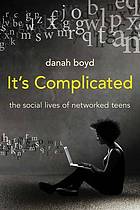
its_complicated_coverAny human being who uses the internet — that is, by definition, anyone reading this blog post — should make time to read It’s Complicated: The Social Lives of Networked Teens by Danah Boyd (Yale University Press, 2014). I say this not only because we should all care enough to read nuanced, respectful examinations of the world in which our young people live and work — rare is the study of teenagers that so gracefully resists moral panic — but because It’s Complicated describes the social lives of networked grown-ups as well.

My sister Maggie, who works in Facebook’s e-crimes division (specializing in combating crimes against children), recommended Boyd’s work to me earlier this year in light of previous unsatisfactory reading on bullying, cyber-bullying and harassment. She’s been following Boyd’s work for several years now, and brought her in to talk with her team about teens, vulnerability, and human sexuality. Like Maggie, what I particularly appreciate about Boyd’s work is that she insists on the subjectivity of her interviewees, and doesn’t pull her punches about how the mainstream media only cares about the vulnerability of some (white, middle-class) teens. As the shooting of Michael Brown in Ferguson, Missouri, recently reminded us all, that selectivity costs lives — lives that matter. Highlighting another example of such inequality of moral and humanitarian concern, Boyd recently published a piece on trans victim of sex trafficking, Jane Doe, who was imprisoned as a result of her abuse. For both Brown and Doe, narratives of teen vulnerability to adult violence failed to protect them in the way they (supposedly) protect more privileged counterparts.

It’s Complicated challenges us to reconsider our social narratives about teenagers, technology, and the relationship between the two. Based on interviews with real-life teens (!) from a wide variety of socioeconomic contexts, Boyd’s work is organized around a series of identity and social questions, such as “Privacy: Why Do Youth Share so Publicly?” and “Inequality: Can Social Media Resolve Social Divisions?”. Each chapter pushes us to think beyond what we assume we know about how technology operates in society and in our own lives. Ultimately, we are encouraged to remember that the questions about our (virtual) social lives are not that different from questions about our social lives generally. The challenges and rewards of being part of the “networked public” of the Internet are many of the same we reap “in real life” as well. And teens — like adults — should be supported in their quest to become part of their communities.


forward intentions: an introduction

04 Thursday Sep 2014

Posted by Anna Clutterbuck-Cook in life writing

≈ Leave a comment

Tags

art, boston, domesticity, forward intentions, hanna, michigan, oregon, west coast

Reflections on local intentions in this eighth year of my Boston residency, and a long melancholy weekend at the end of summer, has pushed me to think about what my forward intentions actually are. Now that I’m done with grad school (*weeps with relief*), doing the whole “emerging professional” thing at a job a genuinely like, married with two cats, I’m like … so what’s next, life?

View from the Sylvia Beach Hotel (Newport, Ore.), 24 Sept 2013.

I never really had a plan, per se. I mean, I almost didn’t go to college? I was emotionally allergic to school and considered some sort of roguish apprenticeship instead. I wanted to run a writer’s colony in the U.P. (“upper peninsula” for you non-Michiganders), feed people and fix septic systems, maybe have a lot of time for hiking around with a compass in the back woods. Or maybe open a bookshop by the sea, with the writers tucked away upstairs in garret rooms overlooking the surf. Again: Tea, biscuits, quiet, thoughts, maybe a puppy and obviously cats.

Continue reading →

local intentions: year eight

01 Monday Sep 2014

Posted by Anna Clutterbuck-Cook in a sense of place

≈ 1 Comment

Tags

boston, boston summer seminar, domesticity, family, hanna, librarians, professional gigs

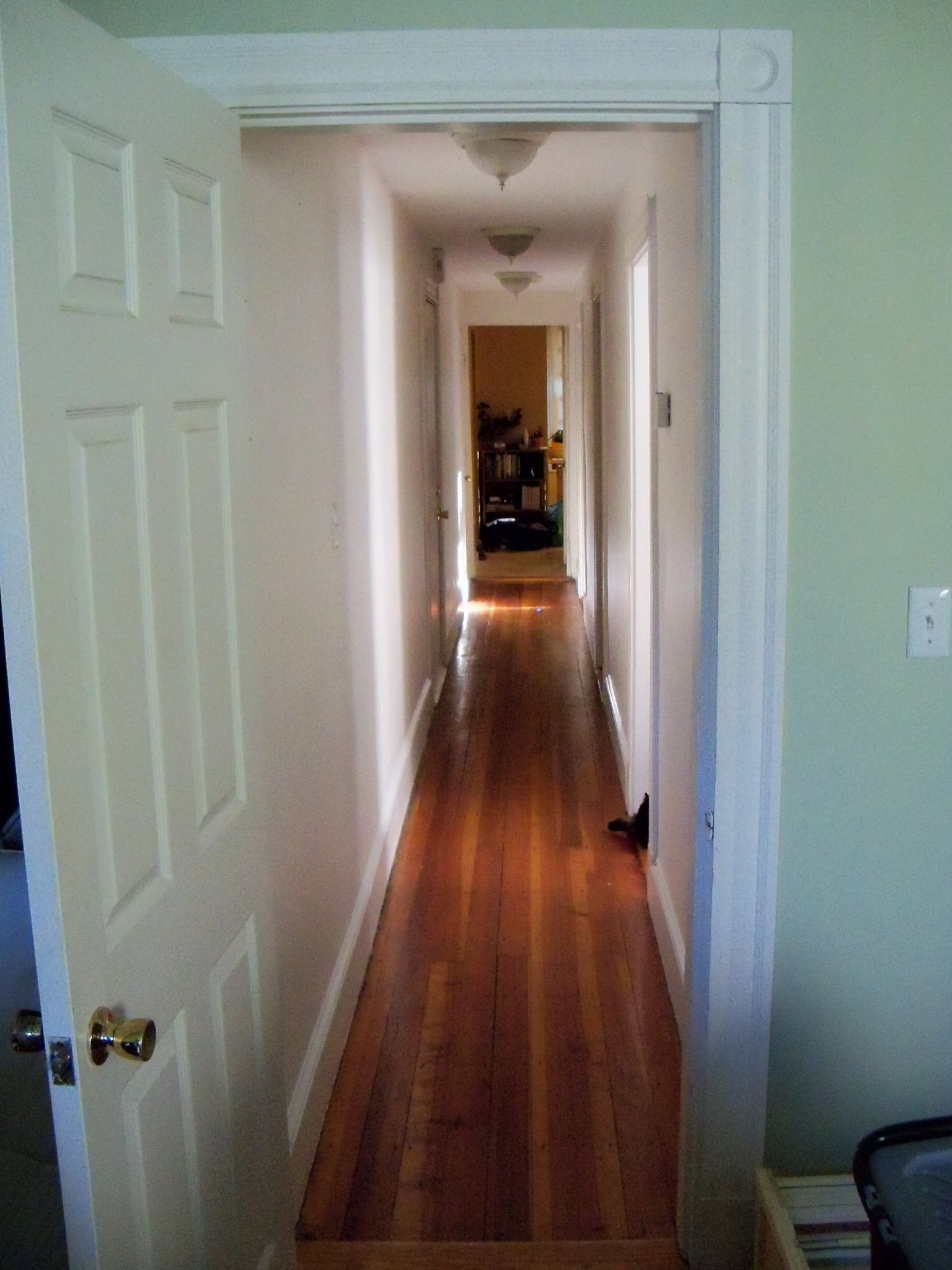
Photograph of the hallway in our new Jamaica Plain apartment (May 2014)It’s become a tradition here at the feminist librarian for me to pause and take stock every year around Labor Day. It was on Labor Day weekend in 2007 that I first arrived in Boston, trunk packed with dorm room necessities, to begin a new chapter of my life as an East Coast urbanite.

read year one | year two | year three
year four | year five | year six | year seven

2014 has been a tough year for us, so far. As Hanna said back at the beginning of August, “I’ve decided to break up with 2014. We’re through.” Things started last fall with a positive but tiring whirlwind trip to the West Coast, out of which Hanna barely had time to recover before coming down with a pernicious case of pneumonia which required multiple courses of antibiotics and several weeks of bed rest. Then we began the new year with a Midwest polar vortex, then returned to Michigan in March to sit with my family during my grandmother’s deathtime. Hanna sprained her ankle the day after we got back to Boston, and while she was still on crutches we got the call to view what is now our apartment. We moved in May, then got the call that my grandfather had cancer. I’ve just come through the busiest summer on record at the MHS library and at this point we’re both looking forward to what we hope will be the most peaceful, boring autumn Jamaica Plain has ever seen.

At the same time, it feels good — more than good — to be looking forward to fall (my favorite season!) in Jamaica Plain, which in turn is here in Boston. We’re so pleased to be living here, in fact, that when we take our vacation in September we decided to stay put.

We’ve done a hell of a lot of traveling this year and it’s good to be home.

Which brings me to the point of this year’s post: local intentions. Continue reading →

tech transitions [admin note]

30 Saturday Aug 2014

Posted by Anna Clutterbuck-Cook in admin

≈ Leave a comment

This weekend I’m working to standardize my old Blogger tags into the WordPress categories and tagging system. As I do so, I am catching some formatting issues with the migration from one platform to another — chiefly embedded videos that have disappeared, ugly tables framing images and captions, and some block quotations that have ended up with seriously whacked out formatting. I’m trying to clean these up as I find them, but with over 1200 posts spanning seven years, I probably won’t hand update every one immediately.

Bear with me! And always feel free to leave me a comment on a post if you notice something broken; I will do my best to fix it at the earliest possible opportunity.

booknotes: out in the country

28 Monday Jul 2014

Posted by Anna Clutterbuck-Cook in book reviews

≈ Leave a comment

Tags

children, sociology

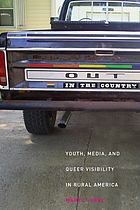
Last week I reviewed Sarah Schulman’s Ties That Bind which explored from a very personal perspective the ravages of familial homobigotry. This week I picked up and read Mary L. Gray’s Out in the Country: Youth, Media, and Queer Visibility in Rural America (New York University Press, 2009). Gray’s ethnographic study of queer teen lives in rural Kentucky took place in the early 2000s and she published her book in the same year as Schulman. Both authors write thoughtfully about the importance of family in the lives of their queer subjects — though from very different perspectives. Ironically — given our usual narrative of urban tolerance vs. rural bigotry — Gray’s consideration of the place of family within queer lives is much more nuanced than Schulman’s.

As a researcher, Gray came from a rural California childhood followed by an urban California adulthood working with queer youth organizations. Her exploration of teen lives in rural Kentucky was prompted by national attention on the ways in which the Internet and other media connectivity and queer visibility might work differently in the lives of rural young people rather than urban young people. As she (and others before her) have pointed out, much of our understanding of queer coming-of-age posits a rural-to-urban migration in which our queer selves are incapable of being fully discovered and/or nourished until we “escape” our hometown settings and find the LGBT community in physical locales — gay bars, lesbian bookstores, gay ghettos, queer action groups. Pushing back against this assumption, Gray sought out youth who were either unable or uninterested in making such a migratory journey of self-discovery. How would young queer people without the resources or desire to leave rural life for the city construct a queer identity? Continue reading →

friday evening thoughts on sociality

25 Friday Jul 2014

Posted by Anna Clutterbuck-Cook in life writing

≈ Leave a comment

Tags

friends, work-life balance

Image via.

I had lunch with a friend today – a rare opportunity though we live in the same city and, until recently, only several streets away from one another. We both work, on opposite sides of the River of Charles, we’re both married — to spouses we like to spend time with on a daily basis –, and both of us are that breed of people society identifies as “introverts.” Working in public services, at the end of a seven, eight, nine hours of being “on” around other people, the last thing we usually have oomph for is happy hour or dinner out. Most days, I can barely string out enough public-space energy to pick up a book at the library or pick up a foodstuff on my way home.

What this means, in practical day-to-day terms, is that the maintenance and cultivation of social connections with my people is spatially and temporally constrained: I need to be careful about how far, how long, and how many commitments I make. Since weekends need to be reserved, to a great extent, for quiet recharging — both Hanna and I need down time — we can usually at most make one social plan a weekend. A booked week, for me, usually looks like a weekend activity and a weekday lunch with a colleague. Three such meetings and I start to feel prostrate with togetherness.

This, I must stress, even with people I like very much and enjoy being around.

I was thinking, after the lovely lunch with my friend today; a lunch at which we talked about our mutual need for such unscheduled weekends, and the affective labor of public services work that — while rewarding in the context of professional work we both chose and (mostly) love — takes a particular toll on the private lives of those introverted people who choose to pursue it. In that it enforces a rather severe rationing of non-waged sociality.

Continue reading →

booknotes: ties that bind

21 Monday Jul 2014

Posted by Anna Clutterbuck-Cook in book reviews

≈ Leave a comment

Tags

gender and sexuality, memoir, the personal is political

Me, footnote hopping. The story of my life.

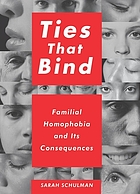
I found Sarah Schulman’s Ties That Bind: Familial Homophobia and Its Consequences (New Press/Perseus, 2009) reading The Tolerance Trap and requested it inter-library loan thinking it was going to be a study of the ravages of anti-gay animus within families. Instead, it is more of a philosophical-political reflection on the practices within families (and by extension within the wider culture) that create we queer people as a lesser group. Schulman draws powerfully on work done by feminist activists around domestic violence and the workings of other types of prejudice such as antisemitism to describe how queer family members are isolated and scapegoated within families — and how the social systems these families are a part of support that violence through passive bystander behaviors. She illustrates a lot of her observations with stories about her own family’s unwillingness to maintain positive connections with her because of her lesbian identity: parents who say in front of her that she was born “bad’; siblings who refuse to allow her contact with her their children.

Reading Ties That Bind was personally disorienting as an experience; I kept checking the publication date — really? 2009? — because so much of what she was describing felt like the climate of the 1970s and 80s rather than the early 2000s. Which is definitely a good reminder that our experience, as queer individuals, of homobigotry is far from uniform, and that our treatment at the hands of friends and family shapes how we interpret and react to the structural and more distant social inequalities that continue to color all of our lives. Because of my family’s support, and because of the social norms of my immediate community (expecting nondiscrimination), when I do encounter erasure or hostility I experience it as a departure from, rather than a reinforcement of, the morality of my people. That is, not only do I believe that there’s no reason to fear my sexuality would harm children, but all of my friends and family members would look at someone like they were right bastards for suggesting such a thing.

That kind of support, in turn, leads to resilience for those of us who have it: with our many-layered communities behind is, we aren’t isolated in the face of structural discrimination or individual acts of bigotry. For those whose families do disown them, as Schulman points out, the recourse is the much more difficult and contingent road of creating your own support system from scratch, always with the voices in the back of your head — the parental authorities of your childhood — telling you how worthless, how lesser-than, you are. Continue reading →

← Older posts
Newer posts →
"the past is a wild party; check your preconceptions at the door." ~ Emma Donoghue

Recent Posts

  • medical update 11.11.22
  • medical update 6.4.22
  • medical update 1.16.2022
  • medical update 10.13.2021
  • medical update 8.17.2021

Archives

Categories

Creative Commons License

This work by Anna J. Clutterbuck-Cook is licensed under a Creative Commons Attribution 3.0 Unported License

Meta

  • Create account
  • Log in
  • Entries feed
  • Comments feed
  • WordPress.com

Blog at WordPress.com.

  • Subscribe Subscribed
    • the feminist librarian
    • Join 37 other subscribers
    • Already have a WordPress.com account? Log in now.
    • the feminist librarian
    • Subscribe Subscribed
    • Sign up
    • Log in
    • Report this content
    • View site in Reader
    • Manage subscriptions
    • Collapse this bar
 

Loading Comments...